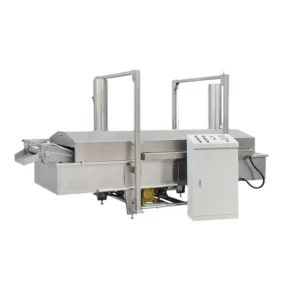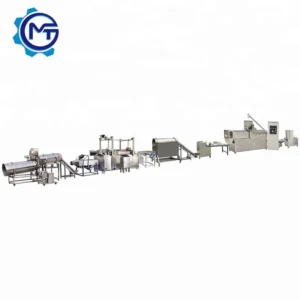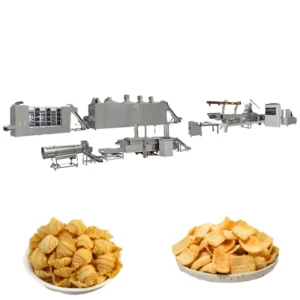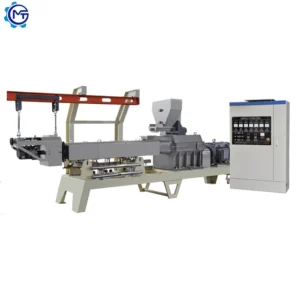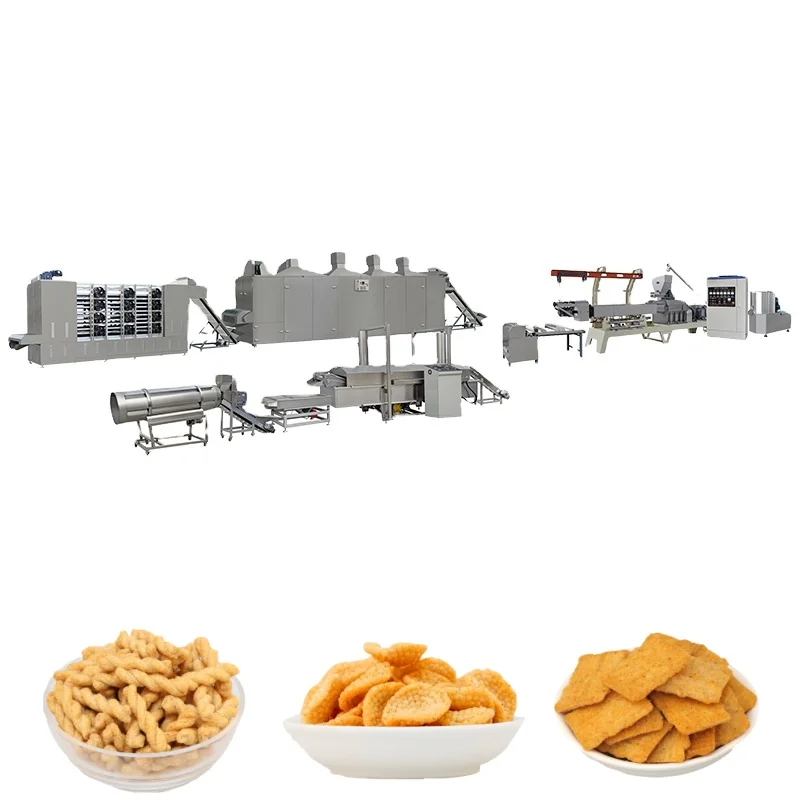
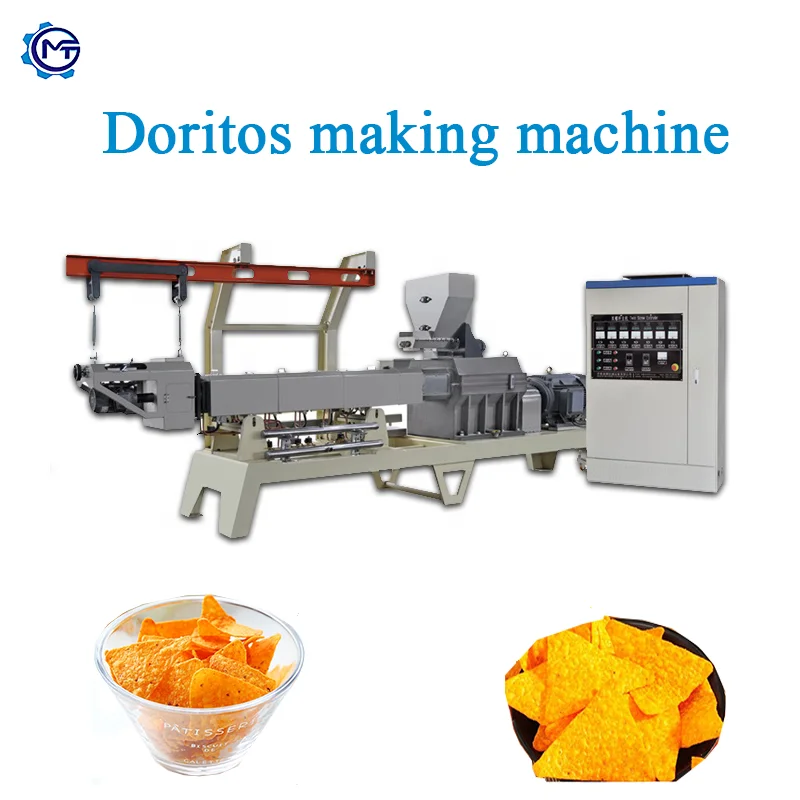

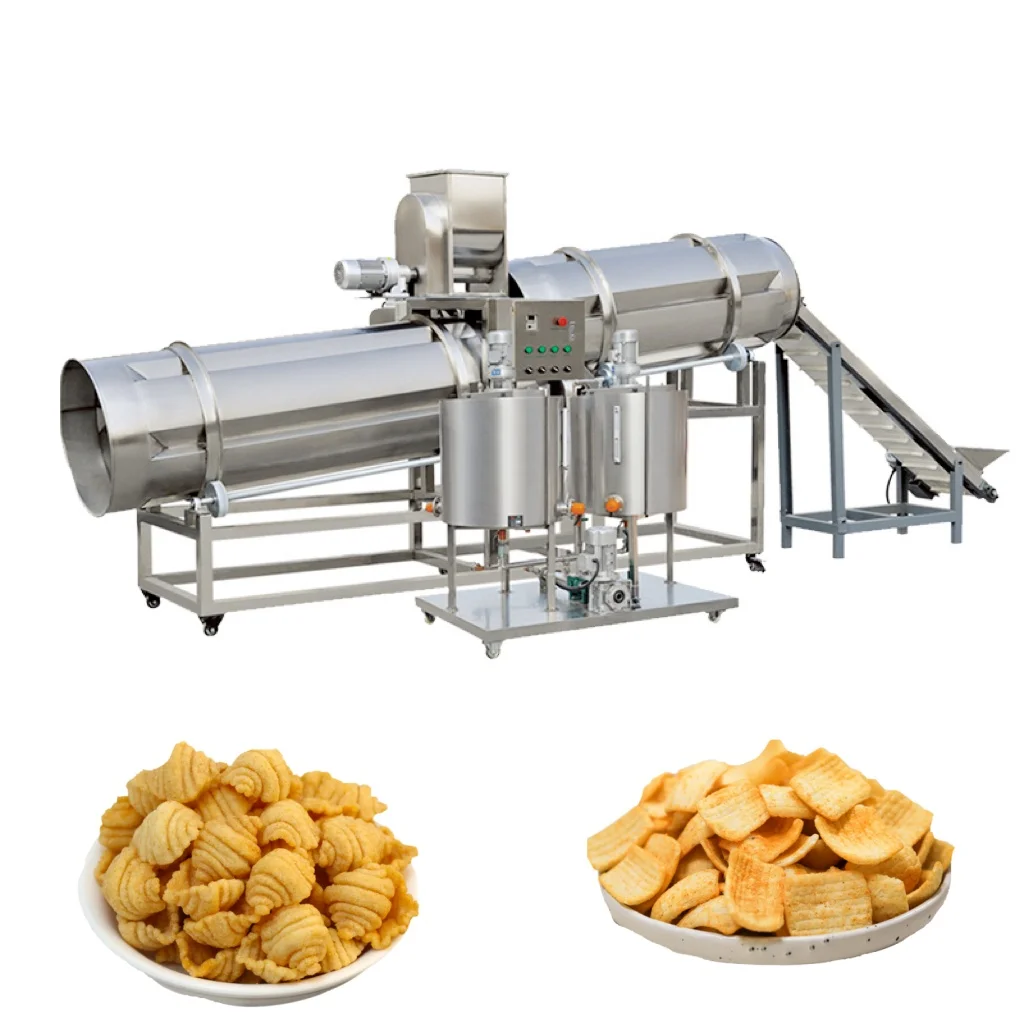


Fried Pellet Snack Production Line, Twin-Screw Extruder, 600 mm Fryer Belt — engineered as a complete turnkey project from batching through extrusion, frying, and packing.
- Co-rotating twin-screw with sectional modules and interchangeable dies for bugles, chips, shells, and wave formats
- Fryer station sized to match extruder output with automatic temperature and belt speed control
- Food-grade stainless steel on all product-contact surfaces
Delivered with line layout and capacity calculation, screw and die configuration matched to your raw material, and trial runs in our testing workshop before shipment.
Description
Integrated throughput engineering — every station from the mixer through the fryer is sized as a single system so extruder output never waits on downstream capacity, validated with trial runs on your raw material before the line ships.
Technical Specifications
| Parameter | Value |
|---|---|
| Product Type | Fried Pellet Snack Production Line |
| Screw Type | Twin-screw, co-rotating sectional modules |
| Models Available | MT-65 / MT-70 / MT-85 / MT-75 / MT-95 |
| Rated Power | 100 kW (MT-65) up to 280 kW (MT-95) |
| Output Capacity | 120–150 kg/h to 800–1000 kg/h (basis not stated in source — confirm raw material, moisture, and product shape) |
| Mixer Power Options | 4 kW / 7.5 kW / 15 kW, matched to line capacity |
| Cutter Power | 1.47 kW |
| Cutter Dimensions | 2500 × 600 × 1100 mm |
| Fryer Belt Width | 600 mm stainless steel mesh belt |
| Fryer Heating Options | Electricity / Fuel Gas |
| Drying Method | Gas / Electric / Diesel heating |
| Voltage & Frequency | Configurable (e.g., 3ph 380V 50Hz, 3ph 415V 60Hz, 3ph 220V 60Hz) |
| Line Stations | Mixer → Twin-screw extruder → Cutting/forming → Fryer → Flavouring / Packing |
| Contact Material | Food-grade stainless steel on all product-contact surfaces |
| Standards | CE (electronic edition for export); ISO certified facility |
| Warranty | 1 year complete warranty, lifetime maintenance service |
Application Suitability
| Application | Material or Output |
|---|---|
| Corn bugles and horn-shaped fried snacks | Corn flour, corn starch blends |
| Doritos-style triangular crispy chips | Corn flour, wheat flour with seasoning |
| Salad sticks and pillow-shaped snacks | Wheat flour, rice flour, potato starch |
| Shell, screw, and wave-shaped pellets | Potato powder, corn starch, wheat flour blends |
| Square tube and round tube fried snacks | Rice flour, potato starch mixtures |
| Diamond and wavy chip formats | Multi-grain flour blends |
What "300 kg/h Output" Actually Depends On
Capacity is meaningless without the raw material specification and moisture content it was measured against.
When buyers compare fried pellet snack lines on output alone, they miss the variable that really determines whether the line holds its rated throughput day after day. Corn flour at a given moisture level behaves very differently from a potato starch blend through the same screw configuration, and a die designed for bugles creates more back-pressure than one cutting simple tubes. A fried pellet snack production line turnkey project that quotes a single number without stating the test conditions is asking you to commission the line before you know what it actually produces [NEED_CITE: industrial extrusion throughput testing standards for starch-based snacks].
How the Turnkey Layout Prevents Station Mismatches
The most common failure on a fried snack line is not the extruder itself — it is the station upstream or downstream that cannot keep pace. When the fryer belt runs slower than the cutter output, product piles up, cools unevenly, and enters the oil at inconsistent moisture. This fried pellet snack production line turnkey package sizes the mixer batch cycle, extruder screw speed, cutter rate, and fryer belt speed as one connected system, so every station pulls at the same rhythm.
Screw Module Arrangement and Starch Gelatinisation
Co-rotating twin-screw extruders in this line use sectional modules that can be reordered along the barrel. Forward-flight sections push material toward the die, while reverse-flight segments create dwell zones where starch fully gelatinises under heat and shear. For corn-based bugles, the gelatinisation window is narrow — too little residence time and the pellet fractures during frying; too much and the surface blisters. The sectional design lets the screw profile be rebuilt for each target format without replacing the entire assembly [NEED_CITE: twin-screw extrusion screw element configuration for starch gelatinisation].
Reading the Specs That Matter for Fried Snack Output
The fryer belt width of 600 mm sets the maximum product layer depth and therefore the oil contact time per kilogram of output. A narrower belt forces product to travel in a thicker bed, meaning the centre pieces absorb less oil and emerge softer than the edges. Rated power across the model range spans 100 kW to 280 kW, which reflects not just motor size but total installed electrical load including barrel heaters, cutter drive, and fryer elements. Voltage configurability across 380V, 415V, and 220V three-phase options matters because a 60 Hz market running a 50 Hz motor will see the extruder screw turn faster than designed, altering shear rate and expansion ratio. Food-grade stainless steel on all contact surfaces is not merely a hygiene requirement — it also resists the acidic seasoning residues that accumulate during flavouring and would corrode carbon steel within weeks.
What Happens When the Cutter and Fryer Are Specified Separately
Buying the extruder from one vendor and the fryer from another almost always leaves a gap in belt speed synchronisation. The cutter drops pellets at a fixed rate, but if the fryer belt cannot match that cadence, product queues on the infeed conveyor, sticks together, and enters the oil in clumps. Clumped pellets fry unevenly — some emerge over-dark while others remain pale and doughy inside. On a fried pellet snack production line turnkey project sourced from a single supplier, the cutter motor, belt drive, and fryer controller are wired to communicate, so a speed adjustment at the extruder cascades downstream automatically [NEED_CITE: production line synchronisation between extrusion and frying stations].
Why This Line Ships as a Single Project
Every station on this line — from the 15 kW mixer matched to the highest-capacity model, through the twin-screw extruder with its configurable screw profile, to the 600 mm belt fryer — is selected and tested together before dispatch. The in-house testing workshop runs your specific raw material through the complete sequence, producing finished fried pellets that you can evaluate for shape, crunch, oil absorption, and colour before the equipment leaves the factory. Screw and die configuration records are documented per product format so your operators can repeat setups. CE documentation in electronic edition accompanies every export shipment, and voltage confirmation happens before production begins, not after the containers arrive.
Documentation & Verification
- Line layout drawing showing matched throughput across mixer, extruder, cutter, and fryer stations
- Screw and die configuration record matched to your raw material and target pellet shape
- Trial run report on your supplied flour blend, documenting expansion, density, and fry colour
- Electrical schematic with voltage, frequency, and control language confirmed for your facility
- CE declaration of conformity in electronic edition prepared for customs clearance
- Wear parts list covering screws, die inserts, cutter blades, and fryer belt segments
Installation, Commissioning & Support
- Foundation plan referencing the 22–30 m line length and utility connection points per model
- Dedicated electrical circuit sizing based on 100–280 kW total installed load per selected model
- Equipment shipped in sectional modules for container loading and on-site reassembly
- On-site commissioning covering screw profile tuning, fryer temperature ramp, and belt speed sync
- Operator training on die changeover between bugles, chips, tubes, and shell formats
- Wear parts stocking plan for screws, dies, cutter blades, and 600 mm fryer belt links
What We Need to Configure Your Line
To size each station correctly, share the specific flour or starch blend you plan to run, the target pellet shapes from the available die range, and your planned daily output in kilograms. We also need your facility voltage and frequency, available floor length and ceiling height, and whether gas or electric heating is preferred for the fryer and dryer. If you have existing mixing or packing equipment that should tie into the new line, send the make and model so we can match interface points.
Frequently Asked Questions
Q: How is throughput verified across the full line and on what basis?
A: Before shipment, your raw material runs through the mixer, extruder, cutter, and fryer in our testing workshop. We document output in kg/h along with moisture content, pellet density, and fry colour. This trial confirms that every station keeps pace and the stated capacity holds on your specific flour blend rather than a generic test recipe.
Q: Can voltage and control language be set for my market before production?
A: Yes. Voltage and frequency are confirmed during the specification stage — options include 380V 50Hz, 415V 60Hz, and 220V 60Hz three-phase. Control panel labels and HMI language are set to your local standard before wiring begins, so operators read instructions in their working language from the first day of commissioning.
Q: What does phased installation look like for a fried snack line?
A: The line arrives in modular sections sized for standard container loading. Foundation and utility rough-in happen first, followed by station-by-station placement from mixer to fryer. Electrical and control wiring connects all stations, then dry runs precede the first product run. Commissioning typically spans several days with our engineer on-site adjusting parameters.
Q: How are spare wear parts stocked after commissioning?
A: A wear parts list ships with every line, covering screw elements, die inserts, cutter blades, and fryer belt links. Initial spares are included in the first shipment. Replacement orders reference the documented configuration record so the correct screw profile and die geometry reach your factory without trial-and-error reordering.
Q: How is the fryer sized relative to extruder output?
A: The 600 mm stainless steel belt fryer is selected so its belt speed and oil volume handle the maximum pellet flow from the chosen extruder model. If the extruder model changes during project planning, the fryer specification is recalculated to prevent product queuing on the infeed conveyor or under-utilisation of oil capacity.
Related products
-
Máquina automática para la fabricación de chips de costra de arroz Bugles, línea de procesamiento de alimentos fritos de rollos de pizza.
¥8,570.00 Select options This product has multiple variants. The options may be chosen on the product page -
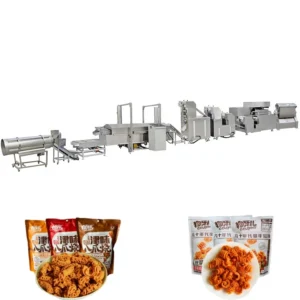
Puffed Octopus Snack Processing Line – Full-Automatic Fried Octopus Production Machinery
¥65.00 Select options This product has multiple variants. The options may be chosen on the product page -
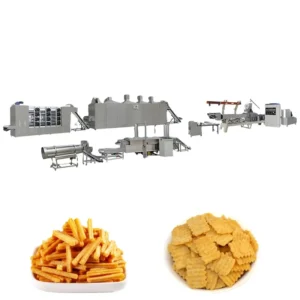
Línea de producción de chips de Bugles fritos Extrusora de alimentos para bocadillos de tortilla Doritos fritos
¥100.00 Select options This product has multiple variants. The options may be chosen on the product page -
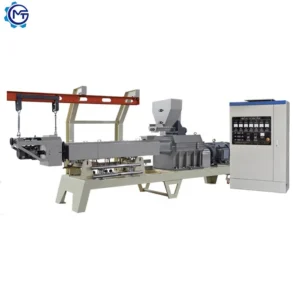
Industrial Fully Automatic Stainless Steel Deep Fried Line – Snack Factory Miscellaneous Grains Special Processing Equipment
¥65.00 Select options This product has multiple variants. The options may be chosen on the product page