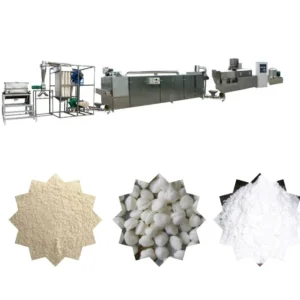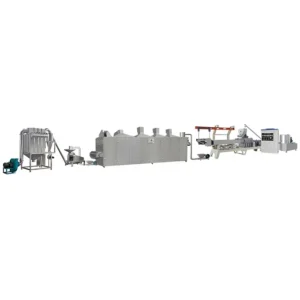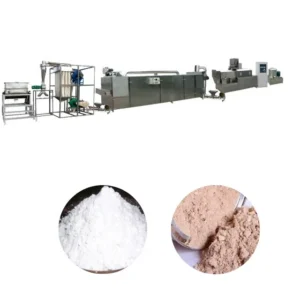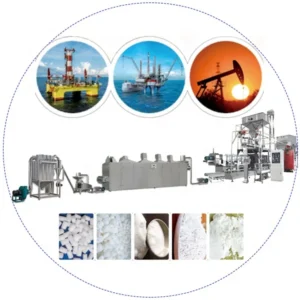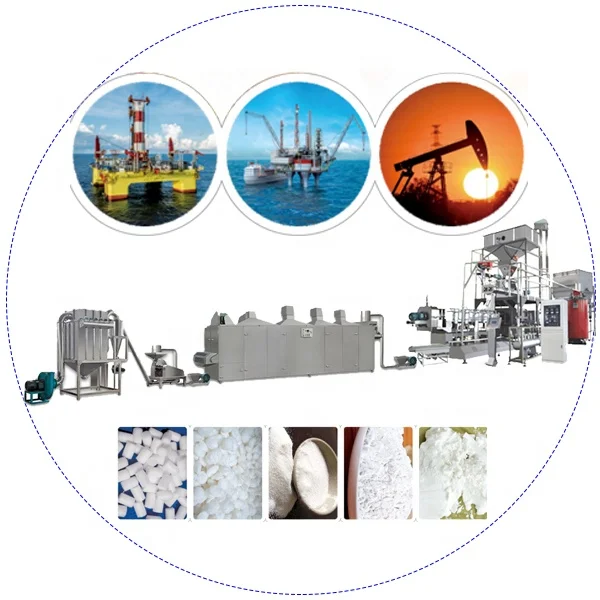


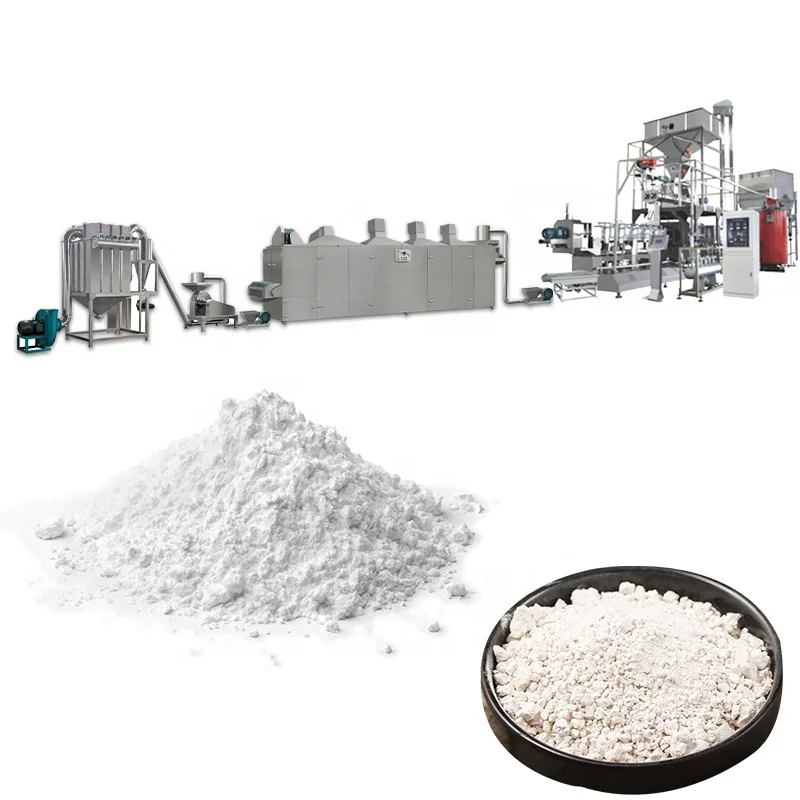
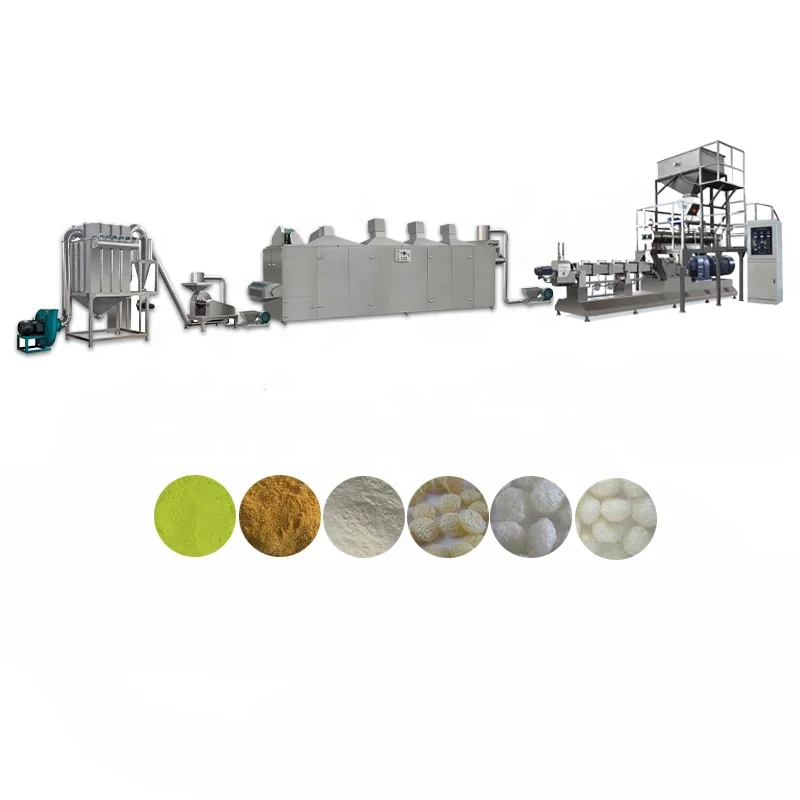

MT70 / MT85 / MT100 Modified Starch Extrusion Processing Line, Twin-Screw, PLC & MCC Control — engineered as a complete turnkey project from starch hydrolysis through extrusion gelatinisation to drying and packing. Screw configuration and barrel temperature profile are specified to your raw material and target modification degree, with throughput matched across every station to eliminate bottlenecks. Trial runs on your exact raw material are completed in our in-house testing workshop before shipment, with a documented report provided for your verification.
Description
Whole-Line Throughput Matching — every station from starch hydrolysis to packing is engineered as one coordinated project, eliminating the bottleneck risk that comes from assembling separate vendors’ equipment.
Technical Specifications
| Parameter | Value |
|---|---|
| Product Type | Modified Starch Extrusion Processing Line |
| Models Available | MT70, MT85, MT100 |
| Extruder Type | Twin-screw |
| MT70 Installed Power | 160 kW |
| MT70 Power Consumption | 120 kW |
| MT70 Output Capacity | 150–200 kg/h (basis not stated in source — confirm raw material type and moisture content) |
| MT70 Overall Dimensions | 41000 × 1500 × 2200 mm |
| MT85 Installed Power | 190 kW |
| MT85 Power Consumption | 140 kW |
| MT85 Output Capacity | 300–400 kg/h (basis not stated in source — confirm raw material type and moisture content) |
| MT85 Overall Dimensions | 43000 × 1500 × 3200 mm |
| MT100 Installed Power | 210 kW |
| MT100 Power Consumption | 150 kW |
| MT100 Output Capacity | 300–500 kg/h (basis not stated in source — confirm raw material type and moisture content) |
| MT100 Overall Dimensions | 45000 × 1500 × 3500 mm |
| Screw Diameter (MT70-level unit) | 70 mm |
| Screw Length | 1520 mm |
| Main Motor Power | 30 kW |
| Heating Ring | 7 × 2 kW = 14 kW |
| Screw Material | 38CrMo |
| Control System | PLC and MCC with cooling system for temperature control |
| Line Stations | Starch hydrolysis, saccharification, denaturation treatment, extrusion, drying |
| Food Contact Material | Food-grade stainless steel (excluding PVC conveyors) |
| Voltage Options | 3ph 380V 50Hz, 3ph 380V 60Hz, 3ph 415V 60Hz, 3ph 220V 60Hz |
| Warranty | 1 year complete warranty, life-time maintenance |
| Certification | CE |
Application Suitability
| Application | Material or Output |
|---|---|
| Food-grade modified starch for bakery, sauces and dressings | Corn starch, wheat flour |
| Pregelatinized starch for instant food and nutritional powders | Corn starch, wheat flour |
| Industrial modified starch for textile sizing | Corn starch |
| Modified starch for paper coating and corrugating adhesives | Corn starch, wheat flour |
What "Nominal Capacity" Leaves Out About Starch Lines
A modified starch production line turnkey quoted at a round number rarely holds that output on your specific raw material and moisture profile.
I have watched buyers sign off on a starch line based on a capacity figure that looked solid on paper, only to discover during commissioning that the extruder could not keep pace with the upstream hydrolysis tank on their particular corn starch variety. The wet material pooled on the conveyor between stations, gelatinisation degree dropped below spec, and the entire line sat idle while engineers reworked the screw configuration. That kind of delay costs far more than the price difference between a matched line and a mismatched one. A modified starch production line turnkey should always be verified against the buyer’s actual material before it leaves the factory [NEED_CITE: starch gelatinisation behaviour across corn varieties and moisture levels].
Barrel Temperature Profiling for Starch Gelatinisation
Starch modification depends on precise thermal and mechanical energy input across the barrel zones. The twin-screw extruder in this line uses seven independently controlled heating rings, each rated at 2 kW, paired with a cooling system managed through the PLC. This arrangement lets operators set a temperature gradient that matches the gelatinisation onset temperature of their specific starch source, whether that is corn starch with its higher gelatinisation threshold or wheat flour with its lower one. Getting this profile right is what separates consistent modification degree from batch-to-batch variation.
Throughput Matching Across Hydrolysis, Extrusion and Drying
A modified starch production line turnkey involves more than the extruder itself. The upstream hydrolysis and saccharification tanks must release material at a rate the extruder can absorb, and the downstream dryer must remove moisture fast enough to prevent the extruded starch from clumping or retrograding. When these stations are sourced from different suppliers, each one quotes their own nominal throughput, and the mismatches only become visible on the factory floor. This line is designed as a single project, with every station’s capacity calculated against the others before the layout is finalised [NEED_CITE: throughput balancing in continuous food processing lines].
Reading the Specs That Actually Matter
The screw diameter of 70 mm and screw length of 1520 mm on the MT70-level unit define the residence time inside the barrel — longer residence allows more complete starch granule disruption, which directly affects the degree of modification achievable in a single pass. The 38CrMo screw material provides the wear resistance needed when processing abrasive starch slurries over extended production runs. The main motor at 30 kW delivers the torque required to maintain screw speed under the viscous load of partially gelatinised starch. Installed power across the full line ranges from 160 kW on the MT70 to 210 kW on the MT100, which determines the transformer and dedicated circuit requirements at the buyer’s facility. The availability of multiple voltage configurations — 380V, 415V and 220V, all three-phase — means the electrical design can be locked in during the specification phase rather than discovered as a problem during commissioning.
The Cost of Undersized Downstream Equipment
When the dryer capacity falls short of the extruder output, modified starch exits the line with residual moisture above specification. That material may pass a quick visual check but will fail shelf-life testing or cause caking in the buyer’s packaging. I have seen producers lose entire shipments because the moisture content drifted upward during the second shift when the dryer could not recover between batches. The problem is never the dryer alone — it is the absence of a throughput calculation that linked extruder output to dryer evaporation rate before the line was built [NEED_CITE: moisture specification standards for modified food starch].
Why Source the Complete Line Here
The screw configuration and die design are specified to the buyer’s raw material and target modification degree, not copied from a generic build. An in-house testing workshop runs the buyer’s actual corn starch or wheat flour before shipment, producing a documented trial run report that confirms capacity and product specification. Every station — hydrolysis, saccharification, denaturation, extrusion, drying and packing — is calculated as one system, so throughput is matched rather than hoped for. Voltage, frequency and control language are confirmed during the specification phase and recorded in the electrical schematic, removing the most common cause of commissioning delays. Pre-sales consultation carries through to on-site installation, operator training and ongoing wear parts supply.
Documentation & Verification
- Line layout and capacity calculation showing throughput matching between hydrolysis, extrusion and drying stations
- Screw and die configuration record specific to your starch variety and target modification degree
- Trial run report on your raw material from the in-house testing workshop before shipment
- Electrical schematic with voltage and frequency confirmed to your site power supply
- CE declaration of conformity and ISO certificate for the complete line
- Operation and maintenance manual with wear parts list for screws, dies and heating rings
Installation, Commissioning & Support
- Foundation plan based on the MT100 footprint of 45000 × 1500 × 3500 mm, including utility trench routing
- Dedicated circuit sized to the MT85 installed power of 190 kW with voltage confirmed to local supply
- Phased assembly sequence from hydrolysis tanks through extruder to dryer, matching the line layout document
- First-run parameter setting on your starch material using the trial run report as the baseline
- Operator training on PLC interface language and MCC panel procedures for your production crew
- Wear parts list covering 38CrMo screws, dies and heating rings with recommended stocking quantities
What We Need to Configure Your Line
To prepare a line layout and quotation, share the specific starch type you plan to process — corn starch, wheat flour or a blend — along with the target modification degree and end-use application. Provide your facility’s available floor space and ceiling height so the layout can account for the full line length. Confirm the local voltage and frequency, and let us know your preferred control panel language. If you have existing upstream or downstream equipment that needs to integrate with the new line, send the model and capacity details so throughput matching can begin before the proposal stage.
Frequently Asked Questions
Q: How is line capacity verified on my specific raw material before shipment?
A: Your corn starch or wheat flour is run through the extruder in the in-house testing workshop before dispatch. The trial produces a documented report recording output rate, gelatinisation degree and product texture on your exact material. This eliminates the risk of discovering capacity shortfalls only after the line is installed at your facility.
Q: How is throughput matched between the extruder, dryer and downstream stations?
A: Every station is calculated as part of one project. The hydrolysis tank release rate, extruder screw speed and dryer evaporation capacity are all modelled against each other during the layout phase. This prevents the situation where one station runs faster than the next can handle, which is the most common cause of unplanned downtime on assembled lines.
Q: What voltage, frequency and control language options are available?
A: The line is available in 380V 50Hz, 380V 60Hz, 415V 60Hz and 220V 60Hz three-phase configurations. The PLC interface language is confirmed during the specification phase. The electrical schematic is then built to match, so the control panel arrives ready to connect without on-site rewiring or software reloading.
Q: How are screw configuration and die design selected for different starch targets?
A: The screw elements are arranged and the die geometry is chosen based on your raw material and the degree of modification required. A higher modification target typically needs a longer residence time and specific shear profile. The configuration is recorded in the documentation package so replacements can be ordered with confidence.
Related products
-
Almidón modificado de gran capacidad para uso industrial y aditivos alimentarios
¥50.00 Select options This product has multiple variants. The options may be chosen on the product page -
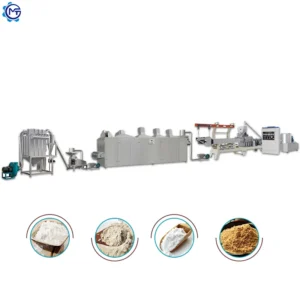
Automatic Deep Processing Machine – Food Grade Modified & Pregelatinized Starch Manufacturing Line
¥65.00 Select options This product has multiple variants. The options may be chosen on the product page -
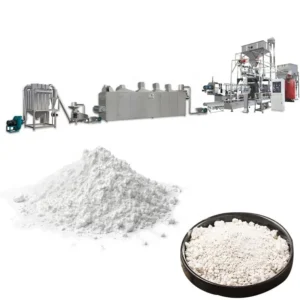
Modified Starch for Construction Adhesives Production – Custom Built Double Screw Extruder Line
¥65.00 Select options This product has multiple variants. The options may be chosen on the product page -
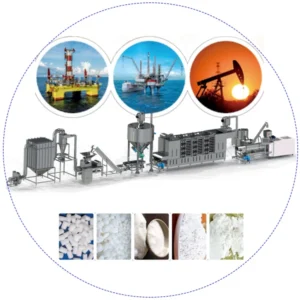
Automatic Pregelatinized Starch Processing Machine – Large-Scale New Condition Modified Starch Production Line
¥65.00 Select options This product has multiple variants. The options may be chosen on the product page