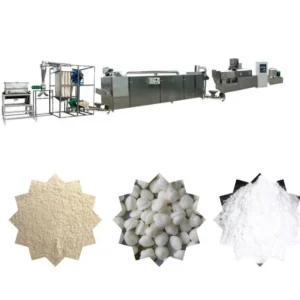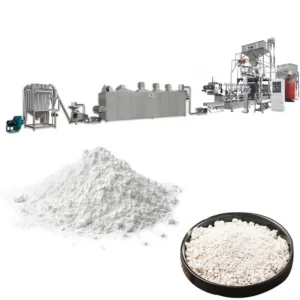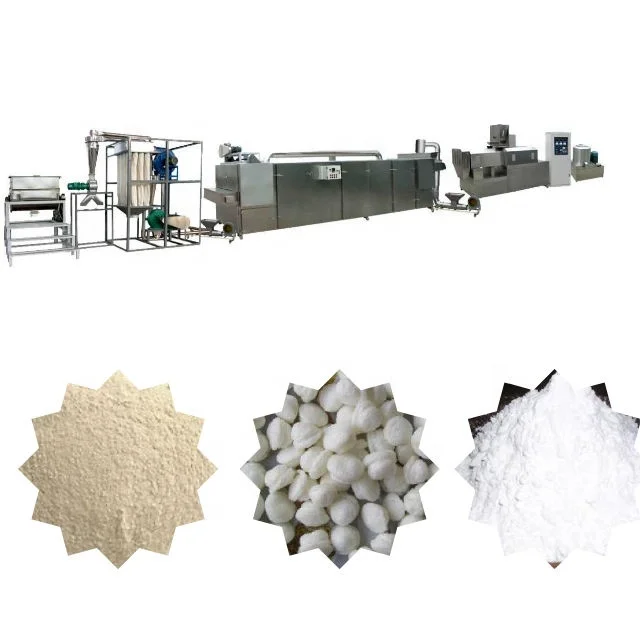


MT70 / MT85 / MT75 Modified Starch Processing Line, Twin-Screw Extrusion, PLC & MCC Control — configured for pre-gelatinized and physically modified starch production from corn, wheat, or custom starch sources.
- Screw configuration and die design matched to your raw material and target gelatinization degree
- Full-line throughput balancing across mixer, extruder, dryer, and pulse grinding stations
Trial runs on your actual starch in our testing workshop confirm output and product specification before shipment.
Description
Matched throughput across every station — A modified starch line only works when extrusion, drying, and grinding capacities align, which is why each MT configuration is balanced from the mixer batch size through the pulse grinder output.
Technical Specifications
| Parameter | Value |
|---|---|
| Product Type | Modified Starch Processing Line (Twin-Screw Extrusion) |
| Model | MT70 / MT85 / MT75 |
| Installed Power | MT70 — 160 kW; MT85 — 190 kW; MT75 — 210 kW |
| Power Consumption | MT70 — 120 kW; MT85 — 140 kW; MT75 — 150 kW |
| Output Capacity | MT70 — 150–200 kg/h (basis to be confirmed); MT85 — 300–400 kg/h (basis to be confirmed); MT75 — 300–500 kg/h (basis to be confirmed) |
| Overall Dimensions (L×W×H) | MT70 — 41,000×1,500×2,200 mm; MT85 — 43,000×1,500×3,200 mm; MT75 — 45,000×1,500×3,500 mm |
| Voltage & Frequency | 380V 50Hz Three Phase (configurable to 380V 60Hz, 415V 60Hz, 220V 60Hz) |
| Control System | PLC and MCC with configurable control language |
| Screw Type | Twin-screw |
| Screw Diameter | 70 mm (MT70) |
| Screw Length | 1,510 mm (MT70) |
| Screw Material | 38CrMoAl |
| Barrel Temperature Control | Heating rings with extruder cooling system |
| Main Motor Power | MT70 — 30 kW |
| Line Stations | Mixing & batching → Twin-screw extrusion → Drying → Pulse grinding → Cooling → Packing |
| Dryer Type | 5-layer baking oven (5,000×1,200×2,300 mm) |
| Dryer Fuel Options | Gas / Diesel / Electricity / Steam |
| Mixer Capacity | 20–30 kg/batch; 70–80 kg/batch; 170–180 kg/batch (three sizes available) |
| Mixer Material | 201SS or 304SS (standard options) |
| Food-Grade Contact | Stainless steel on all food-contact parts |
| Certification | CE, ISO |
| Warranty | 1 year with lifetime maintenance service |
Application Suitability
| Application | Material or Output |
|---|---|
| Pre-gelatinized starch for instant food | Corn starch, wheat starch |
| Physically modified starch for industrial adhesives | Cassava starch, potato starch blends |
| Expanded corn starch for snack coating | Corn starch with controlled moisture |
| Modified wheat flour for bakery improvers | Wheat flour and starch blends |
| Nutritional starch base for infant formula | Fortified starch raw materials |
| Modified starch for aquaculture feed binder | Corn and cassava starch blends |
Why Nominal Capacity Figures Mislead Starch Buyers
A modified starch processing line turnkey rated at a fixed output number means very little until that number is proven on your actual starch source and moisture level.
I have seen buyers commit to a line based on a capacity figure generated from standard corn starch, only to arrive on-site and discover their cassava-blended raw material behaves entirely differently under shear and heat. The gelatinization degree shifts, the extruder amperage climbs, and suddenly the whole line runs well below the quoted throughput. Every time this happens, the buyer absorbs weeks of trial and error that should have been completed before the machine left the factory [NEED_CITE: raw material variability in starch extrusion processes].
Screw Profile and Barrel Zones That Control Gelatinization
Starch modification through extrusion depends entirely on how the screw profile manages shear, residence time, and temperature across the barrel zones. The twin-screw configuration in this modified starch processing line turnkey allows operators to rearrange screw elements — kneading blocks, reverse flights, and conveying sections — to match the gelatinization curve of a specific starch source. A corn starch with high amylose content demands a different shear history than a waxy maize or cassava blend, and that difference is engineered into the screw stack before the machine ships.
Throughput Matching Between Extruder, Dryer, and Grinder
A line that extrudes faster than its dryer can handle creates a wet starch backlog that degrades product quality within minutes. Conversely, an oversized dryer running half-empty wastes fuel and extends residence time beyond what the starch tolerates. Each station in this modified starch processing line turnkey is sized so that the mixer batch cycle, extruder output rate, five-layer oven belt speed, and pulse grinder throughput all align. The 5-layer baking oven with inverter-controlled belt speed provides the residence time flexibility needed when switching between starch sources that carry different initial moisture levels.
Reading the Specification Sheet for Starch Work
The 38CrMoAl screw material is selected for its nitride-hardened surface, which resists the abrasive wear that raw starch granules impose over thousands of operating hours. Barrel heating rings paired with a dedicated cooling circuit let operators hold precise temperature zones — critical when a two-degree drift can push pregelatinized starch past its target viscosity. The PLC control system records these temperature profiles and screw speeds per batch, which matters when a food safety auditor asks for process traceability on a nutritional starch run. Available mixer capacities ranging from 20 kg to 180 kg per batch allow the front end to feed the extruder at a consistent rate regardless of which model in the range is selected.
The Cost of Skipping a Pre-Shipment Trial
When a modified starch line ships without a trial run on the buyer’s actual raw material, the first weeks of production become an expensive experiment. Screw speeds are adjusted, die plates are swapped, and dryer temperatures are guessed — all while the buyer produces off-spec starch that cannot be sold. In one project I worked on, a Southeast Asian buyer had blended cassava into their corn starch formulation without mentioning it during the ordering phase, and the gelatinization degree was wrong from the first hour of commissioning. Three days of on-site adjustment followed before the line stabilized [NEED_CITE: importance of pre-shipment material trials in extrusion projects]. That entire disruption could have been caught in the factory testing workshop.
What Separates a Properly Engineered Starch Line
Every station in this line comes from one supplier, which means the extruder output curve, the dryer belt capacity, and the pulse grinder cyclone discharge are all calculated together rather than assembled from independent vendors who never spoke to each other. Screw configuration and die design are specified against the buyer’s starch source and target modification degree — not copied from a generic build. The in-house testing workshop runs the buyer’s actual raw material before shipment, producing a documented trial report that confirms output, gelatinization degree, and particle size. Electrical schematics are drawn with the buyer’s facility voltage and frequency confirmed before production starts, avoiding the commissioning delays that happen when a 50Hz machine arrives at a 60Hz plant. CE and ISO certification covers the complete line, not just individual components.
Documentation & Verification
- Line layout drawing with throughput calculations matched to your starch source and target output
- Screw and die configuration record documenting element arrangement for your raw material
- Trial run report on your starch confirming gelatinization degree and finished particle size
- Electrical schematic with voltage, frequency, and control language confirmed to your facility
- Operation and maintenance manual covering barrel zone settings and screw replacement intervals
- CE declaration of conformity and ISO certificate for the complete processing line
Installation, Commissioning & Support
- Foundation plan accounts for the full 41–45 meter line length and dryer weight of 1,800 kg
- Dedicated power circuit sized to the installed power range of 160–210 kW depending on model
- Line ships in sectional assemblies for staged installation across extrusion, drying, and grinding zones
- First-run commissioning includes screw speed and barrel temperature mapping on your starch formulation
- Operator training covers PLC parameter adjustment for different starch sources and modification targets
- Wear parts list identifies 38CrMoAl screw elements and die plates with recommended replacement intervals
Starting Your Modified Starch Line Inquiry
To size a modified starch processing line turnkey properly, we need your actual starch source — corn, wheat, cassava, or a blend — along with the target gelatinization degree and any functional specifications your end customer requires. Share your facility voltage and frequency, available floor space including ceiling height for the five-layer dryer, and your preferred control language. If you have an existing upstream batching system or downstream packing line, tell us the interface points so the new stations integrate without rework.
Frequently Asked Questions
Q: How is output capacity verified on my specific starch raw material before shipment?
A: Your starch is run in our testing workshop on the configured twin-screw extruder. We measure actual throughput, gelatinization degree, and particle size across the full line including the dryer and pulse grinder. A trial run report documenting these results ships with the machine, so you know what the line produces on your material before it leaves the factory.
Q: How are screw configuration and die design selected for different starch sources?
A: Each starch source — corn, wheat, cassava, or blends — has a distinct gelatinization temperature and shear sensitivity. We arrange kneading blocks, reverse flights, and conveying elements within the 38CrMoAl screw stack to match that profile, and select die aperture size to control expansion and density of the finished modified starch.
Q: Can voltage, frequency, and control language be customized to my facility?
A: Yes. The standard 380V 50Hz three-phase configuration can be changed to 380V 60Hz, 415V 60Hz, or 220V 60Hz. Control language on the PLC and MCC panel is set to your preference. All electrical parameters are confirmed and documented in the schematic before production begins.
Q: How is throughput balanced between the extruder, dryer, and grinding stations?
A: Mixer batch size, extruder output, five-layer oven belt speed, and pulse grinder cyclone capacity are all calculated against each other during line design. No station is sized independently. This prevents wet starch accumulation before the dryer or bottlenecking at the grinder when running at target output.
Q: What happens if my starch formulation changes after the line is installed?
A: The twin-screw configuration can be rearranged — screw elements are modular and the PLC stores multiple barrel temperature profiles. For significant formulation changes, we can run trials in the testing workshop with your new material and provide updated screw configuration documentation and process parameters.
Related products
-
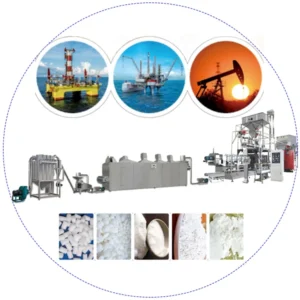
Modified and Pregelatinized Starch Processing Equipment – Pregelatinized Corn Cassava Modified Starch Puffing Machine
¥65.00 Select options This product has multiple variants. The options may be chosen on the product page -
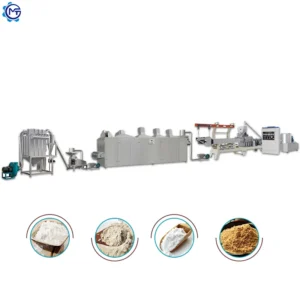
Automatic Deep Processing Machine – Food Grade Modified & Pregelatinized Starch Manufacturing Line
¥65.00 Select options This product has multiple variants. The options may be chosen on the product page -
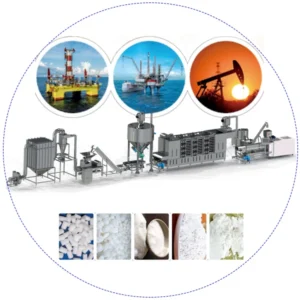
Línea de producción de almidón modificado para perforación industrial Extrusora de doble tornillo de gran salida Máquina de fabricación de almidón modificado
¥50.00 Select options This product has multiple variants. The options may be chosen on the product page -
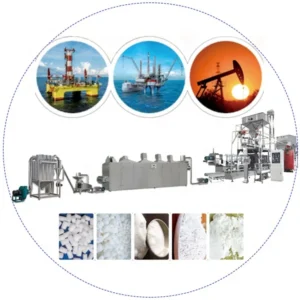
Automatic Industrial Adhesive Starch Modification Production Line – Pre-Gelatinization Extrusion Equipment
¥65.00 Select options This product has multiple variants. The options may be chosen on the product page