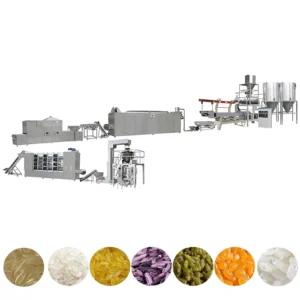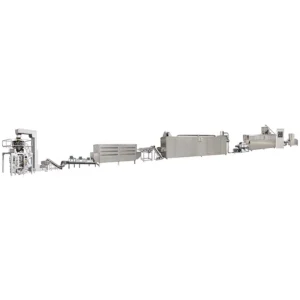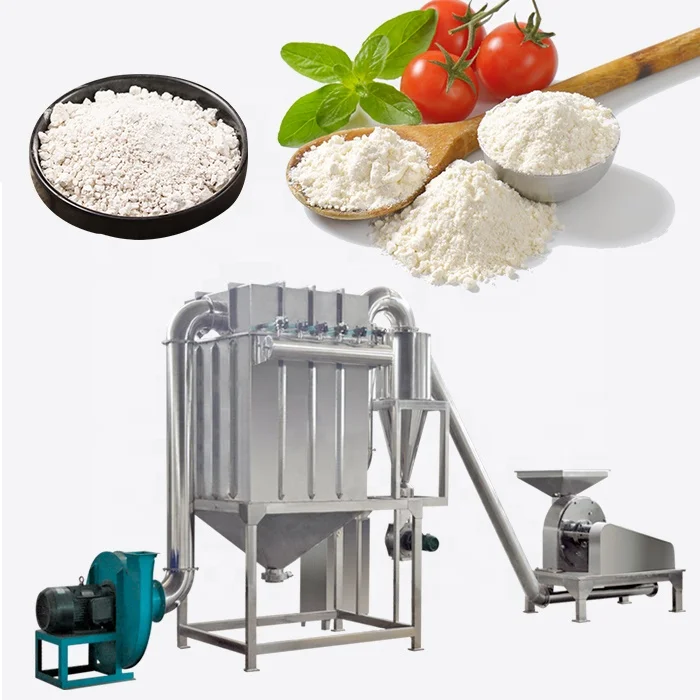
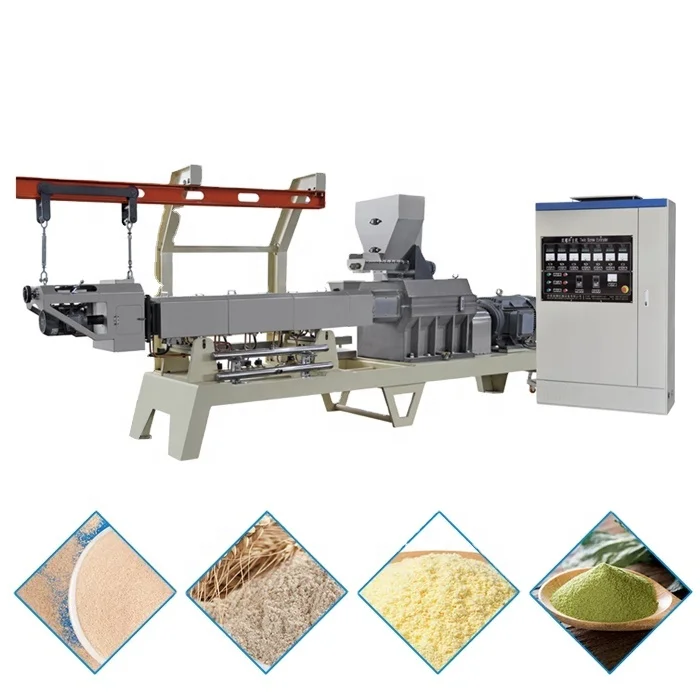
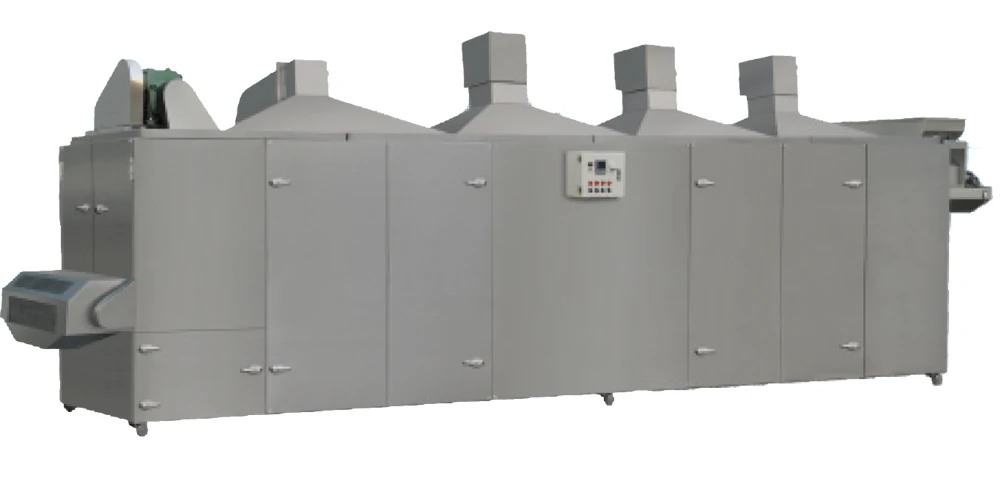
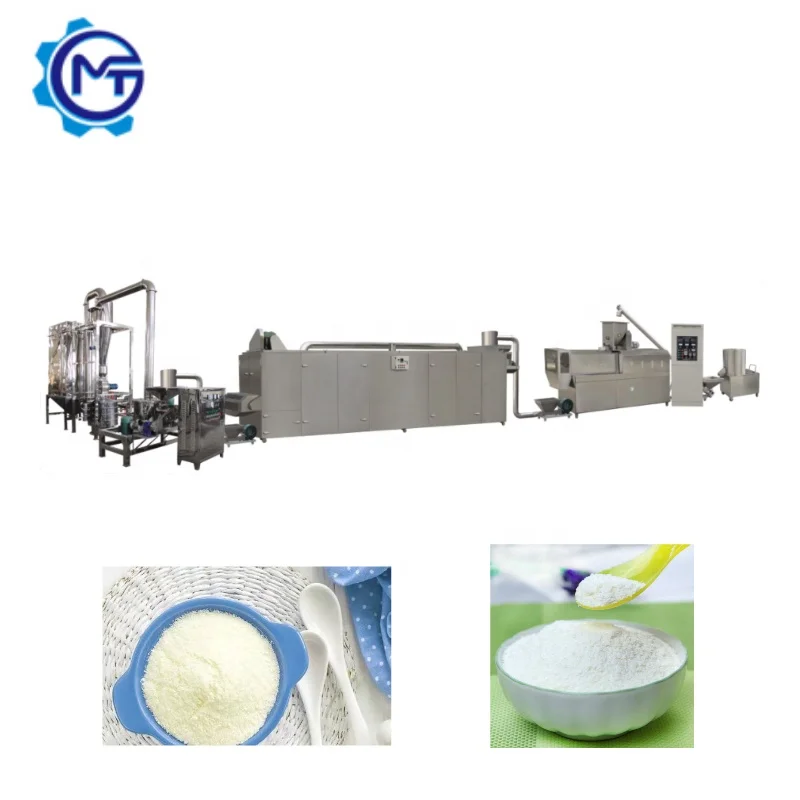


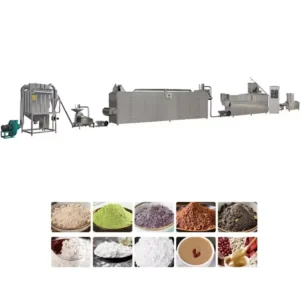
MT65 / MT70 / MT85 Twin-screw Nutritional Powder Processing Line, Stainless Steel Contact Parts — engineered for continuous baby food and infant formula production. Screw configuration and barrel temperature profile are matched to grain formula and target powder fineness, with line throughput calculated across mixing, extrusion, roasting and milling stations to prevent downstream bottlenecks. Layout, trial run on customer raw material and phased commissioning schedule provided under one supplier.
Description
Screw Configuration Matched to Your Formula — Every barrel temperature zone and screw pitch is specified against the buyer’s actual grain blend and target powder fineness, not copied from a generic build sheet.
Technical Specifications
| Parameter | Value |
|---|---|
| Product Type | Nutritional Powder Processing Line |
| Models Available | MT65, MT70, MT85 |
| Extruder Type | Twin-screw |
| MT65 Installed Power | 85 kW |
| MT65 Real Power | 65 kW |
| MT65 Output | 150–200 kg/h (basis not stated in source — confirm raw material / moisture / formula) |
| MT65 Dimension | 18000 × 1300 × 2300 mm |
| MT70 Installed Power | 120 kW |
| MT70 Real Power | 90 kW |
| MT70 Output | 200–300 kg/h (basis not stated in source — confirm raw material / moisture / formula) |
| MT70 Dimension | 20000 × 1500 × 2400 mm |
| MT85 Installed Power | 195 kW |
| MT85 Real Power | 165 kW |
| MT85 Output | 600–800 kg/h (basis not stated in source — confirm raw material / moisture / formula) |
| MT85 Dimension | 24000 × 3500 × 4300 mm |
| High-Temperature Roaster Effective Belt Length | 3.5 m |
| High-Temperature Roaster Far Infrared Heater Power | 3.9 kW × 24 |
| High-Temperature Roaster Belt Motor Power | 0.55 kW |
| High-Temperature Roaster Gas Consumption | 6.8 m³/h |
| High-Temperature Roaster Dimension | 4500 × 1500 × 1600 mm |
| Powder Mixer Tank Volume | 150 kg |
| Powder Mixer Rotary Speed | 385 rpm |
| Powder Mixer Mixing Time | 10 min per batch |
| Powder Mixer Power | 4 kW |
| Powder Mixer Dimension | 1000 × 630 × 1100 mm |
| Air Conveyor Power | 1.1 kW |
| Air Conveyor Dimension | 4200 × 500 × 2200 mm |
| Construction Material | Stainless steel (food-grade contact parts) |
| Control System | Available with PLC or MCC control (confirm configuration) |
| Voltage & Frequency | Configurable to site requirement (confirm 380V/50Hz or custom) |
| Certification | CE |
Application Suitability
| Application | Material or Output |
|---|---|
| Baby rice cereal and infant formula powder | Rice, pre-gelatinised starch, milk powder blends |
| Fortified nutrition programme powder | Corn, soybean, grain-based vitamin and mineral premixes |
| Sesame paste powder and soybean powder | Roasted sesame, defatted soy flour, pulse grains |
| Modified starch for textile and papermaking | Corn starch, cassava starch, potato starch |
| Pregelatinised starch for building materials | Tapioca starch, corn starch for cold-water solubility |
Why "Nominal Capacity" Rarely Survives Contact With Your Actual Grain
Throughput must be validated on the exact formula and moisture level the line will run in production, not on a reference material.
I watched a complete nutritional powder line stall for two weeks because the extruder was quoted against standard white rice flour while the buyer’s actual formula was a high-fibre blend of brown rice, oat bran, and a calcium-fortified premix. The screw pitch that handled rice flour at 180 kg/h choked on the bran-heavy mix at barely 90 kg/h, and the downstream roaster was already sized for the higher figure. Nobody had run the buyer’s material before the machines left the factory. That is the gap a nutritional powder processing line turnkey project has to close before shipping day. [NEED_CITE: extrusion throughput validation on buyer raw material]
Layout and Throughput Matching Across Every Station
A nutritional powder processing line turnkey is only as fast as its slowest station. The extruder may be rated for a given output, but if the roaster belt length cannot dry that volume at the required residence time, or if the powder mixer batch cycle is longer than the extruder discharge rate, material queues up and moisture migrates into finished powder. Before any machine is built, every station — mixing, extrusion, roasting, milling, blending, packing — is calculated against a single target throughput so that no single unit becomes the bottleneck.
In-House Trial Runs on the Buyer’s Own Grain Blend
Sending a sample bag of your formula to the testing workshop is the single most valuable step in the entire procurement cycle. The twin-screw extruder is re-configured with screw elements and barrel spacers selected for your particle size and fat content, then run at production temperature and feed rate. The resulting powder is measured for bulk density, moisture, and nutrient distribution before the line is finalised. If the trial shows a deviation, the screw profile or roaster belt speed is adjusted and re-tested — not discovered six months later on your factory floor.
Reading the Spec Sheet Against Real Production Variables
The installed power figures for MT65, MT70 and MT85 differ noticeably from real power consumption, which reflects the actual mechanical and thermal load during steady-state extrusion rather than peak motor draw at start-up. Roaster far-infrared heaters at 3.9 kW across 24 zones allow independent temperature profiling along the 3.5 m belt, so the moisture gradient can be controlled from entry to discharge rather than averaged with a single setpoint. The powder mixer runs at 385 rpm with a 10-minute batch cycle on a 150 kg tank, which determines how many batches per hour can keep pace with continuous extruder output; if the extruder is set to a higher output range, a second mixer or a larger tank becomes necessary to prevent batch starvation downstream. The air conveyor at 1.1 kW moves milled powder to the blending station without mechanical screw augers that can cause segregation in low-density fortified blends. [NEED_CITE: powder conveying methods and nutrient segregation risk]
The Hidden Cost of Skipping Configuration Verification
When voltage, frequency and control language are left unconfirmed until the machines arrive, commissioning stalls while transformers are sourced and PLC screens are reprogrammed. When the roaster gas supply is sized for a different altitude or ambient humidity, drying times drift and moisture in the finished powder creeps outside specification. When wear parts — screws, dies, mixer blades — are not identified before shipment, the first replacement cycle becomes an emergency air-freight order instead of a planned stock item. Every one of these issues costs production days that a proper nutritional powder processing line turnkey handover should eliminate. [NEED_CITE: commissioning delays from unconfirmed voltage and frequency]
Why Procurement Converges Here
Line layout and capacity calculation cover every station from batching to packing under a single supplier, removing the integration risk that comes from assembling equipment from separate vendors. Screw configuration and die design are documented against the buyer’s raw material rather than carried over from a previous customer’s build. An in-house machine testing workshop allows trial runs on customer-supplied grain before any equipment leaves the factory. Twin-screw expertise spans baby cereal, fortified nutrition powder, and modified starch, so the same engineering team that configured the extruder understands the downstream milling and blending requirements. Pre-sales consultation extends through on-site installation, commissioning, and operator training, closing the loop from first inquiry to steady-state production.
Documentation & Verification
- Line layout drawing with throughput calculation at each station from mixer to packing
- Trial run report on customer grain formula confirming powder density and moisture before dispatch
- Screw and die configuration record matched to target product fineness and expansion
- Electrical schematic with voltage, frequency, and PLC screen language confirmed to site
- Wear parts list identifying screws, dies, and mixer blades for first replacement order
- Factory test record with running parameters and powder sample analysis
Installation, Commissioning & Support
- MT85 footprint of 24000 × 3500 × 4300 mm requires level reinforced concrete floor with drainage provision
- Confirm local three-phase voltage and frequency before transformer and motor procurement begins
- Extruder barrels ship disassembled; on-site alignment and heater band wiring verified at commissioning
- First production run supervised with screw speed and feeder calibration against trial run baseline
- Operator training covers barrel temperature profiling, roaster belt speed, and mixer batch timing
- Spare screw elements and die plates stocked on-site based on wear parts list provided before shipment
What to Include in Your Inquiry
Provide the grain types and any added fat or fibre percentage in your formula so that screw configuration and roaster settings can be calculated before the quote is issued. State your local voltage, frequency, and preferred PLC language so the electrical package matches your site from day one. Share your workshop dimensions and ceiling height so the line layout can be fitted without later modification.
Frequently Asked Questions
Q: How is line capacity verified on my specific grain formula and moisture content?
A: Your raw material is shipped to the testing workshop where the twin-screw extruder is configured with screw elements and barrel spacers selected for your blend. A production-scale trial run measures output rate, powder moisture, and bulk density against your specification. Results are documented in a trial run report before the line is released for manufacture.
Q: What throughput matching is done between the extruder, roaster and milling station?
A: Each station is calculated against the same target output. The roaster belt length and heater zone count are matched to extruder discharge rate, and the powder mixer batch cycle is aligned so that continuous extrusion is not interrupted by batch blending delays.
Q: What voltage, frequency and control language options are confirmed before production?
A: The electrical schematic is issued for buyer approval before assembly. Voltage, frequency, and PLC interface language are locked in the specification sheet so that the control panel arrives configured for the target site without on-site reprogramming.
Q: Can a trial run be done on my raw material before shipment?
A: Yes. The in-house testing workshop runs your actual grain formula through the configured extruder and roaster. Powder samples are retained for your evaluation, and any screw or temperature adjustment is made and re-tested before the production machines are built.
Related products
-

Línea de procesamiento de extrusión de arroz en polvo nutricional para bebés de alta precisión 500kg/h
¥9,500.00 Add to cart -
Máquina de hacer harina de arroz para bebés con extrusora de doble tornillo de 150-500kg/h
¥9,500.00 Select options This product has multiple variants. The options may be chosen on the product page -
Máquina comercial de mezcla y molienda de polvo de arroz para bebés de acero inoxidable
¥8,238.27 Select options This product has multiple variants. The options may be chosen on the product page -
Línea de Producción de Alimentos Saludables para Bebés Equipos de Polvo Nutricional para Suplementos Alimenticios para Bebés para Maquinaria de Procesamiento de Harina
¥8,500.00 Select options This product has multiple variants. The options may be chosen on the product page