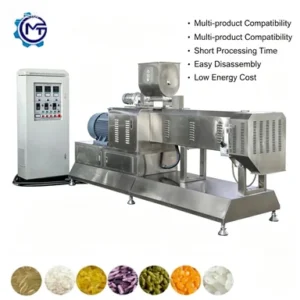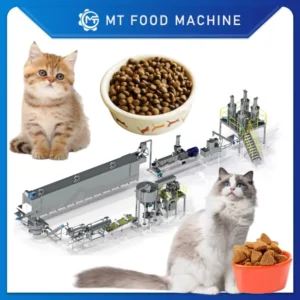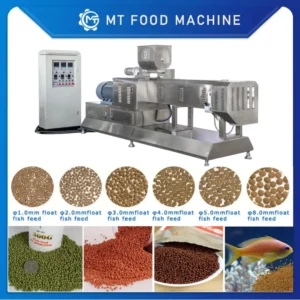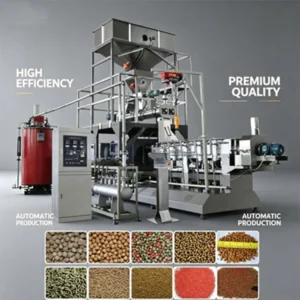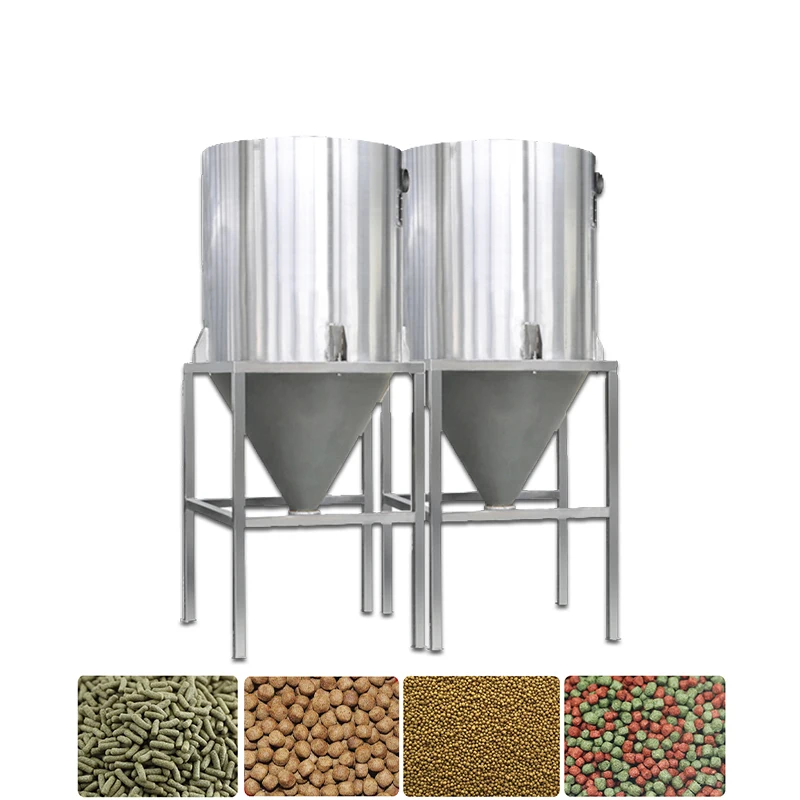

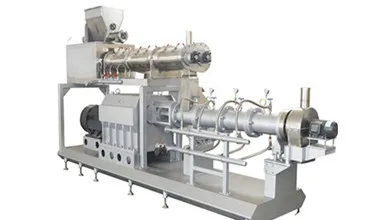

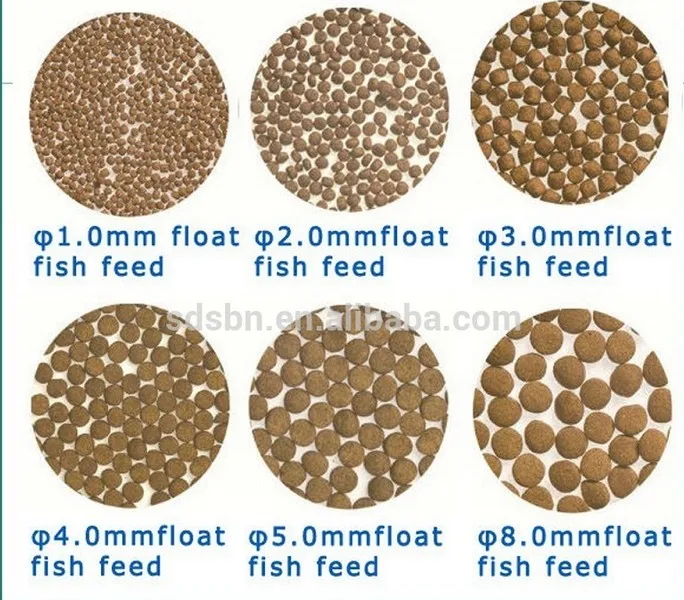
Twin Screw Pet Food Extrusion Production Line, Up to 3 Tons/Hour Output, 1-Year Warranty — engineered for dry dog and cat kibble as well as aquatic feed, with screw configuration and die design matched to your specific raw material formulation and target density.
- Line layout and capacity calculation provided for every station from batching through extrusion, drying, coating and packing
- In-house trial runs conducted on your raw material before shipment to verify actual throughput and product specification
Delivered as one turnkey project under single-supplier accountability, with on-site installation, commissioning and operator training included.
Description
Throughput-Matched Line Engineering — every station from batching through packing is sized against your actual formulation, not a generic nameplate figure.
Technical Specifications
| Parameter | Value |
|---|---|
| Product Type | Twin Screw Pet Food Extrusion Production Line |
| Output Capacity | up to 3 tons per hour (basis not stated in source — confirm raw material formulation, moisture content and kibble size) |
| Applications | dry dog and cat kibble, aquatic fish feed |
| Screw Configuration | matched to raw material and target product density |
| Control System | available with PLC and MCC integration |
| Voltage & Frequency | configurable to destination market (confirm before order) |
| Process Documentation | fish feed process drawing included |
| Warranty | 1-year warranty |
| Certifications | CE and ISO certified (verify current scope with manufacturer) |
Application Suitability
| Application | Material or Output |
|---|---|
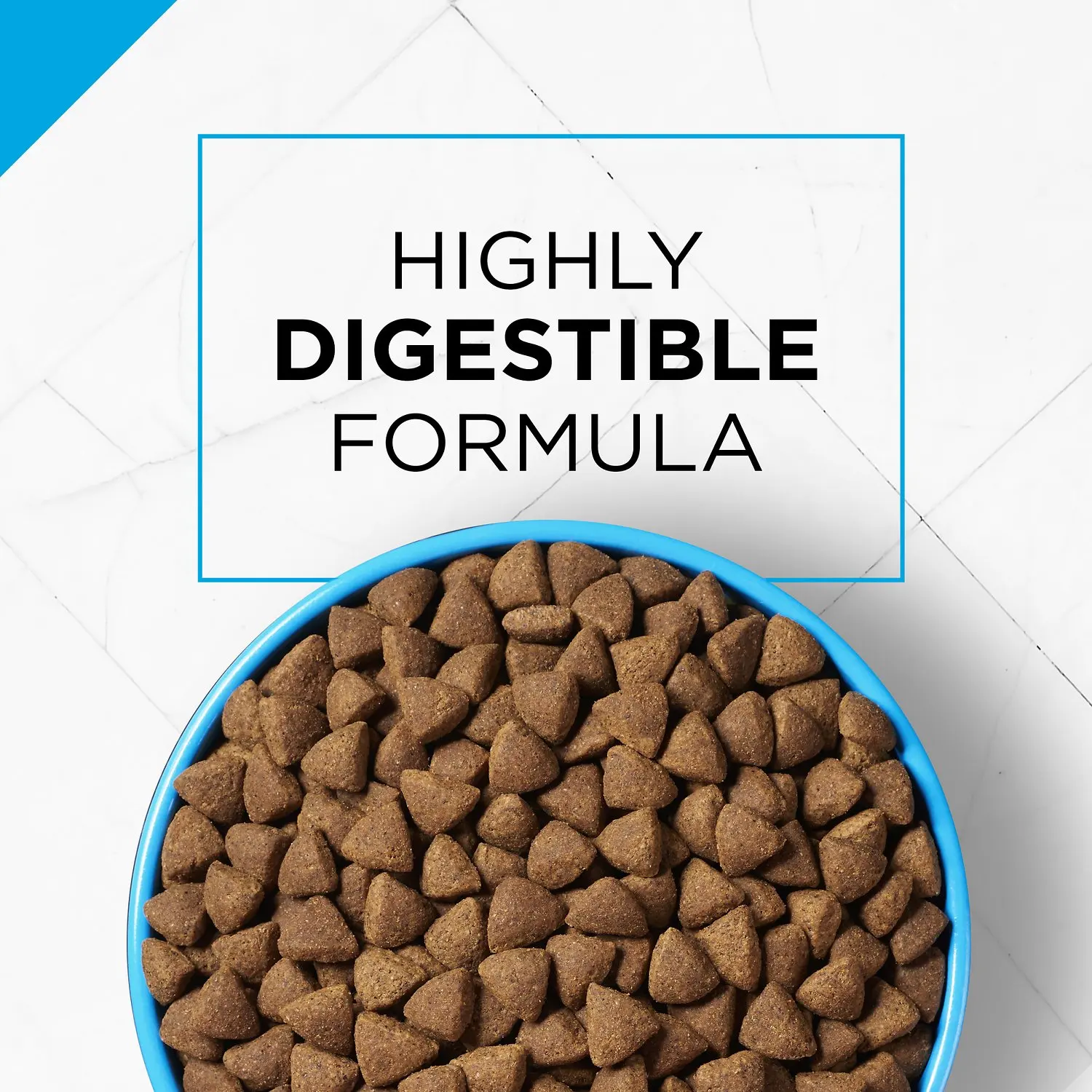
| Dry dog kibble production | corn, poultry meal, bone meal, vitamin premix blends |
| Dry cat kibble production | fish meal, meat meal, starch-based carbohydrate blends |
| Floating aquatic feed | soybean meal, wheat flour, fish meal formulations for tilapia and catfish |
| Sinking aquatic feed | high-protein shrimp and bottom-feeding fish formulations |
| Premium pet treat extrusion | single-protein or limited-ingredient formulations at lower throughput |
What a Nominal Capacity Rating Leaves Out on a Pet Food Production Line Turnkey
The number on the quotation rarely survives contact with your actual recipe.
I spent years on workshop floors in Shandong watching lines get bolted together station by station, and the most expensive lesson was always the same: a pet food production line turnkey rated at a clean capacity figure that drops the moment the buyer’s real raw material hits the hopper. Meat meal behaves differently from pure corn grits. Moisture content shifts expansion ratios. Kibble size changes die resistance. Every one of these variables pulls the extruder away from its nameplate number, and if the dryer and coating drum were sized to that nameplate, you end up with a bottleneck that no amount of operator tweaking can fix. [NEED_CITE: extrusion throughput dependency on raw material moisture and fat content]
That is why our approach starts with your formulation, not a brochure figure. We run your actual raw material through the testing workshop before the line ships, so the capacity number you plan around is the one the line actually delivers.
Layout Engineering That Matches Every Station
A pet food production line turnkey is only as reliable as its slowest station. When the extruder pushes more volume than the dryer can handle, moisture stays trapped inside the kibble, shelf life drops, and mold risk climbs. When the coating drum cannot keep pace, fat application becomes uneven and the product leaves the line below the palatability standard the market expects. Each station in this line is sized against the verified throughput of the one before it, so material flows continuously without surge hoppers acting as hidden buffers.
Trial Runs Before the Line Leaves the Factory
Shipping a line without testing it on your raw material means product development happens on your floor, with your downtime paying for every adjustment. Our in-house testing workshop runs your exact formulation through the configured screw and die setup before crating. You receive a trial run report documenting throughput, kibble density, expansion ratio, and moisture at the dryer exit — so when the line arrives at your facility, commissioning is about fine-tuning, not starting from scratch. [NEED_CITE: importance of pre-shipment factory trial runs for extrusion lines]
Reading the Specifications That Actually Matter
Screw configuration is the single most consequential choice on an extrusion line. The arrangement of forwarding elements, kneading blocks, and reverse-flight sections determines shear intensity, residence time, and the degree of starch gelatinisation your formulation achieves. A generic screw build copied from a standard pet food template will not produce the correct density if your recipe is heavy on fresh meat slurry or unusual starch sources. Die design works in tandem — the number of die holes, their diameter, and the land length control the pressure profile at the face, which directly shapes kibble expansion and final bulk density.
Control architecture matters for batch-to-batch consistency. PLC control with recipe storage means an operator can call up the exact screw speed, barrel temperature profile, and feeder rate for each SKU rather than relying on handwritten logs. MCC integration keeps motor protection and power distribution organised, which simplifies troubleshooting when a drive faults mid-shift.
Voltage and frequency must be confirmed against the destination facility before electrical panels are wired. A 380 V / 50 Hz panel shipped to a 440 V / 60 Hz plant will not simply underperform — it will trip breakers on startup and risk motor winding damage.
The Cost of Skipping Configuration Verification
I have walked into facilities where the extruder was already set on concrete before anyone realised the dryer was undersized for the actual kibble moisture load. The result was a line that could only run at a fraction of its quoted output because pushing harder meant shipping product with unsafe water activity. In another case, a screw configuration meant for grain-heavy kibble was installed on a line that needed to process a high-fat, high-meat recipe, and the output density was so far off specification that floating fish feed sank straight to the bottom of the pond. These are not warranty issues — they are configuration failures that no field adjustment can fully correct. [NEED_CITE: consequences of mismatched extruder screw configuration on kibble density]
Why Source This Line Through a Single Supplier
Single-supplier accountability means the extruder, dryer, coating drum, and packing station are all warrantied by one entity — there is no finger-pointing between vendors when throughput falls short.
Screw and die configuration is specified against your raw material data sheet and target kibble density, not pulled from a generic catalogue build.
In-house testing on your formulation happens before shipment, so the trial run report travels with the container and serves as the commissioning baseline.
The line ships with matched throughput across every station, eliminating the surge-bin workarounds that multi-vendor assemblies often require.
On-site installation, operator training, and wear-part support are handled by the same engineering team that configured the line, so institutional knowledge carries through from design to daily operation.
Documentation & Verification
- Line layout drawing showing throughput calculation at every station from batching to packing
- Screw and die configuration record matched to your raw material and target kibble density
- Trial run report on your actual formulation conducted before shipment
- Electrical schematic with voltage, frequency, and control language confirmed to your market
- Operation and maintenance manual with wear parts list and replacement intervals
- CE declaration of conformity and ISO certificate for customs and regulatory clearance
Installation, Commissioning & Support
- Foundation plan and utility drop locations provided based on the confirmed line layout and extruder footprint
- Dedicated circuit sizing confirmed against total connected load of extruder, dryer, and coating drum motors
- Modular station assembly allows phased installation aligned with your facility construction schedule
- First-run parameter logging against the factory trial run report to verify throughput and kibble density on-site
- Operator training covers recipe changeover, screw wear inspection, and emergency stop sequences on the PLC interface
- Wear parts stock list including screw elements, die plates, and cutter bearings with recommended reorder intervals
What to Prepare Before Requesting a Quotation
To configure a pet food production line turnkey that holds its rated output on your actual material, we need your target kibble sizes, raw material formulation with moisture and fat percentages, daily production target, local voltage and frequency, preferred control language, and available floor space with ceiling height. If you already have upstream milling or downstream packing equipment, share the interface specifications so we can match the line endpoints to your existing infrastructure.
Frequently Asked Questions
Q: How is line capacity verified against my specific raw material formulation and target kibble size?
A: We conduct a trial run using your actual raw material in our testing workshop before the line ships. The test records throughput, kibble density, expansion ratio, and moisture levels across the configured screw and die setup, giving you a verified capacity figure tied to your recipe rather than a generic nameplate rating.
Q: What is included in the turnkey scope for this pet food production line turnkey?
A: The scope covers every station from batching and mixing through extrusion, drying, flavouring or fat coating, cooling, and packing. Each station is sized to match the verified throughput of the one before it, so the line runs as a continuous system rather than a collection of standalone machines.
Q: Can a trial run be conducted on my raw material before the line ships, and what does the report cover?
A: Yes. The trial run report documents throughput at the extruder, kibble density and expansion ratio at the die face, moisture content at the dryer exit, and coating uniformity. This report serves as the baseline for on-site commissioning and operator training.
Q: How is throughput matched between the extruder, dryer, and coating drum?
A: Each station is sized based on the verified output from the preceding station, accounting for moisture removal in the dryer and residence time in the coating drum. This prevents bottlenecks where one station limits the entire line to a fraction of its potential output.
Q: What does on-site installation and commissioning include?
A: Our engineers oversee station placement, utility connections, and first-run parameter adjustment against the factory trial run report. Operator training covers recipe management on the PLC, screw and die changeover, wear part inspection, and daily maintenance routines specific to your line configuration.
Related products
-
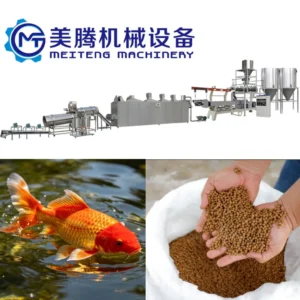
Línea de procesamiento de alimento para peces multi-especies de alta capacidad de 1.0-1.5t/h para producir alimento para peces
¥45,000.00 Select options This product has multiple variants. The options may be chosen on the product page -
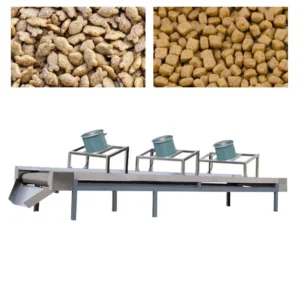
Línea de producción de alimentos para mascotas completamente automática Máquina de extrusión de grano de doble tornillo grande
¥9,500.00 Select options This product has multiple variants. The options may be chosen on the product page -
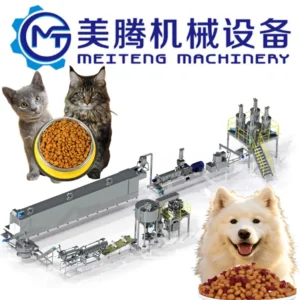
Línea de Producción de Extrusión de Alimentos para Mascotas de Alta Capacidad MT para Perros, Gatos, Aves, Peces, Ganado y Más (150kg/h-3T/h)
¥35,000.00 Select options This product has multiple variants. The options may be chosen on the product page -
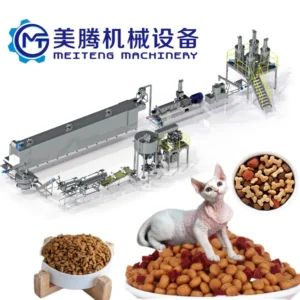
MT70 100-200kg/h Dog & Cat Pet Food Processing Line with 380V 50Hz Three Phase Power
¥35,000.00 Select options This product has multiple variants. The options may be chosen on the product page