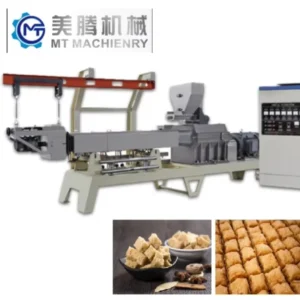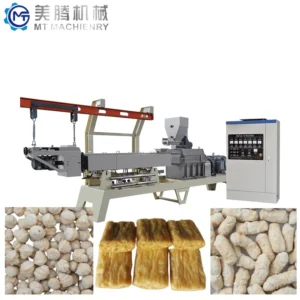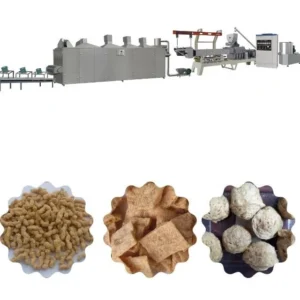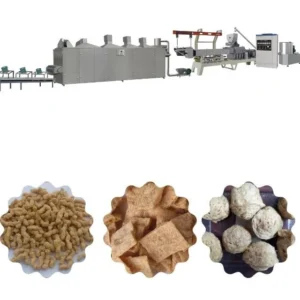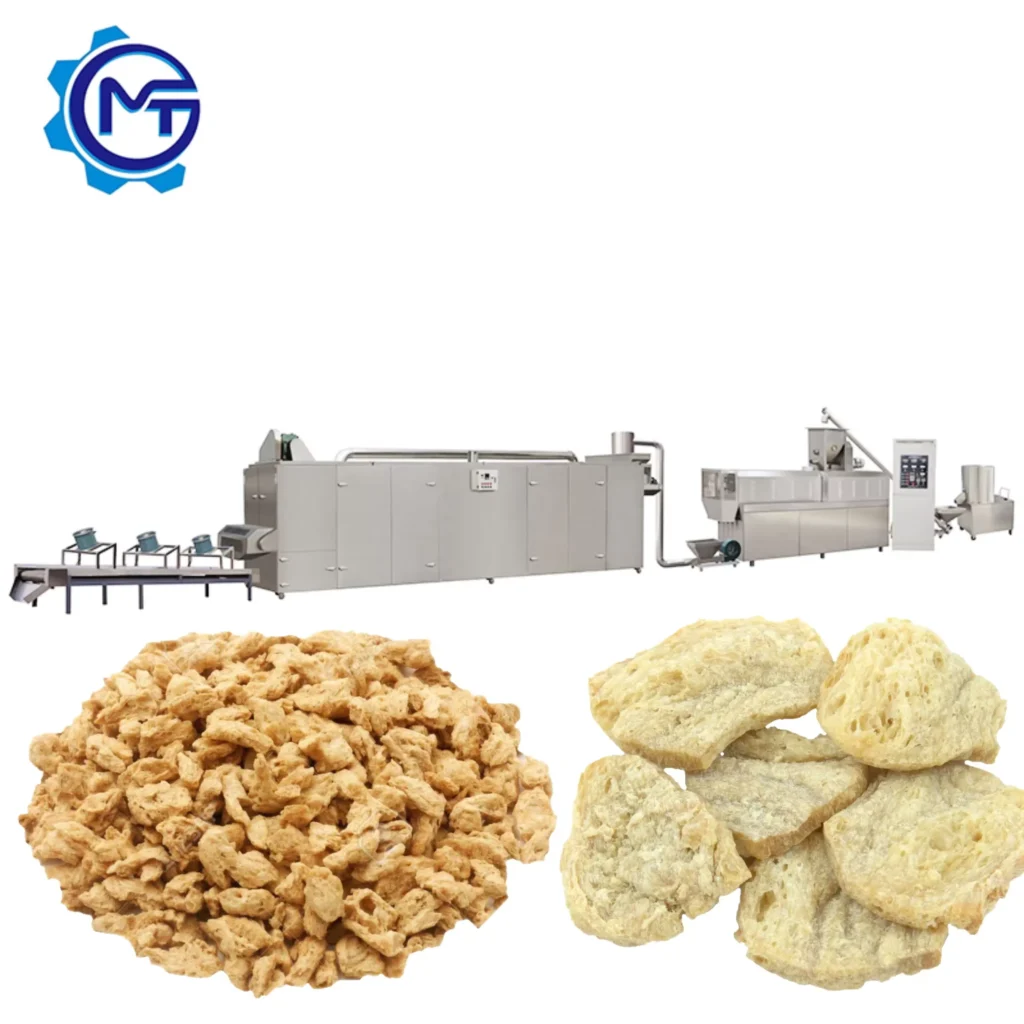


In-house trial runs on customer raw material validate output rate and product texture before shipment
Description
Turnkey Integration — Complete TVP/TSP processing line from batching to cooling, designed under one supplier to ensure station throughput matching rather than assembling independent machines from separate vendors.
Technical Specifications
| Parameter | Value |
|---|---|
| Product Type | Twin Screw Extrusion Line for Textured Vegetable Protein (TVP/TSP) |
| Model | MT65 / MT70 / MT75 / MT85 |
| Screw Configuration | Twin-screw |
| Main Motor Power | 22 kW / 30 kW / 45 kW (mapped to extruder models) |
| Installed Power | MT65: 84 kW; MT70: 160 kW; MT75: 190 kW; MT85: 210 kW |
| Power Consumption | MT65: 59 kW; MT70: 120 kW; MT75: 140 kW; MT85: 140 kW |
| Output Capacity | MT65: 100–150 kg/h; MT70: 150–200 kg/h; MT85: 250–300 kg/h (basis not stated in source) |
| Overall Dimensions (L×W×H) | MT65: 40000×1200×2200 mm; MT70: 41000×1500×2200 mm; MT75: 43000×1500×3200 mm; MT85: 45000×1500×3500 mm |
| Heating Power | 10 kW / 14 kW |
| Rotary Cutting Motor | 0.75 kW |
| Feeding Motor | 0.75 kW |
| Mixer Power Options | 4 kW / 7.5 kW / 15 kW |
| Mixer Capacity Options | 20–30 kg / 70–80 kg / 170–180 kg |
| Contact Material | Stainless steel 304 |
| Dryer Type | Multi-layer oven with double pitch roller chain drive |
| Line Sequence | Mixer → Screw Conveyor → Twin Screw Extruder → Air Conveyor → Multi-layer Dryer → Cooling Machine |
Application Suitability
| Application | Material or Output |
|---|---|
| Soy meat analogue production | Defatted soya flour and low-temperature soya flakes |
| Soya chunks and nuggets processing | High-protein soy isolate blends |
| Plant-based meat substitute | Layered fiber-structure protein blocks from soybean dregs |
| Vegetarian snack formats | Reprocessed peanut dregs and vegetable protein mixes |
What "150 kg/h" Leaves Out in a Textured Vegetable Protein Production Line Turnkey
Nominal output assumes ideal protein content and moisture; actual throughput depends on raw material behavior inside the barrel.
When a buyer purchases a textured vegetable protein production line turnkey based on a catalog number, the rating often reflects testing on standardized, high-protein isolates. In field conditions, soy flour batches vary in residual oil and fiber. These variations alter the friction and shear inside the extruder barrel, causing density fluctuations that force operators to slow the feed rate to maintain the required fibrous texture [NEED_CITE: impact of residual oil on extrusion shear and expansion]. Without matching the screw profile to the specific soy batch, the line runs below its nameplate speed to avoid producing a crumbling, non-fibrous output.
Line Synchronization Across Heating and Cooling Zones
A textured vegetable protein production line turnkey project succeeds or fails on how well the downstream stations handle the extruder’s discharge. If the multi-layer dryer cannot remove moisture fast enough, the protein strands collapse before the structure sets. We size the dryer belt speed and the airflow volume to the extruder’s actual discharge rate, ensuring the product enters the cooling machine with a stable moisture level suitable for packing or further processing.
Barrel Temperature Profiles and Fiber Alignment
The formation of the meat-like fiber structure relies on precise thermal gradients along the twin-screw barrel. Different soy protein concentrations require different heating zone settings to achieve the correct melt viscosity before the die. Our engineering team maps the barrel temperature profile to the buyer’s specific raw material formulation, adjusting the shear rate to align the protein molecules into continuous strands rather than broken chunks [NEED_CITE: protein alignment mechanisms in twin-screw extrusion].
Motor Load and Screw Pitch Selection
The installed power and the screw pitch determine how much mechanical energy is transferred into the soy mass. A higher torque is necessary when processing low-temperature soya flakes that require intense mechanical shear to denature and restructure. Selecting the correct screw element combination prevents motor overloading during continuous shifts while maintaining the necessary pressure buildup at the die face for proper expansion.
The Cost of Unmatched Throughput Between Stations
When the cooling conveyor runs faster than the dryer can supply, or when the mixer batch size does not align with the extruder’s continuous feed requirements, the line experiences micro-stoppages. These interruptions cause temperature drops in the barrel, leading to inconsistent product density and wasted raw material. A single-supplier layout prevents these bottlenecks by calculating the dwell time at every station from the mixer to the final cooling rack [NEED_CITE: continuous processing bottlenecks in food extrusion lines].
Why Source the Complete Layout Here
We build the textured vegetable protein production line turnkey around your specific raw material analysis. Our in-house testing workshop runs your actual defatted soya flour to verify the fiber structure before the machine leaves the factory. The screw configuration record is documented and shipped with the line, and we provide a complete electrical schematic matched to your local voltage and frequency requirements, ensuring the installation team connects the main motors correctly on the first day.
Documentation & Verification
- Line layout and capacity calculation matched to your specific soy protein concentrate
- Screw and die configuration record for targeted TVP fiber density
- Electrical schematic confirming motor voltage and control panel language
- Factory test record using your raw material batch before dispatch
- CE declaration of conformity and ISO certificate for import clearance
Installation, Commissioning & Support
- Foundation plan accounting for the 45-meter footprint and vibration dampening
- Dedicated circuit sizing for the 210 kW peak load on the MT85 extruder
- On-site assembly of the multi-layer dryer chain drive and heating ducts
- Parameter setting for barrel zones based on local soy flour moisture content
- Operator training on die changes for switching between nuggets and chunks
- Wear parts list identifying spare screw elements and die plates for first-year maintenance
Preparing Your Project Inquiry
To receive an accurate layout, specify the protein content and residual oil percentage of your soy flour. Define your target daily output and the available ceiling height for the multi-layer dryer installation. Provide your local voltage and frequency standards so we can configure the main motor and heating elements before shipment.
Frequently Asked Questions
Q: How is the actual capacity verified before shipment?
A: We conduct trial runs in our testing workshop using your specific raw material sample. This process confirms the fiber structure and actual throughput, ensuring the textured vegetable protein production line turnkey setup meets your market requirements before it is packed for dispatch.
Q: Can the line handle different soy protein concentrations?
A: Yes, the twin-screw extruder allows for screw element reconfiguration. By adjusting the screw pitch and barrel temperature zones, operators can process varying grades of defatted soya flour and maintain the necessary shear for fiber formation.
Q: How do you ensure the dryer matches the extruder output?
A: The multi-layer oven is specified with a belt speed and thermal capacity calculated from the extruder’s discharge rate. This prevents moisture retention issues that could compromise the texture of the soya chunks during the cooling phase.
Related products
-
Extrusora de Doble Tornillo para Proteína Vegetal Texturizada (TVP)
¥9,500.00 Select options This product has multiple variants. The options may be chosen on the product page -
Línea de producción automatizada de proteína de soja de alto rendimiento extrusora de un solo tornillo para TVP
Price range: ¥20.00 through ¥30.00 Select options This product has multiple variants. The options may be chosen on the product page -
Máquina de Hacer Proteína de Soja Línea de Producción Automática de Trozos de Soja
¥30.00 Select options This product has multiple variants. The options may be chosen on the product page -
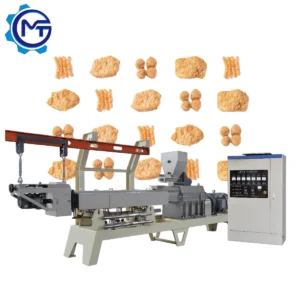
Línea de producción de proteína de soja texturizada para la fabricación de nuggets de carne vegetariana
¥8,238.27 Select options This product has multiple variants. The options may be chosen on the product page