

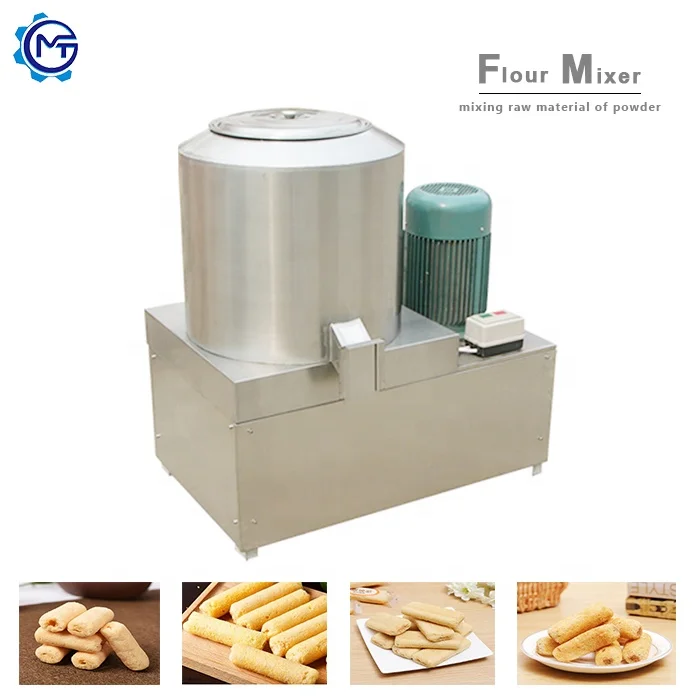
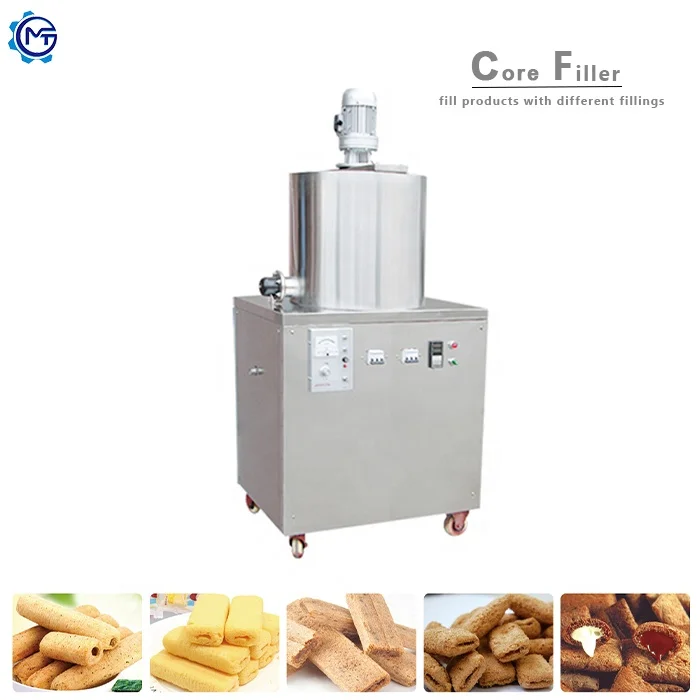
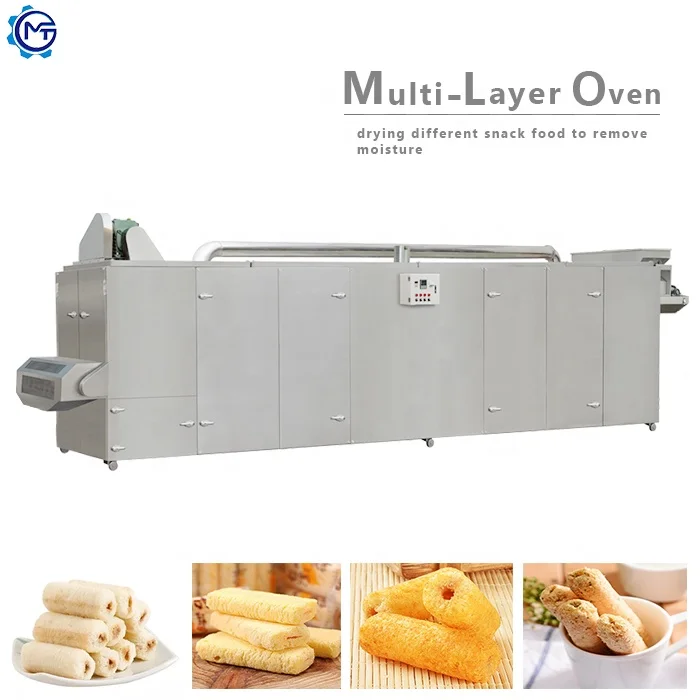
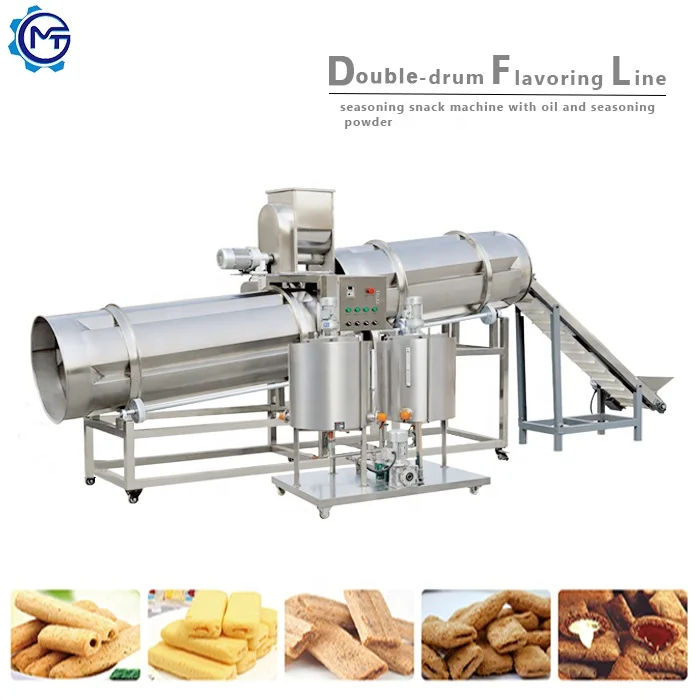
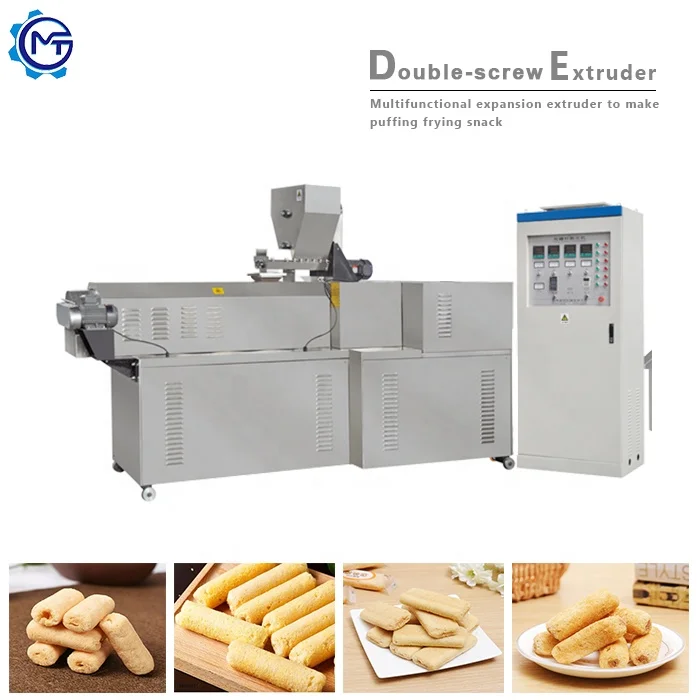
MT70 / MT85 / MT75 Twin Screw Extrusion Puffed Snacks Production Line, 130–220 kW Installed Power, PLC Control — configured as a complete turnkey project from batching through packing, with every station throughput-matched to eliminate bottlenecks.
- Screw configuration and die design specified to your raw material and target shape (cheese balls, rings, fruit loops, tubes, sticks)
- In-house testing workshop validates output on your formulation before shipment, with trial run report provided
- Line layout and capacity calculation designed to your factory footprint and local voltage standard
Delivered as one accountable project with full documentation — from electrical schematics and screw configuration records to CE conformity and operator training on site.
Description
Screw Configuration Matched to Your Formula — Every MT series build specifies screw profile and die geometry against the buyer’s actual raw material, preventing the density and texture mismatches common with generic extrusion builds.
Technical Specifications
| Parameter | Value |
|---|---|
| Product Type | Twin Screw Extrusion Puffed Snacks Production Line |
| Model | MT70 / MT85 / MT75 |
| Screw Type | Twin Screw |
| Installed Power (MT70) | 130 kW |
| Installed Power (MT85) | 180 kW |
| Installed Power (MT75) | 220 kW |
| Power Consumption (MT70) | 95 kW |
| Power Consumption (MT85) | 120 kW |
| Power Consumption (MT75) | 130 kW |
| Output Capacity (MT70) | 100–120 kg/hr (basis not stated in source — confirm raw material / moisture content) |
| Output Capacity (MT85) | 200–300 kg/hr (basis not stated in source — confirm raw material / moisture content) |
| Output Capacity (MT75) | 300–500 kg/hr (basis not stated in source — confirm raw material / moisture content) |
| Overall Dimensions (MT70) | 21 × 1.5 × 2.2 m |
| Overall Dimensions (MT85) | 25 × 1.5 × 2.2 m |
| Overall Dimensions (MT75) | 28 × 1.5 × 2.2 m |
| Control System | Automatic (PLC/MCC details to be verified) |
| Raw Materials | Corn, rice, wheat, oat, barley flour |
| Line Stations | Mixing → Extruding → Drying → Coating/Flavoring → Cooling → Packing |
| Dryer Heating Source | Gas or Electric |
| Die Configuration | Interchangeable moulds |
| Voltage & Frequency | Customized to local standard |
| Screw Feature | Special alloy, wear-resistant, automatic lubricating and cooling |
| Standards | CE, ISO |
Application Suitability
| Application | Material or Output |
|---|---|
| Cheese ball and corn ring production | Corn flour and corn grits formulations |
| Fruit loop and cereal ring extrusion | Wheat, oat, and barley flour blends |
| Tube, stick, and star snack formats | Rice flour and mixed grain recipes |
| Core-filled and co-extruded snack pillows | Dual-stream cereal and filling compounds |
| Custom 2D and 3D pellet shapes | Starch-based dough with interchangeable die sets |
What "Nominal Capacity" Leaves Out When Sourcing a Puffed Snacks Production Line Turnkey
A line rated for a certain throughput on paper often cannot sustain that number on the buyer’s actual flour blend and moisture level.
When a snack manufacturer receives an extruder quoted at a fixed output, that figure almost always comes from a test run on a reference material — typically a standard corn grits formulation at a controlled moisture percentage. Switch to a rice-heavy blend, introduce oat flour for a health-positioned SKU, or adjust moisture for a denser bite, and the real throughput shifts. The barrel residence time, screw shear profile, and die back-pressure all respond differently to each formulation. I have watched lines stall at well below nameplate rates simply because the screw configuration was never adjusted for the buyer’s recipe. [NEED_CITE: extrusion throughput variance across grain formulations]
How Screw Profile and Die Geometry Shape the Final Snack
The twin screw extruder sits at the center of any puffed snacks production line turnkey project, and its internal configuration determines far more than throughput. Screw element arrangement — the sequence of conveying, kneading, and reverse-flight segments — controls shear intensity, residence time, and the degree of starch gelatinisation inside the barrel. A formulation high in rice flour requires a different kneading block layout than one built around corn, because rice starch gelatinises at a lower temperature and generates less melt elasticity. Matching the screw profile to the recipe is the single most influential decision in achieving consistent expansion and the correct crunch density.
Moisture, Barrel Temperature, and Expansion Control
Beyond screw geometry, the interplay between feed moisture and barrel zone temperatures governs how much the product expands at the die exit. Higher moisture delays the flash-off of steam, producing a denser, harder bite; lower moisture causes rapid expansion and a more fragile structure. The barrel’s multi-zone heating system — typically divided into three to five independently controlled sections — lets the operator build a precise temperature gradient from feed inlet to die face. Getting this gradient right for each recipe is what separates a uniformly puffed snack from a batch where half the pieces are hollow and the other half are under-expanded. [NEED_CITE: starch gelatinisation temperature ranges by grain type]
Reading the Specification Sheet Against Your Production Reality
The installed power figures across the MT70, MT85, and MT75 models reflect the mechanical and thermal energy needed to process increasing volumes of cereal dough through the barrel. The difference between installed power and actual power consumption represents headroom for start-up surges, harder formulations, and ambient temperature swings in the production hall. Overall line length — from 21 metres on the MT70 up to 28 metres on the MT75 — determines the floor space required for the full station sequence, including the dryer, coating drum, and cooling conveyor. The interchangeable die system allows producers to switch between shapes such as cheese balls, rings, sticks, and stars without changing the extruder barrel, keeping format changeover measured in hours rather than days. The special alloy screw construction with automatic lubrication and cooling extends wear life under the continuous abrasion of mineral-rich grain flours.
The Hidden Cost of Mismatched Line Stations
An extruder that runs at the correct output means little if the downstream dryer cannot remove moisture fast enough, or if the coating drum is too small to apply seasoning evenly at that throughput. Bottlenecks at any single station force the entire line to throttle back, wasting the extruder’s capacity and creating uneven product quality — over-dried pieces mixed with under-dried ones, or unevenly coated snacks that fail shelf-life testing. These mismatches typically surface only after installation, when the cost of adding or replacing equipment has already multiplied. [NEED_CITE: production line bottleneck analysis in food processing]
Why Sourcing the Complete Line From One Project Supplier Matters
Every station on this puffed snack line — from the batching and mixing system through extrusion, drying, coating, cooling, and packing — is sized and specified under a single layout design, so throughput is matched across the sequence rather than assembled from unrelated vendors. The screw configuration and die design are documented against the buyer’s raw material and target shape before production begins, not copied from a generic reference build. An in-house testing workshop allows trial runs on the customer’s actual flour formulation before the line ships, generating a test report that confirms expansion ratio, texture, and achievable output. The project includes full electrical schematics with voltage and frequency confirmation for the destination market, eliminating commissioning delays caused by mismatched power supplies. Pre-sales engineering consultation covers factory layout design around the buyer’s existing floor space and utility connections.
Documentation & Verification
- Line layout drawing with station throughput matched to your target output
- Screw and die configuration record specific to your flour formulation
- Trial run report on your raw material produced in the testing workshop
- Electrical schematic with voltage and frequency confirmed for your market
- CE declaration of conformity and ISO certificate for the complete line
- Wear parts list identifying screws, dies, and cutting blades for reorder
Installation, Commissioning & Support
- Floor plan review accounting for the 21–28 m line length and utility routing
- Power supply verification against the 130–220 kW installed power range
- On-site assembly with station alignment checked against the approved layout
- First-run parameter setting for barrel temperature zones and screw speed
- Operator training on die changeover and coating drum adjustment
- Spare screw and die elements supplied with the initial shipment
Preparing Your Inquiry
To move from a general puffed snacks production line turnkey inquiry to a concrete layout proposal, the most useful information you can share starts with your primary flour type and any secondary grain blends, along with the moisture content you typically run. Your target daily output and available factory dimensions — length, width, and clear height — let the engineering team design a station sequence that fits without costly hall modifications. Confirming the local voltage, frequency, and preferred control language at this stage prevents rework once production of the electrical cabinets begins.
Frequently Asked Questions
Q: How is output capacity verified against my specific raw material and moisture content?
A: Before shipment, your flour formulation is run through the extruder in the testing workshop at your target moisture level. The trial documents actual throughput, expansion ratio, and product texture, and a written report accompanies the line so you know the verified capacity on your recipe rather than relying on a generic reference figure.
Q: What does the trial run in the testing workshop cover, and what report do I receive?
A: The trial covers screw speed, barrel temperature profile, feed rate, and die selection on your raw material. You receive a report recording the parameters used, the measured output rate, product density, and photographs of the extruded shapes, giving your team a documented baseline for commissioning.
Q: Can the line layout be designed around my existing factory footprint and utility connections?
A: Yes. The engineering team works from your factory dimensions and utility entry points to arrange the mixing, extrusion, drying, coating, cooling, and packing stations. The line length varies by model, so the layout is adapted to your available space and ceiling height constraints.
Q: What spare wear parts are included, and how are replacements supplied?
A: The initial shipment includes a documented list of wear items — screws, dies, and cutting blades — sized to your configuration. Replacement elements are manufactured to the same alloy specification and screw profile, ensuring consistent extrusion performance across changeover cycles.
Related products
-

Máquina de Extrusión Automática de Crujientes de Maíz para Chips de Maíz y Palitos de Maíz en Nueva Condición
¥8,000.00 Select options This product has multiple variants. The options may be chosen on the product page -

Línea de procesamiento de puff de maíz con mezclador, freidora, horno de horneado, máquina automática de alta productividad para la fabricación de productos de grano y snacks.
¥8,300.00 Select options This product has multiple variants. The options may be chosen on the product page -

Máquina de Sazonado de Snacks Inflados Sabor Extrusora de Alimentos de Doble Tornillo para Puff de Maíz
¥8,355.00 Select options This product has multiple variants. The options may be chosen on the product page -

Máquina Extrusora de Snacks de Maíz Pequeña de Puffs de Maíz de Doble Tornillo
¥100.00 Select options This product has multiple variants. The options may be chosen on the product page


