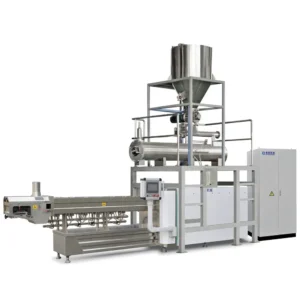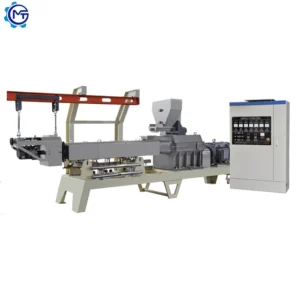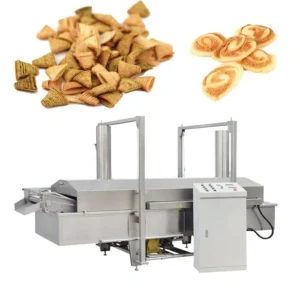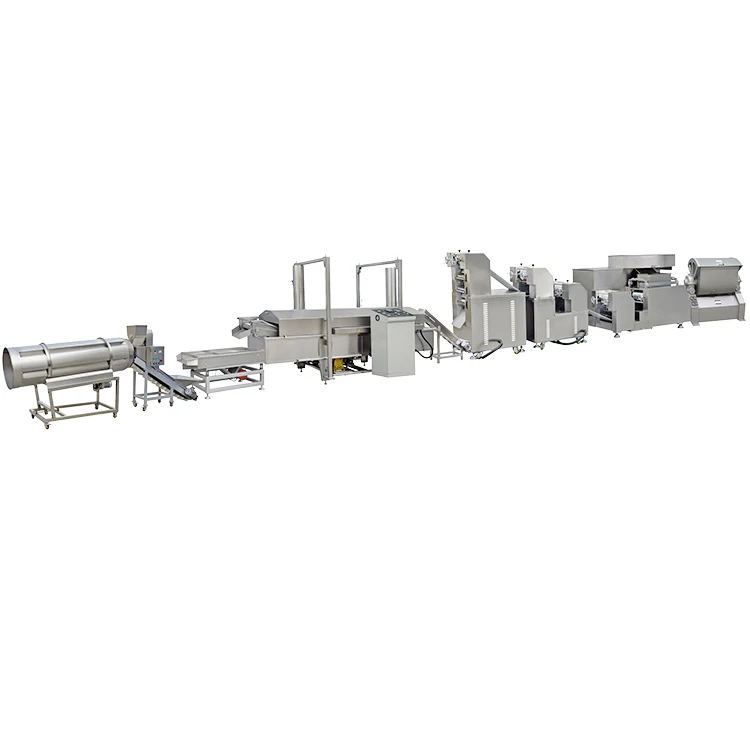


MT100/MT120 Puffed Snack Production Line, Single Screw Extruder, 380V/50Hz — configured for starch-based secondary puffing snacks from mixing through frying, flavouring and packing.
- Single screw with high/low pressure setup controls expansion behaviour across potato, corn and wheat starch formulations
- Die and cutting configuration matched to target shape — turtle chips, golgappa, tubes, rings and cartoon forms
- Energy options: electricity, gas, diesel or steam aligned to your site utilities
Throughput across every station is balanced and verified in our testing workshop on your actual raw material before shipment.
Description
Throughput-Matched Line Design — every station from mixer to packing sized against your actual starch formulation and target chip density, not assembled from catalog defaults.
Technical Specifications
| Parameter | Value |
|---|---|
| Model | MT100/MT120 |
| Product Type | Puffed Snack Production Line |
| Extruder Type | Single Screw Extruder (high and low pressure screw equipped) |
| Rated Power | 50–70 kW (electric); 50–60 kW (gas/diesel) |
| Voltage & Frequency | Three-phase 380 V / 50 Hz; single-phase 220 V / 50 Hz (customizable to local voltage) |
| Overall Dimensions (L×W×H) | 12,000–26,000 × 1,200 × 2,200 mm |
| Output Capacity | 120 kg/h (basis not stated in source — confirm raw material, moisture, product shape) |
| Raw Materials | Potato starch, corn starch, wheat flour |
| Line Stations | Mixer → Screw Conveyor → Single Screw Extruder → Pulling and Cutting Machine → Automatic Fryer → Automatic Flavoring Line → Cooling → Packing |
| Material of Construction | Food-grade stainless steel 201/304 |
| Energy Options | Electricity / Gas / Diesel / Steam |
| Motor & Electrical | Siemens (China) or top Chinese brand motors; Delixi or Delta inverters |
| Certification | CE / ISO 9001 |
| Warranty | One year with lifetime technical guidance |
| After-sales | Engineers available for overseas installation and commissioning |
Application Suitability
| Application | Material or Output |
|---|---|
| Turtle chips and multi-layer crispy snacks | Potato starch and corn starch blends |
| Golgappa / pani puri shells | Wheat flour and starch mixtures |
| Screw shell, round tube, square tube, ring shapes | Corn starch and potato starch |
| Cartoon and novelty 2D/3D puffed shapes | Starch-based secondary puffing formulations |
What "120 kg/h" Actually Means on Your Starch Blend
Output capacity holds only when the screw, die, fryer and flavouring drum are each matched to your raw material — and verified before the line ships.
I have watched starch-based puffing lines stall at barely half their nameplate throughput because the single-screw configuration was copied from a corn grits setup and then fed a high-tapioca blend. The expansion collapsed, the pulling unit could not grip the sheet, and the fryer residence time was all wrong for the thicker, denser pellet. A puffed snack production line turnkey should be quoted on your exact formulation, not on a laboratory benchmark. [NEED_CITE: starch gelatinisation behaviour across different moisture and amylose ratios]
Balancing the Screw Profile to the Starch Source
The single-screw extruder in this puffed snack production line turnkey comes equipped with both high-pressure and low-pressure screw elements. Swapping or combining these elements changes the shear history the dough experiences inside the barrel. Potato starch gelatinises at a lower temperature than corn starch, so running a high-pressure profile on a potato-dominant blend can over-cook the melt before it reaches the die, producing a brittle pellet that shatters in the fryer instead of expanding.
Matching Fryer Residence Time to Pellet Geometry
A turtle chip needs a longer fry than a thin pani puri shell because its multi-layer cross-section traps moisture deeper inside the pellet. If the automatic fryer is sized only for the lightest shape in the range, heavier formats will leave the oil undercooked and turn soft on the shelf. Throughput matching across the pulling-and-cutting station, the fryer belt speed and the flavouring drum rotation is the difference between a line that runs all day and one that constantly jams on format changeovers. [NEED_CITE: oil absorption and moisture migration in secondary-puffed starch snacks]
Reading the Specs That Actually Matter
The 50–70 kW electric rating (or 50–60 kW on gas or diesel) tells you the thermal headroom available at the barrel and the fryer. Running near the upper limit continuously on a high-moisture dough shortens heating-element life, so knowing your typical formulation moisture lets you pick the right energy option. The 12,000–26,000 mm line length reflects the number of stations and the cooling conveyor run — a longer cooling belt matters in humid climates where the flavoured chips need more time to set before packing. Food-grade stainless steel 201/304 contact parts keep corrosion at bay when the fryer oil aerosol settles on downstream surfaces, and the Delixi or Delta inverters allow fine speed adjustment on the pulling unit so pellet length stays within tolerance across shift changes.
When a Generic Build Becomes a Bottleneck
A line assembled from stand-alone catalog machines almost always has one station that limits the rest. The extruder pushes more pellets than the fryer can handle, or the flavouring drum cannot coat fast enough and product piles up on the cooling belt. The consequence is unplanned downtime, inconsistent seasoning coverage and oil degradation from pellets sitting too long in the basket. Every one of those problems traces back to a layout that was never balanced against a single target product. [NEED_CITE: throughput mismatch consequences in multi-stage snack lines]
Why Sourcing the Whole Line Together Changes the Outcome
A puffed snack production line turnkey from one supplier means the extruder die, the pulling-and-cutting speed, the fryer belt and the flavouring drum are all specified against the same capacity target rather than ordered separately and forced to agree on site. Screw configuration and die design are documented to your raw material and target chip shape before production starts. The in-house testing workshop runs your actual starch blend through the extruder and fryer so expansion, oil uptake and texture are confirmed before the line is crated. Electrical schematics and voltage are locked to your facility standards — not left for the commissioning engineer to sort out on arrival. CE and ISO 9001 documentation accompanies the shipment, and the wear-parts list covers screws, dies and fryer belt links from day one.
Documentation & Verification
- Line layout and capacity calculation confirming throughput at each station for your target chip format
- Screw and die configuration record matched to your starch blend and pellet geometry
- Trial run report on your raw material covering expansion, oil uptake and final moisture
- Electrical schematic and voltage confirmation aligned to your local supply standard
- CE declaration of conformity and ISO 9001 certificate included with shipping documents
- Wear parts list specifying screws, dies, cutting blades and fryer belt links
Installation, Commissioning & Support
- Floor plan based on the 12,000–26,000 mm footprint with utility drop points marked before equipment arrives
- Dedicated circuit sized for the 50–70 kW electric or 50–60 kW gas/diesel supply option you selected
- Assembly from skid-mounted modules with stainless steel 201/304 frames leveled and anchored on site
- First-run parameter setting covering barrel zones, pulling speed, fryer temperature and drum rotation
- Operator training on screw changeover, die cleaning and inverter adjustment for format switches
- Spare screw, die and cutting blade set handed over at commissioning with reorder intervals noted
What to Include in Your Inquiry
Send the exact starch type or blend ratio you plan to run, the chip shape and size you want to produce, and your target daily output. Include your site voltage, frequency and the control language your operators will need. If you already have upstream mixing or downstream packing equipment, share the model and throughput so the line can be configured around it.
Frequently Asked Questions
Q: How is output capacity verified on my specific raw material and product shape?
A: Before the puffed snack production line turnkey ships, your starch blend is run through the extruder and fryer in the testing workshop. Expansion ratio, pellet density and oil uptake are measured against your target chip specification, and the capacity figure is confirmed on that basis rather than on a generic benchmark.
Q: How do you ensure throughput is matched between extruder, fryer and flavouring stations?
A: Each station is sized against the same target output during the layout stage. The pulling-and-cutting speed, fryer belt length and flavouring drum rotation are calculated so no single machine becomes a bottleneck when the line runs continuously on your chosen product format.
Q: What voltage, frequency and control language will be confirmed before production?
A: Your local supply standard — whether three-phase 380 V / 50 Hz, single-phase 220 V / 50 Hz or another combination — is documented in the electrical schematic before build. Control panel labels, inverter menus and the HMI language are all set to match your operators’ requirements.
Q: Can I run a trial on my raw material in your testing workshop before shipment?
A: Yes. You supply or approve the exact starch formulation, and the single-screw extruder is fitted with the screw profile and die intended for your order. The trial covers extrusion, cutting, frying and flavouring, and a full report with sample product is sent for your approval before dispatch.
Q: What does the phased installation and commissioning schedule look like for a complete line?
A: Equipment arrives as skid-mounted modules that are positioned, connected and leveled in sequence. Electrical and utility hook-ups follow the pre-agreed schematic. Commissioning covers dry runs, product trials with your raw material and operator training, typically spanning several working days depending on line length and station count.
Related products
-
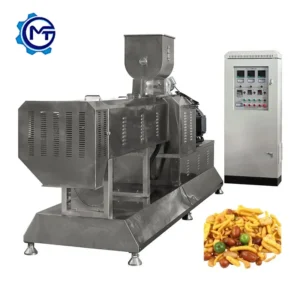
Nueva máquina extrusora automática de Nimko frita de 100-200 kg/h de acero inoxidable de grado alimenticio para el procesamiento de snacks fritos de alta productividad
¥8,575.00 Select options This product has multiple variants. The options may be chosen on the product page -
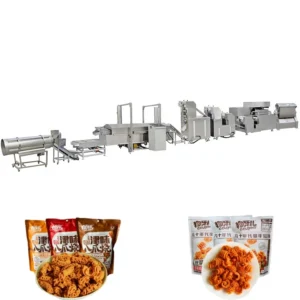
Puffed Octopus Snack Processing Line – Full-Automatic Fried Octopus Production Machinery
¥65.00 Select options This product has multiple variants. The options may be chosen on the product page -
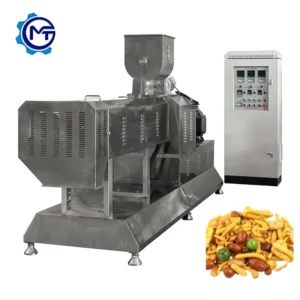
Nueva Máquina Automática de Fabricación de Nimko Frito Tradicional Alta Productividad Gran Capacidad Línea de Producción de Acero Inoxidable
¥8,575.00 Select options This product has multiple variants. The options may be chosen on the product page -
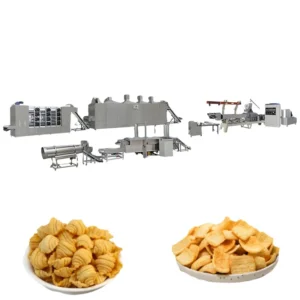
Nueva Línea de Producción de Alimentos para Freír Automática, Portátil y de Alta Productividad para Palitos de Ensalada, Chips y Snacks
¥100.00 Select options This product has multiple variants. The options may be chosen on the product page