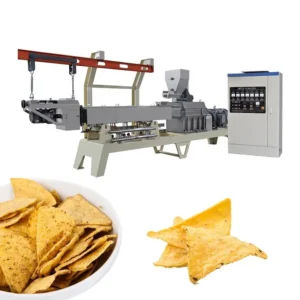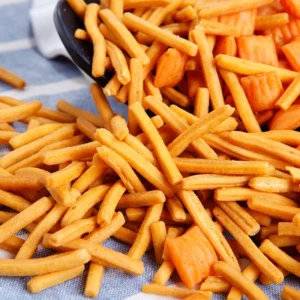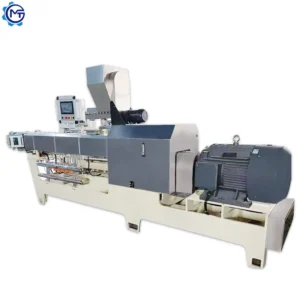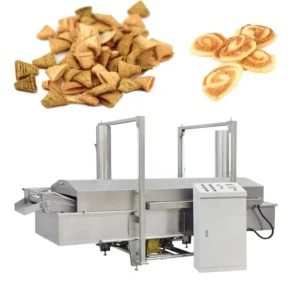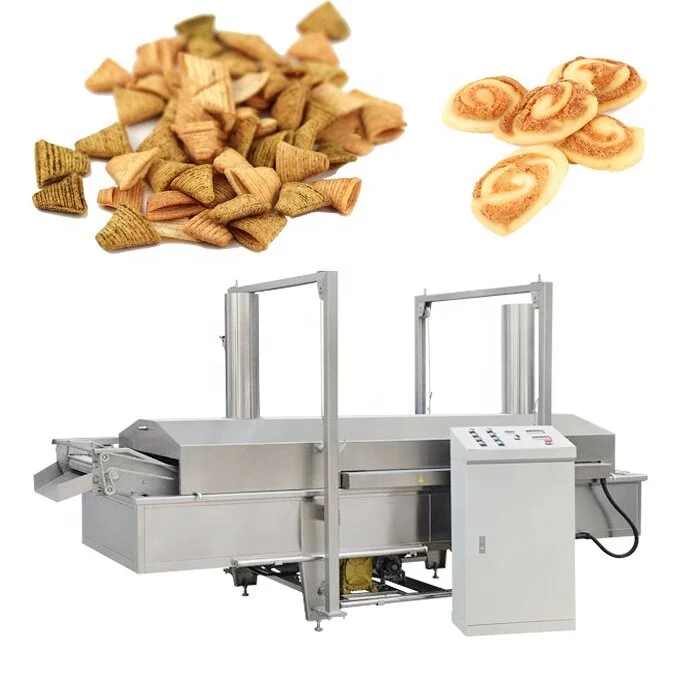


MT65 / MT70 / MT70c / MT75 Twin Screw Extruder for Fried Snack Chips, 22–55 kW, Alloy 38CrMoAl Screws — configured for corn-flour nacho, tortilla and Doritos-style chip lines with matched frying and flavouring stations.
- Screw configuration and die design specified to your raw material and target chip density, controlling expansion and post-fry texture.
- Inverter-controlled feeding, extrusion and cutting deliver repeatable chip geometry; self-cleaning screws enable fast recipe changeover.
Trial runs on your corn-flour formulation run in our testing workshop before shipment, with a full report and screw/die record included.
Description
Turnkey Line Integration — Every station from batch mixer to double-drum flavouring is throughput-matched to the twin screw extruder, so no dryer, fryer or coater bottlenecks your fried chip output.
Technical Specifications
| Parameter | Value |
|---|---|
| Product Type | Twin Screw Extruder for Fried Snack Chips (Nacho / Tortilla / Doritos) |
| Model | MT65 / MT70 / MT70c / MT75 |
| Screw Type | Twin Screw |
| Screw Material | Alloy 38CrMoAl, nitriding process |
| Self-Cleaning | Yes — no barrel discharge required on material changeover |
| Main Motor | Siemens brand |
| Main Power | MT65: 22 kW; MT70: 30 kW; MT70c: 45 kW; MT75: 55 kW |
| Real Power | MT65: 22 kW; MT70: 30 kW; MT70c: 55 kW; MT75: 55 kW |
| Output Capacity | MT65: 100–150 kg/h; MT70: 150–200 kg/h; MT70c: 200–250 kg/h; MT75: 200–300 kg/h (basis to be confirmed — depends on raw material formulation, moisture content and die format) |
| Overall Dimensions | MT65: 22000 × 1200 × 2200 mm; MT70: 25000 × 1500 × 2200 mm; MT70c: 30000 × 3500 × 4300 mm; MT75: 33000 × 3500 × 4300 mm |
| Feeding System | Speed-adjusted converter, food-grade stainless steel twin screw feeder |
| Gearbox | Automatic lubrication function |
| Drive Cooling | Increased radiator on driving part for forced cooling |
| Cutting Mechanism | Knife fixed in die head seat, rotary cutting by V-belt drive |
| Control System | Inverter-controlled feeding, extrusion and cutting systems |
| Voltage & Frequency | Configurable to destination market (to be confirmed before ordering) |
| Fryer Energy Options | Electric / Diesel / Gas |
| Flavouring System | Double drums with automatic powder dosing, conveyor and sprayer |
| Line Stations | Mixer → Twin Screw Extruder → Shaper / Die → Hot-Air Expansion → Fryer → Double Drum Flavouring |
| Warranty | 1 year from equipment arrival at customer site |
| Installation | Engineers available for overseas installation and commissioning (typical multi-week engagement) |
| Standards | CE; ISO |
Application Suitability
| Application | Material or Output |
|---|---|
| Nacho chip production | Corn flour / corn powder based formulations, triangular die geometry |
| Tortilla chip line | Corn flour formulations, thin-sheet die profiles for crispy texture after frying |
| Doritos-style seasoned chips | Corn-based extrudates requiring uniform blister formation during frying |
| Puffed corn snacks (pre-fry stage) | Corn grits and corn flour blends, pellet or direct-expanded intermediate forms |
| New fried chip format launches | Custom die shapes and thickness profiles for proprietary snack concepts |
Why the Extruder-Fryer Mismatch Kills Your Line Before It Starts
Throughput must be matched station-to-station, or the slowest link dictates your actual output.
I once spent nights on a factory floor in West Africa watching a twin screw extruder push material faster than the downstream fryer could handle. Corn-based chips piled up on the conveyor, losing moisture and turning brittle before they ever reached the oil bath. The line had been quoted on the extruder’s nominal capacity with no regard for what the fryer could actually process. That mismatch cost the operator weeks of lost production and a rewrite of the entire line layout [NEED_CITE: line throughput matching principles for extrusion-based snack production].
A twin screw extruder for fried snack chips turnkey production line is only as fast as its slowest station. The mixer must feed consistently, the hot-air expansion stage must stabilize moisture, the fryer must recover temperature between batches, and the double-drum flavouring system must keep pace without chip breakage. When one supplier designs the complete layout, every interface — conveyor speed, dwell time, thermal recovery — is calculated against the same throughput target rather than assembled from disconnected quotes.
Extrusion Geometry That Defines Chip Texture Before It Hits the Oil
The twin screw extruder for fried snack chips turnkey production line begins its work well before frying. Screw configuration, barrel temperature profile, and die geometry collectively determine the moisture content, density, and internal cell structure of the extrudate. These factors are what produce — or fail to produce — the characteristic blisters and crunch on a nacho chip after it passes through hot oil.
Alloy 38CrMoAl nitrided screws maintain dimensional accuracy across production runs, which means the shear profile inside the barrel stays consistent batch after batch. The self-cleaning design allows recipe changeovers without discharging residual material from the barrel, cutting downtime between product formats. For a plant running both thick tortilla chips and thin nacho formats, this matters every shift.
Matching Fryer Capacity to Extruder Output — The Calculation Most Quotes Skip
Fryer sizing depends on extruder output, chip thickness, target post-fry moisture, and oil recovery rate. A twin screw extruder pushing material at the upper end of its capacity range will overwhelm an undersized fryer, causing oil temperature drops that leave chips undercooked and greasy. Conversely, an oversized fryer burns energy while waiting for product.
The hot-air expansion stage between extrusion and frying plays a role many line designs overlook. It stabilizes surface moisture so chips enter the oil at a consistent state, which directly controls blister uniformity and final texture. When this station is underspecified, fryer operators constantly adjust temperature to compensate for moisture swings upstream [NEED_CITE: moisture management in fried extruded snack processing].
Reading the Spec Sheet for What It Actually Tells You
Motor power and screw diameter set the mechanical ceiling, but the feeding system determines whether you ever reach it. The speed-adjusted converter on the stainless steel twin screw feeder controls mass flow rate into the barrel. Inconsistent feeding causes pressure surges that show up as density variation in the extrudate — and ultimately as uneven frying in the finished chip.
The Siemens main motor paired with the forced-cooling radiator on the drive section addresses thermal buildup during continuous operation. In hot-climate factories, ambient temperature already pushes gearbox oil toward its upper limit. The increased radiator surface keeps the drive section within operating temperature, preventing the thermal shutdowns that interrupt production mid-run.
Automatic gearbox lubrication reduces the maintenance burden on shift operators. Manual lubrication schedules in food plants frequently drift because production pressure takes priority over preventive tasks. An automatic system delivers oil at set intervals regardless of who is on shift, extending gear life under the sustained loads of continuous extrusion.
The inverter-controlled cutting system at the die head maintains chip geometry within tight tolerances. V-belt driven rotary cutting with a fixed knife in the die head seat produces repeatable thickness and shape, which is critical because fry time and oil absorption are directly tied to chip cross-section.
What Happens When Screw Configuration Is Copied Instead of Specified
A generic screw build that works on one corn flour formulation can fail entirely on another. Starch ratio, particle size, and moisture content all change how material behaves inside the barrel. I have watched lines where the chips came out dense and glassy because the screw elements generated too little shear for that particular flour blend. The operator blamed the extruder when the real problem was a configuration copied from an unrelated project [NEED_CITE: screw configuration matching to raw material formulation in twin screw extrusion].
When die design is not matched to target chip thickness and post-fry density, the result is a product that looks right at the die face but collapses or over-expands in the fryer. These defects do not appear in the first ten minutes of a trial run. They show up after hours of production when barrel wear, temperature drift, and raw material variation expose a configuration that was marginal from the start.
Why Procurement Through One Supplier Changes the Commissioning Experience
Throughput matching across every station is calculated before fabrication begins, so the fryer, expansion chamber, and flavouring drums are sized against the same capacity model as the extruder. There is no finger-pointing between vendors when a station underperforms.
Screw configuration and die design are specified against your actual corn flour formulation and target chip geometry, not copied from a generic template library. The in-house testing workshop runs your raw material before the line ships, generating a trial run report that documents output, texture, and density.
Electrical schematics, voltage confirmation, and control language are verified against the destination market before production starts. This eliminates the commissioning delays that occur when a control panel arrives labeled in a language the local operators cannot read, or wired for a voltage the plant does not supply.
Pre-sales consultation covers line layout, utility planning, and phased installation scheduling. On-site engineers handle installation, commissioning, and operator training, then remain available for ongoing maintenance support and wear part supply.
Documentation & Verification
- Line layout and capacity calculation showing throughput matching from extruder through fryer and flavouring stations
- Screw and die configuration record specified to your corn flour formulation and target chip density
- Trial run report on your raw material from the in-house testing workshop, documenting output and product quality before dispatch
- Electrical schematic with voltage, frequency, and control language confirmed to your destination market
- CE declaration of conformity and ISO certificate for market entry compliance
- Wear parts list with screw element and die specifications for reorder planning
Installation, Commissioning & Support
- Floor plan and utility layout provided for the full line footprint, covering the MT65 through MT75 dimension range up to 33000 × 3500 × 4300 mm
- Power supply requirements documented per model, from 22 kW for the MT65 to 55 kW for the MT75, with dedicated circuit specifications
- Line arrives as coordinated stations requiring on-site assembly and alignment by installation engineers
- First-run parameter setting covers barrel temperature profiles, feeder speed, die pressure, and fryer temperature matched to your formulation
- Operator training addresses screw configuration recognition, self-cleaning changeover procedure, and inverter adjustment for feeding and cutting
- Wear parts supply covers alloy 38CrMoAl screw elements, die plates, and cutting knives with reorder lead times
- Maintenance schedule aligned with automatic gearbox lubrication intervals and forced-cooling radiator inspection
Before You Request a Quote, Prepare These Details
To configure a line that matches your production target, share your corn flour formulation including starch ratio and moisture content, the chip formats you plan to produce with target dimensions, and your daily output requirement. Confirm the voltage and frequency at your facility, the control panel language your operators need, and whether you have existing upstream or downstream equipment that the new line must integrate with. If you want a trial run on your raw material before shipment, send a representative sample batch with your inquiry.
Frequently Asked Questions
Q: How is output capacity verified against our specific corn-flour formulation and moisture content?
A: Your raw material is run in the in-house testing workshop before shipment. The trial uses your exact corn flour formulation at your specified moisture level, and the resulting report documents achievable throughput, chip texture, and post-fry density. This confirms what the line actually produces with your material rather than relying on nominal ratings.
Q: How are extruder, fryer, and flavouring drum capacities matched so no station bottlenecks the line?
A: Every station is sized from the same throughput calculation. The fryer’s oil volume and recovery rate, the hot-air expansion chamber’s dwell capacity, and the double-drum flavouring system’s throughput are all calculated against the extruder’s confirmed output on your formulation, preventing downstream bottlenecks.
Q: What voltage, frequency, and control language will be confirmed before production begins?
A: Your facility’s electrical supply specifications and preferred control panel language are confirmed during the line configuration stage. The electrical schematic is then produced to match those parameters, so the control system arrives wired and labeled correctly for your local operators and electrical infrastructure.
Q: Is a trial run on our raw material done before shipment, and what does the trial run report include?
A: Yes. The in-house testing workshop runs your corn flour formulation through the configured screw and die setup. The trial run report covers output rate, extrudate moisture and density, chip geometry at the die, and product quality after simulated frying. This report ships with the line documentation package.
Q: What screw and die configuration is specified for our target chip shape, thickness, and post-fry density?
A: Screw element arrangement and die geometry are selected based on your target chip format and corn flour formulation. The configuration record documents element sequence, die opening dimensions, and the reasoning behind each choice, giving your process engineers a baseline for future recipe adjustments.
Related products
-
High-Yield Automated Fried Snack Production Line – Double Screw Salad Strips & Millet Crust Making Equipment
¥65.00 Select options This product has multiple variants. The options may be chosen on the product page -
Puffed Octopus Snack Processing Line – Full-Automatic Fried Octopus Production Machinery
¥65.00 Select options This product has multiple variants. The options may be chosen on the product page -

Nueva línea de producción automática de bocadillos Puff Bugles Precio máquina para hacer chips de maíz máquina de maíz frito alta productividad grande
¥8,570.00 Select options This product has multiple variants. The options may be chosen on the product page -
Nueva máquina de equipo de fritura de chips Doritos Línea de producción automática de chips de maíz tortilla portátil de alta productividad
¥100.00 Select options This product has multiple variants. The options may be chosen on the product page