

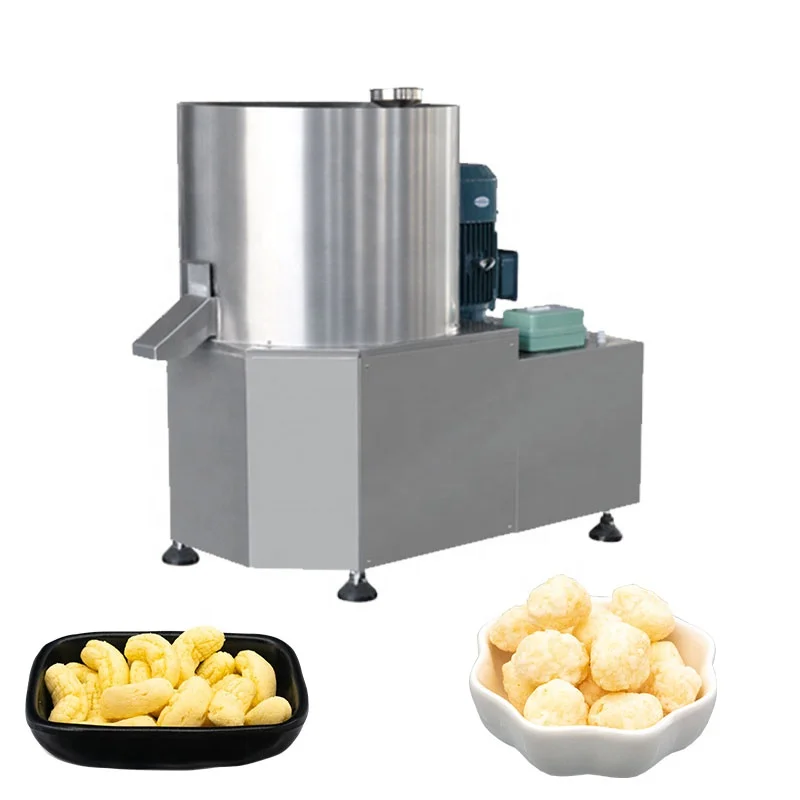
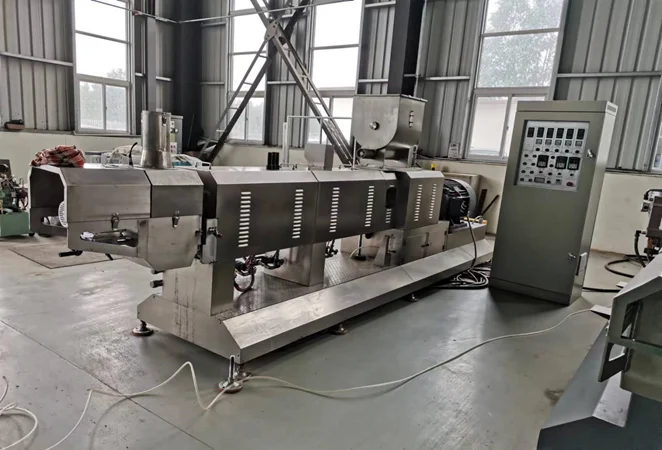
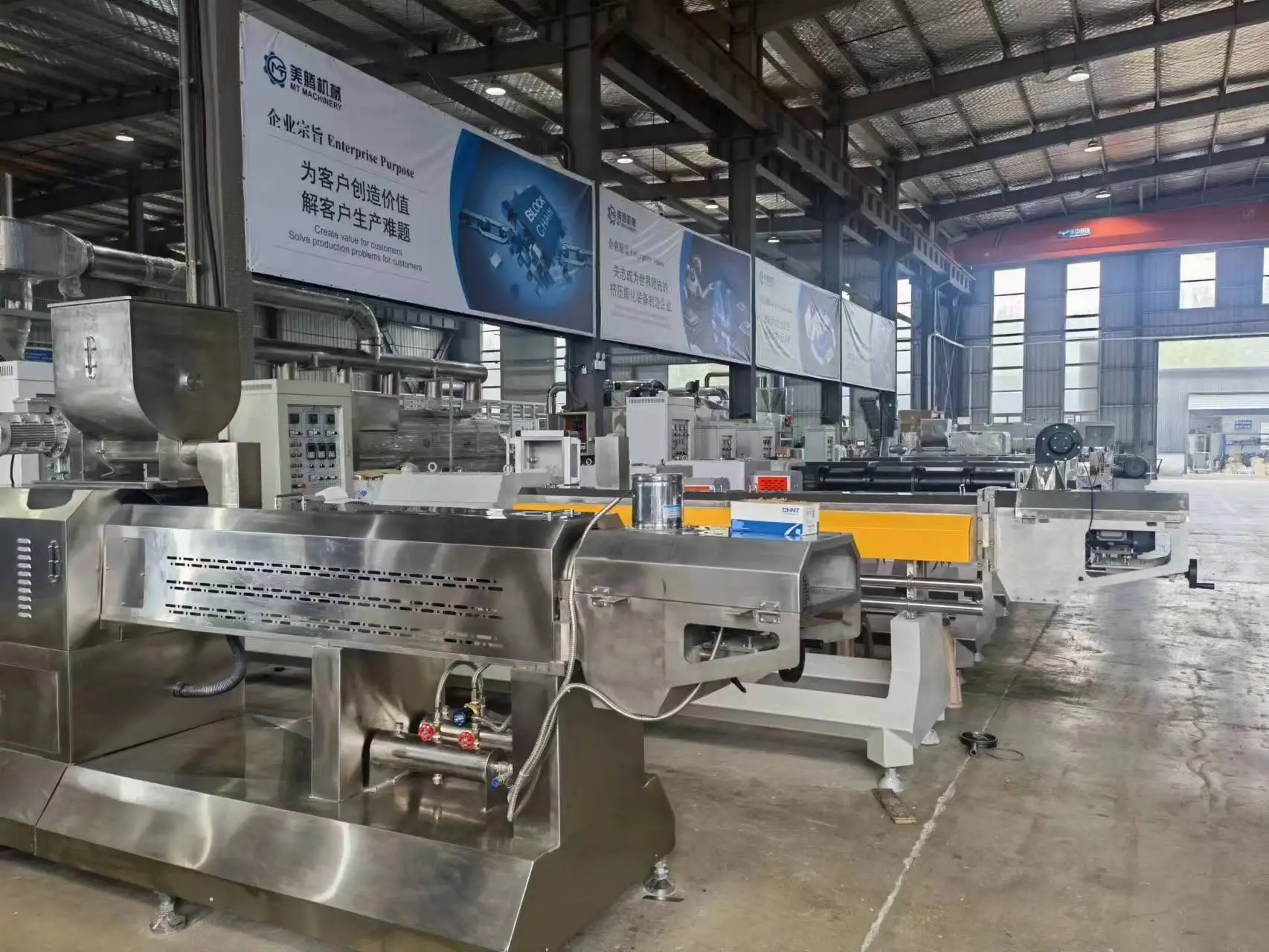
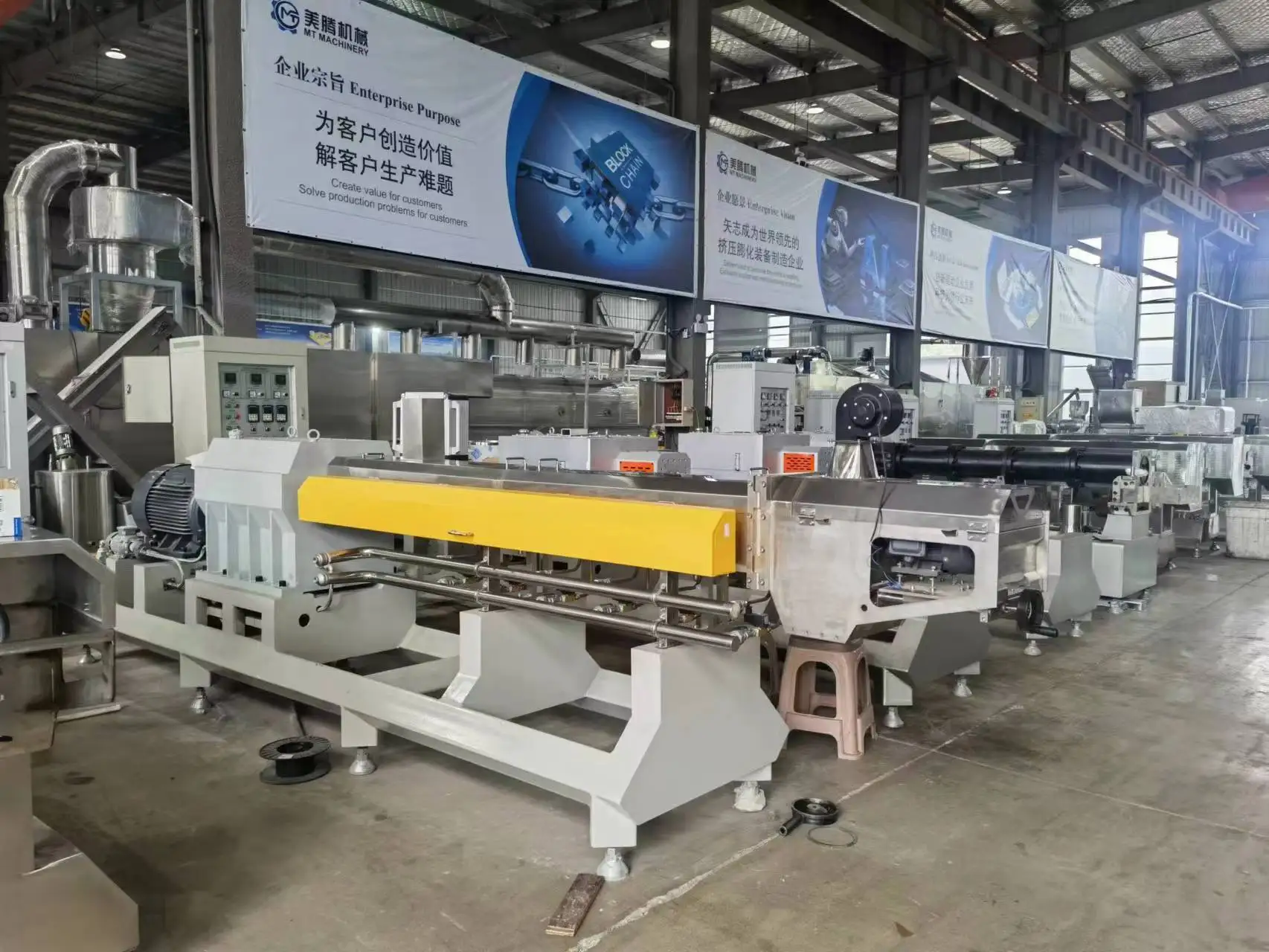
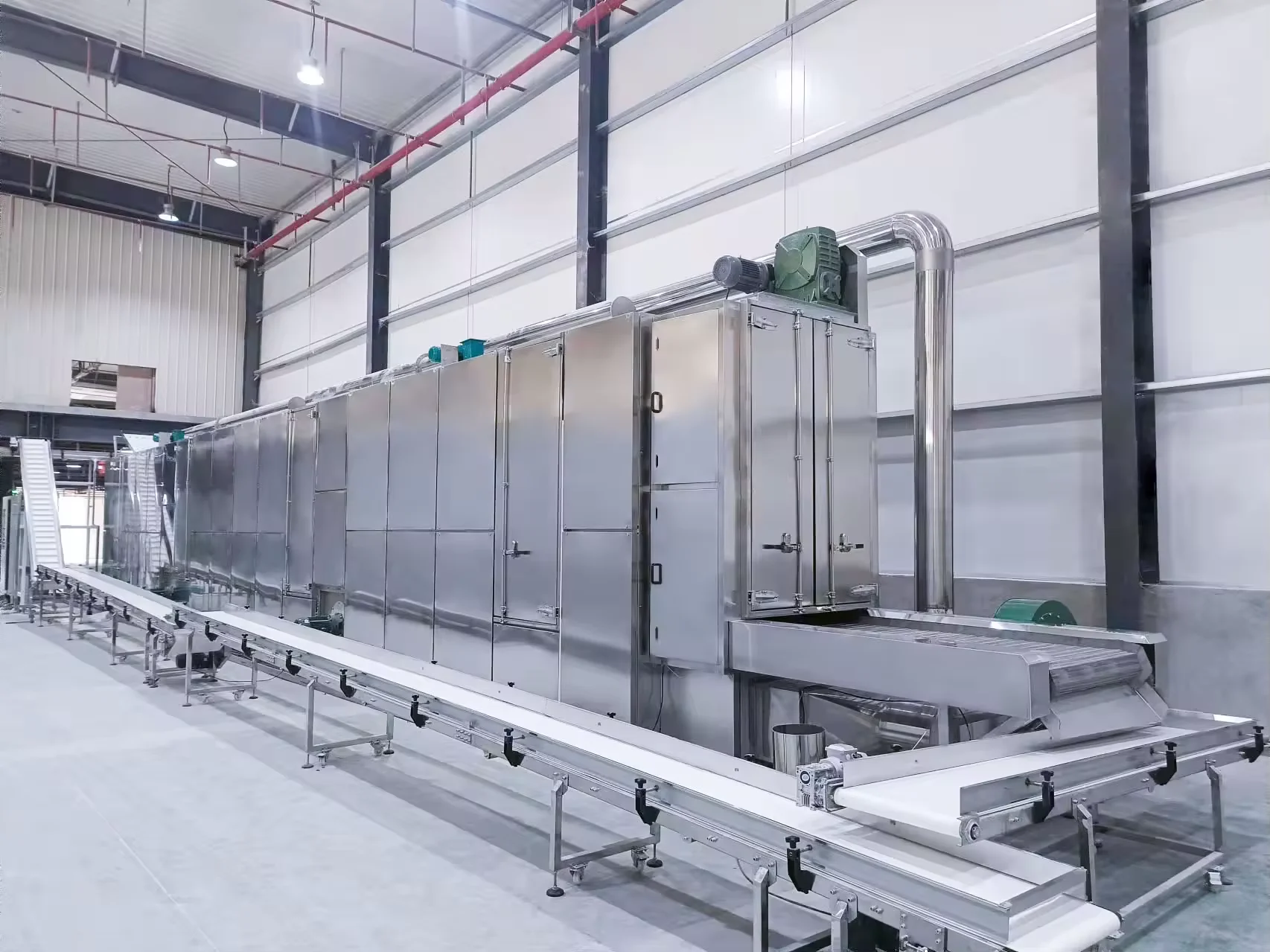
Twin Screw Puffed Snack Food Extrusion Line, PLC & MCC Automated Control, Multi-layer Dryer — engineered for complete puffed corn and maize snack production from batching through packing. Screw configuration and die design are specified to your raw material formulation and target snack density, with throughput matched across every station including drying and flavoring to prevent line bottlenecks. In-house trial runs on your actual raw material are conducted before shipment, so product development begins before installation.
Description
Turnkey line integration — every station from batching to packing is throughput-matched under one supplier, eliminating the bottleneck risk of assembling a puffed corn snack extrusion production line turnkey from separate vendors.
Technical Specifications
| Parameter | Value |
|---|---|
| Product Type | Twin Screw Puffed Snack Food Extrusion Line |
| Extruder Type | Double Screw (Twin Screw) |
| Control System | PLC and MCC automated control |
| Line Operation | Full automatic from mixing, extruding, shaping, cutting, drying to flavoring in one-pass |
| Output Capacity | (basis to be confirmed — depends on raw material formulation, moisture content and target snack density) |
| Screw Configuration | Specified to buyer’s raw material and target product |
| Die Configuration | Matched to target shape and size, freely selectable |
| Dryer | Multi-layer design, length and layer count configured per product type |
| Flavoring System | Semi-automatic and automatic options; supports sugar, oil, and powder seasoning |
| Voltage & Frequency | (source value — verify against manufacturer catalog based on target market) |
| Assembly State | Complete production line (batching to packing) |
| Testing | In-house machine testing workshop for trial runs on customer raw material before shipment |
| Standards | CE, ISO |
Application Suitability
| Application | Material or Output |
|---|---|
| Puffed corn and maize snack production | Corn grits, maize flour, rice flour blends at controlled moisture |
| Puffed rice snack production | Rice flour, broken rice, rice grits with starch gelatinisation targets |
| Core-filled snack production | Outer shell from cereal flour, inner filling from cream, chocolate or fruit paste |
| Various extruded and puffed snack formats | Customizable shape and size through interchangeable die plates |
Why "Rated Capacity" Means Nothing Without Your Raw Material
A puffed corn snack extrusion production line turnkey quoted on nominal output rarely holds that number on the buyer’s actual formulation.
I have watched lines stall within the first hour because the screw profile was copied from a generic build that assumed a different starch ratio. The extruder ran fine on paper, but the corn grits the buyer sourced locally had higher fiber content, which changed the melt viscosity inside the barrel. Throughput dropped, the downstream dryer had nothing to dry, and the whole line sat idle while the operator kept adjusting feed rate. This happens far more often than equipment brochures suggest [NEED_CITE: common causes of extrusion line downtime in emerging markets].
Screw Configuration Decides What Actually Leaves the Die
The twin screw extruder at the heart of this line is configured after the buyer’s raw material is tested in the workshop. Screw element arrangement — conveying sections, kneading blocks, reverse-flight segments — is chosen to match the specific corn or maize flour behavior under heat and shear. A puffed corn snack extrusion production line turnkey built this way avoids the common failure mode where generic screw sets produce either under-expanded, dense pellets or over-expanded, fragile pieces that shatter during drying.
Matching Every Station So Nothing Chokes
A complete line only performs as well as its slowest station. The multi-layer dryer length and belt speed are calculated against the extruder’s actual discharge rate on the buyer’s formulation, not against a catalog maximum. The flavoring drum diameter and residence time are then matched to the dried output volume. When one vendor supplies every station, throughput calculations are done once across the entire chain rather than negotiated between three separate suppliers who each blame the other when the line backs up.
Reading the Specs That Matter
The twin screw design gives operators independent control over shear and residence time, which is critical when switching between corn, maize, and rice formulations that gelatinise at different temperatures. Die plate selection governs the cross-section of the extrudate — round, star, ring, or custom profile — and must be paired with the correct cutting mechanism to hold consistent piece length. The PLC and MCC control system logs barrel temperature zones, screw speed, and feed rate so that batch-to-batch variation stays within a narrow band, reducing the off-spec product that ends up as waste or rework [NEED_CITE: process control standards for snack food extrusion].
The Hidden Cost of Skipping Station-by-Station Verification
When the dryer is undersized relative to the extruder, moisture stays trapped inside the snack, shortening shelf life and inviting mold in humid climates. When the flavoring drum is too small, seasoning coats unevenly and the buyer faces customer complaints about taste inconsistency. These mismatches rarely show up during a factory acceptance test that runs for twenty minutes on the seller’s standard flour — they appear weeks after commissioning, when the buyer is already committed to production schedules and retail delivery dates [NEED_CITE: post-installation disputes in food processing line procurement].
Why Buyers Source This Line Here
Every station — batching, mixing, extruding, shaping, cutting, drying, flavoring, cooling, packing — is designed and assembled under one roof, so throughput figures are calculated across the full chain before the line ships. Screw configuration and die design are locked to the buyer’s raw material after a trial run in the in-house testing workshop, not borrowed from a catalog default. Voltage, frequency, and control language are confirmed against the destination country’s electrical grid before production begins, preventing the commissioning delays that arise when a panel arrives wired for the wrong supply. Documentation — from line layout drawings to CE declarations — is issued as a single package covering the complete installation.
Documentation & Verification
- Line layout and capacity calculation matching every station to your target throughput
- Screw and die configuration record specific to your corn or maize formulation
- Trial run report on your raw material generated in the testing workshop before shipment
- Electrical schematic with voltage and frequency confirmed for your facility
- CE declaration of conformity and ISO certificate covering the full line
Installation, Commissioning & Support
- Foundation and utility planning based on the PLC-controlled line’s total connected load
- Dedicated circuit requirements verified against your facility’s voltage and frequency
- Station-by-station assembly sequence with matched conveyor heights and belt speeds
- First-run parameter logging on your raw material to establish baseline operating settings
- Operator training covering screw speed, barrel temperature zones, and die changeover procedures
- Wear parts list with reorder intervals for screws, die plates, and dryer belt segments
Before You Request a Quote
Provide your raw material type — corn grits, maize flour, rice flour, or a blend — along with the moisture content you typically work with and the target snack density or expansion ratio you need for your market. Share your facility’s available floor area and ceiling height so the line layout can be drafted to fit. Confirm your local voltage and frequency, preferred control language, and whether you want to send a sample batch of your raw material for a workshop trial run before the puffed corn snack extrusion production line turnkey is finalized.
Frequently Asked Questions
Q: How is line capacity verified on my actual raw material before shipment?
A: Your raw material is run in the in-house testing workshop using the exact screw configuration and die plate specified for your order. The trial run report records throughput, expansion ratio, and product density under controlled conditions, so you see real output numbers — not catalog estimates — before the line leaves the factory.
Q: How do you ensure dryer and flavoring station throughput matches extruder output?
A: Each station is sized against the extruder’s verified discharge rate on your specific formulation. Dryer length, layer count, and belt speed are calculated together with flavoring drum volume and residence time, so no single station becomes a bottleneck once the line is running at operating tempo.
Q: What screw and die configuration will be specified for my corn or maize formulation?
A: Screw element arrangement — conveying, kneading, and reverse-flight sections — is selected after testing your raw material. Die plate geometry is matched to your target snack shape and size. Both are documented in a configuration record supplied with the line.
Q: How are voltage, frequency, and control language confirmed for my target market?
A: Before production starts, the electrical schematic is reviewed against your facility’s supply specifications. Motor ratings, heater elements, and PLC interface language are set accordingly, so the control panel and MCC arrive ready for connection without rewiring on site.
Q: What is included in on-site installation, commissioning, and operator training?
A: Engineers supervise station-by-station assembly, verify conveyor alignment, and run the full line on your raw material. Operators are trained on screw speed adjustment, barrel temperature zones, die changeover, and daily maintenance routines before the team departs.
Related products
-

Máquina para hacer pasteles de maíz de puff de acero inoxidable Máquinas de alimentos de bocadillos de maíz Máquina de snacks más vendida
¥8,560.00 Select options This product has multiple variants. The options may be chosen on the product page -

Máquina Extrusora de Snacks de Maíz Pequeña de Puffs de Maíz de Doble Tornillo
¥100.00 Select options This product has multiple variants. The options may be chosen on the product page -

Línea de Alimentos de Snacks de Maíz Inflado Equipos de Producción de Bolas de Arroz Infladas
¥10,565.00 Select options This product has multiple variants. The options may be chosen on the product page -

Equipo de producción de extrusión de bocadillos de maíz inflado de alta productividad automático en nueva condición Máquina para hacer alimentos de bocadillos inflados
¥11,050.00 Select options This product has multiple variants. The options may be chosen on the product page


