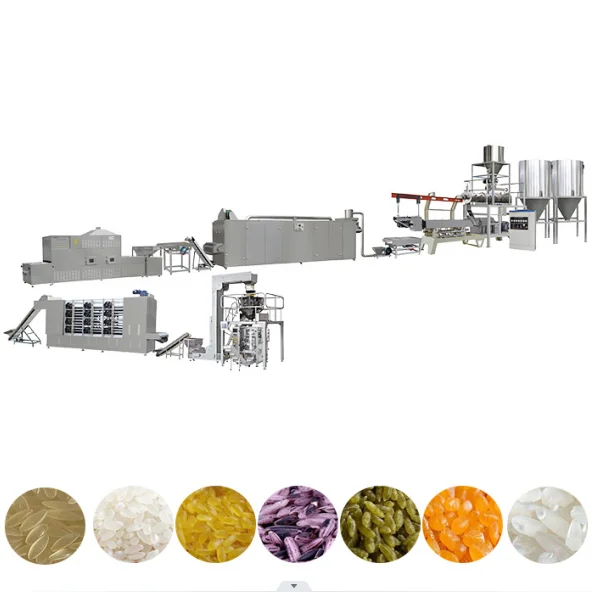


Pre-sales consultation through on-site installation, commissioning and operator training included with every turnkey project
Description
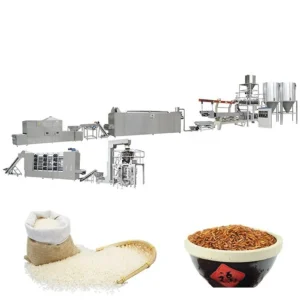
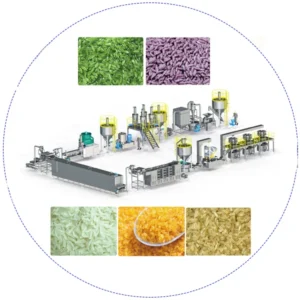
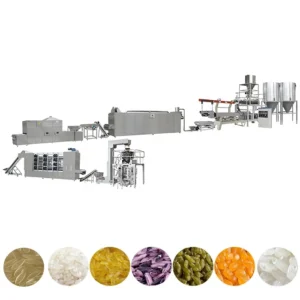
Integrated Turnkey Engineering — Every station from mixing to packing is sized against the same material throughput calculation, preventing mid-line accumulation and kernel breakage common on assembled-from-separate-vendors setups.
Technical Specifications
| Parameter | Value |
|---|---|
| Model | MT65 / MT70 / MT85 / MT75 / MT95 |
| Product Type | Artificial Nutritional Fortified Rice Processing Line |
| Screw Type | Twin-screw |
| Installed Power | MT65: 85 kW / MT70: 120 kW / MT85: 235 kW / MT75: 180 kW / MT95: 260 kW |
| Power Consumption | MT65: 60 kW / MT70: 85 kW / MT85: 165 kW / MT75: 135 kW / MT95: 195 kW |
| Output Capacity | MT65: 80–100 kg/h (basis not stated in source — confirm raw material / moisture) |
| Output Capacity | MT70: 100–120 kg/h (basis not stated in source — confirm raw material / moisture) |
| Output Capacity | MT85: 200–300 kg/h (basis not stated in source — confirm raw material / moisture) |
| Output Capacity | MT75: 300–500 kg/h (basis not stated in source — confirm raw material / moisture) |
| Output Capacity | MT95: 800–1000 kg/h (basis not stated in source — confirm raw material / moisture) |
| Overall Dimensions (L×W×H) | MT65: 28×1.2×2.2 m / MT70: 30×1.5×2.2 m / MT85: 34×3.5×4.3 m / MT75: 32×3.5×4.3 m / MT95: 36×3.5×4.3 m |
| Control System | PLC and MCC with frequency speed control |
| Feeding System | Single or double screw feeding, selected by material |
| Screw Material | Special wear-resistant alloy |
| Drying Oven Heat Source | Electric or gas |
| Drying Oven Feature | Circulation drying process, frequency motor controlled mesh belt speed |
| Lubrication | Automatic lubricating and cooling system |
| Line Stations | Mixing → Extruding → Vibrating → Low Temperature Drying → Cooling → High Temperature Roasting → Cooling → Packing |
| Assembly State | Complete turnkey line |
| Certification | CE |
Application Suitability
| Application | Material or Output |
|---|---|
| Fortified nutritional rice production | Broken rice, rice bran, corn, millet blended with vitamins and minerals |
| Artificial rice kernel processing | Wheat, oats, buckwheat, bean flour with starch binder |
| Instant nutritional rice manufacturing | Pre-gelatinised starch base with micro-nutrient fortification additives |
| Value-added rice by-product conversion | Rice bran and broken rice reprocessed into uniform fortified kernels |
What "300 kg/h Fortified Rice" Leaves Out About Your Actual Formula
Capacity only holds when every downstream station can match the extruder’s real output on your specific raw material blend.
When I first started specifying nutritional powder processing lines, I learned the hard way that a mixer feeding faster than the extruder can handle leads to compacted material in the buffer hopper. Workers end up poking at clumps with metal rods. The same problem repeats between extrusion and drying — if the dryer cannot remove moisture at the rate the extruder produces it, kernels stick together on the belt. A fortified rice production line turnkey must account for the actual density and moisture behaviour of your vitamin-mineral premix, not just a nominal flour throughput figure [NEED_CITE: material density variance in fortified grain blends].
Throughput Matching Across Every Processing Station
The core engineering discipline behind a fortified rice production line turnkey is ensuring each station handles identical mass flow. The mixing system must deliver a consistent feed rate into the twin-screw extruder, which then deposits shaped kernels onto the vibrating separator before they enter the low-temperature drying oven. The oven’s mesh belt speed is frequency-controlled so residence time aligns with the moisture removal curve of your particular formulation. After cooling, the high-temperature roasting stage must process the same hourly mass without creating a backlog.
Screw Configuration Specified to Your Premix Behaviour
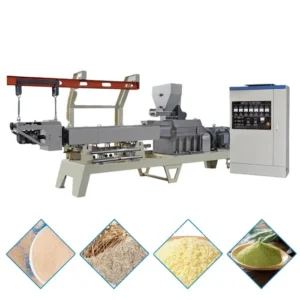
The twin-screw configuration is selected based on how your raw material blend responds to shear and heat. Vitamin and mineral additives change gelatinisation temperature and expansion characteristics compared to plain rice flour. The screw profile, compression ratio, and die aperture are matched to your target kernel density and cooking behaviour. Running a generic screw setup on a micronutrient-fortified blend often produces kernels that fracture during drying or fail to rehydrate properly in the end user’s kitchen. The in-house testing workshop runs your actual raw material before the line ships, confirming the screw and die combination delivers the specified kernel integrity [NEED_CITE: twin-screw extrusion parameters for fortified starch matrices].
Power and Control Architecture for Continuous Operation
The installed power range — from 85 kW on the MT65 to 260 kW on the MT95 — reflects the energy demand of driving viscous fortified dough through the barrel at production throughput. The PLC and MCC control system manages frequency-driven motors across feeding, extrusion, drying belt speed, and roasting temperature. Automatic lubrication and cooling circulate through the screw bearings continuously, preventing thermal seizure during extended production runs. The control interface language is confirmed before build so operators can read alarms and adjust setpoints without translation delays.
Specification Impact on Kernel Quality
The twin-screw design provides the mixing intensity needed to distribute micro-nutrients uniformly through the starch matrix before gelatinisation occurs in the barrel. Single-screw extruders cannot achieve the same homogeneity when vitamin premixes are introduced, leading to hotspots of nutrient concentration in some kernels and deficiency in others. The die design determines kernel shape and wall thickness, which directly affects how evenly moisture migrates out during the low-temperature drying stage. If the drying oven’s circulation airflow is uneven, kernels at the belt edges retain more moisture than those in the centre — causing inconsistent cooking behaviour downstream. The frequency-controlled mesh belt allows operators to adjust residence time without stopping the line, accommodating different formulations across production shifts.
The Cost of Undersized Downstream Equipment
When the dryer is specified on a lower capacity than the extruder actually delivers, kernels pile up at the dryer infeed. This creates uneven bed depth on the mesh belt, meaning some kernels overdry and become brittle while others remain too moist and stick together. The roasting stage then receives an inconsistent feed, producing colour variation across the batch. I have seen lines where the packing station was the bottleneck — kernels waited in an open hopper, absorbing ambient humidity and losing the surface crispness the market expects. Every undersized station compounds the problem backward through the line [NEED_CITE: throughput mismatch consequences in multi-stage food processing lines].
Why This Line Is Specified as One System
The fortified rice production line turnkey approach means one supplier is accountable for throughput continuity from the batching system through to packing. Screw configuration and die design are specified against your raw material formulation, not copied from a generic build. The in-house testing workshop runs your actual premix before shipment, generating a trial report that confirms kernel density, expansion ratio, and drying behaviour. Electrical schematics are drawn with your local voltage and frequency confirmed, avoiding commissioning delays. Pre-sales consultation covers the entire layout — utility connections, floor loading, phased installation sequence, and operator training — so the line starts producing within days of arrival rather than weeks.
Documentation & Verification
- Line layout drawing showing throughput calculation at every station from mixer to packer
- Screw and die configuration record matched to your fortified rice formulation
- Trial run report conducted on your raw material in the testing workshop before dispatch
- Electrical schematic with voltage, frequency, and control language confirmed to your standard
- CE declaration of conformity with machine-specific serial documentation
- Wear parts list with screw element and die specifications for reorder
Installation, Commissioning & Support
- Foundation plan accounts for MT85 line footprint of 34×3.5×4.3 m and vibration isolation at extruder
- Dedicated power circuit sized to 235 kW installed load on MT85 with confirmed local voltage
- Arrives as modular stations; assembly crew aligns extruder-to-dryer transfer height on site
- First-run parameter setting covers screw speed, barrel temperature zones, and dryer belt frequency
- Operator training includes PLC navigation, alarm response, and die changeover procedure
- Wear parts package includes replacement screw elements and die plates specific to your configuration
What We Need to Quote Your Line
To specify the right model and station sizing, provide your raw material formulation including the vitamin-mineral premix ratio, target kernel dimensions, and required hourly output. Share your workshop floor area and ceiling height so the layout accounts for the drying oven and roasting section clearance. Confirm your local electrical supply — voltage, phase, and frequency — along with your preferred control panel language.
Frequently Asked Questions
Q: How is line capacity verified against my specific raw material and formulation?
A: Your actual raw material blend, including vitamin and mineral additives, is run in the in-house testing workshop before the line ships. The trial confirms extrusion behaviour, kernel expansion, drying curve, and final product density against your specification. A trial run report is provided showing throughput achieved on your material.
Q: What screw and die configuration is specified for fortified rice with micro-nutrient additives?
A: The screw profile and compression ratio are selected based on how your premix gelatinises under heat and shear. Die aperture is matched to your target kernel size and wall thickness. The configuration record is documented and supplied with the line, and replacement screw elements and dies are listed in the wear parts schedule.
Q: How is throughput matched between the extruder, dryer, roaster and packing station?
A: Each station is sized using the same mass flow calculation based on your raw material density and moisture content at each processing stage. The dryer mesh belt speed, roaster dwell time, and packing rate are all set to handle the extruder’s actual output without accumulation or starvation at any transfer point.
Q: What voltage, frequency and control language options are confirmed before production?
A: Your local electrical supply specifications are confirmed during the quotation stage. The electrical schematic is drawn to match your voltage, phase, and frequency. The PLC interface language is set to your preference before the control cabinet is wired, so operators can read setpoints and alarms in their working language from day one.
Related products
-
Small Scale MT Brand Automatic Baby Food Nutrition Powder Rice Flour Making Machine with 500kg/h Production Capacity PLC Control
¥9,500.00 Add to cart -

High Quality Automatic PLC Controlled 500kg/h Twin Screw Extruder Machine for Baby Rice Nutrition Powder
¥8,238.27 Add to cart -
500kg/h Automatic PLC Controlled Nutrition Baby Food Extruder Machine for Rice Cereal Processing
¥9,500.00 Add to cart -

High Precision Automatic 500kg/h Baby Food Nutrition Powder Rice Extrusion Processing Line
¥9,500.00 Add to cart