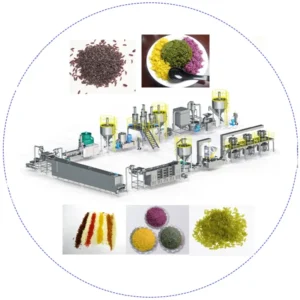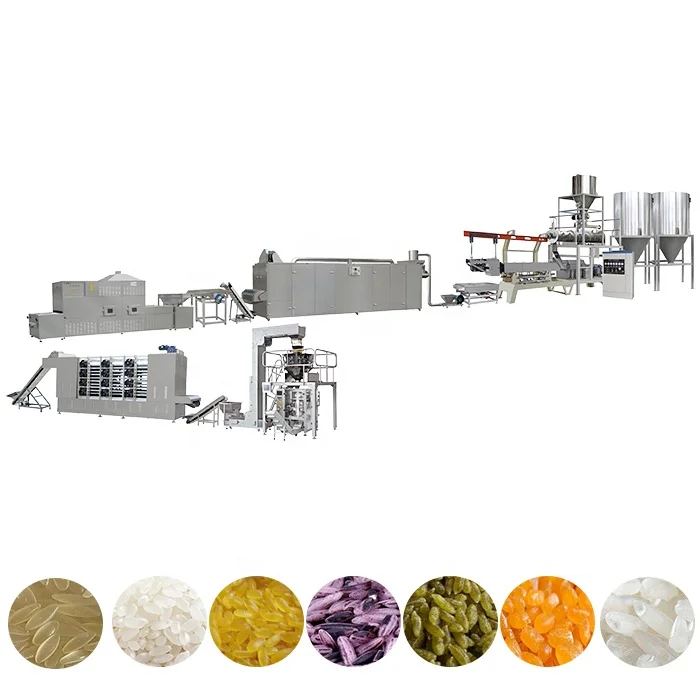
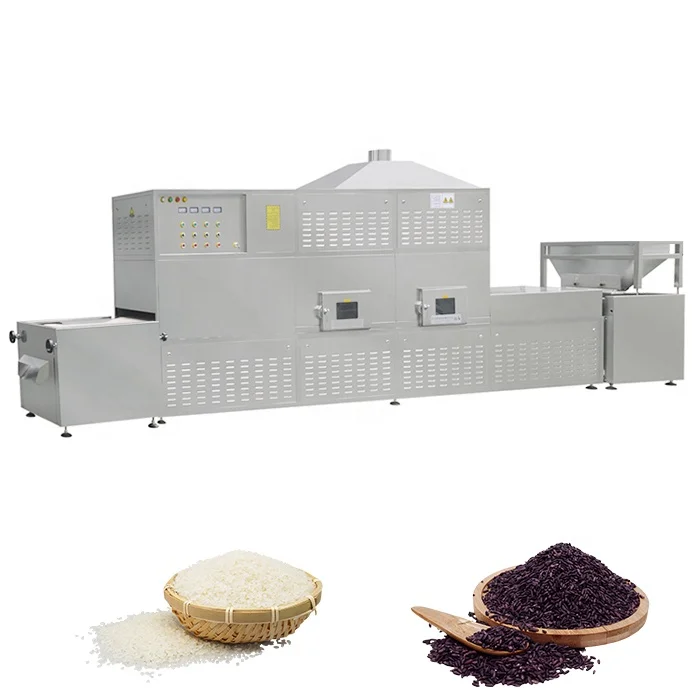


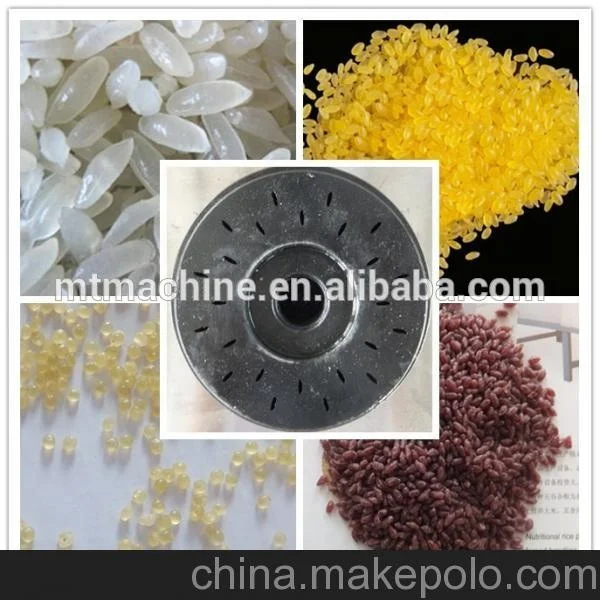
MT65 / MT70 / MT85 / MT75 / MT95 Artificial Rice Production Line, Twin-Screw Extruder, 85-260 kW Installed Power — configured as a complete turnkey project from mixing through extrusion, low-temperature drying, high-temperature roasting, cooling and packing. Each station is throughput-matched to prevent bottlenecks on your specific grain-and-starch formulation, with screw and die geometry specified to your target kernel density. Delivered with a factory trial run on your raw material before shipment and full electrical schematic confirmed to your local grid.
Description
Automatic Artificial Rice Production Line – Turnkey Solution
Throughput-matched project design — every station from batching to packing is engineered against your actual grain-and-starch formulation so the line holds its rated output once installed.
Technical Specifications
| Parameter | Value |
|---|---|
| Product Type | Artificial Rice & Fortified Rice Kernel Production Line |
| Model | MT65 / MT70 / MT85 / MT75 / MT95 |
| Screw Type | Twin-screw |
| Installed Power | 85 kW (MT65) / 120 kW (MT70) / 235 kW (MT85) / 180 kW (MT75) / 260 kW (MT95) |
| Power Consumption | 60 kW (MT65) / 85 kW (MT70) / 165 kW (MT85) / 135 kW (MT75) / 195 kW (MT95) |
| Output Capacity | 80–100 kg/h (MT65), 100–120 kg/h (MT70), 200–300 kg/h (MT85), 300–500 kg/h (MT75), 800–1000 kg/h (MT95) (basis to be confirmed against raw material composition, moisture content and kernel size) |
| Overall Dimensions (L×W×H) | 28×1.2×2.2 m (MT65) / 30×1.5×2.2 m (MT70) / 34×3.5×4.3 m (MT85) / 32×3.5×4.3 m (MT75) / 36×3.5×4.3 m (MT95) |
| Control System | Frequency speed control; PLC and MCC available on request |
| Lubrication | Automatic lubricating and cooling system |
| Drying Oven Heating Source | Electric or gas |
| Drying Oven Feature | Circulation drying with frequency motor-controlled mesh belt speed |
| Line Stations | Mixing → Extruding → Vibrating → Low-temperature drying → Cooling → High-temperature roasting → Cooling → Packing |
| Raw Material Compatibility | Broken rice, rice, corn, millet, wheat, oats, buckwheat, bean, starch as main ingredient; vitamin and mineral as supplementary ingredient |
| Assembly State | Complete turnkey line |
| Voltage & Frequency | Customisable to local grid requirements |
| Certification | CE (company-level) |
Application Suitability
| Application | Material or Output |
|---|---|
| Fortified rice kernel production for nutrition programmes | Broken rice and rice flour blended with vitamin and mineral premixes |
| Artificial rice reconstitution | Broken rice, rice bran and starch with micro-nutrient addition |
| Multi-grain reformed rice | Corn, millet, wheat, oats, buckwheat and bean blends |
| Institutional food supply chain blending | Pre-mixed grain and nutrient batches entering extruder feed |
What "200 kg per Hour" Leaves Out When Your Premix Changes
Nominal capacity means nothing if the screw cannot hold steady feed on your specific starch-and-vitamin formulation.
I once watched a line that ran smoothly on standard rice flour drop to half its nameplate output the moment the customer switched to a high-fibre, vitamin-fortified blend. The screw configuration had been copied from a generic build, the gelatinisation window was missed, and the dryer suddenly had wet, sticky kernels arriving faster than it could handle [NEED_CITE: starch gelatinisation behaviour under varying vitamin and mineral premix ratios]. That is why the artificial rice production line turnkey project must begin with your exact raw material recipe, not a catalogue number.
Designing the Whole Line as One Integrated Project
An artificial rice production line turnkey layout only works when every station is sized to the same real throughput. If the extruder pushes 300 kg/h but the dryer belt can only handle 200 kg/h of moist kernels, the bottleneck simply moves downstream. On this project the mixing capacity, extruder screw volume, vibrating screen area, dryer belt length and roasting oven residence time are all calculated together before the first drawing is issued.
Utility Planning That Matches Your Factory Reality
Gas-heated drying and roasting stages demand a confirmed calorific value and supply pressure before the oven is built. Electric versions need a dedicated circuit sized for the combined kW of heaters and circulation fans. Water cooling loops for the extruder barrel and automatic lubrication unit must be routed before the slab is poured. Utility mismatches discovered after the crate arrives routinely add weeks to commissioning [NEED_CITE: industrial utility planning standards for food extrusion facilities].
Reading the Specs That Actually Matter
Twin-screw extrusion is chosen here because the formulation includes supplementary vitamins and minerals that alter melt viscosity; a single-screw design would struggle to distribute those minor ingredients evenly through the starch matrix. Installed power ranges from 85 kW on the MT65 to 260 kW on the MT95, which dictates transformer sizing and cable run thickness. The automatic lubricating and cooling system keeps barrel temperature stable across long shifts, directly influencing gelatinisation degree and therefore kernel cooking behaviour after reconstitution. Low-temperature drying followed by high-temperature roasting is a two-stage strategy: the first pass removes surface moisture without case-hardening, the second pass sets the internal structure so the kernel survives transport and blending without breaking.
The Hidden Cost of Skipping a Factory Trial Run
Sending an extruder overseas without first running the buyer’s premix in the testing workshop is the single most expensive mistake in this category. Screw pitch, compression ratio and die aperture that work perfectly on plain rice flour may produce under-gelatinised, crumbly kernels when fibre content rises. By the time the engineer discovers the mismatch on the customer’s factory floor, the vessel has sailed and replacement screw elements are weeks away [NEED_CITE: twin-screw wear and replacement logistics for food extrusion].
Why Source This Project Here
Complete line responsibility under one supplier means throughput matching is calculated before steel is cut, not argued after delivery. The in-house testing workshop runs your specific broken-rice-and-vitamin blend so the screw configuration and die design are locked before shipment. Electrical schematics and voltage are confirmed against your local grid standard, preventing the commissioning delay that plagues so many overseas installations. Twin-screw expertise spans pet food, aquatic feed and cereal applications, so lessons learned in adjacent starch-heavy processes feed directly back into artificial rice kernel engineering.
Documentation & Verification
- Line layout drawing showing station spacing and throughput balance for your selected model
- Screw and die configuration record matched to your target kernel shape and density
- Trial run report on your actual grain-and-vitamin formulation before dispatch
- Electrical schematic with voltage, frequency and control language confirmed for your market
- Operation and maintenance manual covering the full station sequence
Installation, Commissioning & Support
- Foundation plan accounts for the 36 m maximum line length and dryer vibration isolation
- Dedicated power circuit sized for up to 260 kW installed load on the MT95
- Frequency-controlled motors verified against local 50 Hz or 60 Hz supply before wiring
- First-run parameter setting covers barrel temperature profile and mesh belt speed tuning
- Operator training addresses screw element removal and automatic lubrication system checks
- Wear parts list identifies screw and die elements with lead times for first replacement
What We Need From You to Start
Share your raw material formulation including the exact vitamin and mineral premix percentage, plus the target kernel size and reconstitution time. Confirm your factory floor length, ceiling height and local voltage so the layout and electrical package are correct from day one. If you already have upstream milling or downstream blending equipment, send their throughput data so the artificial rice production line turnkey project can be matched at both ends.
Frequently Asked Questions
Q: How is throughput matched between extruder, dryer and packing stations?
A: Each station is calculated against your confirmed formulation output, not catalogue nominal figures. Dryer belt length, roasting oven residence time and packing scale speed are all set to the same real throughput so no single unit becomes the bottleneck.
Q: Can a trial run be performed on our specific premix before shipment?
A: Yes. You send a representative sample of your broken rice, starch and vitamin blend to the in-house testing workshop. The extruder is run with your material, and a trial report covering kernel shape, density and gelatinisation is issued before the line ships.
Q: What voltage and control language options are available?
A: The electrical package is built to your local grid voltage and frequency. Control panel labels and PLC interface language are confirmed during the specification stage so operators see familiar terminology from day one of commissioning.
Q: What does the commissioning schedule include?
A: On-site commissioning covers station alignment, utility connection verification, first-run parameter tuning and operator training on screw element maintenance and automatic lubrication checks. The schedule is phased to fit your factory readiness.
Q: How are spare screw elements and dies supplied?
A: A wear parts list is provided with the line documentation. Screw elements and die plates are stocked against your specific configuration, and first-replacement lead times are agreed before shipment so production continuity is maintained.
Related products
-

Automatic Iron Fortified Baby Rice Cereal Nutrition Powder Making Machine 500kg/h PLC Controlled
¥8,238.27 Add to cart -
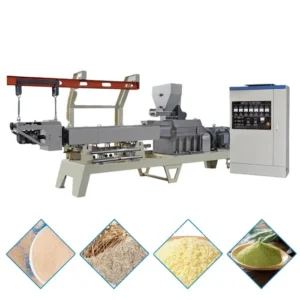
Industrial Instant Corn Paste Production Line Nutritional Powder Processing Equipment Meal Replacement Nutrition Powder Machine
¥65.00 Select options This product has multiple variants. The options may be chosen on the product page -
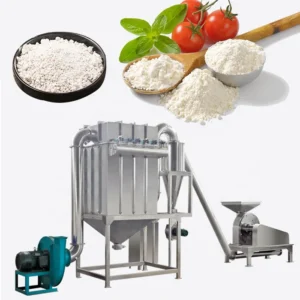
New Automatic Nutritional Powder Making Machine for Baby Food Production Line
¥20.00 Select options This product has multiple variants. The options may be chosen on the product page -

Automatic Instant Powder Production Line Nutritional Powder Extruder Machine
¥10,000.00 Select options This product has multiple variants. The options may be chosen on the product page