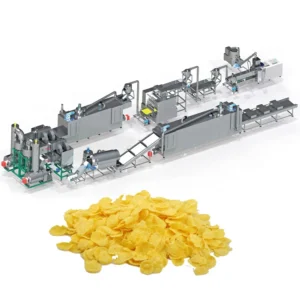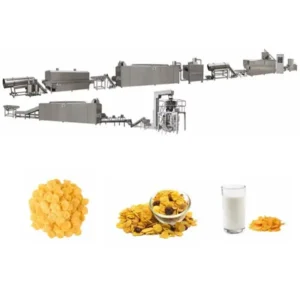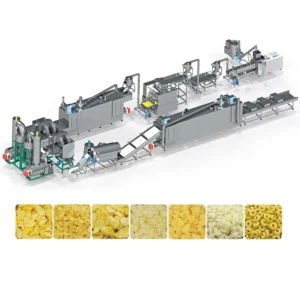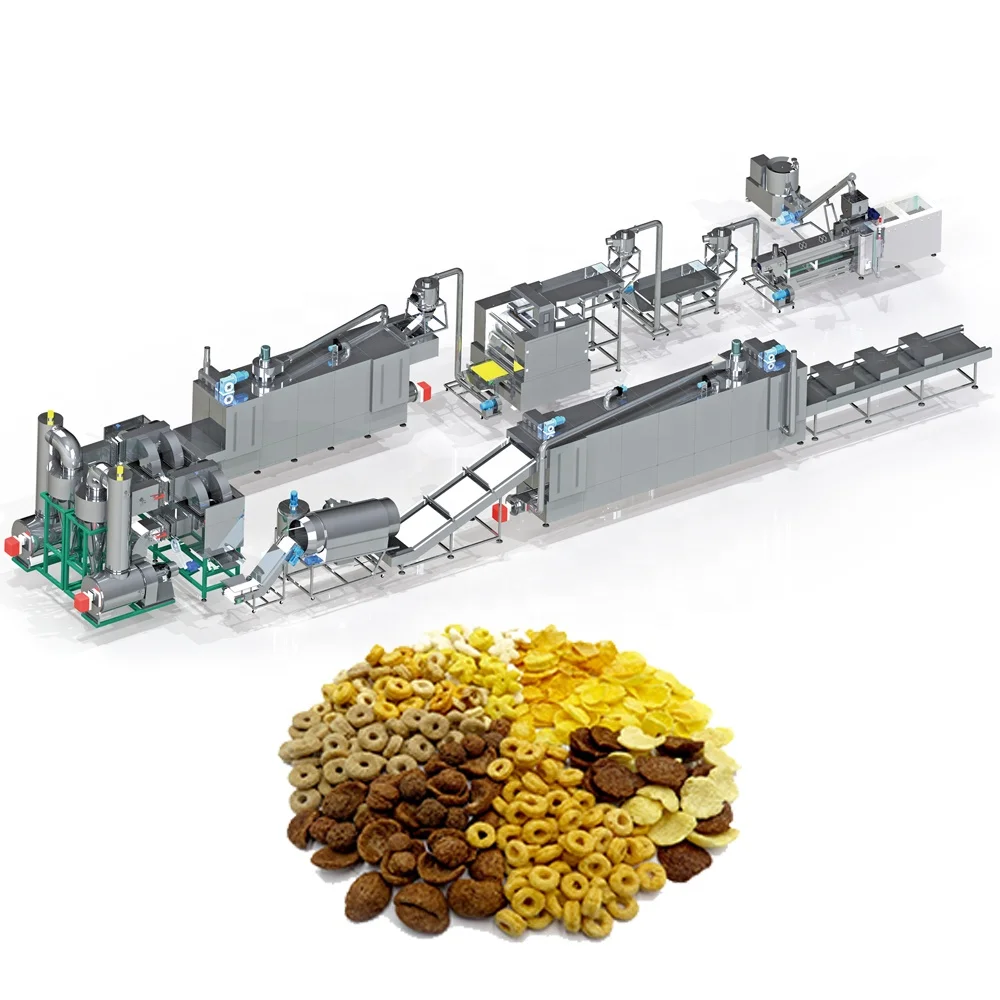

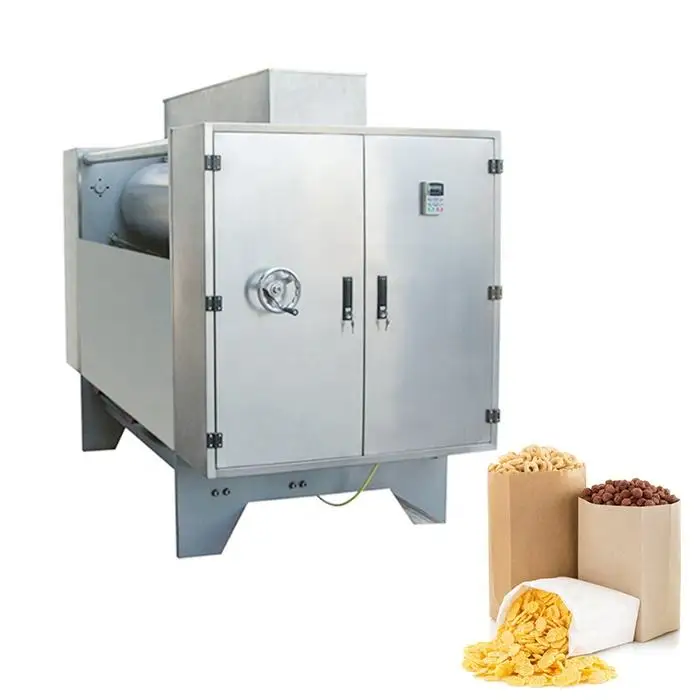



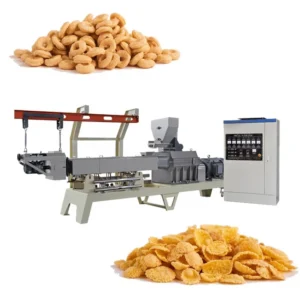
MT70 / MT85 / MT75 Corn Flakes Production Line, Twin-Screw Extruder, PLC Control — configured as a complete turnkey project from batching through flaking, hot air roasting, coating to packing.
- Throughput at every station is calculated and balanced against your raw material profile and target flake density before layout design begins.
- Screw configuration and die geometry are specified to your formulation, not copied from a generic build.
- Trial runs on your actual raw material are completed in our testing workshop before shipment, with a full report delivered.
Description
Integrated Throughput Engineering — Every station on this corn flakes line is calculated as a single system, preventing the flaker or roaster from becoming a bottleneck that stalls the extruder upstream.
Technical Specifications
| Parameter | Value |
|---|---|
| Product Type | Corn Flakes Breakfast Cereal Production Line |
| Model Options | MT70, MT85, MT75 |
| Screw Configuration | Twin Screw |
| Installed Power | MT70: 160 kW / MT85: 190 kW / MT75: 210 kW |
| Power Consumption | MT70: 120 kW / MT85: 140 kW / MT75: 150 kW |
| Output Capacity | MT70: 150–200 kg/hr (basis not stated in source); MT85: 300–400 kg/hr (basis not stated in source); MT75: 300–500 kg/hr (basis not stated in source) |
| Overall Dimensions (L×W×H) | MT70: 41×1.5×2.2 m; MT85: 43×1.5×3.2 m; MT75: 45×1.5×3.5 m |
| Basic Raw Materials | Corn, rice, wheat, oat, barley powder |
| Control System | PLC control with MCC available for complete line |
| Flaking System | Hydraulic double-roller, dual independent motors, infrared temperature sensor |
| Dryer Heating Source | Gas or Electric (configurable) |
| Hot Air Roasting Oven | Vibrating pan, conciliation burner, dual circulating fans, cyclone dust removal |
| Coating System | Double tumble sugar melting, elevator, coating drum, spraying nozzle |
| Extruder Systems | Feeding, extruding, cutting, heating, gearing, controlling |
| Screw Durability | Special wear-resistant technology; automatic lubrication and cooling |
| Final Product Shapes | Natural flakes, sugar-coated flakes, plus ball, tube, stick, ring, fruit loop, star, wheel, flower, heart via mould adjustment |
| Certification | CE (since 2014), ISO |
Application Suitability
| Application | Material or Output |
|---|---|
| Natural corn flakes production | Corn grits and corn flour as primary grain base |
| Sugar-coated breakfast cereal | Corn, rice, or wheat base with sugar coating stage |
| Multi-grain cereal formats | Blends of oat, barley, wheat, and rice powder |
| Institutional nutrition programmes | Fortified grain blends requiring consistent flake density and size |
| Retail-ready shaped cereal | Ball, ring, star, and loop shapes via extruder die changes |
Why the Flaker and Extruder Must Agree Before You Build
A corn flakes production line turnkey project fails the moment one station runs faster than the next. The common pattern I see in aftermarket calls: the extruder pushes dough to the flaker, but the flaker cannot compress it fast enough, so warm material piles up, sticks, and hardens into clumps that jam the conveyor. The operator slows the extruder down, and now the roaster runs half-empty, burning the flakes that do make it through.
The line must be calculated backward from the packing rate, not forward from the extruder barrel.
When I moved from service calls into project configuration, the first thing I changed was the order of questions. I stopped asking what extruder size the buyer wanted and started asking what their packing machine could handle per hour. Every station upstream of packing — cooling, roasting, drying, flaking, extrusion, mixing — gets its throughput target from that number. If the flaking rollers cannot compress at the extruder’s output rate, we change the roller specification or adjust the screw speed before the order goes to the workshop [NEED_CITE: throughput balancing methodology in continuous food processing lines].
How the Flaking Station Holds Uniform Thickness
The flaking machinery on this line uses a hydraulic system to set pressure across the double rollers, with each roller driven by its own independent motor. This separation matters because corn dough arrives at the rollers at a specific temperature and moisture level; if one roller drags or slips, the flake exits wedge-shaped — thick on one side, paper-thin on the other. The infrared sensor on the temperature pipe monitors the dough condition entering the nip, giving the PLC a signal to adjust roller speed or gap in real time. For a corn flakes production line turnkey installation, this station is where texture is decided.
What the Roasting Oven Actually Does to the Flake
After drying, flakes enter the hot air roasting oven where the conciliation burner raises surface temperature rapidly while two separate circulating fans move air across the vibrating pan. The vibration keeps flakes in motion so no single piece sits in a hot zone long enough to scorch. The cyclone dust removal device pulls fine particulate out of the air stream before it can settle back onto the product or accumulate in the ductwork. This stage creates the blistered surface and the crisp snap that defines a market-ready corn flake [NEED_CITE: hot air roasting parameters for breakfast cereal surface blistering].
Reading the Specification Sheet Against Your Raw Material
The twin-screw extruder is available in three models — MT70, MT85, and MT75 — each with a different installed power and physical footprint. The screw configuration and die design are not generic templates; they are specified against the buyer’s actual grain blend and target flake density. Corn behaves differently from an oat-barley mix inside the barrel: gelatinisation temperature, shear sensitivity, and expansion ratio all shift. The MT75 at 210 kW installed power handles higher-throughput or higher-moisture formulations, while the MT70 at 160 kW suits a smaller plant running primarily corn grits. Selecting between them requires knowing your raw material profile and the moisture content at which you intend to run, not just the output number on the brochure.
The PLC control governs barrel temperature zones, screw speed, and feed rate together. When one variable drifts — say, ambient humidity raises the moisture content of stored corn flour — the PLC adjusts the heating profile to hold the same gelatinisation point. This is what keeps flake density consistent across a Monday morning start-up and a Thursday afternoon run [NEED_CITE: PLC temperature compensation in twin-screw extrusion].
What Happens When Stations Are Sourced Separately
I once took a service call at a plant where the owner had bought an extruder from one vendor, a dryer from another, and a flaker from a third. Each machine performed well on its own test. Together, the dryer could not remove moisture fast enough for the flaker downstream, so flakes tore instead of compressing. The owner spent months adjusting temperatures and belt speeds, never solving the root cause. The line only ran properly after we replaced the dryer with one matched to the extruder’s actual output moisture and the flaker’s required input condition. Assembling a corn flakes line from separate vendors saves money on paper and costs it back in commissioning time and wasted raw material.
Why This Line Is Engineered as One Project
Every station from the batching system through mixing, extrusion, flaking, drying, roasting, coating, cooling, and packing is calculated as a single throughput chain, so no station waits on another. Screw configuration and die design are documented against your specific grain blend and target flake specification, not copied from a generic build. The in-house testing workshop runs your actual raw material before shipment, producing a trial report that confirms output texture, flake density, and station-by-station throughput. Electrical schematics are drawn with your factory’s voltage, frequency, and control language confirmed before production begins. CE and ISO certification documentation ships with the line, supporting customs clearance and local regulatory filing.
Documentation & Verification
- Line layout drawing showing throughput calculation at every station from mixer to packer
- Screw and die configuration record matched to your grain blend and target flake density
- Trial run report from in-house workshop on your raw material with texture and density data
- Electrical schematic with confirmed voltage, frequency, and PLC language for your market
- Factory test record covering all station run-ups before crating and dispatch
Installation, Commissioning & Support
- Foundation plan accounts for the 41–45 m line length and vibrating roaster load points
- Power supply sized for 160–210 kW installed capacity with dedicated circuits for extruder and flaker motors
- Machines ship in modular sections for sequential assembly through standard factory doorways
- First-run commissioning includes barrel temperature profiling and roller gap calibration on your material
- Operator training covers PLC interface navigation, screw wear inspection, and hydraulic pressure adjustment
- Wear parts list specifies screw segments, die plates, and flaker roller shells with replacement intervals
What to Include in Your First Inquiry
To configure the right model and station layout, share your primary grain material and any blend ratios, your target packed output per hour, and the available floor space and ceiling height in your production hall. Specify your local voltage and frequency, and note the language your operators need on the PLC interface. If you have existing upstream or downstream equipment that must integrate, provide the make and throughput rating so the corn flakes production line turnkey layout can be matched to it.
Frequently Asked Questions
Q: How is throughput balanced across mixing, extrusion, flaking, roasting, and packing?
A: We calculate backward from your packing machine rate. Each upstream station is sized so its output slightly exceeds the next station’s input requirement, preventing material buildup. The layout document you receive before production shows these calculations for every station on the corn flakes production line turnkey project, so you can verify balance before we build.
Q: What does the phased installation and commissioning schedule look like?
A: Installation follows a sequence from mixing through packing, with each station mechanically set, electrically connected, and individually tested before the next is started. Full-line commissioning runs your actual raw material through every stage. The schedule depends on your factory readiness — foundation, utilities, and ambient conditions — and is confirmed before shipment.
Q: Can you trial our raw material before the line ships?
A: Yes. We run your grain blend through the extruder, flaker, and roaster in our in-house testing workshop. The trial report documents flake thickness, surface blistering, density, and throughput at each station. You review this report before the line is crated, and we adjust screw configuration or roller settings if the results do not match your specification.
Q: How do you confirm voltage, frequency, and control language for our market?
A: Before production begins, we request your factory’s electrical specification and the preferred HMI language. The electrical schematic is drawn to these values, and the PLC and MCC panels are wired and labelled accordingly. This confirmation step is documented in the project file so there are no surprises at commissioning.
Q: What documentation and training are provided at handover?
A: You receive an operation and maintenance manual specific to your line configuration, a wear parts list with part numbers and replacement intervals, the trial run report, and all certification documents. On-site training covers daily operation, PLC parameter adjustment, screw and die changeover, and routine maintenance scheduling for your production team.
Related products
-
New Technical Automatic Cereal Nutritional Powder Instant Porridge Baby Food Making Machine
¥10,000.00 Select options This product has multiple variants. The options may be chosen on the product page -
Sweet Corn Flakes Maize Breakfast Cereal Full-automatic Food Grade Stainless Steel Heat Exchanger Mixer Fryer Processing Line
¥8,000.00 Add to cart -
Best Price Corn Flakes Making Machine Breakfast Cereals Processing Line with Motor As Core Component
¥19,000.00 Select options This product has multiple variants. The options may be chosen on the product page -
Corn Flakes Machine Breakfast Cereal Corn Flakes Production Line Cornflakes Making Machine
¥85,800.00 Select options This product has multiple variants. The options may be chosen on the product page