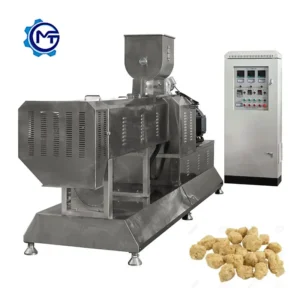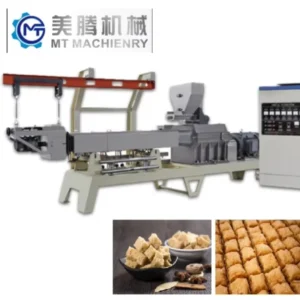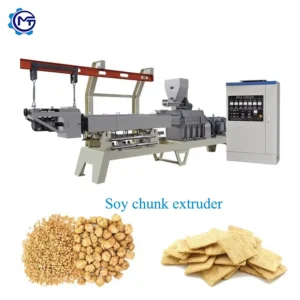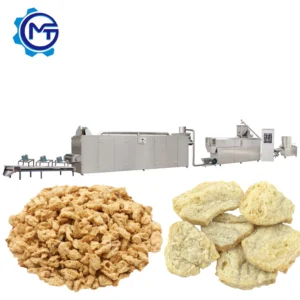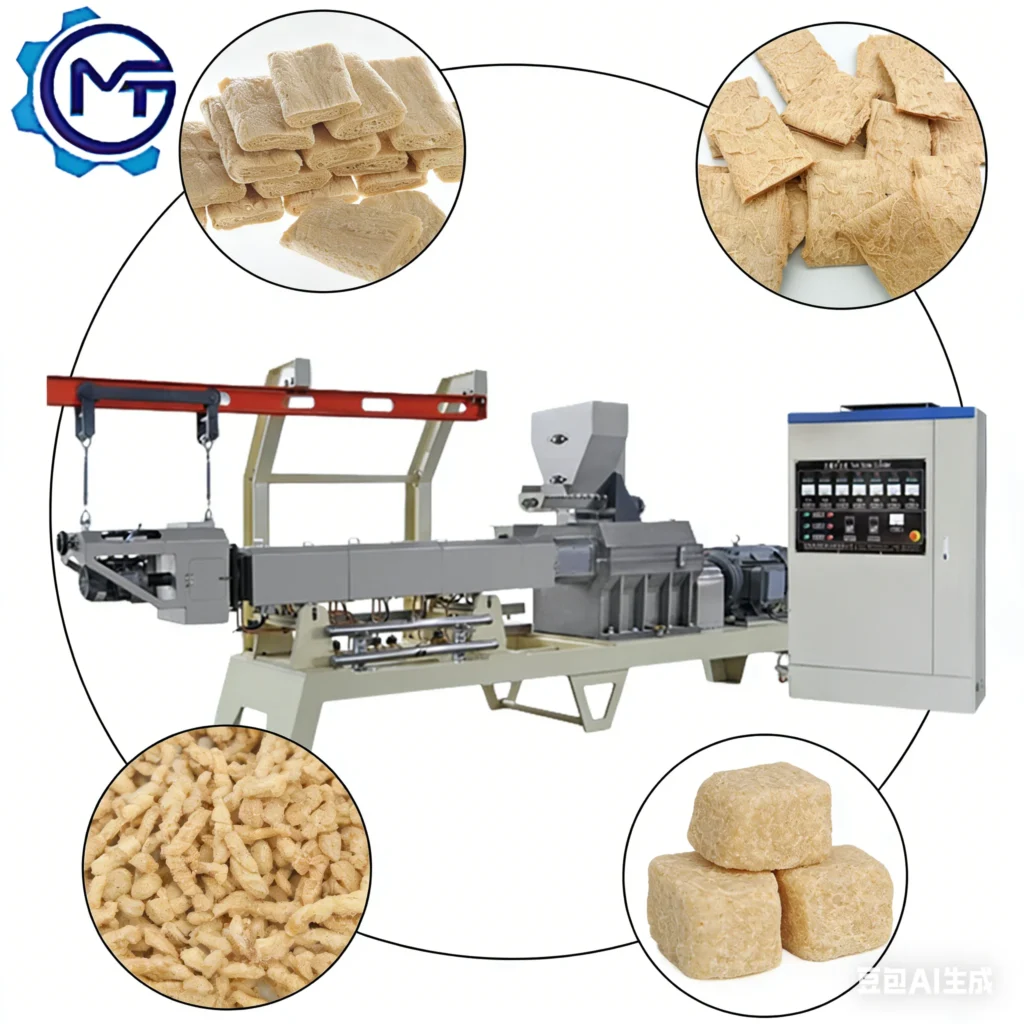




MT65 / MT70 / MT75 / MT85 Twin Screw Extruder Production Line, 22–45 kW main motor, multi-layer dryer with fuel/gas/electricity heat source options — engineered as a complete turnkey project from mixing through cooling with throughput matched across every station. Screw configuration and die design are specified to your defatted soya flour or low-temperature soya flakes, controlling fibre structure and expansion for TVP chunks, nuggets, or mince formats.
- Full line sequence: mixer, screw conveyor, twin-screw extruder, air conveyor, multi-layer dryer, cooling machine
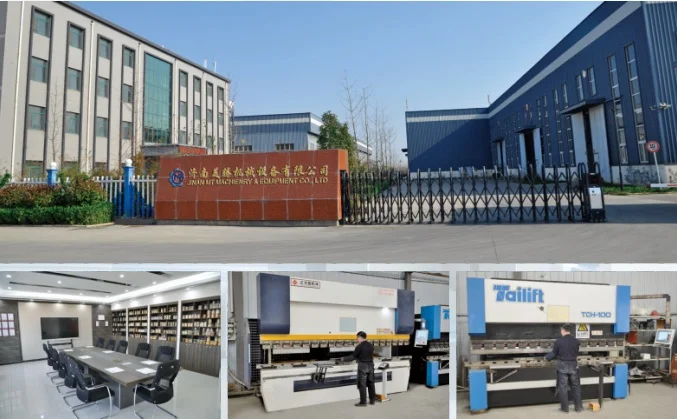
- In-house testing workshop validates real output on your raw material before shipment
- Single-source responsibility for layout design, utility planning, phased installation, and operator training
Description
Integrated Line Engineering — every station from mixing through cooling is throughput-matched and utility-planned as a single TVP extrusion project, eliminating the bottleneck risk that arises when assembling equipment from separate vendors.
Technical Specifications
| Parameter | Value |
|---|---|
| Product Type | Twin Screw Extruder Production Line for Texturized Vegetable Protein (TVP) |
| Models Available | MT65 / MT70 / MT75 / MT85 |
| Screw Type | Twin-screw |
| Screw Length | 1050 mm / 1520 mm (model mapping to be confirmed) |
| Main Motor Power | 22 kW / 30 kW / 45 kW (model mapping to be confirmed) |
| Feeding Motor Power | 0.75 kW |
| Rotary Cutting Motor Power | 0.75 kW |
| Pump Motor Power | 0.37 kW |
| Heating Power | 10 kW / 14 kW (model mapping to be confirmed) |
| Installed Power (MT65) | 84 kW |
| Power Consumption (MT65) | 59 kW |
| Installed Power (MT70) | 160 kW |
| Power Consumption (MT70) | 120 kW |
| Installed Power (MT75) | 190 kW |
| Power Consumption (MT75) | 140 kW |
| Installed Power (MT85) | 210 kW |
| Power Consumption (MT85) | 140 kW |
| Output Capacity (MT65) | 100–150 kg/h (basis not stated in source — confirm raw material, moisture, die format) |
| Output Capacity (MT70) | 150–200 kg/h (basis not stated in source — confirm raw material, moisture, die format) |
| Output Capacity (MT75) | 150–200 kg/h (basis not stated in source — confirm raw material, moisture, die format) |
| Output Capacity (MT85) | 250–300 kg/h (basis not stated in source — confirm raw material, moisture, die format) |
| Overall Dimensions (MT65 line) | 40,000 × 1,200 × 2,200 mm |
| Overall Dimensions (MT70 line) | 41,000 × 1,500 × 2,200 mm |
| Overall Dimensions (MT75 line) | 43,000 × 1,500 × 3,200 mm |
| Overall Dimensions (MT85 line) | 45,000 × 1,500 × 3,500 mm |
| Mixer Capacity | 20–30 kg / 70–80 kg / 170–180 kg (model mapping to be confirmed) |
| Mixer Power | 4 kW / 7.5 kW / 15 kW (model mapping to be confirmed) |
| Mixer Construction | Stainless steel 304 mixing blade; carbon steel frame |
| Dryer Heat Source Options | Fuel / gas / electricity |
| Dryer Drive | Double pitch roller chain; round-trip drying |
| Line Stations | Mixer → Screw Conveyor → Twin Screw Extruder → Air Conveyor → Multi-layer Dryer → Cooling Machine |
| Standards | CE certified (since 2014); ISO certified |
Application Suitability
| Application | Material or Output |
|---|---|
| TVP and soya chunk production | Defatted soya flour, low-temperature soya flakes |
| Soya nuggets and mince analogues | Soya protein concentrate, wheat gluten blends |
| Plant-based meat block processing | Mixed plant protein formulations for food service ingredient supply |
| Vegetarian and vegan product lines | High-protein extruded formats for retail and food manufacturing |
| Fast food and deep-freeze ingredient supply | Texturized protein chunks and strips for frozen meal assembly |
| Cereal and snack formats (via reconfiguration) | Grain-based formulations using screw and die adjustment |
What "Nominal Line Capacity" Leaves Out on a Plant Based Meat Processing Line
A quoted throughput figure means nothing until it is verified on your specific protein blend at your target moisture level.
I spent years on the assembly floor in Shandong before moving into line planning, and one lesson stuck harder than any other. A Southeast Asian customer sent us a blend of soya protein concentrate and wheat gluten for a plant based meat processing line trial. The lab data looked clean. But when we ran their actual material through the extruder, the water absorption rate was off — the extrudate came out sticky and refused to hold fibre structure. An entire batch of raw material was ruined before we caught the problem. That is why every line now runs a full trial on the buyer’s own material before it leaves the workshop [NEED_CITE: material variability in plant protein extrusion across growing regions and suppliers].
Layout and Throughput Matching Across Every Station
A complete plant based meat processing line is only as reliable as its weakest station handoff. If the extruder pushes 200 kg/h but the dryer can only handle 150 kg/h of wet output, you accumulate backlog and compromise moisture uniformity across the batch. Each configuration from MT65 through MT85 is laid out so that the mixer batch cycle, screw conveyor feed rate, extruder output, air conveyor transfer, dryer residence time, and cooling capacity all align to a single target throughput.
Phased Installation From Foundation to First Production Run
Deploying a turnkey TVP production line involves more than placing machines in a row. Utility planning covers electrical load distribution across the 84 kW to 210 kW installed power range, dryer heat source selection between fuel, gas, and electricity, and compressed air routing for pneumatic gates on the air conveyor. The commissioning sequence typically begins with cold runs on each station, progresses to single-station material trials, and finishes with full-line continuous operation [NEED_CITE: industrial food extrusion line commissioning protocols and staged startup procedures].
Reading the Power and Dimension Data for Real Facility Planning
The gap between installed power and actual power consumption matters for transformer sizing and running cost projection. On the MT65, installed power sits at 84 kW while consumption is rated at 59 kW — the difference reflects motors and heaters that cycle rather than run continuously. On the MT85, installed power reaches 210 kW but consumption is rated at 140 kW, indicating substantial thermal and drive headroom for high-volume TVP runs. Line footprint scales from 40 metres in length for the MT65 up to 45 metres for the MT85, with height increasing from 2.2 metres to 3.5 metres as the dryer and cooling sections grow to match higher extruder output. The twin-screw configuration across all models allows screw element rearrangement and die changes to shift between chunk, nugget, and mince formats without replacing the barrel assembly.
The Hidden Cost of Skipping Pre-Shipment Material Trials
When an extruder arrives at your facility and the first test run produces off-spec TVP, you face weeks of screw reconfiguration, die adjustment, and dryer tuning while raw material sits in inventory. The downtime compounds — installation crews are still on site, your production schedule slips, and customer orders for plant-based meat ingredients go unfilled. A pre-shipment trial on your exact soya flour or protein blend eliminates this risk by locking in the screw configuration, die geometry, and moisture parameters before the line is crated [NEED_CITE: cost of post-installation process debugging versus pre-shipment validation in food extrusion projects].
Why Source This TVP Line From a Single Project Supplier
The extruder, dryer, and cooler are engineered as one system rather than sourced from separate vendors and bolted together on your floor. The screw configuration and die design are specified to your raw material and target TVP fibre structure, not copied from a generic build. An in-house testing workshop runs your actual defatted soya flour or soya flakes before dispatch, generating a trial report that travels with the shipment. Documentation includes a full line layout with capacity calculation, electrical schematics with voltage confirmation for your facility, and an operation manual covering every station. Ongoing support extends through on-site commissioning, operator training, and wear parts supply for screws and dies.
Documentation & Verification
- Line layout and capacity calculation matching every station from mixer to cooling machine
- Screw and die configuration record specified to your protein blend and target TVP format
- Trial run report on your raw material conducted in the testing workshop before dispatch
- Electrical schematic with voltage and frequency confirmed against your facility supply
- CE declaration of conformity and ISO certificate included with shipping documentation
- Wear parts list covering screws, dies, and cutting blades with replacement intervals
Installation, Commissioning & Support
- Foundation and floor load planning based on line dimensions up to 45,000 × 1,500 × 3,500 mm
- Dedicated electrical circuit sizing for installed power ranging from 84 kW to 210 kW depending on model
- Modular station assembly with sequential mechanical and electrical hookup across all six line stations
- Cold-run verification on each station before introducing raw material during commissioning
- Operator training covering screw configuration changes, die swaps, and dryer temperature adjustment
- Wear parts inventory guidance for screws, dies, and mixer blades based on your production volume
Preparing Your Line Inquiry
To configure a plant based meat processing line that fits your facility and production targets, share your protein raw material specification including soya flour type and blend ratios, your target TVP format such as chunks, nuggets, or mince, and your required hourly output on that specific formulation. Include your workshop dimensions, ceiling height, and available utility connections including voltage, frequency, and preferred dryer heat source. If you have existing upstream or downstream equipment that the line must integrate with, provide those interface details as well.
Frequently Asked Questions
Q: How is line throughput verified against the buyer’s specific raw material before shipment?
A: The buyer ships a representative sample of their protein blend to the in-house testing workshop. A full trial run is conducted using the configured screw combination and die set, with output rate, moisture content, and fibre structure documented in a report that accompanies the line at shipment.
Q: What is the phased installation and commissioning schedule for a complete TVP processing line?
A: Installation proceeds station by station, starting with the mixer and conveyor, then the extruder, dryer, and cooler. Commissioning follows with cold runs, single-station material tests, and finally full-line continuous operation with operator training integrated throughout.
Q: How are extruder screw configuration and die design matched to different TVP formats?
A: Screw elements are rearranged along the shaft to control shear, residence time, and pressure profile. Die geometry is selected to produce the target chunk, nugget, or mince shape, with cutting speed adjusted to control piece length at the extruder face.
Q: What utility planning is required across all line stations?
A: The line requires electrical supply matching the model’s installed power rating from 84 kW to 210 kW, a dryer heat source selected from fuel, gas, or electricity, compressed air for pneumatic components, and water supply for the mixer and cooling station.
Q: How is operator training structured during on-site commissioning?
A: Training covers daily startup and shutdown sequences, screw and die changeover procedures, dryer temperature and chain speed adjustment, and routine maintenance schedules for wear parts. Operators work alongside the commissioning engineer through multiple production cycles.
Related products
-
New High Efficiency Protein Production Line Plant Protein Equipment for Artificial Vegetarian Meat Processing Food Grade
¥65.00 Select options This product has multiple variants. The options may be chosen on the product page -
Twin Screw Extruder for High Moisture Vegetarian Meat
¥9,500.00 Select options This product has multiple variants. The options may be chosen on the product page -
Vegetarian Beef Substitute Making Machine with Twin Screw Extruder
¥9,500.00 Select options This product has multiple variants. The options may be chosen on the product page -

Customized Vegetarian Meat Production Line for Food Factory
¥9,500.00 Select options This product has multiple variants. The options may be chosen on the product page