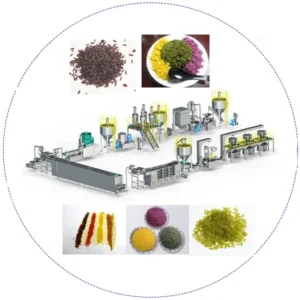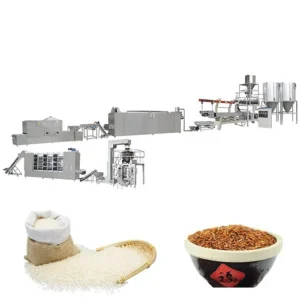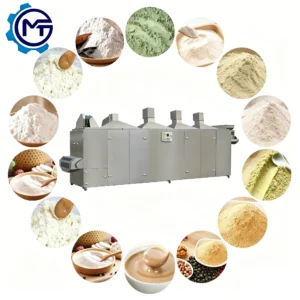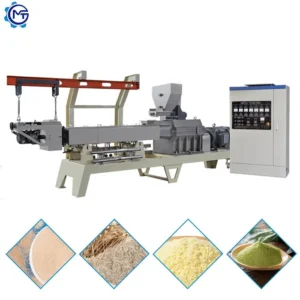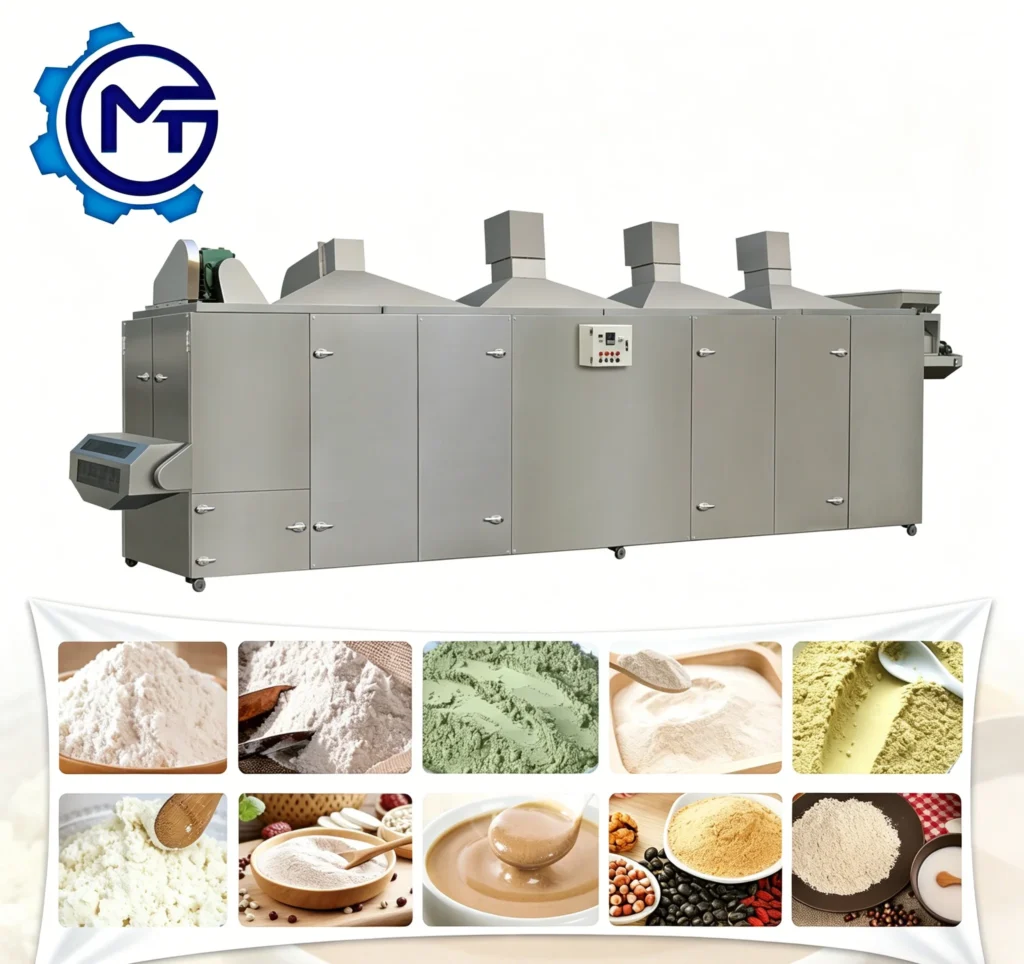


Nutrition Powder Processing Line, 200-500 kg/h, Food-Grade 304 SS, Touch Control Panel — configured as a turnkey project from raw material batching through extrusion, drying, and packing. Each station is throughput-matched to your actual grain formulation and target output, eliminating bottlenecks common when extruders are supplied without aligned downstream capacity. Flexible heat source options (electric, gas, steam) adapt to your factory utility infrastructure. Delivered as one integrated project under a single supplier, with in-house trial runs on your raw material before shipment and on-site commissioning included.
Description
Integrated Project Delivery — Every station from raw material batching through extrusion to final packing is sized against your specific grain formulation and target output, eliminating the mismatched capacities that stall commissioning.
Technical Specifications
| Parameter | Value |
|---|---|
| Product Type | Nutrition Powder Processing Line |
| Output Capacity | 200–500 kg/h (basis not stated in source — confirm raw material formulation and moisture content) |
| Construction Material | Food-Grade 304 Stainless Steel |
| Control System | Touch Control Panel with Digital System |
| Heat Source Options | Electric / Gas / Steam |
| Applicable Raw Materials | Rice, corn, beans, various grains |
| Assembly State | Complete production line |
| Warranty | 1 year |
| Standards | CE, ISO |
Application Suitability
| Application | Material or Output |
|---|---|
| Infant nutrition powder production | Rice flour, corn starch, and blended grain formulations |
| Fortified nutritional porridge | Beans, mixed cereals, and pulse-based raw materials |
| Baby food cereal processing | Pre-gelatinized rice and corn meal bases |
| Institutional feeding programme supply | Grain-based fortified powder at sustained daily volumes |
What "500 kg/h" Leaves Out About Nutrition Powder Lines
Nominal capacity means nothing until the extruder meets your actual raw material blend.
I spent four nights in a West African plant recalibrating screw combinations and temperature curves because a line rated at 500 kg/h on standard rice flour collapsed in expansion when the client switched to a local sorghum and cassava ratio. The gelatinisation temperature shifted, the extrudate density went out of spec, and the downstream dryer could not keep pace. A nutrition powder processing line turnkey project only works when throughput is calculated against the buyer’s real formulation, not a generic reference material [NEED_CITE: raw material moisture and starch composition effects on extrusion expansion].
Phased Installation Sequencing for Grain Powder Facilities
A nutrition powder processing line turnkey delivery involves more than placing machines in a row. The layout must account for raw material receiving, preconditioning moisture equilibration time, extruder footprint with barrel access clearance, dryer belt length matched to residence time, and packing station throughput. Each phase of installation depends on the previous station being commissioned first — mixer calibration before extruder start-up, extruder stability before dryer loading, dryer output consistency before flavouring and packing integration.
Throughput Matching Between Extrusion and Drying Stages
The most common failure point in grain-based powder lines is an extruder pushing volume that the dryer cannot handle at the required moisture reduction level. When extruded rice-corn blend exits the die at elevated moisture, the dryer must remove water without case-hardening the particle surface. If the dryer belt speed or heat zone configuration is undersized, partially dried material reaches the milling stage and produces inconsistent powder granularity. Sizing the dryer to the extruder’s actual output on your specific grain blend — not a catalogue figure — is the core engineering task in any nutrition powder processing line turnkey scope [NEED_CITE: drying curve requirements for extruded cereal products].
How Screw Profile and Barrel Zones Shape Powder Functionality
The twin-screw configuration determines shear intensity and residence time inside the barrel, which directly controls starch gelatinisation degree in the final powder. For infant nutrition applications, the gelatinisation level affects reconstitution behaviour — how the powder disperses in warm water without lumping. Barrel temperature zones, typically four to six independently controlled sections, allow the operator to build a thermal profile that matches the specific grain blend’s starch behaviour. Die aperture size and configuration then govern the expansion ratio of the extrudate before it enters the dryer, influencing the final milled powder’s bulk density and flow characteristics through packing equipment.
The Cost of Skipping the Trial Run
Lines shipped without a factory trial on the buyer’s actual raw material arrive with unverified screw configurations and temperature settings. The commissioning period then stretches from days into weeks as engineers troubleshoot expansion, density, and moisture issues that should have been resolved before crating. In my experience across Sub-Saharan and South Asian installations, the projects that skipped pre-shipment trials consistently burned more raw material during on-site debugging than a planned workshop run would have consumed [NEED_CITE: pre-shipment testing protocols for food extrusion equipment].
Why Source This Line as a Single Project
Full integration from mixing and batching through extrusion, drying, and packing under one supplier means every conveyor height, every transition chute, and every control signal is designed as part of a unified system rather than adapted on-site. The touch control panel with digital system provides centralized monitoring across all stations, so an operator can track barrel temperatures, dryer zone heat, and packing rate from one interface. Food-grade 304 stainless steel construction throughout product contact zones meets hygiene expectations for infant food production. Flexible heat source options — electric, gas, or steam — allow the dryer and oven configuration to match whatever utility infrastructure the facility has available. In-house testing on your grain formulation before shipment means the screw and die configuration arrives documented and verified, not guessed.
Documentation & Verification
- Line layout drawing with station-by-station throughput calculation for your grain formulation
- Screw and die configuration record matched to your raw material trial results
- Electrical schematic with voltage and frequency confirmed for your facility
- Trial run report on your actual grain blend documenting expansion and moisture data
- Operation and maintenance manual covering all line stations
- Wear parts list with replacement intervals for screws, dies, and dryer belts
Installation, Commissioning & Support
- Foundation requirements mapped to the complete line footprint including extruder and dryer load points
- Power distribution plan confirming voltage and frequency for the digital touch control panel
- Assembly sequence from batching station through packing with station-by-station commissioning checkpoints
- First-run parameter setting on your grain blend with documented screw speed and barrel temperatures
- Operator training covering formulation changeover procedures and control panel navigation
- Spare screw elements and die plates identified for your specific product configuration
What to Include in Your Project Enquiry
To configure a line that matches your facility, share your target raw material formulation with ratios, desired daily output volume, available factory floor dimensions with ceiling height, and local electrical supply specifications including voltage and frequency. If you have existing upstream milling or downstream packing equipment that must integrate, provide the interface details. Specify whether you need a pre-shipment trial run on your grain blend at the testing workshop before dispatch.
Frequently Asked Questions
Q: How is line capacity verified against my specific raw material formulation?
A: We conduct a trial run using your actual grain blend — rice, corn, beans, or mixed cereals — in the in-house testing workshop before shipment. The results document expansion ratio, moisture content, and output rate on your formulation, and the screw and die configuration is adjusted accordingly. This trial run report ships with the line.
Q: What does phased installation look like for a complete nutrition powder line?
A: Installation proceeds station by station: batching and mixing first, then extruder positioning and barrel alignment, followed by dryer and oven integration, and finally packing station connection. Each station undergoes individual commissioning before the next is brought online, with the digital control panel integrating all stations progressively.
Q: How do you prevent bottlenecks between the extruder and dryer?
A: The dryer belt length, heat zone configuration, and air flow are calculated against the extruder’s actual output on your grain formulation, not a generic capacity figure. This ensures moisture reduction targets are met without partially dried material reaching the milling and packing stages.
Q: What electrical and control options are confirmed before shipment?
A: Voltage, frequency, and control language are confirmed during the specification phase to match your facility’s supply and operator requirements. The electrical schematic is reviewed and approved before production begins, preventing commissioning delays caused by mismatched power configurations.
Related products
-
Small Scale MT Brand Automatic Baby Food Nutrition Powder Rice Flour Making Machine with 500kg/h Production Capacity PLC Control
¥9,500.00 Add to cart -
CE cerelac Instant Baby Food Porridge Making Machine Production Line
¥35,000.00 Select options This product has multiple variants. The options may be chosen on the product page -
Commercial Stainless Steel Baby Rice Powder Grinding Mixing Machine
¥8,238.27 Select options This product has multiple variants. The options may be chosen on the product page -

High Precision Automatic 500kg/h Baby Food Nutrition Powder Rice Extrusion Processing Line
¥8,238.27 Add to cart