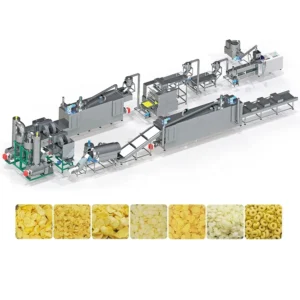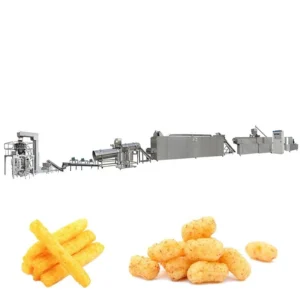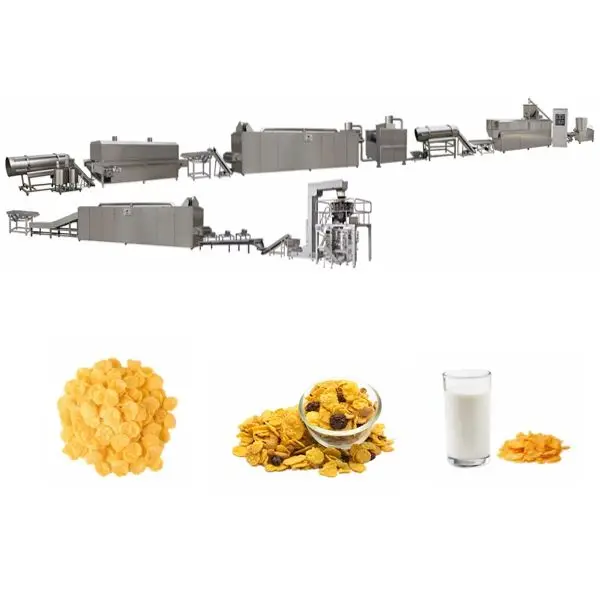


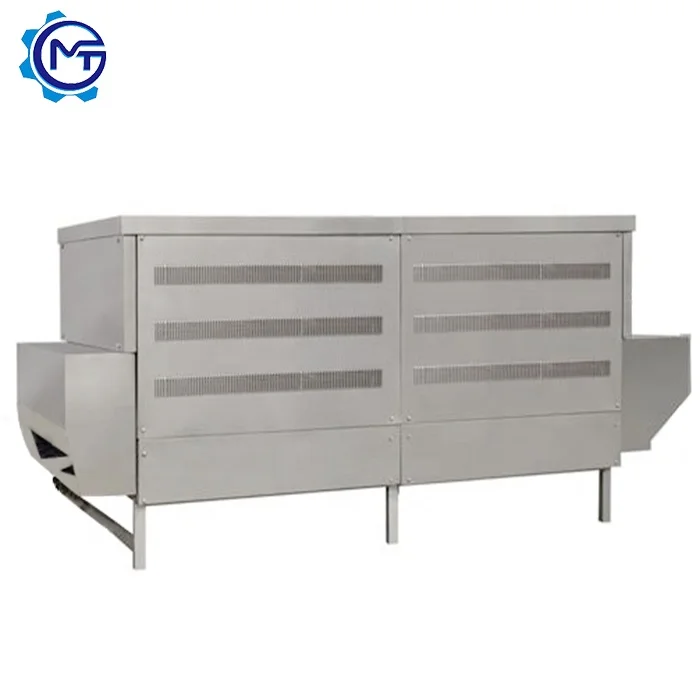

MT75 Corn Flake Production Line, Twin Screw, PLC Control — engineered as a complete turnkey project from batching through extrusion, flaking, roasting, coating, and packing.
- Screw configuration and die design matched to your grain blend for consistent flake density and expansion
- Hydraulic double-roller flaking station with infrared temperature monitoring ensures uniform thickness
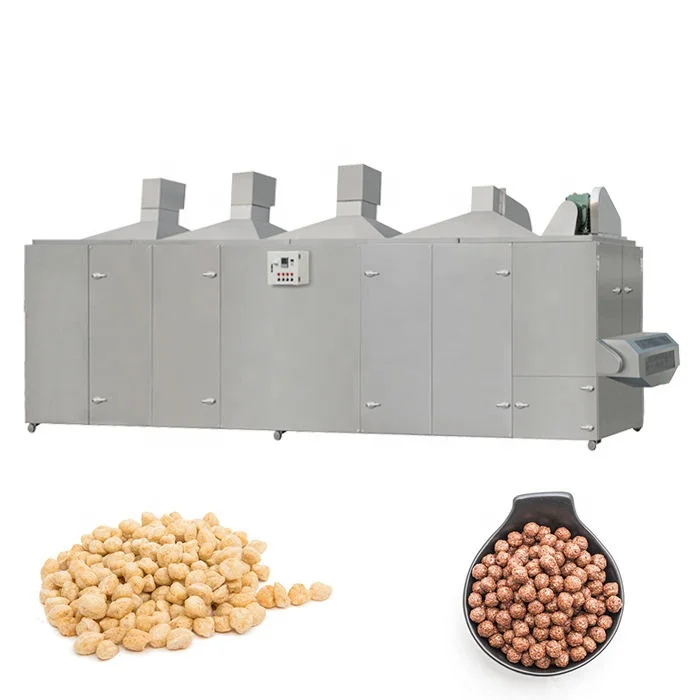
- Hot air roasting with dual circulating fans delivers even surface blistering and crispness
Designed and commissioned as one integrated line with throughput matched across every station, backed by in-house trial runs on your raw material before shipment.
Description
Integrated throughput engineering — Every station from batching to packing is sized against your actual grain moisture and target flake density, not catalog estimates.
Technical Specifications
| Parameter | Value |
|---|---|
| Model | MT75 |
| Product Type | Corn Flake Production Line |
| Extruder Type | Twin Screw |
| Installed Power | 210 kW |
| Power Consumption | 150 kW |
| Output Capacity | 300–500 kg/h (basis not stated in source — confirm raw material type, moisture content, and product format) |
| Extruder Output | 200–300 kg/h (basis not stated in source — confirm raw material and moisture) |
| Overall Dimensions | 45 × 1.5 × 3.5 m |
| Control System | PLC and MCC |
| Flaking Drive | Double motors, hydraulic roller system |
| Flaking Temperature Monitoring | Infrared sensor |
| Dryer Heating Source | Gas or Electric |
| Roasting Oven | Hot air with conciliation burner, dual circulating fans, cyclone dust removal |
| Coating System | Double tumble sugar melting, elevator, coating drum, spraying nozzle |
| Raw Materials | Corn, rice, wheat, oat, barley powder |
| Standards | CE, ISO |
Application Suitability
| Application | Material or Output |
|---|---|
| Natural corn flake production | Corn powder or grits, dried to target crispness without sugar coating |
| Sugar-coated breakfast cereal | Corn or multi-grain flakes with sugar tumble and spray application |
| Multi-grain flake processing | Blends of rice, wheat, oat, and barley powder through the same extrusion front-end |
| Puffed snack production | Grain-based snacks using the twin-screw extruder before the flaking stage |
Why "300 kg/h on Paper" Fails at the Flaking Station
A line rated at nominal output becomes useless when the dryer cannot match the extruder on your actual grain blend.
I once watched a breakfast cereal plant in the Yangtze Delta run a corn flakes line where the extruder pushed 300 kg/h but the corn flour moisture sat higher than the dryer was sized for. The flakes came out soft, the roasting oven could not keep up, and two tonnes of material went straight to waste before anyone found the mismatch. The problem was not the extruder. The problem was that each station had been quoted independently [NEED_CITE: throughput matching between extrusion and downstream drying stages]. A corn flakes production line turnkey project eliminates this risk because every piece of equipment is specified together, not assembled from separate purchase orders.
How Twin-Screw Configuration Controls Flake Density
The twin-screw extruder in this corn flakes production line turnkey setup allows screw configuration and die geometry to be adjusted for the specific grain blend you feed into the system. Different ratios of corn, wheat, and oat powder behave differently under shear and heat, and a fixed screw build designed for pure corn grits will produce inconsistent gelatinisation when the recipe changes. Matching the screw profile to your actual raw material formulation is what keeps flake thickness and blistering uniform across production runs.
Flaking and Roasting Precision That Holds Over Long Runs
The flaking station uses a hydraulic double-roller system with independent motor drives and an infrared sensor tracking temperature across the roller surface. This prevents the common failure mode where one side of the sheet runs cooler, producing flakes that shatter during roasting. Downstream, the hot air roasting oven runs two separate circulating fans with a conciliation burner and a cyclone dust removal device, giving even heat distribution and pulling fines out of the air stream before they scorch onto the product [NEED_CITE: hot air circulation design in cereal roasting ovens]. The coating system follows with a double tumble for sugar melting, a dedicated spraying nozzle, and a coating drum sized to match the extruder output rather than a generic catalog model.
What the Numbers on the Spec Sheet Actually Mean
The MT75 carries an installed power of 210 kW and a running consumption of 150 kW, which tells you the motor headroom available when the extruder encounters a denser or wetter batch. The full line footprint at 45 × 1.5 × 3.5 m includes every station from mixing through packing, so you need a workshop that accommodates this length with clearance for maintenance access on both sides. The PLC and MCC control system manages the flaking machine, dryer temperature, and roasting oven from a single point, which matters for batch-to-batch consistency when operators change grain formulations mid-shift. The availability of gas or electric dryer heating means the thermal source can match whatever utility infrastructure your facility already has in place.
The Hidden Cost of Assembling Stations from Different Vendors
When the extruder, dryer, and roasting oven come from separate suppliers, each one ships to its own rated capacity with no obligation to match the station before or after it. I have seen a coating drum that handled the output fine in dry conditions but choked when the sugar spray added moisture the downstream dryer was never asked to account for. These mismatches do not show up during factory acceptance tests with clean, ideal material. They show up on your third production day, when the real grain blend and ambient humidity are in the room [NEED_CITE: commissioning failures from unmatched upstream and downstream capacities]. Downtime on a continuous cereal line compounds quickly because material already in the extruder and dryer cannot simply be paused.
Why Sourcing the Full Line from One Engineering Source Matters
This corn flakes production line turnkey project is configured as a single engineering package rather than a bundle of standalone machines. The screw and die design are specified against your grain formulation, not copied from a generic build. The in-house testing workshop runs your actual raw material before shipment, so the dryer and roasting oven sizing is confirmed with real product, not assumptions. The line layout and capacity calculation document shows throughput matching at every station, giving you a verifiable engineering basis before the machines leave the factory. Voltage, frequency, and control language are confirmed before production starts, which prevents the commissioning delays I have seen when a PLC ships with default settings in a language the local operators cannot read [NEED_CITE: voltage and frequency confirmation practices for exported food processing lines]. Spare wear parts like screws, dies, and flaking roller components are documented from day one, so the first replacement order does not become a research project.
Documentation & Verification
- Line layout showing throughput matching between extruder, dryer, flaking machine, and roasting oven
- Trial run report on your actual grain blend and moisture content before shipment
- Screw and die configuration record matched to your specific flake density target
- Electrical schematic with confirmed voltage, frequency, and PLC language for your market
- Factory test record covering all stations operating together at sustained output
- CE declaration of conformity and ISO certificate included with dispatch documentation
Installation, Commissioning & Support
- Foundation must support the full 45 m line length with utility trenches aligned to the layout drawing
- Electrical supply rated for 210 kW installed capacity with dedicated breaker for the twin-screw extruder motor
- Gas or electric dryer connection verified against site utility before the heating section is piped
- PLC and MCC commissioning includes parameter setting for your grain formulation and target flake thickness
- Operator training covers screw changes, hydraulic roller adjustment, and roasting oven fan balancing
- Wear parts list provided at delivery covering screws, dies, flaking rollers, and spray nozzles
What to Prepare Before Requesting a Quotation
Share the specific grain powder or blend you intend to run, along with its typical moisture content and particle size. Provide your target daily output and the usable floor space and ceiling height in the production area. Confirm the local voltage, frequency, and the language your operators will need on the PLC interface. If you have existing upstream mixing or downstream packing equipment, note the interface requirements so the line can be configured around them.
Frequently Asked Questions
Q: How is line capacity verified, and what conditions does the quoted output depend on?
A: Output figures depend on raw material type, moisture content, and the target flake format. We run your actual grain blend in the testing workshop before shipment and document the achievable throughput under those specific conditions, so the quoted capacity reflects your real production environment rather than a generic rating.
Q: How is throughput matched between the extruder, flaking machine, dryer, and roasting oven?
A: Each station is sized during the layout phase based on the extruder output and the moisture load the dryer must remove. The flaking machine roller speed and the roasting oven fan capacity are then set to handle the same sustained mass flow without accumulation or starvation at any point.
Q: What voltage, frequency, and control language options are confirmed before production?
A: We confirm your site voltage and frequency before the electrical panels are built, and the PLC interface language is set to match your operators. This avoids rewiring or reprogramming during commissioning and prevents the startup delays that occur when default factory settings do not match local standards.
Q: What does the in-house trial run cover, and how does it reduce risk after installation?
A: The trial run uses your supplied raw material to test extrusion stability, flake thickness, roasting uniformity, and coating adhesion. The results are documented in a report that confirms the line configuration, so product development work is largely complete before the machines arrive at your facility.
Q: What is the installation and commissioning process, and does it include operator training?
A: Engineers arrive on-site for phased installation following the layout drawing, then run commissioning with your actual material to set parameters. Operator training covers daily operation, screw and die changes, hydraulic roller adjustment, and the wear parts replacement schedule.
Related products
-

Best Price Corn Flakes Making Machine Breakfast Cereals Processing Line with Motor As Core Component
¥19,000.00 Select options This product has multiple variants. The options may be chosen on the product page -
Corn Flakes Breakfast Cereal Production Line Making Machine Automatic
¥8,000.00 Select options This product has multiple variants. The options may be chosen on the product page -
New Automatic Cornflakes Making Machine Oats Snack Food Chips Extruder Processing Line
¥30.00 Select options This product has multiple variants. The options may be chosen on the product page -

200kg/h Breakfast Cereal Extruder Making Machine Hot Sale Corn Flake Production Line
¥30,000.00 Select options This product has multiple variants. The options may be chosen on the product page