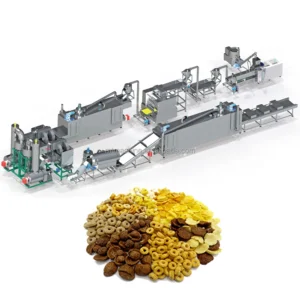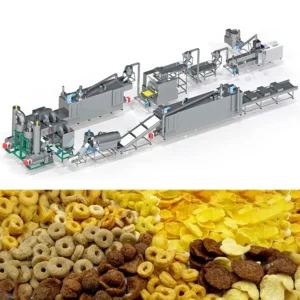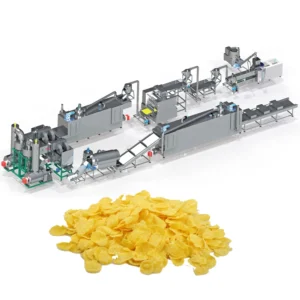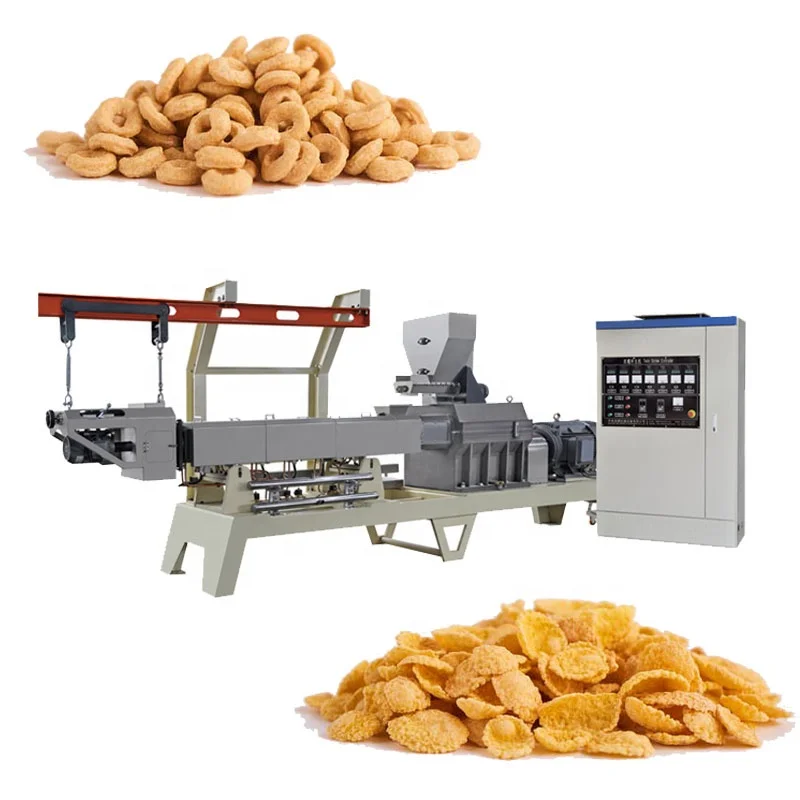
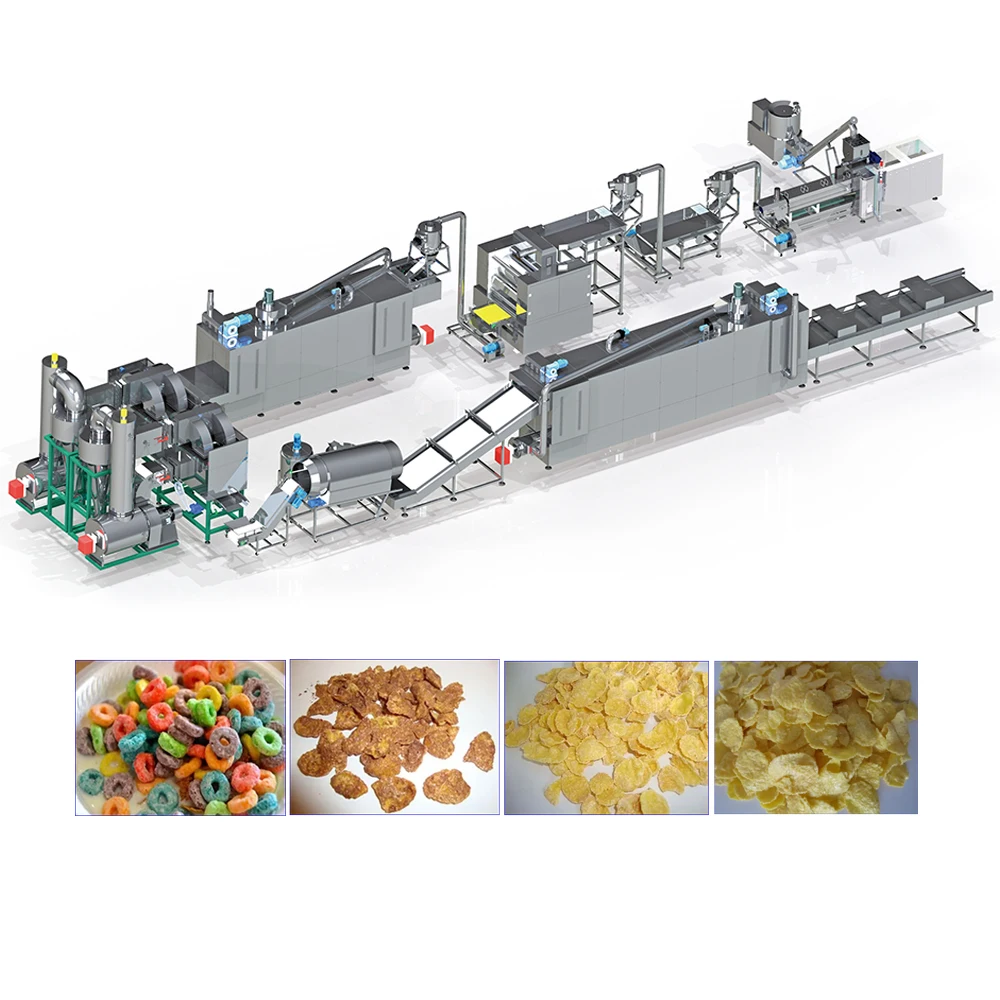


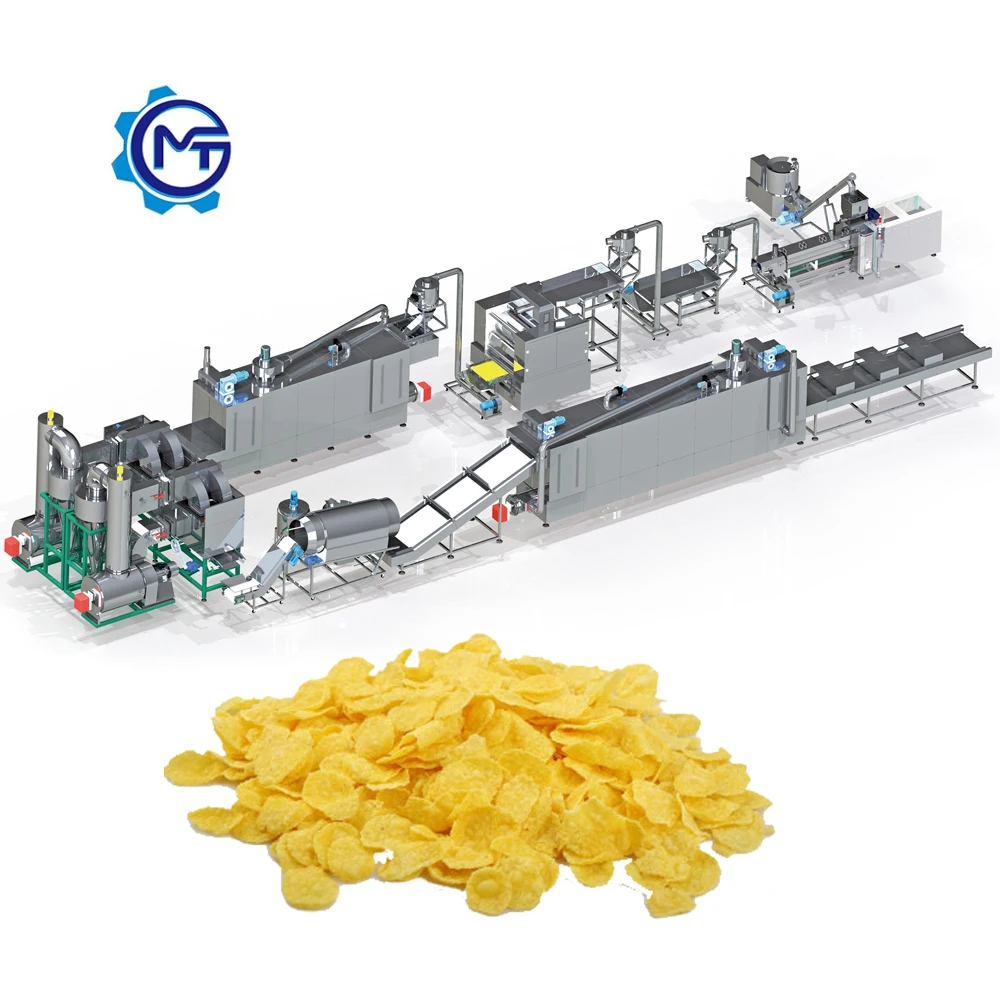
MT-65 / MT-70 / MT-75 / MT-85 Corn Flakes Production Line, Twin-Screw Extruder, Gas-Fired Oven, PLC Control — configured as a complete turnkey project from batching through extrusion, flake pressing, baking, and sugar coating. Every station is throughput-matched to eliminate bottlenecks, with screw configuration and die design specified to your raw material blend and target flake density.
- Co-rotating sectional screw modules with self-cleaning function and forced gearbox lubrication
- Dual-side gas oven and adjustable press roller gap for consistent crispness and thickness
In-house trial runs on your actual raw material validate line performance before shipment, supported by on-site installation and operator training.
Description
Line-Wide Throughput Matching — Every station from batching to packing is capacity-balanced to your actual raw material, preventing the bottleneck effect that plagues multi-vendor assemblies.
Technical Specifications
| Parameter | Value |
|---|---|
| Model | MT-65 / MT-70 / MT-75 / MT-85 |
| Product Type | Corn Flakes Production Line (Breakfast Cereal Extrusion Line) |
| Screw Type | Twin screw (co-rotating, sectional modules) |
| Extruder Key Features | Self-cleaning function; gearbox oil forced automatic lubrication; non-stop cutting system |
| Output Capacity (MT-65) | 120–150 kg/h (basis not stated in source — confirm raw material, moisture content, flake thickness) |
| Output Capacity (MT-70) | 200–250 kg/h (basis not stated in source — confirm raw material, moisture content, flake thickness) |
| Output Capacity (MT-75) | 300–400 kg/h (basis not stated in source — confirm raw material, moisture content, flake thickness) |
| Output Capacity (MT-85) | 400–500 kg/h (basis not stated in source — confirm raw material, moisture content, flake thickness) |
| Installed Power Range | 84 kW (MT-65) to 239 kW (MT-85) |
| Real Power Range | 59 kW (MT-65) to 167 kW (MT-85) |
| Line Stations | Mixer → Screw Conveyor → Twin-Screw Extruder → Corn Flakes Press → High-Temperature Oven → Sugar Spraying System |
| Press Machine Roller Size | 510 × 310 × 1050 mm |
| Press Machine Features | Big roller, cooling system, adjustable roller distance for flake thickness |
| Oven Heating Source | Gas-fired, dual-side baking system |
| Material Contact Parts | Stainless steel |
| Warranty | 1 year complete; lifetime maintenance service |
Application Suitability
| Application | Material or Output |
|---|---|
| Breakfast cereal corn flakes | Corn grits, corn flour with sugar coating |
| Grain-based flake formats | Rice flour, wheat flour, soybean blends |
| Puffed corn snack variants | Corn grits, peanut, walnut mixtures |
| Fortified cereal production | Multi-grain blends with nutritional additives |
What "Nominal Capacity" Leaves Out on a Corn Flakes Line
A production line is only as fast as its slowest matched station, not the number printed on the extruder nameplate.
I remember configuring a corn flakes line where the extruder was rated for a certain throughput, but the client’s corn grits were coarser than standard. The press couldn’t flatten the pellets uniformly, the oven produced scorched edges, and the whole line rhythm collapsed. The extruder wasn’t the problem — the station-to-station matching was. When sourcing a corn flakes production line turnkey, the critical question isn’t what the extruder can push through its die, but what the downstream press, oven, and coating drum can actually handle with your specific material blend [NEED_CITE: throughput matching methodology for extrusion-based cereal lines].
Coordinating Every Station Around Your Raw Material
A corn flakes production line turnkey project succeeds or fails on how well each station adapts to your actual ingredient profile. The twin-screw extruder generates a cooked pellet, but the corn flakes press machine — with its 510 × 310 × 1050 mm rollers and adjustable gap — determines whether that pellet becomes a uniform flake or a cracked reject. The roller cooling system must dissipate heat fast enough to prevent sticking, especially when processing high-sugar formulations.
Planning Utilities Before the Equipment Arrives
The gas-fired high-temperature oven uses a dual-side baking system that demands a stable gas supply and specific venting infrastructure. Electrical load planning must account for the full installed power — up to 239 kW for the MT-85 configuration — while real running power settles lower. Floor space planning requires accommodating the longest configuration at 28 meters for the MT-85, plus clearance for maintenance access and operator movement around the sugar spraying system [NEED_CITE: industrial bakery utility planning standards].
Reading the Specs That Actually Matter
The co-rotating sectional screw modules inside the twin-screw extruder define how your corn or multi-grain blend gets cooked and gelatinized. Sectional modules mean the screw profile can be reconfigured — different flight depths and kneading block positions change residence time and shear intensity, which directly controls starch gelatinization degree. The gearbox forced lubrication system protects the drive train during continuous operation, while the self-cleaning function reduces changeover downtime between product runs. The press roller gap adjustment is the parameter that translates extruder output into the flake thickness your market expects — too thin and the flakes shatter in packaging, too thick and they stay chewy after baking.
The Hidden Cost of Mismatched Station Capacity
When an extruder is paired with an undersized oven, the line either runs below its potential or produces under-baked flakes that go stale within days. An oversized sugar spraying system wastes coating material and creates buildup that requires frequent cleaning stops. These mismatches don’t show up in a quotation — they surface weeks after commissioning when operators can’t hit the target output without sacrificing product quality. I’ve walked into facilities where the press machine was the bottleneck, forcing the extruder to idle while the press caught up, burning energy and labor on a line that was never balanced [NEED_CITE: common bottlenecks in breakfast cereal manufacturing].
Why This Line Is Built as One Project
Every station is sourced from a single supplier, meaning throughput calculations are coordinated rather than guessed across multiple vendors. The in-house testing workshop runs your actual corn grits or grain blend before shipment, validating that the screw configuration and press settings produce the flake density and crispness your market requires. Screw and die configurations are specified to your raw material, not copied from a generic template. The gas oven, press machine, and sugar coating system are selected to match the extruder model you choose, eliminating the finger-pointing between equipment suppliers when something doesn’t perform. Pre-sales engineering covers line layout and utility planning, and on-site commissioning includes operator training on your specific product parameters.
Documentation & Verification
- Line layout drawing showing station throughput matched to your target corn flakes output
- Trial run report from testing workshop using your supplied corn grits or grain blend
- Screw and die configuration record specific to your raw material and flake density target
- Electrical schematic with voltage and frequency confirmed for your facility’s power supply
- Factory test record documenting performance before crate packing and dispatch
- Operation manual with press roller gap settings and oven temperature profiles for your product
Installation, Commissioning & Support
- Floor space allocation based on line dimensions up to 28000 × 1500 × 2800 mm for the MT-85 configuration
- Dedicated electrical circuit sized to installed power requirements with confirmed voltage and frequency
- Gas supply line and venting infrastructure planned for the dual-side baking oven before equipment arrival
- Press roller gap calibrated to your target flake thickness during on-site commissioning
- Operator training covering screw module changes, oven temperature profiles, and sugar spraying parameters
- Wear parts list provided with first replacement schedule for screws, dies, and press roller surfaces
What We Need to Scope Your Line
To configure a corn flakes production line turnkey proposal that actually holds its rated throughput on your floor, share your raw material specification — corn grits particle size, moisture content, and any blend components. Confirm your target daily output, available floor space with ceiling height, and local voltage and frequency. If you have existing upstream milling or downstream packing equipment, let us know the interface points.
Frequently Asked Questions
Q: How is line throughput verified against my raw material before shipment?
A: Your actual corn grits or grain blend is run through the extruder, press, and oven in the testing workshop. The trial run produces sample flakes that are measured for thickness, density, and crispness. A full report documents the screw configuration, press gap, and oven settings that achieved the target specification, so commissioning starts from a proven baseline rather than guesswork.
Q: How are stations matched to avoid bottlenecks between extruder, press, and oven?
A: Capacity calculations start from your target output and work backward through every station. The extruder model is selected so its output matches what the press rollers can flatten and the oven can bake within the required dwell time. The sugar spraying system is sized to coat the full oven output without accumulation or idle time between batches.
Q: What utility planning is needed for a complete corn flakes line?
A: Gas supply must support the high-temperature oven’s dual-side baking system with proper pressure and venting. Electrical infrastructure needs to handle the installed power of the selected extruder model plus all auxiliary stations. Floor space must accommodate the full line length with clearance for maintenance access and operator movement around the sugar spraying drum.
Q: What does the commissioning schedule look like on-site?
A: Installation begins with station placement and utility connections, followed by cold testing of all conveyors and drives. Hot commissioning runs your raw material through the full line, adjusting press roller gap, oven temperature zones, and sugar spray rate until product specification is met. Operator training covers daily startup, parameter adjustments, and cleaning procedures.
Q: How are spare wear parts supplied and when is the first replacement due?
A: A wear parts list is included with your documentation, identifying screws, dies, and press roller surfaces as primary consumables. The first replacement timing depends on your raw material abrasiveness and daily running hours. Replacement parts are manufactured to the same specification as your original configuration and shipped with installation guidance.
Related products
-
Corn Flakes Machine Breakfast Cereal Corn Flakes Production Line Cornflakes Making Machine
¥85,800.00 Select options This product has multiple variants. The options may be chosen on the product page -

Best Price Corn Flakes Making Machine Breakfast Cereals Processing Line with Motor As Core Component
¥19,000.00 Select options This product has multiple variants. The options may be chosen on the product page -
Corn Flake Making Machine Corn Puffs Making Machine Snack Food Production Line
Price range: ¥500.00 through ¥1,200.00 Select options This product has multiple variants. The options may be chosen on the product page -

200kg/h Breakfast Cereal Extruder Making Machine Hot Sale Corn Flake Production Line
¥30,000.00 Select options This product has multiple variants. The options may be chosen on the product page