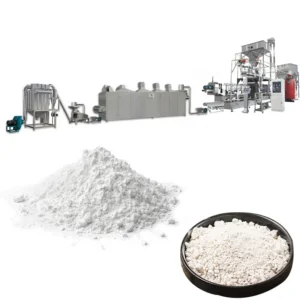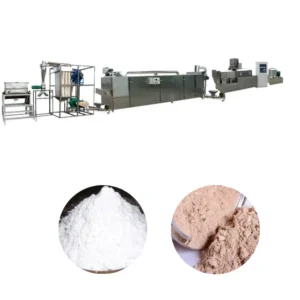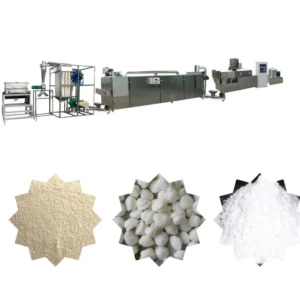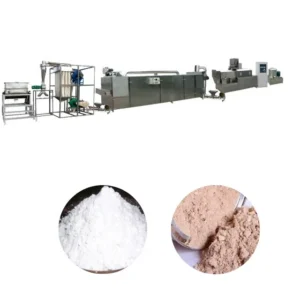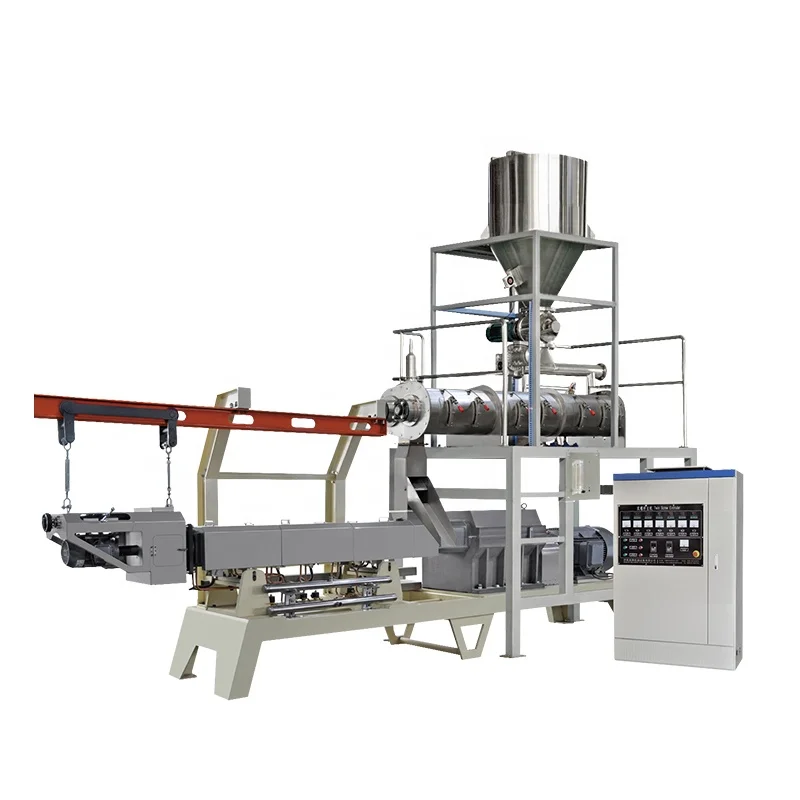


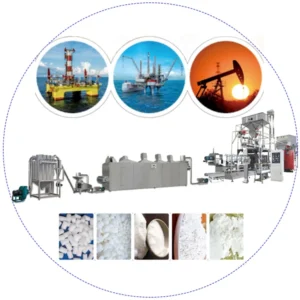
MT65 Modified Starch Processing Line, Twin-Screw, 110 kW — complete turnkey layout from flour mixing through extrusion, drying and pulse grinding, with all stations throughput-matched to prevent bottlenecking.
- Screw and barrel configuration matched to your starch source and target modification degree
- Dryer fuel selectable between gas, electric or fuel oil to suit site utility conditions
- 304 stainless steel contact materials across mixer, extruder and grinder
- Grinder mesh adjustable to 100–120 for final powder fineness specification
Trial runs on your actual raw material are completed in our in-house testing workshop before shipment, so product development starts on day one of installation.
Description
Configuration Matched to Your Starch Source — screw profile, barrel heating zones, and die geometry are specified against your raw material and target modification degree, not copied from a generic build.
Technical Specifications
| Parameter | Value |
|---|---|
| Product Type | Modified Starch Processing Line |
| Model | MT65 |
| Extruder Type | Twin Screw |
| Installed Power | 110 kW |
| Power Consumption | 90 kW |
| Output Capacity | 100–150 kg/h (basis not stated in source — confirm raw material type, moisture content, and target starch modification degree) |
| Overall Dimensions | 40000 × 1500 × 2200 mm |
| Voltage & Frequency | 380V / 50Hz / Three Phase (verify against target market standard) |
| Line Configuration | Flour Mixer → Screw Conveyor → Twin Screw Extruder → Air Conveyor → Roasting Oven → Air Conveyor → Pulse Grinder |
| Mixer Batch Size | 20–30 kg per batch (verify against manufacturer catalog) |
| Mixer Power | 4 kW |
| Grinder Drive Motor | 15 kW |
| Grinder Mesh Number | 100–120 mesh |
| Dryer Fuel Options | Fuel, Gas, or Electricity selectable |
| Dryer Drive | Double pitch roller chain, round-trip drying |
| Contact Material | Stainless Steel (201 S.S. or 304 S.S. options) |
| Control System | Confirm PLC / MCC / manual panel |
| Certification | CE, ISO |
Application Suitability
| Application | Material or Output |
|---|---|
| Food-grade modified starch | Corn, cassava, rice starch for thickeners, stabilisers, and binders |
| Industrial textile sizing | Modified starch applied to warp yarns for loom efficiency |
| Paper coating and surface sizing | Pregelatinised starch for paper surface treatment |
| Oil drilling fluid additives | Denatured starch for fluid loss control in drilling mud |
| Construction material additives | Modified starch used in dry-mix mortar and gypsum products |
What the Quoted Output Figure Leaves Out on a Modified Starch Processing Line Turnkey Project
Capacity only means something when it is tied to your specific starch source, moisture level, and target modification degree.
A modified starch processing line turnkey proposal often arrives with a single output number that sounds definitive. In practice, cassava starch gelatinises at a different temperature window than corn starch, and the screw configuration that works for one will produce inconsistent results on the other. I once watched a line configured for corn starch parameters fail to reach the required expansion degree on cassava — throughput dropped noticeably, and the screw combination had to be entirely reworked on site [NEED_CITE: starch gelatinisation temperature differences by botanical source]. When the raw material behaviour is not confirmed before the configuration is locked, the quoted capacity becomes a theoretical ceiling rather than an achievable daily average.
Screw Configuration Determines Modification Uniformity
The twin screw extruder sits at the centre of this modified starch processing line turnkey setup. Starch modification depends on controlled shear, temperature, and residence time inside the barrel. The screw elements — their pitch, stagger angle, and arrangement of kneading blocks versus conveying segments — must be selected based on whether the target is partial pregelatinisation, cross-linking, or full denaturation. A generic screw build produces uneven gelatinisation: some granules pass through under-processed while others are over-sheared, resulting in inconsistent viscosity profiles in the final powder.
Throughput Matching Prevents Station Bottlenecks
Every station on this line — from the flour mixer through the extruder, roasting oven, and pulse grinder — is sized against the others. An extruder that outputs steadily means nothing if the dryer cannot handle the same mass flow, or if the grinder cannot keep pace without sacrificing mesh fineness. The 40-metre line footprint accommodates all stations in sequence with air conveyors bridging each handoff point, ensuring material moves continuously without accumulation or starvation at any stage [NEED_CITE: throughput matching principles in continuous food processing lines].
Reading the Specs That Actually Matter
The MT65 twin screw extruder draws 90 kW in operation across a 110 kW installed base, leaving headroom for start-up surges and varying raw material loads. The roasting oven supports fuel, gas, or electric heating — a choice that must be made against local utility availability and cost structure before the order is placed, not after arrival. The pulse grinder runs on a 15 kW drive motor with a separate 1.5 kW air circulating system and 1.1 kW impeller fan, producing powder in the 100–120 mesh range. Mesh fineness directly affects downstream solubility and dispersion behaviour, so this specification must align with your end-user requirements. The 201 or 304 stainless steel contact material option affects both corrosion resistance in high-moisture zones and compliance with food-grade regulations in certain markets.
The Cost of Skipping the Trial Run
When a starch modification line ships without a trial run on the buyer’s actual raw material, the first production attempts become the real test — conducted on your floor, with your time and material at stake. Screw combinations may need multiple adjustments, temperature profiles get rewritten, and dryer retention times shift until the product specification is met. During this period, output is unpredictable, and the grinding station may produce off-spec powder that cannot be sold or reprocessed. These commissioning delays compress the schedule for every downstream activity, from packaging procurement to first customer delivery [NEED_CITE: commissioning delays in starch processing plant startups].
Why Source This Line From One Supplier
The entire modified starch processing line from batching to grinding comes from a single supplier, which means every station’s capacity is calculated against the others rather than assembled from independent quotes. The screw and die configuration is specified against your raw material sample and target modification degree, not pulled from a standard template. An in-house testing workshop conducts trial runs on your starch source before the equipment leaves the factory, producing a test report that confirms achievable output and product properties. Pre-sales engineering covers line layout and utility planning, and on-site installation includes operator training on the specific screw configuration and temperature profiles your material requires. Documentation — including the screw configuration record, electrical schematic, and factory test results — ships with the equipment, so your maintenance team has a reference baseline from day one.
Documentation & Verification
- Line layout and capacity calculation showing matched throughput across mixer, extruder, dryer, and grinder
- Screw and die configuration record specified to your starch source and target modification degree
- Trial run report on your raw material from the in-house testing workshop
- Electrical schematic with voltage and frequency confirmed against your site utility supply
- CE declaration of conformity and ISO certificate for the complete line
- Wear parts list covering screws, dies, and grinder screens with replacement specifications
Installation, Commissioning & Support
- The 40-metre line length requires a clear floor span with level foundation and adequate headroom for the 2,200 mm overall height
- A dedicated three-phase 380V / 50Hz circuit must be provisioned for the 110 kW installed power load, with voltage confirmed before dispatch
- Stations arrive as a complete assembly sequence; air conveyors and ducting are connected on site to match your floor layout
- First production runs are supervised on site, with screw speed, barrel temperature zones, and dryer retention time adjusted to your material
- Operators are trained on the specific control panel configuration, including setpoints for each processing stage
- Spare screws, dies, and grinder screens are identified and listed before shipment so replacements are available when wear occurs
What to Include With Your Inquiry
To configure a modified starch processing line turnkey project accurately, share your starch source — corn, cassava, rice, or another botanical origin — along with the target modification type and any product specification sheets your end users require. Confirm your site voltage and frequency, the available fuel source for the dryer, and your daily production target in kilograms so each station can be sized correctly. If you have existing upstream batching or downstream packing equipment, provide the interface details so the line layout accounts for those connection points.
Frequently Asked Questions
Q: How is the output capacity verified before shipment?
A: Output is verified through a trial run using your raw material in the in-house testing workshop. The test confirms achievable throughput, product modification degree, and powder fineness at the grinder stage. A written report documents the screw configuration, barrel temperatures, dryer settings, and mesh results so you have a confirmed baseline before the line ships.
Q: How is the screw configuration chosen for my starch type?
A: The screw element arrangement — kneading blocks, conveying segments, and stagger angles — is designed around your specific starch source and the target modification degree. Corn, cassava, and rice starches each gelatinise at different temperatures and shear thresholds, so the profile is matched to your material rather than copied from a standard build.
Q: Is a trial run performed on my raw material before the line ships?
A: Yes. Your raw material is tested in the factory workshop before dispatch. The trial covers extrusion behaviour, gelatinisation consistency, dryer output, and grinder fineness. Results are compiled into a report that travels with the equipment, giving your commissioning team confirmed parameters to start from.
Q: How are electrical specifications confirmed for my factory?
A: Voltage, frequency, phase configuration, and control panel language are confirmed during the specification stage before production begins. The electrical schematic is included in the documentation package. This prevents commissioning delays caused by mismatched power supplies or interface language barriers on site.
Related products
-
Cassava Corn Potato Flour Starch Production Line – Industrial Pregelatinized & Modified Extrusion Machinery
¥65.00 Select options This product has multiple variants. The options may be chosen on the product page -
Automatic Modified Starch Making Machine Oil Drilling Starch Processing Production Line
¥30.00 Select options This product has multiple variants. The options may be chosen on the product page -
Modified Starch Production Line for Industrial Drilling Twin Screw Extruder Large Output Modified Starch Manufacturing Machine
¥50.00 Select options This product has multiple variants. The options may be chosen on the product page -
New Automatic Modified Starch Puffing Production Line – Long Service Life Pregelatinized Starch Equipment
¥65.00 Select options This product has multiple variants. The options may be chosen on the product page