

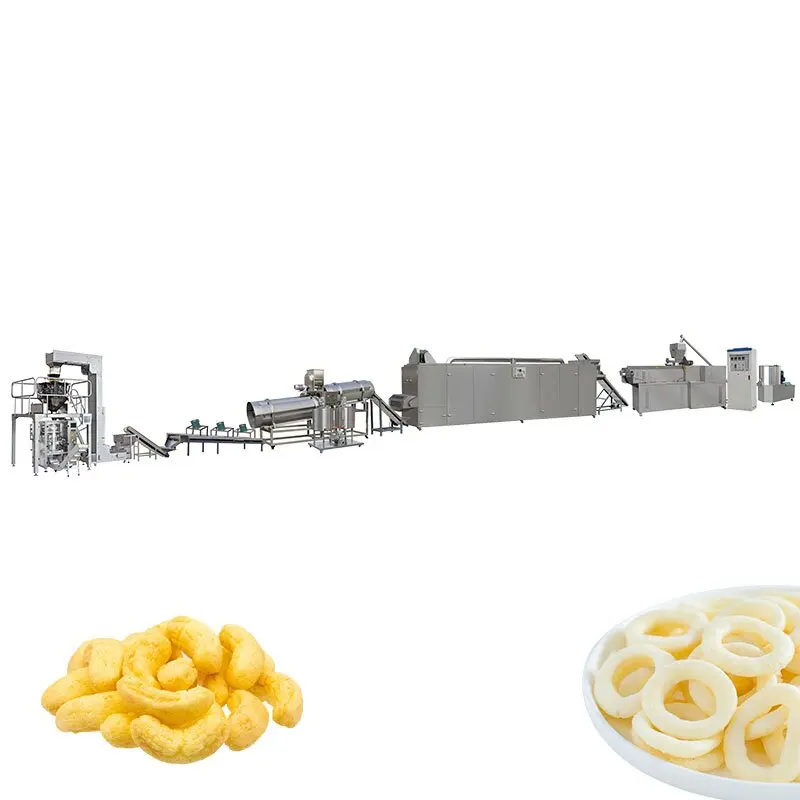
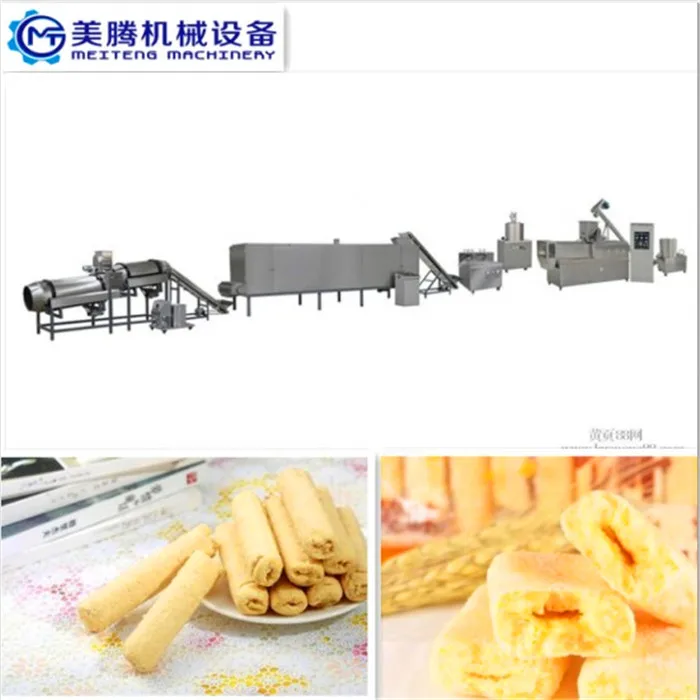
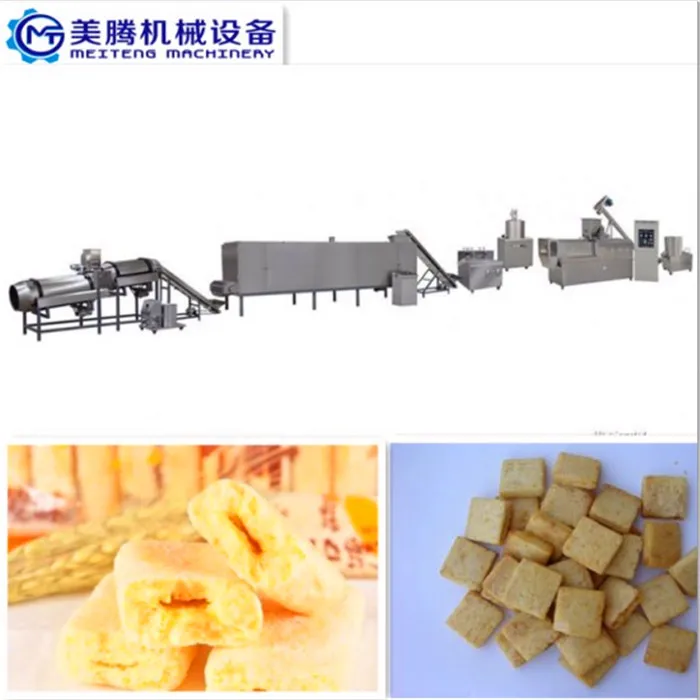
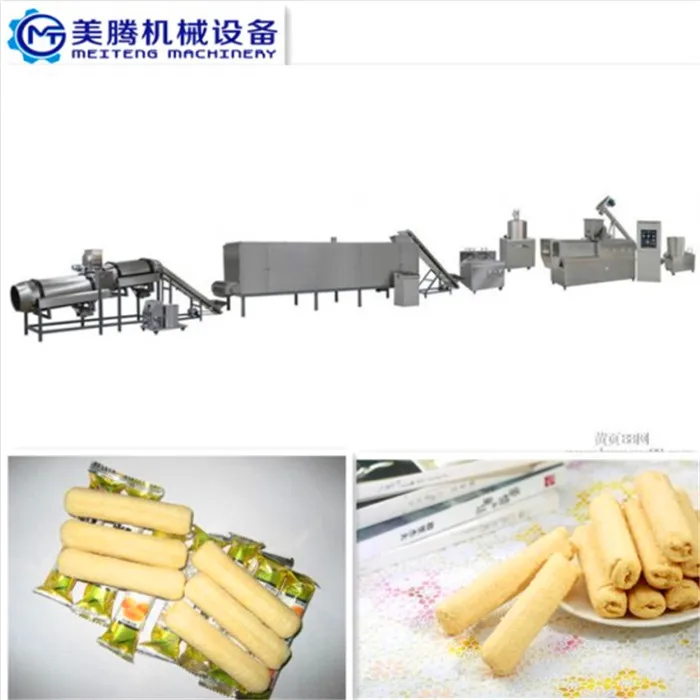
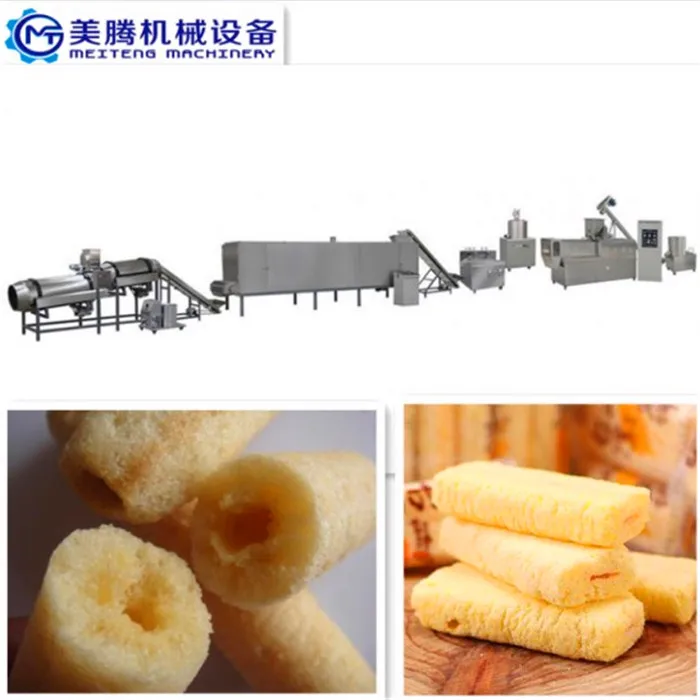
MT-65 / MT-70 / MT-85 Core Filling Snack Extruder Machine, Twin Screw, 100-500 kg/h Capacity Range — engineered for snack manufacturers producing filled extruded products.
- Integrated turnkey line from flour mixing through extrusion, core filling, drying, and flavoring with throughput matched across every station to eliminate bottlenecks
- Screw configuration and die design specified to your raw material formulation and target product texture for consistent expansion and density control
- Three capacity tiers available to scale from pilot production to full-volume output
Complete line layout, in-house trial runs on your raw material before shipment, and on-site installation with operator training included.
Description
Integrated line throughput matching — every station from flour mixing through extrusion, core injection, drying, and flavoring is calculated against the next so the line runs as one rhythm instead of a stack of mismatched machines.
Technical Specifications
| Parameter | Value |
|---|---|
| Product Type | Core Filling Snack Food Extruder Machine |
| Model Options | MT-65 / MT-70 / MT-85 |
| Screw Type | Twin screw |
| Installed Power | MT-65: 81.5 kW; MT-70: 115 kW; MT-85: 181 kW |
| Real Power Consumption | MT-65: 53 kW; MT-70: 76 kW; MT-85: 117 kW |
| Output Capacity | MT-65: 100–150 kg/h (basis not stated in source — confirm raw material / moisture content); MT-70: 200–240 kg/h (basis to be confirmed); MT-85: 400–500 kg/h (basis to be confirmed) |
| Overall Dimensions (L×W×H) | MT-65: 21000×1200×2200 mm; MT-70: 23000×1500×2200 mm; MT-85: 28000×3500×4300 mm |
| Line Stations | Flour mixer, double screw extruder, core filling unit, dryer, flavoring system |
| Outer Shell Raw Materials | Wheat, rice, corn, barley, rye, oats, sorghum |
| Core Filling Materials | Chocolate, cream, jelly, fruit paste, date paste |
| Control System | Automation (PLC/MCC option available — confirm before order) |
| Voltage & Frequency | Configurable to buyer’s site supply — confirm before production |
| Warranty | 1 year complete guarantee, life-time maintenance service |
| Certification | CE, ISO |
Application Suitability
| Application | Material or Output |
|---|---|
| Chocolate-filled extruded pillows | Wheat or corn outer shell with chocolate center |
| Cream-filled snack tubes | Rice and oat blend shell with dairy cream filling |
| Fruit paste-core cereal bites | Barley or sorghum shell with date or fruit paste center |
| Jelly-filled puffed snacks | Corn and wheat blend shell with jelly injection |
| Fortified nutrient snacks | Multi-grain outer shell with nutrient-enriched cream core |
Why Nominal Capacity Numbers Mislead Snack Line Buyers
A core filling snack extruder production line quoted at a single output figure rarely tells you whether that number survives contact with your actual recipe.
Buyers often receive a capacity rating based on ideal laboratory flour at controlled moisture. Once the line meets real corn grits with variable particle size or a chocolate filling that thickens at ambient temperature, throughput drops and the core filling station overflows. I once spent two days on a client site re-balancing extruder screw speed against a cooling conveyor because nobody had matched the stations to the buyer’s recipe in advance. [NEED_CITE: throughput variation between laboratory and production-grade raw materials in extrusion]
Station-by-Station Throughput Alignment
The defining challenge of a core filling snack extruder production line is that five or six different machines must pass material to one another without pile-ups or starvation. The flour mixer must deliver dough at the same mass flow rate the extruder consumes; the extruder must push shell material at a speed the core filler can inject into; the dryer must accept output as fast as the flavoring drum can tumble it. When each station is sourced from a different vendor, those rates are almost never aligned, and the line operator spends shifts adjusting speeds by trial and error. Engineering the entire line under one configuration document removes that guesswork.
Trial Runs on Your Actual Formulation Before Dispatch
Running a buyer’s specific raw material through the extruder and core filling unit before the line ships catches density, moisture, and filling-ratio problems while corrections still cost days rather than weeks. An in-house testing workshop allows screw configuration and die geometry to be adjusted on the actual flour blend and filling the buyer will use in production. The trial run report documents shell expansion, core-to-shell ratio, and moisture profile at the dryer exit, giving both parties a verified baseline before installation begins. [NEED_CITE: pre-shipment trial run protocols for twin-screw food extrusion equipment]
How Screw Geometry and Die Design Shape the Filled Snack
Three parameters control whether a core-filled pillow holds its shape or splits at the seam. First, the twin-screw configuration — flight depth and kneading block arrangement — determines how thoroughly the outer shell material gelatinises before it reaches the die. Second, die orifice diameter and land length set the expansion ratio of the extruded tube; too much expansion and the wall thins until the filling leaks through. Third, moisture content at the die face, typically governed by barrel temperature zones and preconditioner steam, decides whether the shell sets fast enough to contain the injected core. The MT-65, MT-70, and MT-85 models span installed power from 81.5 kW to 181 kW, which translates directly into the thermal and mechanical energy available for starch gelatinisation across different grain formulations.
The Cost of Skipping Configuration Verification
When a line ships with a generic screw profile that was never tested on the buyer’s grain blend, the first production run often produces shells that are either too dense to puff properly or too fragile to contain the filling. Operators then request replacement screw elements, wait weeks for international freight, and lose an entire launch window. [NEED_CITE: downtime costs from incorrect screw configuration in extruded snack production] Voltage mismatches compound the problem: if the control panel was built for 380 V / 50 Hz but the factory runs 440 V / 60 Hz, motor speeds shift and the extruder-to-filler speed ratio drifts off the validated setting.
Why This Line Is Engineered as One Project
Throughput calculations for the mixer, extruder, dryer, and flavoring drum are performed together so that no station becomes a bottleneck. Screw elements and die plates are selected against the buyer’s specific grain mix and filling viscosity rather than copied from a standard build. The in-house testing workshop validates shell expansion and core injection ratio on the customer’s raw material before the line is crated. Electrical schematics, including voltage and frequency, are confirmed with the buyer’s facility engineer before production starts. On-site installation covers mechanical assembly, utility hookup, parameter dial-in, and operator training in a single commissioning visit.
Documentation & Verification
- Line layout and capacity calculation showing throughput at every station for your target output
- Screw and die configuration record matched to your grain blend and filling type
- Trial run report on your raw material documenting shell density and core ratio before dispatch
- Electrical schematic with confirmed voltage, frequency, and control language
- Operation and maintenance manual covering daily checks and screw element replacement intervals
- CE declaration of conformity and ISO certificate included in shipping documents
Installation, Commissioning & Support
- Foundation plan accounts for the MT-85 line length up to 28 m and operating weight distribution
- Dedicated power circuit sized to the selected model’s real power draw, up to 117 kW for MT-85
- Extruder, dryer, and flavoring drum shipped in labeled sections for sequential on-site assembly
- First-run parameter dial-in covers barrel temperatures, screw speed, and core injection pressure
- Operator training on daily cleaning, screw wear inspection, and filling nozzle calibration
- Wear parts list with recommended screw element and die plate stock for the first year of operation
What We Need to Move Your Inquiry Forward
Share the grain or flour blend you intend to use for the outer shell, along with the filling type and target core-to-shell ratio. Let us know your site voltage, frequency, and whether your control room runs on a specific language interface. If you already have upstream milling or downstream packing equipment, provide model details so the line layout can integrate with your existing footprint.
Frequently Asked Questions
Q: How is line throughput verified against my specific raw material and recipe?
A: Before shipment, your grain blend and filling material are run through the extruder and core injection unit in our testing workshop. The trial run report records shell expansion ratio, core-to-shell weight percentage, moisture at the dryer exit, and steady-state throughput, giving you a documented baseline to replicate during commissioning.
Q: What utility requirements need confirmation before production begins?
A: Voltage, frequency, and phase must match your facility supply; steam pressure for the conditioner and dryer must fall within specified ranges; compressed air is required for pneumatic filling valves and control actuators. Confirming these values before the electrical panel is wired prevents motor speed mismatches on site.
Q: How are the extruder, dryer, and flavoring stations matched to prevent bottlenecks?
A: Each station’s mass flow rate is calculated from the preceding station’s output, accounting for moisture loss in the dryer and residence time in the flavoring drum. The line layout document shows the rated throughput at every transfer point so no station starves or overflows during continuous operation.
Q: Can a trial run be performed on my raw material before shipment?
A: Yes. Send a representative sample of your shell flour blend and filling material to the testing workshop. The trial run covers screw configuration tuning, die selection, and core injection calibration, and the resulting report ships with the line as the commissioning reference.
Q: What does the phased installation and commissioning schedule look like?
A: Mechanical assembly proceeds station by station along the line length, followed by utility connections, control system power-up, and dry-run testing. Wet commissioning then runs your raw material through every station, with parameter adjustments documented in the handover file before operator training begins.
Related products
-

Fully automatic puff snack processing line
¥8,500.00 Select options This product has multiple variants. The options may be chosen on the product page -

Puffed Snacks Seasoning Flavor Machine Twin Screw Corn Puffing Food Making Extruder Equipment
¥8,355.00 Select options This product has multiple variants. The options may be chosen on the product page -

New Stainless Steel Automatic Snack Food Machinery Extruder Puffed Corn Maize Puff Processing Line for Food Industry High
¥12,350.00 Select options This product has multiple variants. The options may be chosen on the product page -

Sweet Puffed Rice Making Machine Stainless Steel Extruded Puff Snacks Ball Food Produce Machinery
¥7,580.00 Select options This product has multiple variants. The options may be chosen on the product page


