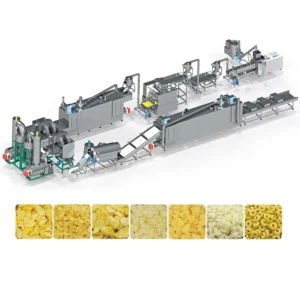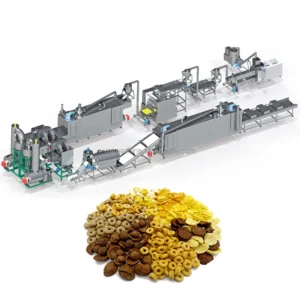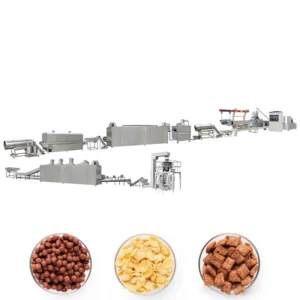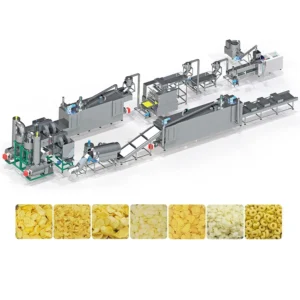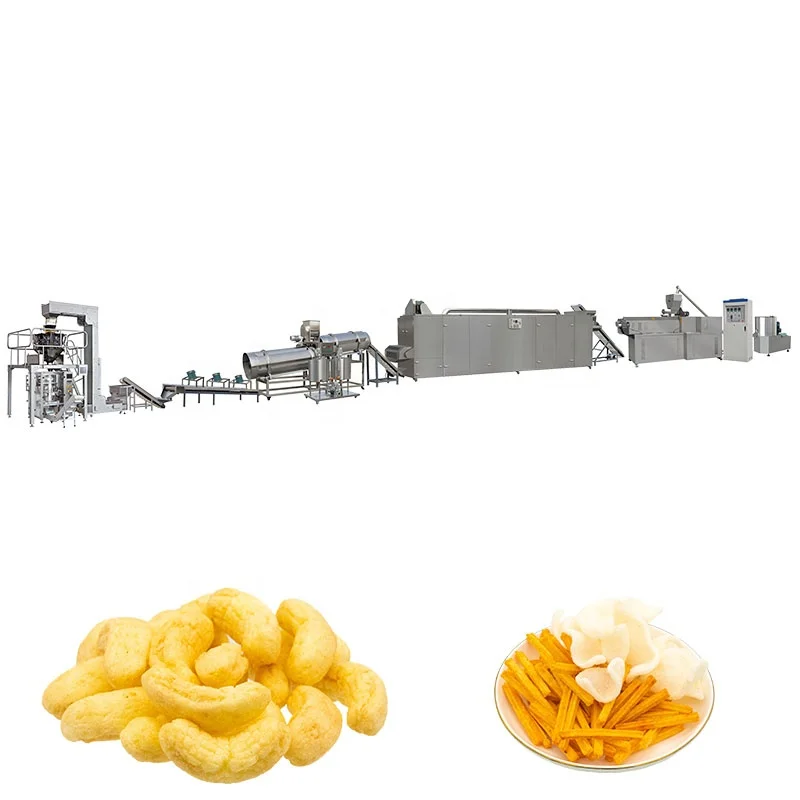
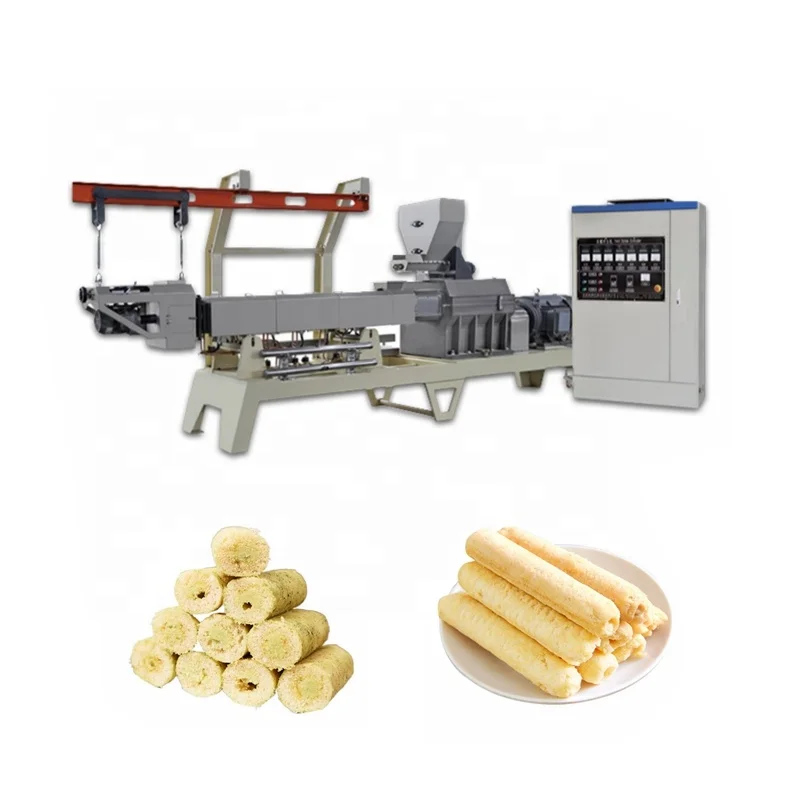
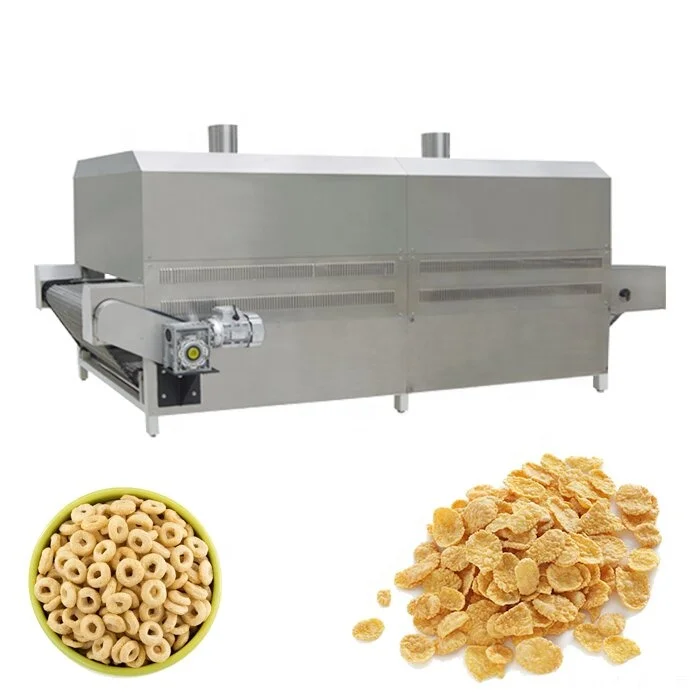
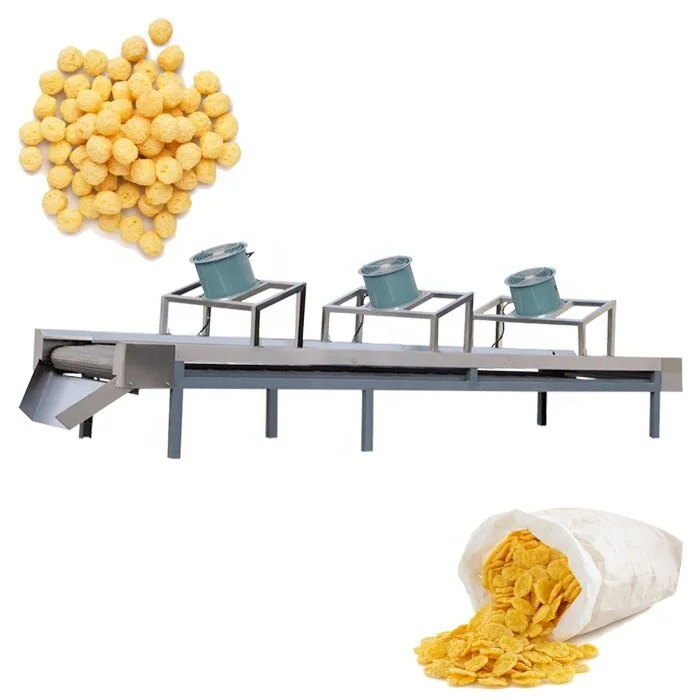

MT-75 Twin Screw Corn Flake Extrusion Production Line, 200-300 kg/hr capacity, PLC Control — engineered as a complete turnkey system where every station from mixing through extrusion, flaking, roasting, coating, and packing is throughput-matched. Screw configuration and die design are specified to your raw material formulation and target flake density, ensuring consistent expansion and crispness. Hot air roasting with dual circulating fans delivers even surface bubbling, while the hydraulic flaking system maintains uniform thickness.
- Trial runs performed on your actual raw material in our testing workshop before shipment
- Line layout and capacity calculation confirming no single station bottlenecks your output
- Electrical schematics with voltage and control language confirmed for your destination market
Description
Turnkey Line Accountability — Every station from batching through packing is throughput-matched under one supplier, so your corn flakes line runs at design speed without a single bottleneck holding back the rest.
Technical Specifications
| Parameter | Value |
|---|---|
| Product Type | Twin Screw Corn Flake Extrusion Production Line |
| Screw Type | Twin screw |
| Capacity | 200-300 kg/hr (basis not stated in source — confirm raw material formulation / moisture content / flake size) |
| Voltage | 220V / 380V (configurable) |
| Rated Power | 3 kW (verify against manufacturer catalog) |
| Control System | PLC control system |
| Flaking System | Hydraulic double-roller with separate motors, infrared temperature control |
| Dryer Heating Source | Gas / Electric |
| Hot Air Roasting Oven | Vibrating pan, dual circulating fans, cyclone dust removal |
| Coating System | Double tumble sugar melting, elevator, coating drum, spraying nozzle |
| Assembly State | Complete turnkey production line |
| Certification | CE, ISO |
| Core Components Warranty | 1 Year |
Application Suitability
| Application | Material or Output |
|---|---|
| Plain corn flakes for breakfast cereal retail | Corn grits, maize flour |
| Sweetened or frosted corn flakes | Corn base with sugar or honey coating |
| Multi-grain breakfast flakes | Blends of corn, rice, wheat, oat, barley |
| Corn puffs and extruded cereal snacks | Corn meal, rice flour with line reconfiguration |
| Institutional and foodservice cereal supply | High-volume bulk packing formats |
Why the Dryer Capacity Question Matters More Than Extruder Output
An undersized dryer will throttle a perfectly configured extruder within the first hour of production.
I have watched buyers focus entirely on extruder throughput during negotiations, only to discover after commissioning that the dryer cannot handle the moisture load coming off the flaking rollers. The extruder pushes product forward at its rated pace, but the dryer falls behind, and within minutes you are either dumping wet flakes or slowing the entire line to match the weakest station. On a corn flakes production line turnkey project, this mismatch typically surfaces during the first full continuous run, when ambient humidity and actual product moisture diverge from lab assumptions. [NEED_CITE: thermal drying capacity matching in cereal processing lines]
Throughput Matching Across Every Station
When we configure a corn flakes production line turnkey solution, each station is scaled to the same output target. The mixer feeds the extruder at a rate the screws can process; the flaking rollers accept the full extrudate stream without pile-up; the dryer and roasting oven carry the moisture and thermal load the product demands. This is not a collection of standalone machines wired together — it is a single continuous process where every link carries the same design throughput.
Screw Configuration Dictates Flake Integrity
The twin-screw extruder on this line is configured specifically for the buyer’s raw material formulation and target flake density. Screw element arrangement, barrel temperature profile, and die geometry are selected after reviewing the customer’s corn source, particle size, and starch content. A screw configuration borrowed from a generic build produces extrudate that either expands too much for clean flaking or arrives at the rollers too dense to achieve the crispness the market expects. [NEED_CITE: twin screw extrusion screw configuration for cereal applications]
What the Flaking and Roasting Hardware Actually Does
The hydraulic double-roller flaking station uses separate motors for each roller and an infrared sensor to hold even surface temperature, which keeps flake thickness consistent across the full roller width. Downstream, the hot air roasting oven uses a vibrating pan with high-temperature spraying tubes and two separate circulating fans paired with a cyclone dust removal device. This arrangement produces the even surface bubbling and crispness that define a quality corn flake. For sweetened variants, the coating system adds a double tumble sugar melting unit, elevator, coating drum, and spraying nozzle in sequence before a second drying pass and final cooling.
The Cost of Skipping the Trial Run
Lines that ship without a trial run on the buyer’s actual raw material carry hidden risk. Corn grits sourced in one region may have a different particle size distribution or starch profile than the material used during factory testing. When that mismatch reaches the flaking station, you get uneven thickness, edge cracking, or rollers that refuse to grip the extrudate properly. Resolving this on-site means days of screw and die adjustments, roller gap recalibration, and product that cannot be sold. [NEED_CITE: raw material variability impact on extrusion line commissioning]
Why Buyers Source This Line From One Supplier
Every station on this line — mixing, extruding, flaking, drying, roasting, coating, cooling, packing — is designed and supplied under single-source accountability. The screw configuration and die design are specified to your raw material, not copied from a generic template. Before shipment, your actual raw material runs through our in-house testing workshop, generating a trial report that confirms product texture, flake thickness, and line throughput. Electrical schematics, voltage, frequency, and control language are confirmed for your facility before production begins. The PLC control system ties every station together so operators manage one integrated process rather than troubleshooting separate machines from separate vendors.
Documentation & Verification
- Line layout drawing confirming throughput match across mixing, extrusion, flaking, roasting, and packing stations
- Trial run report generated on your raw material in the testing workshop before dispatch
- Screw and die configuration record matched to your corn formulation and target flake density
- Electrical schematic with voltage and frequency confirmation for your destination market
- Factory test record documenting continuous run performance before crating
- CE declaration of conformity and ISO certificate included with shipment documentation
Installation, Commissioning & Support
- Foundation and floor space plan based on the full line footprint including drying and roasting oven clearance
- Power supply specification covering 220V or 380V input with dedicated circuits for the 3 kW extruder drive
- On-site assembly and mechanical alignment of flaking rollers and roasting oven vibrating pan
- First-run commissioning with PLC parameter tuning for barrel temperature zones and flaking pressure
- Operator training covering screw configuration logic, die changes, and coating drum operation
- Wear parts list for screws, dies, and roller surfaces with recommended replacement intervals
What We Need To Configure Your Line
Send us your raw material specification — corn variety, particle size, moisture content — along with your target flake dimensions and daily production volume. Confirm your facility voltage, frequency, and preferred control language. If you are replacing or expanding an existing line, tell us what upstream and downstream equipment stays in place so we match the interfaces.
Frequently Asked Questions
Q: How is the line capacity verified against our raw material?
A: The 200-300 kg/hr figure requires confirmation against your specific formulation, moisture level, and flake size. We run your actual raw material through the testing workshop before shipment and issue a trial report documenting achievable throughput, product texture, and flake dimensions under controlled conditions.
Q: How do you prevent dryer and roaster bottlenecks?
A: Each station is calculated against the extruder output during the line configuration phase. The dryer thermal capacity, roasting oven fan volume, and coating drum residence time are all scaled to the same throughput target, so no single station throttles the others during continuous production.
Q: Can this line produce both sweetened and plain corn flakes?
A: Yes. The unsweetened configuration runs mixing through extruding, flaking, drying, roasting, cooling, and packing. For sweetened flakes, the line adds a sugar spraying and coating stage between roasting and final drying using the double tumble melting system and coating drum.
Q: What electrical and control details are confirmed before shipment?
A: Voltage, frequency, and control panel language are confirmed during the specification stage. The electrical schematic is reviewed with your engineering team so the line arrives ready for connection without transformer or relay substitutions on site.
Q: Is a pre-shipment trial run included?
A: Yes. Your raw material is processed in our testing workshop before the line ships. The resulting trial report covers extrudate behavior, flake thickness, roasting response, and final product characteristics so you receive validated process parameters alongside the equipment.
Related products
-

Best Price Corn Flakes Making Machine Breakfast Cereals Processing Line with Motor As Core Component
¥19,000.00 Select options This product has multiple variants. The options may be chosen on the product page -
Corn Flake Making Machine Corn Puffs Making Machine Snack Food Production Line
Price range: ¥500.00 through ¥1,200.00 Select options This product has multiple variants. The options may be chosen on the product page -

200kg/h Breakfast Cereal Extruder Making Machine Hot Sale Corn Flake Production Line
¥30,000.00 Select options This product has multiple variants. The options may be chosen on the product page -

Hot Selling Automatic Corn Flakes Breakfast Cereal Production Line Making Machine
¥20,000.00 Select options This product has multiple variants. The options may be chosen on the product page