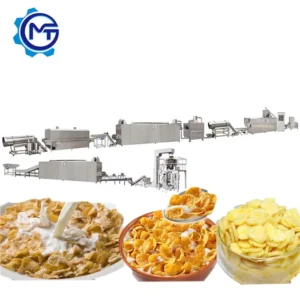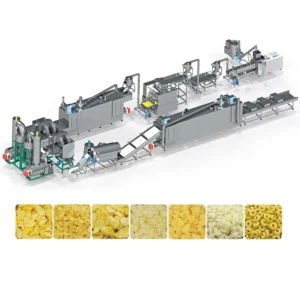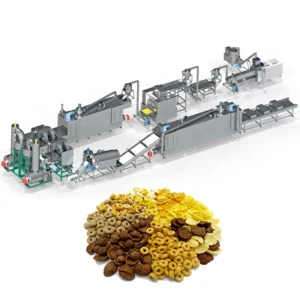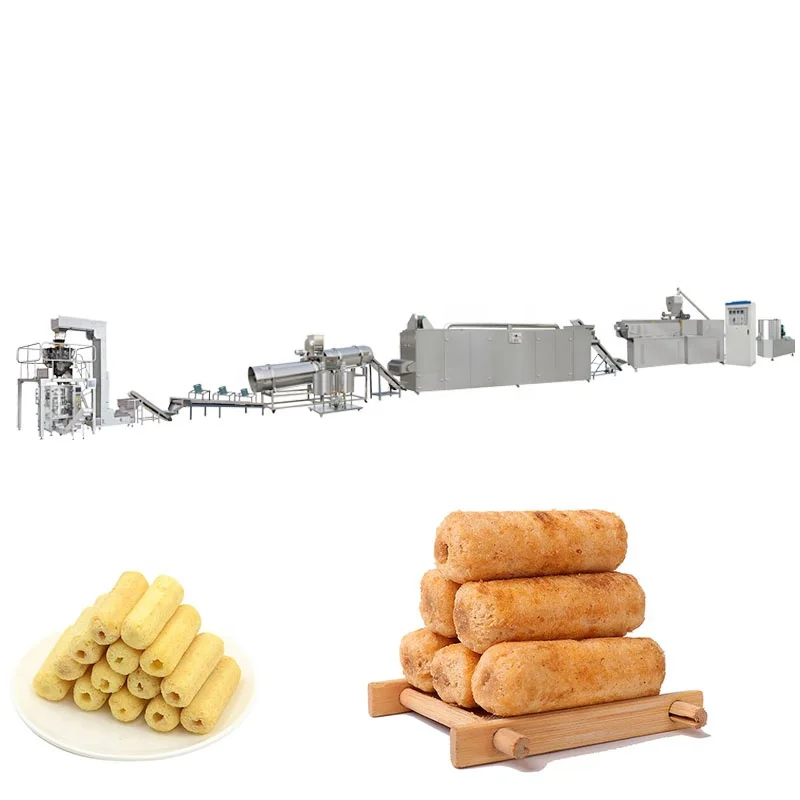


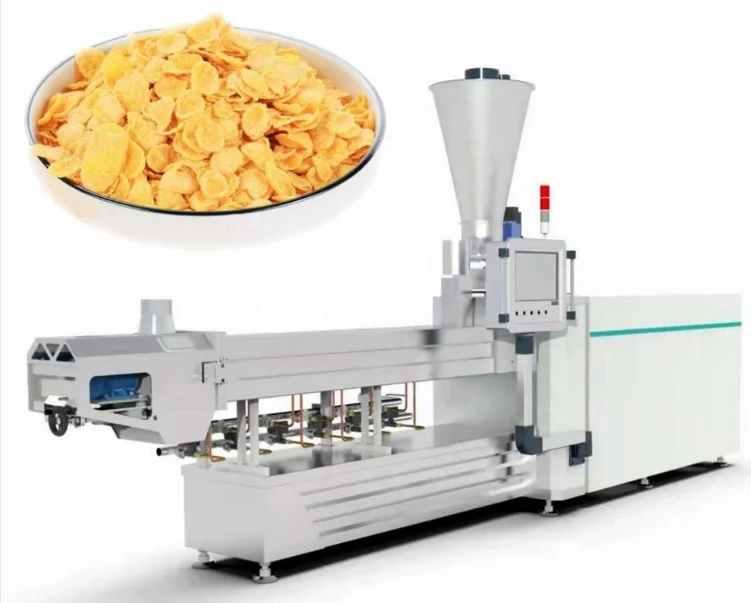
MT70 Corn Flakes Production Line, Twin-Screw Extruder, PLC Control — engineered for consistent starch gelatinisation and uniform flake density through matched screw configuration and die design to your raw material.
- Hot air roasting with dual circulating fans for even blistering
- Throughput balanced from batching through extruding, flaking, drying and coating
Trial runs on your actual material are completed in our testing workshop before shipment, with full configuration records and electrical schematics confirmed to your site voltage.
Description
Turnkey Project Execution — every station on the corn flakes processing line is sized and matched before build, so throughput holds from the mixer through the roaster without a downstream bottleneck.
Technical Specifications
| Parameter | Value |
|---|---|
| Product Type | Corn Flakes Production Line |
| Model Options | MT70 / MT85 / MT75 |
| Extruder Type | Twin Screw |
| Installed Power | 160 kW (MT70) / 190 kW (MT85) / 210 kW (MT75) |
| Power Consumption | 120 kW (MT70) / 140 kW (MT85) / 150 kW (MT75) |
| Output Capacity | 150–200 kg/h (MT70) / 300–400 kg/h (MT85) / 300–500 kg/h (MT75) (basis not stated in source — confirm raw material, moisture content, and target flake thickness) |
| Overall Dimensions | 41 × 1.5 × 2.2 m (MT70) / 43 × 1.5 × 3.2 m (MT85) / 45 × 1.5 × 3.5 m (MT75) |
| Control System | PLC and MCC |
| Dryer Heating Source | Gas or Electric |
| Flaking Machinery Drive | Double Motors with Separate Roller Driving, Hydraulic System |
| Flaking Temperature Control | Infrared Sensor |
| Roasting Oven | Hot Air with Conciliation Burner, Dual Circulating Fans, Cyclone Dust Removal |
| Coating System | Double Tumble for Sugar Melting, Elevator, Coating Drum, Spraying Nozzle |
| Final Product Shapes | Ball, Tube, Stick, Ring, Fruit Loop, Star, Wheel, Flower, Heart |
| Standards | CE, ISO |
Application Suitability
| Application | Material or Output |
|---|---|
| Natural Corn Flakes | Corn, Rice, Wheat, Oat, or Barley Powder through Mixing → Extruding → Flaking → Drying → Hot Air Roasting → Cooling → Packing |
| Sugar-Coated Corn Flakes | Same Grain Base with Additional Sugar Spraying, Sugar Coating, and Secondary Drying Stations |
| Alternate Shape Breakfast Cereal | Same Extrusion Platform Producing Rings, Balls, Stars, and Loops by Die Change |
What "Rated Output" Leaves Out About a Corn Flakes Production Line Turnkey
Capacity on paper means nothing until the extruder runs your actual grain blend.
I have watched lines arrive at a buyer’s facility, fully installed, only to stall at half the quoted throughput because the corn grits were coarser than the supplier assumed. The screw flights could not feed consistently, and the flaking rolls received an uneven stream. Fixing that after installation costs weeks of lost production. A corn flakes production line turnkey should be proven on your specific raw material before it ever leaves the factory [NEED_CITE: importance of material-specific extrusion trials for breakfast cereal lines].
Matching Screw Geometry to Your Grain Blend
The twin-screw extruder at the heart of this corn flakes production line turnkey accepts corn, rice, wheat, oat, and barley powder, but each grain behaves differently under heat and shear. Corn requires higher barrel temperatures and a specific compression ratio to achieve the starch gelatinisation that gives flakes their characteristic blister. Oat, with its higher fat content, needs a gentler shear profile to avoid oil separation inside the barrel. The screw configuration and die design are specified after reviewing the buyer’s actual material sample, not copied from a generic build.
Flaking and Roasting Where Texture Is Decided
Uniform flake thickness depends on the hydraulic double-roller system holding constant pressure while the infrared sensor monitors surface temperature in real time. If the rollers drift even slightly out of parallel, one side of the flake sheet compresses harder, producing uneven blisters after roasting. The hot air roasting oven uses a conciliation burner with two separate circulating fans so that heat distribution remains even across the full belt width, and the cyclone dust removal device keeps fines from recirculating onto the product surface [NEED_CITE: flaking roll alignment and blister consistency in corn flake production].
Reading the Specs That Actually Matter
The installed power figures — 160 kW for the MT70, scaling up to 210 kW for the MT75 — tell you the total energy available to motors, heaters, and controls, but power consumption running figures sit notably lower at 120 kW to 150 kW because the dryer and roaster cycle on and off depending on moisture targets. The overall line length stretching from 41 m to 45 m reflects the number of drying and cooling passes required to bring moisture down to a shelf-stable level without cracking the flakes. A shorter line footprint usually means fewer drying zones, which forces higher temperatures and risks case-hardening the product surface. The PLC control system manages barrel temperature zones, roller pressure, and roaster airflow from a single interface, so that batch-to-batch consistency does not depend on operator memory. The double-motor flaking drive allows each roller to be adjusted independently, which matters when you switch between a hard corn grit and a softer oat base that requires different nip pressures.
The Hidden Cost of Mismatched Stations
A buyer once assembled a cereal line by sourcing the extruder from one vendor and the dryer from another. The extruder ran fine on its own, but the dryer could not handle the moisture load coming off the flaker, so flakes arrived at the roaster still wet inside. The roaster then over-dried the surface trying to compensate, and the final product shattered during packing. Every station on a breakfast cereal line must be capacity-matched to the one before it, not specified in isolation [NEED_CITE: throughput balancing across extrusion, drying, and roasting stations].
Why Source the Full Line Here
The testing workshop inside the Shandong factory runs your actual raw material through the complete corn flakes production line turnkey before shipment, generating a trial run report that documents output, flake thickness, and moisture at every station. Screw configuration records are kept on file so that when wear parts need replacement, the exact flight arrangement is reproduced without guesswork. Electrical schematics confirm voltage, frequency, and control language before production starts, so the line does not sit idle waiting for a transformer or a translated HMI screen. Line layout documents show throughput calculations at each station, making it visible where capacity is matched and where buffer exists. Factory floor plans are designed around the buyer’s actual building dimensions rather than forcing a standard layout into a space that does not fit.
Documentation & Verification
- Line layout drawing with capacity calculation at each station from mixer to packer
- Trial run report on buyer’s grain blend documenting flake thickness and moisture targets
- Screw and die configuration record filed for future wear part replication
- Electrical schematic with confirmed voltage, frequency, and PLC language for target site
- CE declaration of conformity covering the full assembled line
Installation, Commissioning & Support
- Foundation plan accounts for the 41–45 m line length and vibrating flaking machinery load
- Power supply sized for up to 210 kW installed load with dedicated circuits for PLC and MCC panels
- Line arrives in sectioned modules for staged installation matching the buyer’s phased build schedule
- First-run commissioning verifies barrel temperature zones, hydraulic roller pressure, and roaster airflow balance
- Operator training covers die changes for alternate shapes and PLC recipe recall for different grain blends
- Wear parts list specifies screw flight segments, die inserts, and flaking roller shells with reorder intervals
Before You Request a Quote
Send the specific grain blend or flour composition you plan to run, including particle size distribution and typical moisture content at intake. Provide your factory floor dimensions with ceiling height, and confirm the local voltage and frequency so the electrical package is built correctly from the start. If you have existing upstream milling or downstream packing equipment, note the connection points so the line layout integrates cleanly.
Frequently Asked Questions
Q: How is line capacity verified against my specific raw material and moisture content?
A: Before shipment, the testing workshop runs your actual grain sample through the full corn flakes production line turnkey. The trial run report documents throughput, flake thickness, and moisture readings at each station. If the output does not meet the target on your material, the screw configuration or dryer settings are adjusted and retested until the line holds the agreed capacity under real conditions.
Q: How do you match throughput across extruder, dryer, flaker, roaster, and coater?
A: Each station is sized based on the mass flow leaving the extruder, including the moisture that must be removed. The line layout document shows calculated throughput at every point so that no single machine becomes a bottleneck. Dryer belt length, roaster fan capacity, and coating drum volume are all scaled to the extruder’s confirmed output on your material.
Q: What voltage, frequency, and control language options are confirmed before production?
A: The electrical schematic is reviewed and signed off before the build begins. Voltage and frequency are set to your local supply standard, and the PLC interface language is configured to match your operators. This confirmation step prevents commissioning delays caused by mismatched power supplies or unreadable control screens on site.
Q: Can the line produce both natural and sugar-coated corn flakes?
A: Yes. The natural line runs through mixing, extruding, flaking, drying, hot air roasting, cooling, and packing. For sugar-coated product, sugar spraying and coating stations with a secondary drying pass are added after roasting. The extruder and flaker remain the same, so switching between the two products requires only a change in the downstream station sequence.
Q: What does the pre-shipment trial run cover?
A: The trial run uses your raw material to produce a batch of finished flakes. The report includes extruder amperage, barrel temperature profile, flake thickness measurement, moisture content after drying and roasting, and visual blister quality. Screw and die settings used during the trial are recorded so the same configuration is shipped with the machine.
Related products
-
Corn Flakes Machine Breakfast Cereal Corn Flakes Production Line Cornflakes Making Machine
¥85,800.00 Select options This product has multiple variants. The options may be chosen on the product page -
Intelligent Corn Flakes Production Line Twin Screw Extruder to Make Corn Flakes amd Morning Cereals
¥30.00 Select options This product has multiple variants. The options may be chosen on the product page -
Automatic Commercial Breakfast Wheat Circle Corn Flake Production Line
¥65,000.00 Add to cart -
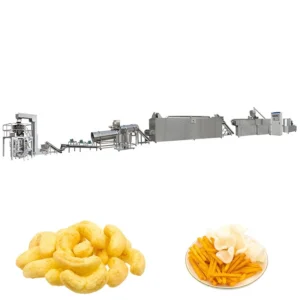
Corn Flake Making Machine Corn Puffs Making Machine Snack Food Production Line
Price range: ¥500.00 through ¥1,200.00 Select options This product has multiple variants. The options may be chosen on the product page