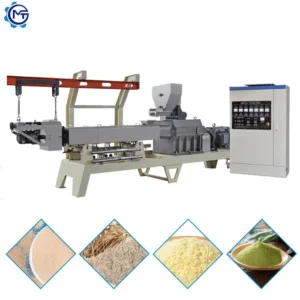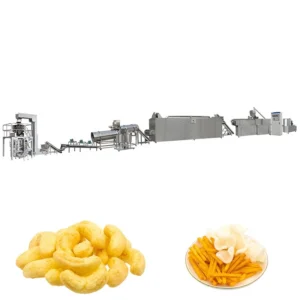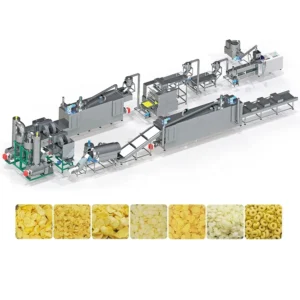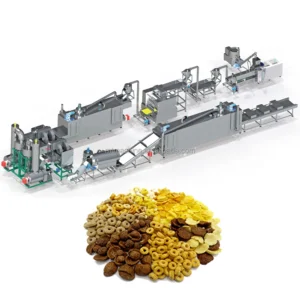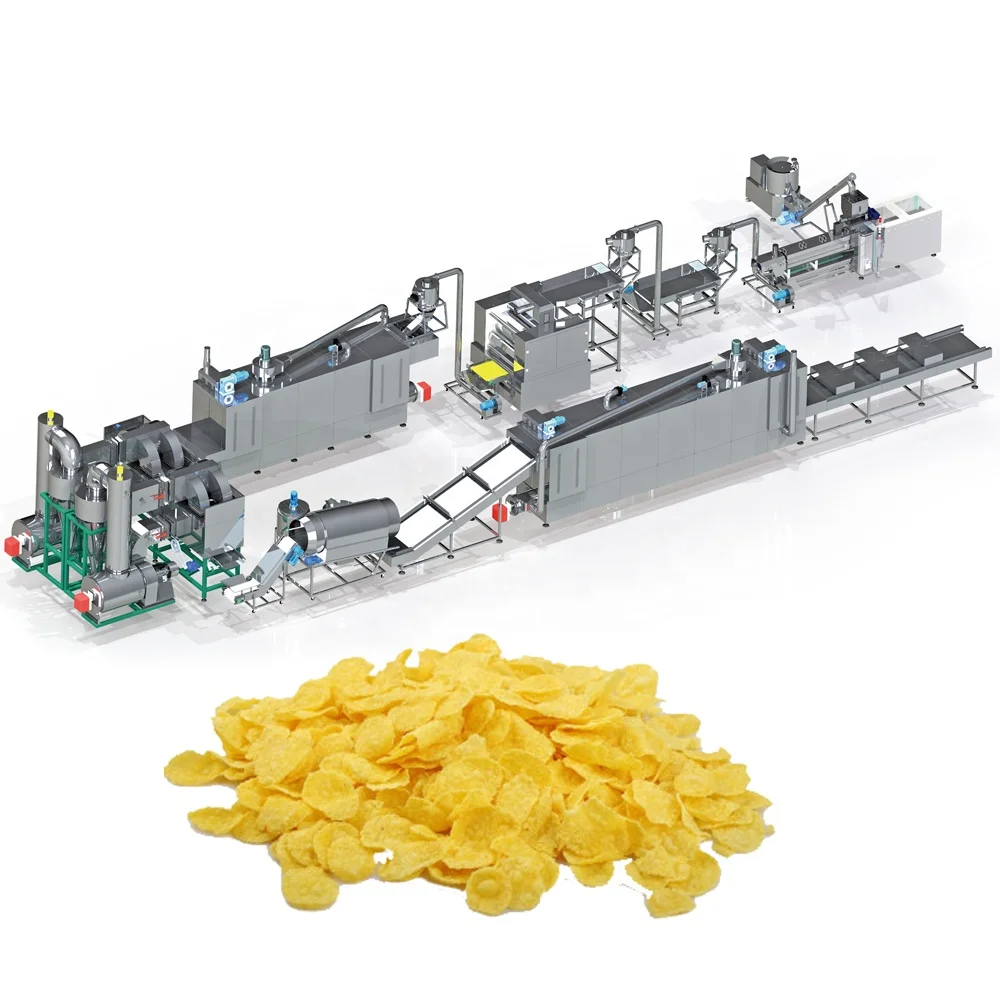


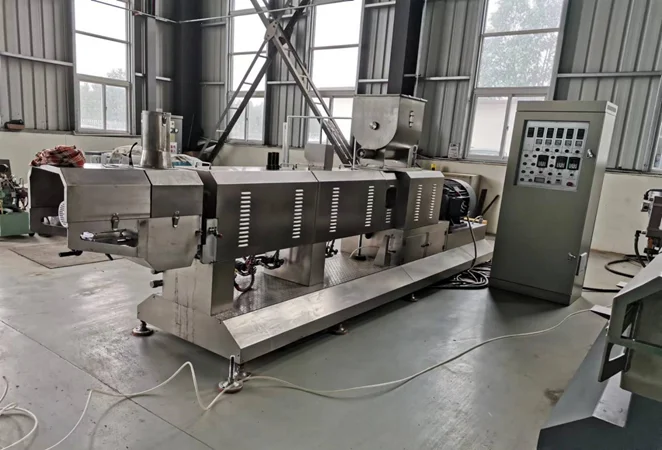


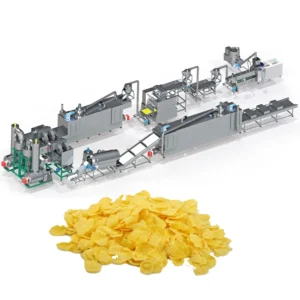
MT75 Corn Flakes Production Line, Twin Screw, 210 kW, PLC Control — complete turnkey layout from mixing to packing, with throughput matched at every station to prevent bottlenecks at drying or coating.
- Screw configuration and die design specified to your raw material and target flake density
- Hydraulic flaking unit with infrared temperature control and hot air roasting for consistent crispness
- Factory trial runs on your actual corn flour before shipment, with full test report provided
Description
Corn Flakes Production Line for Breakfast Cereals – Turnkey Solution
Throughput Alignment — every station from batching to packing is specified against the same raw material and target flake thickness, so no single machine dictates the line’s real output.
Technical Specifications
| Parameter | Value |
|---|---|
| Model | MT75 |
| Product Type | Corn Flakes Production Line |
| Screw Type | Twin Screw |
| Installed Power | 210 kW |
| Power Consumption | 150 kW |
| Output Capacity | 300–500 kg/h (basis not stated in source — confirm raw material, moisture content, and flake thickness) |
| Voltage | 380V / 220V (frequency to be confirmed) |
| Control System | PLC control system; MCC available per client specification |
| Overall Dimensions (L×W×H) | 45 × 1.5 × 3.5 m (customizable) |
| Weight | 5000 kg (source value — verify against manufacturer catalog) |
| Contact Material | Stainless Steel (food-grade) |
| Heating Source Options | Gas / Electric (dryer) |
| Line Stations | Mixing → Extruding → Flaking → Drying → Hot Air Roasting → Sugar Coating (optional) → Cooling → Packing |
| Standards | CE; ISO |
Application Suitability
| Application | Material or Output |
|---|---|
| Natural corn flakes for breakfast cereal packaging | Corn flour, corn grits |
| Sugar-coated and honey-coated corn flakes | Corn base with sugar, honey, or chocolate coating |
| Shaped breakfast cereals (loops, stars, rings, wheels) | Corn, rice, wheat, oat, or barley flour blends |
| Fortified cereal flakes for institutional nutrition programs | Grain flour with added vitamin and mineral premix |
| Aquatic and pet food flake formats (line adaptable) | Grain and protein meal blends |
Why "500 kg/h" Means Nothing Without the Raw Material Story
A capacity figure is only as honest as the test conditions behind it.
I once watched a corn flakes line in a Dubai facility stall at barely half its quoted throughput. The extruder was rated for standard dent corn, but the buyer had sourced a high-amylopectin variety locally. The dough wouldn’t gelatinize properly at the preset barrel temperatures, and the flakes came off the rollers tearing instead of sheeting. Three days of re-tuning screw speed and die clearance later, the line finally ran — but the nameplate capacity number never applied to that material. This is the gap that turns a corn flakes production line turnkey project into a commissioning nightmare [NEED_CITE: raw material variability in grain extrusion processes].
Screw Configuration and Die Design for Flake Integrity
The twin-screw extruder at the heart of this corn flakes production line turnkey system is not a fixed-geometry machine. Screw elements are selected and sequenced based on the starch composition, particle size, and moisture content of your specific flour blend. The die opening is then matched to produce a rope or sheet of the correct density and moisture level for the downstream flaking rollers. A generic screw build copied from a different product category will either over-work the dough — destroying the granular structure needed for a crisp flake — or under-cook it, leaving a raw center that the roasting oven cannot fix.
Flaking and Roasting: Where Texture Is Won or Lost
The hydraulic double-roller flaking unit uses independent motors for each roller and an infrared sensor for temperature monitoring. This matters because uneven roller temperature causes one side of the dough sheet to stick while the other releases, producing flakes with inconsistent thickness. Downstream, the hot air roasting oven uses a vibrating pan with high-temperature spraying tubes and two separate circulating fans to control surface blistering. The cyclone dust removal device captures fine particles before they can scorch inside the chamber. Getting the roasting profile right is what separates a flake that stays crisp in milk from one that turns to mush within seconds [NEED_CITE: moisture migration in toasted cereal flakes].
Reading the Specs That Actually Matter
Installed power of 210 kW with running consumption around 150 kW tells you the thermal and mechanical headroom available — a line that draws close to its installed ceiling has no buffer for harder materials or colder ambient conditions. The 45-meter line length is a floor-planning constraint that determines whether the corn flakes production line turnkey layout fits your existing building or requires a new structure. The PLC control system coordinates every station from mixing through packing, meaning recipe changes — switching from natural to sugar-coated, or from corn to a multi-grain blend — are managed through saved parameter sets rather than manual re-adjustment at each machine. Voltage at 380V or 220V must be confirmed against your site supply and local frequency before electrical panels are built.
The Hidden Cost of Mismatched Downstream Equipment
An extruder running at full output means nothing if the dryer cannot remove moisture fast enough, or if the coating drum cannot tumble the volume without crushing the flakes. When stations are sourced from separate vendors, each one quotes based on their own machine’s nominal rating — not on the actual throughput arriving from the previous station. The result is a bottleneck that no amount of operator skill can overcome, and a line that runs at the speed of its weakest link [NEED_CITE: throughput balancing in multi-vendor food processing lines].
Why Procurement Starts with the Whole Line
Every station on this line — mixing, extruding, flaking, drying, roasting, coating, cooling, packing — is specified by one supplier against the same production target. The screw configuration record is written for your flour blend, not borrowed from a generic template. The flaking rollers and roasting oven are sized to handle the exact moisture and mass flow leaving the extruder. Factory trial runs use your actual raw material before shipment, producing a test report that documents real flake thickness, expansion, and texture. On-site installation includes commissioning and operator training so your team can reproduce the trial results independently. Electrical schematics and control language are confirmed for your market before the panels are wired.
Documentation & Verification
- Line layout drawing with throughput calculations matched to your target flake output
- Screw and die configuration record specific to your grain flour blend
- Factory trial run report on your raw material documenting flake thickness and texture
- Electrical schematic with voltage and frequency confirmed for your site
- CE declaration of conformity and ISO certificate for customs and compliance
- Operation and maintenance manual with wear parts list for screws, dies, and roller surfaces
Installation, Commissioning & Support
- Foundation must accommodate a 45-meter line footprint with level tolerance for flaking roller alignment
- Dedicated electrical circuit required for 210 kW installed load at confirmed voltage and frequency
- PLC control system configured with operator interface language before dispatch
- First production run supervised on-site with parameter logging against factory trial baseline
- Operator training covers recipe switching between natural and coated cereal formats
- Wear parts inventory includes replacement screw elements, die plates, and roller surfaces
What We Need to Quote Accurately
Share your primary grain flour type, any blending ratios, and the target flake thickness and bowl-life expectation. Confirm your site voltage, frequency, and available floor length and ceiling height. Let us know whether sugar coating or multi-shape cereal formats are in your launch plan so the coating drum and die set are included from the start.
Frequently Asked Questions
Q: How is the 300–500 kg/h output capacity verified before shipment?
A: We run your actual raw material through the line in our testing workshop. The trial report documents throughput at specific moisture content, flake thickness, and screw speed settings. Capacity is only confirmed against the conditions your factory will reproduce, not against a generic benchmark material.
Q: How do you ensure the dryer and coater keep up with extruder output?
A: Every station is calculated against the same mass flow and moisture removal requirement. The dryer belt speed, oven temperature zones, and coating drum volume are all specified to match the extruder’s verified output, eliminating the bottleneck risk that comes from multi-vendor line assembly.
Q: Our factory has limited floor space — can the 45-meter layout be adapted?
A: The line layout is configurable. We review your building dimensions and ceiling height during the proposal stage, then arrange stations — including dryer returns and cooling conveyors — to fit the available footprint while maintaining the access clearances needed for maintenance and sanitation.
Q: What happens during on-site commissioning and how long does training take?
A: Our engineer supervises mechanical assembly, utility connection, and the first production runs using your local raw material. Operator training covers PLC recipe management, screw and die changes, flaking roller adjustment, and daily maintenance procedures so your team can run independently before our engineer departs.
Q: Can this line produce shapes beyond flat corn flakes?
A: Yes. By changing the die plate on the twin-screw extruder, the same line can produce loops, stars, rings, tubes, and other breakfast cereal shapes. The flaking station is bypassed for shaped products, and the roasting oven parameters are adjusted accordingly.
Related products
-
Kelloggs Corn Flakes Breakfast Cereal Normal Making Machine Breakfast Cereal Extruder Production Line
¥30,000.00 Select options This product has multiple variants. The options may be chosen on the product page -

MT Cocoa Flour Puffed Breakfast Cereal Production Line-High Large Capacity Multi-Fuel (Steam/Gas/Electric) New Shandong Origin
¥8,000.00 Select options This product has multiple variants. The options may be chosen on the product page -
Sweet Corn Flakes Maize Breakfast Cereal Full-automatic Food Grade Stainless Steel Heat Exchanger Mixer Fryer Processing Line
¥8,000.00 Add to cart -
New High Efficiency Electric Corn Flakes Production & Manufacturing Machine
¥7,500.00 Select options This product has multiple variants. The options may be chosen on the product page