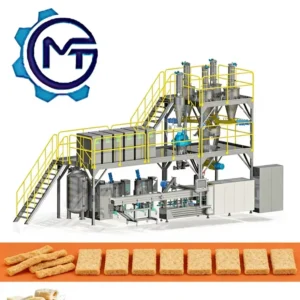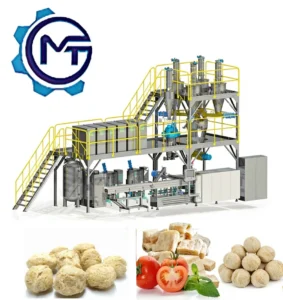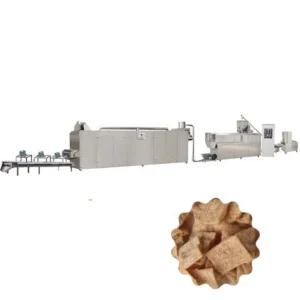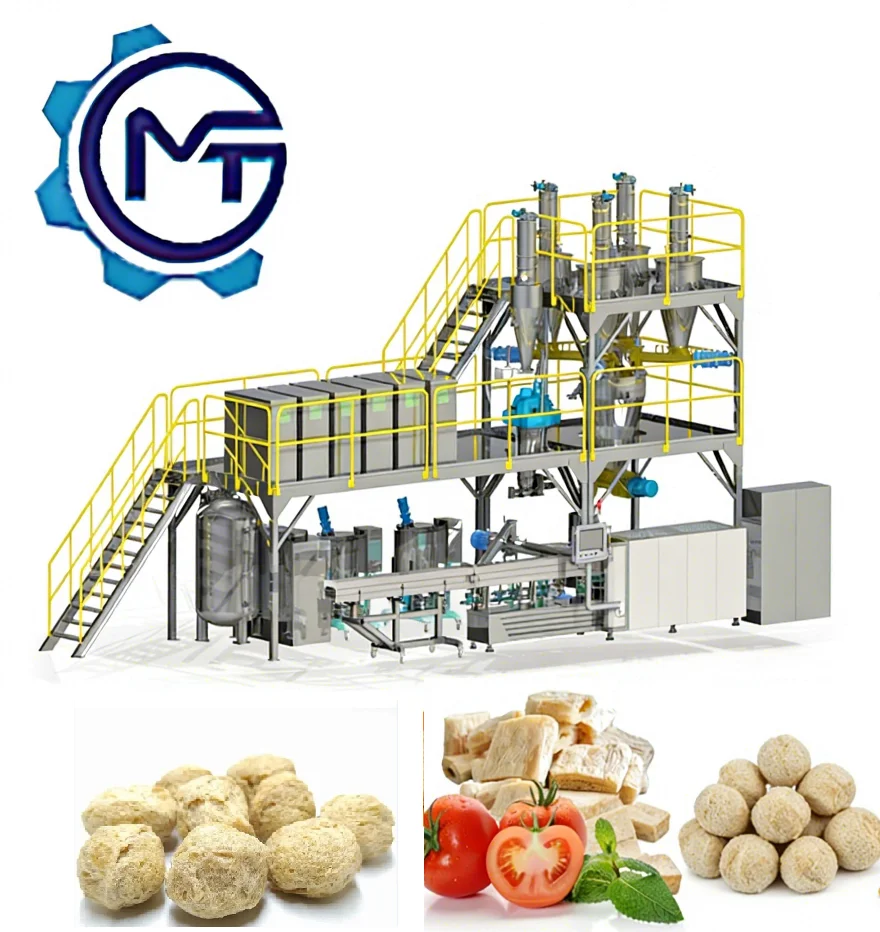


MT65 / MT70 / MT75 / MT85 Plant Based Meat Processing Line, Twin-Screw, CE & ISO Certified — configured for TVP and soya chunk extrusion from defatted soya flour. Screw configuration and die design are matched to your raw material and target fiber structure, with a multi-layer dryer sized to align throughput across every station. In-house trial runs on your actual formulation are conducted before shipment, backed by on-site installation, commissioning and operator training.
Description
Station-to-Station Throughput Alignment — every mixer, extruder, dryer and cooler in the line is sized to the same verified output, preventing the bottlenecks that appear when a plant-based meat production line turnkey is assembled from separate vendors.
Technical Specifications
| Parameter | Value |
|---|---|
| Product Type | Texturized Vegetable Protein (TVP) / Plant-Based Meat Extrusion Line |
| Model Options | MT65 / MT70 / MT75 / MT85 |
| Installed Power | 84 kW (MT65) / 160 kW (MT70) / 190 kW (MT75) / 210 kW (MT85) |
| Power Consumption | 59 kW (MT65) / 120 kW (MT70) / 140 kW (MT75) / 140 kW (MT85) |
| Output Capacity | 100-150 kg/h (MT65) / 150-200 kg/h (MT70) / 150-200 kg/h (MT75) / 250-300 kg/h (MT85) (basis to be confirmed) |
| Overall Dimensions (L×W×H) | 40000×1200×2200 mm (MT65) / 41000×1500×2200 mm (MT70) / 43000×1500×3200 mm (MT75) / 45000×1500×3500 mm (MT85) |
| Screw Type | Twin Screw |
| Main Motor Power | 22 kW / 30 kW / 45 kW |
| Feeding Motor Power | 0.75 kW |
| Rotary Cutting Motor Power | 0.75 kW |
| Mixer Type | Vertical mixer with stainless steel 304 mixing ruler |
| Mixer Capacity Options | 20-30 kg / 70-80 kg / 170-180 kg |
| Mixer Power Options | 4 kW / 7.5 kW / 15 kW |
| Dryer Drive | Double pitch roller chain drive, round-trip drying |
| Dryer Energy Options | Fuel / Gas / Electricity (selectable) |
| Line Stations | Mixer → Screw Conveyor → Twin Screw Extruder → Air Conveyor → Multi-layer Dryer → Cooling Machine |
| Standards | CE, ISO |
Application Suitability
| Application | Material or Output |
|---|---|
| Texturized vegetable protein (TVP/TSP) | Defatted soya flour, low temperature soya flakes |
| Soya chunks and nuggets | Soya protein concentrate, binding agents |
| Plant-based meat analogues | Blended plant protein with layer fiber structure |
| Soybean protein blocks | High-protein soya formulations requiring fibrous texture |
| Adapted cereal and snack formats | Grain-based recipes with adjusted screw configuration |
Why "Nominal Capacity" Is the Wrong Starting Point for a Plant Based Meat Processing Line
Capacity must be verified on your actual defatted soya flour formulation before the line ships.
A plant based meat production line turnkey quoted on a generic output figure often fails to hold that throughput once your specific raw material enters the barrel. Defatted soya flour behaves differently from batch to batch depending on protein content, particle size and residual oil, and a screw configuration copied from a standard build cannot compensate for those variables. When the extruder cannot maintain target output, the downstream dryer runs below design load, the cooler receives uneven product flow, and the entire line settles at a fraction of its nameplate rating [NEED_CITE: twin-screw extrusion behaviour on varying soya flour protein content].
Matching Screw Geometry to Soya Protein Fiber Development
The twin-screw extruder at the core of this plant based meat production line turnkey uses a screw configuration and die design specified to your raw material and target fiber structure. Soya protein requires controlled shear and a defined residence time inside the barrel to unfold and realign into the layered fibrous texture that characterises convincing meat analogues. Screw element sequencing — the arrangement of conveying, kneading and reverse elements — determines that shear profile and is adjusted during the pre-shipment trial run.
Dryer Sizing That Follows the Extruder, Not the Other Way Around
The multi-layer dryer uses a double pitch roller chain drive for round-trip drying, with temperature and drying time adjustable to the moisture content exiting the extruder. Energy source is selectable between fuel, gas and electricity depending on the buyer’s facility. When dryer capacity is undersized relative to extruder output, product backs up at the air conveyor transfer point, and moisture variation across the bed produces inconsistent texture in the finished TVP. Throughput matching across every station prevents this failure mode [NEED_CITE: moisture removal rates in multi-layer belt dryers for extruded protein].
Reading the Power and Dimension Data for Facility Planning
Installed power ranges from 84 kW on the MT65 to 210 kW on the MT85, with actual power consumption rated lower at 59 kW to 140 kW depending on model. The gap between installed and consumed power reflects motor starting loads and heating element cycling rather than continuous draw. Overall line length extends from 40 metres on the MT65 to 45 metres on the MT85, with width and height increasing across the range to accommodate larger dryer beds and higher cooling conveyor volumes. These dimensions define the minimum workshop footprint and must be confirmed against your available floor space and ceiling height before layout finalisation.
The Cost of Skipping the Pre-Shipment Trial Run
When a plant based meat processing line ships without a trial run on the buyer’s actual raw material, product development begins only after installation. Screw configuration changes that would have taken hours in the factory testing workshop instead require days of on-site adjustment, with raw material waste accumulating during each iteration. Die designs that produce the wrong kibble density or fiber alignment in TVP cannot be corrected without replacement tooling, adding weeks of delay [NEED_CITE: extrusion die design impact on texturized protein fiber structure].
Why a Single Supplier for Every Station Matters
This plant based meat production line turnkey is configured from batching through extrusion to cooling under one supplier, so throughput is matched across every station rather than assembled from separate vendors. Screw configuration and die design are specified to your raw material and target product. An in-house testing workshop conducts trial runs on your defatted soya flour before shipment. Pre-sales consultation covers line layout, utility planning and phased installation scheduling. On-site commissioning includes operator training and a wear parts handover so the first screw and die replacement is planned, not emergency-ordered.
Documentation & Verification
- Line layout and capacity calculation with throughput matched across mixer, extruder, dryer and cooler
- Screw and die configuration record specified to your soya flour formulation and target fiber structure
- Trial run report on your raw material conducted in the testing workshop before shipment
- Electrical schematic with voltage and frequency confirmed to your facility supply
- Operation and maintenance manual with wear parts list for screw elements and die plates
- CE declaration of conformity and ISO certificate for customs and regulatory compliance
Installation, Commissioning & Support
- Foundation requirements confirmed against overall line length of up to 45 metres and dryer height of 3.5 metres
- Electrical supply verified against installed power rating up to 210 kW before cable procurement
- Station-by-station assembly sequence from mixer through cooling machine with utility connection schedule
- First production run supervised with screw speed, barrel temperature and dryer settings documented
- Operator training covering screw element replacement intervals and die cleaning procedures
- Wear parts list provided with recommended spare quantities for screws, dies and mixer rulers
Preparing Your Line Enquiry
A plant based meat production line turnkey requires your defatted soya flour specification sheet, including protein percentage and particle size distribution, along with your target daily output in kilograms of finished TVP. Provide your facility voltage, frequency and preferred control language so electrical schematics are confirmed before production begins. If you have existing upstream batching or downstream packing equipment, share the interface dimensions and throughput so the line is matched at both boundaries.
Frequently Asked Questions
Q: How is output capacity verified on my specific defatted soya flour formulation before shipment?
A: Your raw material is run through the twin-screw extruder in the in-house testing workshop using the screw configuration and die design specified for your formulation. Output is measured across a sustained run, and the trial run report documents throughput, product texture and fiber structure achieved. Any screw element adjustments needed to reach target capacity are completed before the line ships.
Q: How do you ensure throughput is matched between the extruder, dryer and cooler so no station bottlenecks the line?
A: The line layout and capacity calculation document specifies the design throughput for every station — mixer batch cycle, extruder kg/h rating, dryer belt speed and moisture removal rate, cooler conveyor volume. Each station is sized to handle the same verified output, and this document is provided for your review before production begins.
Q: What voltage, frequency and control language options are confirmed before production begins?
A: The electrical schematic is finalised with your facility voltage and frequency before the control cabinet is wired. Control language is confirmed at the same stage so the operator interface matches your production team’s requirements. This confirmation is documented in the specification sheet and prevents commissioning delays caused by incompatible power supply or unreadable menus.
Q: How is screw configuration and die design selected for my target TVP fiber structure and density?
A: Screw element sequencing — the ratio of conveying, kneading and reverse elements — is chosen based on the shear and residence time required to develop fiber structure from your specific soya flour. Die geometry controls the expansion and density of the extrudate. Both are adjusted during the pre-shipment trial run until the target texture is achieved, and the final configuration is recorded in your documentation package.
Related products
-
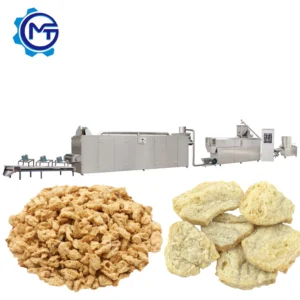
Meat Taste Textured Soybean Protein Processing Machine Vegetable Protein Soy Meat Making Machine
¥8,650.00 Select options This product has multiple variants. The options may be chosen on the product page -
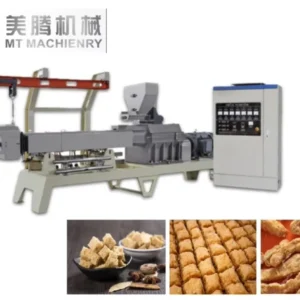
Twin Screw Extruder for High Moisture Vegetarian Meat
¥9,500.00 Select options This product has multiple variants. The options may be chosen on the product page -
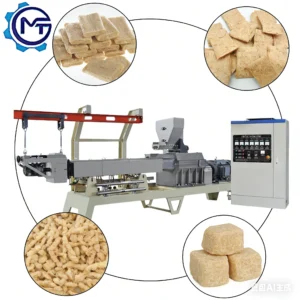
Twin Screw Extruder for Textured Vegetable Protein (TVP)
¥9,500.00 Select options This product has multiple variants. The options may be chosen on the product page -
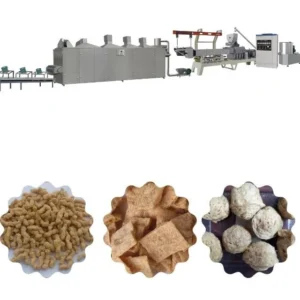
High Productivity Single Screw Extruder Machine New Condition Textured Soya Meat & Soy Protein Like Meat Making Machine
Price range: ¥20.00 through ¥30.00 Select options This product has multiple variants. The options may be chosen on the product page