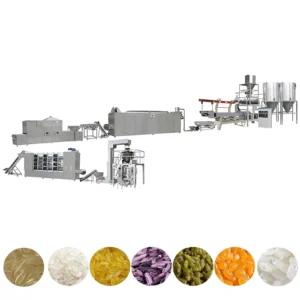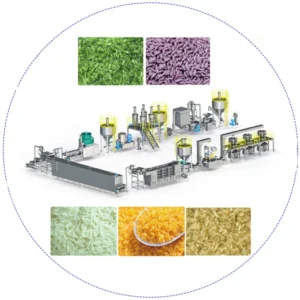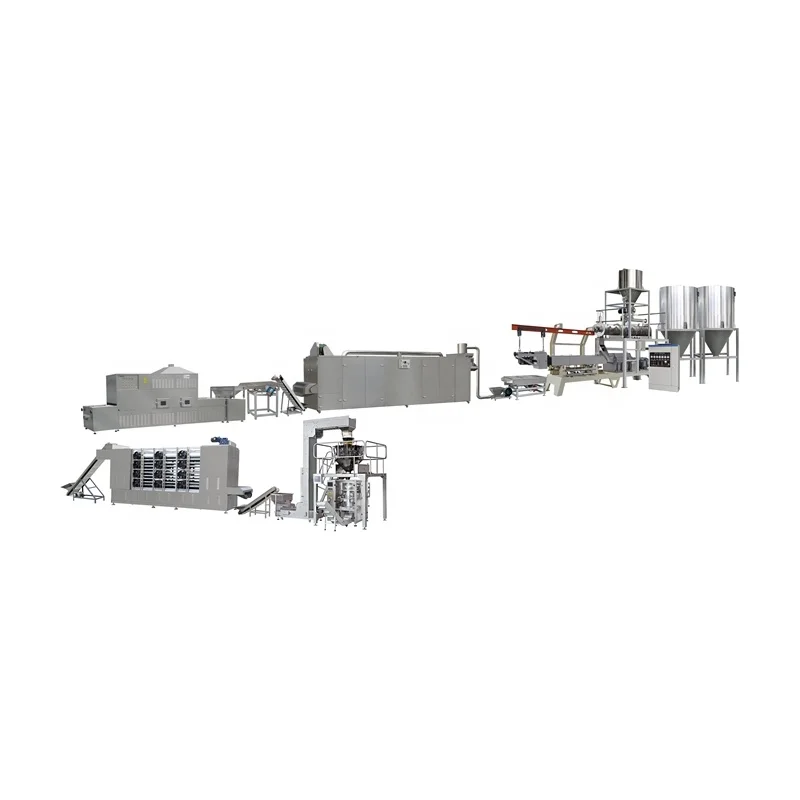
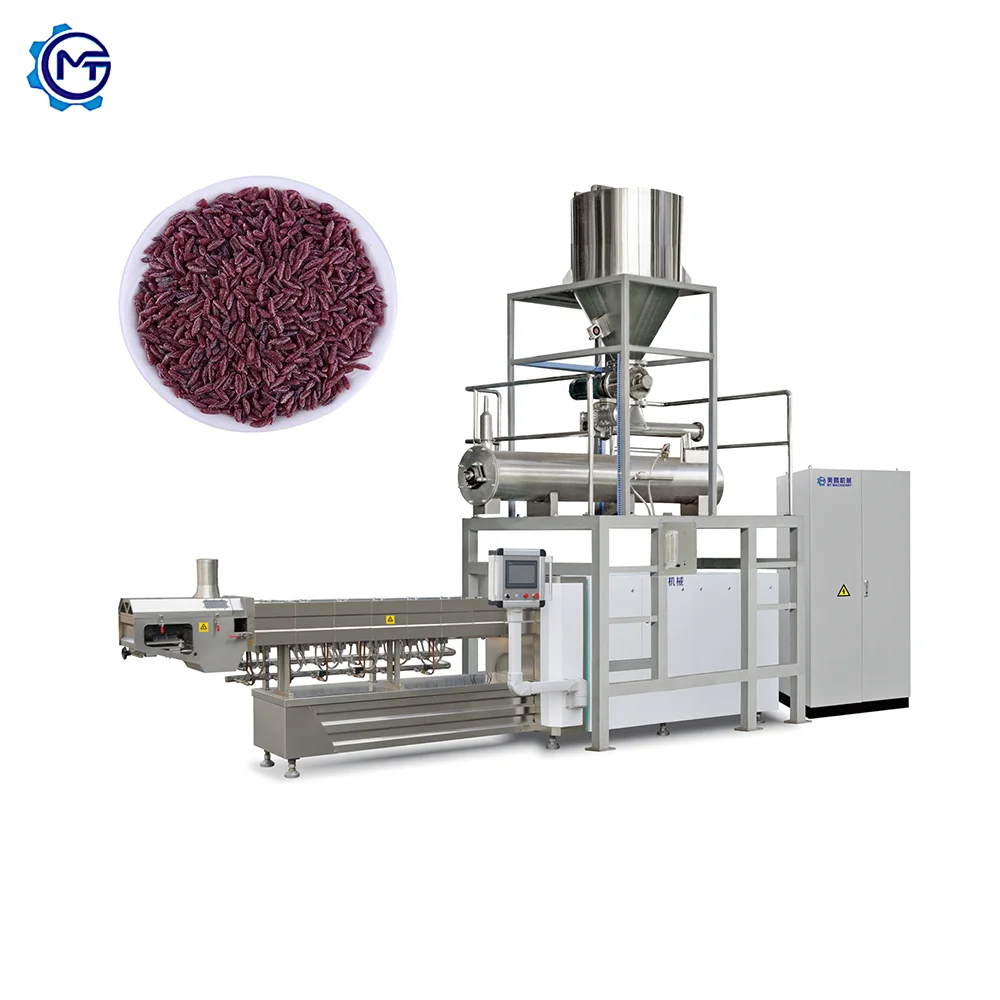


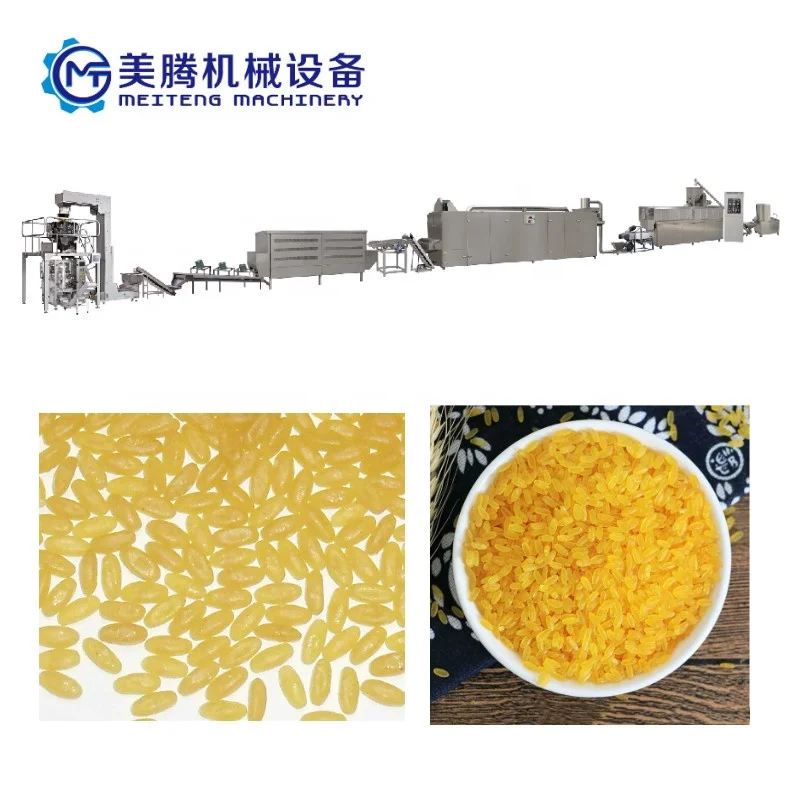

MT65, MT70, MT85, MT75, MT95 Fortified Rice Kernel Extrusion Line, Twin-Screw, PLC Control — engineered as a complete turnkey project from batching through extrusion, drying, roasting, cooling, and packing. Screw configuration and die design are matched to your specific broken rice or multi-grain formulation, ensuring kernel density, shape, and nutritional retention meet target specifications across every processing stage.
- Single or double screw feeding selected to your raw material behavior
- Frequency-controlled drying oven with circulation airflow for uniform moisture removal
- Line throughput matched across all stations to hold rated output on your actual formulation
Trial runs on your raw material are conducted in our in-house testing workshop before shipment, with a full report confirming kernel integrity and process parameters.
Description
Throughput-Matched Turnkey Integration — Every station from batching to packing is engineered as one project, so a fortified rice kernel production line turnkey holds its rated output on your actual broken rice or multi-grain formulation without bottlenecking at the dryer or roaster.
Technical Specifications
| Parameter | Value |
|---|---|
| Product Type | Fortified Rice Kernel Extrusion Line |
| Models Available | MT65 / MT70 / MT85 / MT75 / MT95 |
| Screw Type | Twin-screw extruder |
| Installed Power (MT65) | 85 kW |
| Power Consumption (MT65) | 60 kW |
| Installed Power (MT70) | 120 kW |
| Power Consumption (MT70) | 85 kW |
| Installed Power (MT85) | 235 kW |
| Power Consumption (MT85) | 165 kW |
| Installed Power (MT75) | 180 kW |
| Power Consumption (MT75) | 135 kW |
| Installed Power (MT95) | 260 kW |
| Power Consumption (MT95) | 195 kW |
| Capacity (MT65) | 80–100 kg/h (basis not stated in source — confirm raw material formulation and moisture content) |
| Capacity (MT70) | 100–120 kg/h (basis not stated in source — confirm raw material formulation and moisture content) |
| Capacity (MT85) | 200–300 kg/h (basis not stated in source — confirm raw material formulation and moisture content) |
| Capacity (MT75) | 300–500 kg/h (basis not stated in source — confirm raw material formulation and moisture content) |
| Capacity (MT95) | 800–1000 kg/h (basis not stated in source — confirm raw material formulation and moisture content) |
| Overall Dimensions (MT65) | 28 × 1.2 × 2.2 m |
| Overall Dimensions (MT70) | 30 × 1.5 × 2.2 m |
| Overall Dimensions (MT85) | 34 × 3.5 × 4.3 m |
| Overall Dimensions (MT75) | 32 × 3.5 × 4.3 m |
| Overall Dimensions (MT95) | 36 × 3.5 × 4.3 m |
| Control System | Frequency speed controlling with high automation |
| Feeding System | Single or double screw feeding, selected according to material characteristics |
| Screw Material | Special wear-resistant alloy |
| Lubrication | Automatic lubricating and cooling system |
| Line Stations | Mixing → Extruding → Vibrating → Low Temperature Drying → Cooling → High Temperature Roasting → Cooling → Packing |
| Dryer Heating Source | Electric or gas |
| Dryer Feature | Circulation drying, frequency motor-controlled mesh belt speed |
Application Suitability
| Application | Material or Output |
|---|---|
| Government & NGO micronutrient rice programmes | Broken rice and rice flour base with vitamin-mineral premix |
| Grain deep-processing enterprises | Broken rice, rice bran, corn, millet, wheat, oats, buckwheat blends |
| Instant rice manufacturers | Starch and bean flour blends with added micro-nutrients for retail or institutional markets |
What "Rated Capacity" Actually Means on Your Raw Material
A line only delivers its quoted output when every station is balanced to your specific formulation, not to a generic test grain.
I spent four days on a factory floor in West Africa watching an entire nutritional powder line sit idle because the extruder screw profile had been set for standard rice flour while the customer’s blend contained a heavy share of cassava starch. The gelatinisation window shifted, the extrudate clumped coming out of the die, and the downstream dryer could not keep up. Nobody had run the actual raw material before the machines left the factory. That is the gap a properly specified fortified rice kernel production line turnkey is designed to close — the extruder, dryer, roaster, and cooler must all be matched to the thermal and moisture behaviour of your exact blend before a single crate is loaded [NEED_CITE: starch gelatinisation temperature ranges by grain type].
Station-to-Station Throughput Alignment
On a complete fortified rice kernel production line turnkey, the extruder sets the pace, but the dryer and roaster determine whether that pace can be sustained. If the mesh belt speed on the dryer is too slow for the extruder output, wet kernels pile up, stick together, and lose their shape. If the roaster runs faster than the cooler can handle, residual heat causes post-packaging condensation inside the bags. Each station’s throughput must be calculated against the moisture curve of the specific grain blend being processed.
Formulation-Specific Screw and Die Configuration
Twin-screw extrusion relies on the interaction between screw element geometry and the shear sensitivity of the raw material. Broken rice behaves differently from a corn-millet blend: it requires a different compression ratio inside the barrel and a different die aperture to form a clean kernel shape. The screw configuration and die design are specified to the buyer’s raw formulation and target kernel dimensions, then documented before production begins so the setup is fully repeatable across future batches [NEED_CITE: twin-screw element arrangement and residence time in food extrusion].
Power, Dimensions, and Feeding System Breakdown
The MT65 through MT95 models span installed power from 85 kW to 260 kW, with overall line lengths from 28 m to 36 m. Power consumption sits roughly 30% below installed capacity across the range, reflecting the draw of the frequency-controlled motors under normal running load. The feeding system — single or double screw — is selected based on whether the raw blend contains fine premix powders that tend to bridge in the hopper or coarser grits that flow freely. This choice directly affects feed consistency into the barrel, which in turn determines whether the extrudate density stays uniform over a long production run. The automatic lubricating and cooling system keeps the screw shaft within operating temperature during continuous shifts, reducing unplanned stops for thermal-related wear [NEED_CITE: continuous-duty lubrication requirements for twin-screw food extruders].
The Cost of Skipping Pre-Shipment Validation
When a line ships without a trial run on the buyer’s actual raw material, commissioning becomes product development. Engineers adjust screw combinations, barrel temperatures, and dryer belt speeds on-site while raw material is already in the silos and packaging is already printed. Delays compound: operators are trained on temporary settings that later change, spare wear parts are ordered for the wrong screw profile, and the first commercial batch rarely meets specification. Factories that have experienced this describe weeks of lost production before the line stabilises to a consistent output quality.
Why Procure the Full Line from One Project Supplier
Every station — mixing, extruding, vibrating, low-temperature drying, cooling, high-temperature roasting, cooling, and packing — is supplied under a single project scope, so throughput calculations are done once against the same formulation rather than negotiated across multiple vendors. Screw and die configurations are recorded and filed, making reorder of wear parts straightforward. The in-house testing workshop allows a full trial run on the buyer’s raw material before shipment, producing a documented report that covers kernel shape, density, and moisture at each station. Electrical schematics and voltage specifications are confirmed to the destination market before the control panels are wired, avoiding on-site rewiring during commissioning. Operator training is scheduled as part of the installation phase, not as an afterthought.
Documentation & Verification
- Line layout and capacity calculation showing throughput matching across all stations for your selected model
- Trial run report on your actual raw material confirming kernel shape, density, and moisture before dispatch
- Screw and die configuration record matched to your specific grain blend and premix ratio
- Electrical schematic with voltage, frequency, and control language confirmed to your factory supply
- CE declaration of conformity and ISO certificate included with shipping documentation
- Operation and maintenance manual with wear parts list and replacement intervals
Installation, Commissioning & Support
- Foundation and floor space planning based on line dimensions from 28 m to 36 m depending on model selected
- Dedicated electrical circuit sized to installed power up to 260 kW with voltage and frequency matched to local grid
- Modular station delivery with on-site assembly sequence scheduled to avoid production hall conflicts
- First-run parameter setting on your raw material covering barrel temperature profile, dryer belt speed, and roaster dwell time
- Operator training covering feeding system adjustment, PLC interface navigation, and daily lubrication checks
- Wear parts inventory recommendation covering screws, dies, and mesh belt segments for the first replacement cycle
Preparing Your Project Inquiry
To move from initial enquiry to line configuration proposal, share your raw material formulation including the percentage of broken rice, secondary grains, and micronutrient premix. Specify the target kernel shape and size, the daily production volume you need the line to sustain, and the electrical supply available at your facility including voltage, frequency, and preferred control language. If you have existing upstream milling or downstream packing equipment, include those details so the line boundaries can be defined precisely.
Frequently Asked Questions
Q: How is the line capacity verified on my specific raw material formulation?
A: Capacity figures in the specification table are reference ranges. Actual throughput depends on your grain blend, moisture content, and premix ratio. Before quotation, we calculate the output based on your formulation data, then validate it with a trial run in our testing workshop where kernel shape, density, and moisture are measured at every station.
Q: What screw configuration and die design will be specified for my blend?
A: The screw element arrangement and die aperture are selected based on your raw material’s starch composition and the target kernel dimensions. A configuration record is created and filed before production so the setup is repeatable, and replacement screws and dies can be ordered with exact specifications.
Q: Can a trial run be conducted on my raw material before shipment?
A: Yes. The trial run uses your actual formulation in the in-house testing workshop. The resulting report documents extrudate shape, moisture content after drying, kernel integrity after roasting, and any adjustments made to screw profile or temperature settings before the line is cleared for dispatch.
Q: How is voltage, frequency, and control language confirmed for my factory?
A: During the specification confirmation stage, your electrical supply details and operator language preference are recorded. The control panels are then wired and labelled to match before the line leaves the factory, so commissioning does not require on-site rewiring or reprogramming.
Q: What does the installation and commissioning schedule include?
A: The schedule covers station-by-station assembly, utility connections, first-run parameter setting on your raw material, and operator training on the feeding system, extruder controls, dryer and roaster adjustment, and daily maintenance routines. Wear parts and ongoing support are addressed before the engineering team leaves site.
Related products
-

Full Automatic Complete Baby Food Nutrition Powder Porridge Processing Production Line for Infant Nutrition Factory
¥9,500.00 Add to cart -

High Quality Automatic PLC Controlled 500kg/h Twin Screw Extruder Machine for Baby Rice Nutrition Powder
¥8,238.27 Add to cart -
Hygienic Stainless Steel Infant Rice Powder Processing Line Automatic 500kg/h Capacity PLC Controlled
¥9,500.00 Add to cart -

New Automatic Nutritional Powder Making Machine for Baby Food Production Line
¥20.00 Select options This product has multiple variants. The options may be chosen on the product page