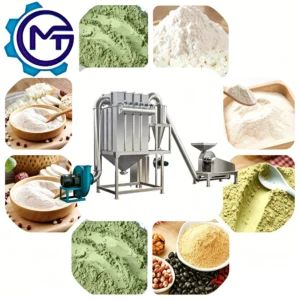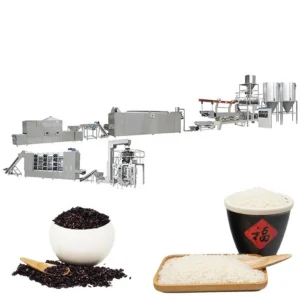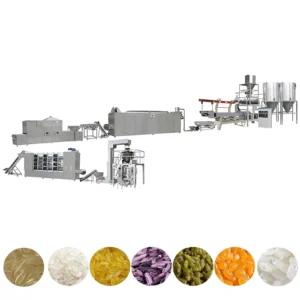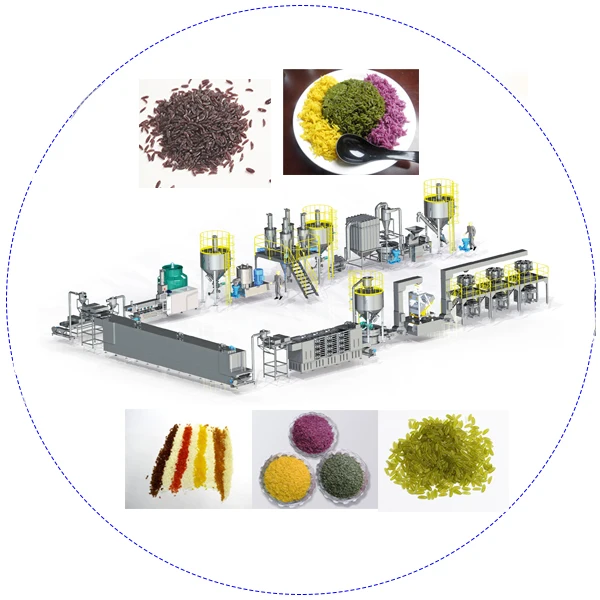
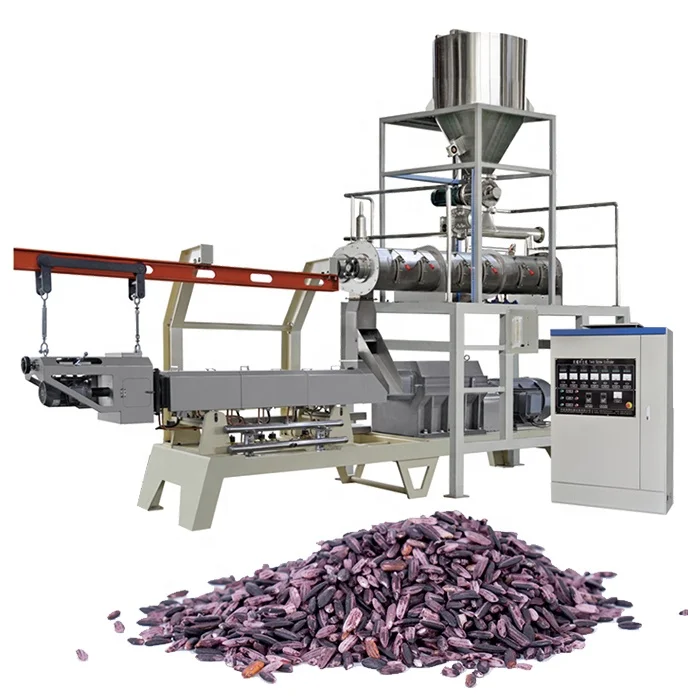
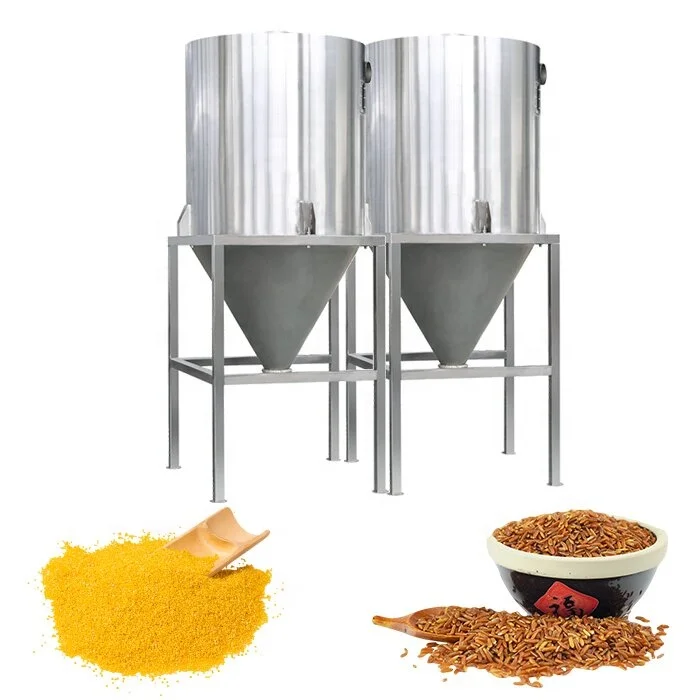


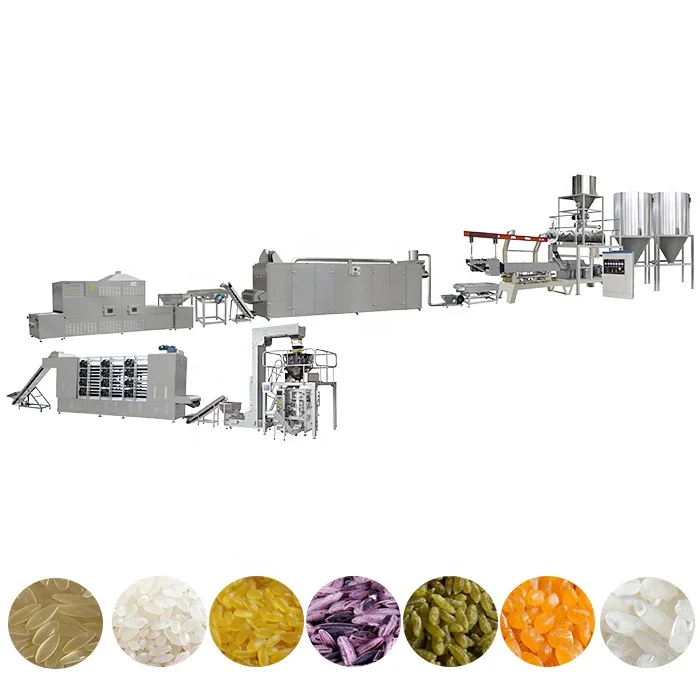
MT65 / MT70 / MT85 / MT75 / MT95 Fortified Rice Kernel Extrusion Production Line, Twin-Screw, PLC Control — complete turnkey line covering mixing, extruding, drying, roasting, cooling and packing stages.
- Screw configuration and die design specified to the buyer’s grain formulation and target kernel density, with frequency speed control across extruder and dryer for process flexibility
- Throughput-matched stations prevent bottlenecks between extrusion output and downstream drying or packing capacity
Every line undergoes trial runs on the customer’s actual raw material in our testing workshop before shipment, with full layout drawings and capacity calculations provided.
Description
Throughput-Matched Line Design — Every station from batching to packing is engineered around your actual rice formulation to prevent bottlenecking.
Technical Specifications
| Parameter | Value |
|---|---|
| Product Type | Fortified Rice Kernel Extrusion Production Line |
| Available Models | MT65 / MT70 / MT85 / MT75 / MT95 |
| Extruder Type | Twin-screw (single-screw feeding option available) |
| Installed Power Range | 85 kW (MT65) to 260 kW (MT95) |
| Power Consumption Range | 60 kW (MT65) to 195 kW (MT95) |
| Capacity Range | 80–100 kg/hr to 800–1000 kg/hr (basis not stated in source — confirm raw material formulation / moisture) |
| Overall Dimensions | 28 × 1.2 × 2.2 m (MT65) to 36 × 3.5 × 4.3 m (MT95) |
| Control System | Frequency speed control; automatic lubrication and cooling |
| Heating Source (Dryer) | Electric or gas |
| Dryer Feature | Circulation drying with mesh belt speed controlled by frequency motor |
| Production Procedure | Mixing → Extruding → Vibrating → Low-temperature Drying → Cooling → High-temperature Roasting → Cooling → Packing |
| Basic Materials | Broken rice, rice, corn, millet, wheat, oats, buckwheat, bean, starch; vitamins and minerals |
| Assembly State | Complete production line |
| Voltage & Frequency | Configurable per local standard (source value — verify against manufacturer catalog) |
| Standards | CE certified; ISO certified |
Application Suitability
| Application | Material or Output |
|---|---|
| Nutritional rice fortification programmes | Rice flour blended with micro-nutrients, vitamins, and minerals |
| Broken rice reprocessing | Broken rice and rice bran reformed into whole-grain-shaped kernels |
| Artificial rice production | Corn, millet, wheat, oats, buckwheat, and bean blends |
| Institutional and NGO food supply | Fortified kernels meeting programme-specific nutritional specifications |
| Commercial food factory expansion | High-volume grain-based extruded kernels for retail or bulk packaging |
What "Nominal Capacity" Leaves Out on a Fortified Rice Kernel Production Line Turnkey Project
A line rated on paper often fails the moment your actual rice starch ratio enters the barrel.
I have stood in commissioning workshops watching a newly installed extrusion line choke because the buyer’s broken rice blend carried a different amylose content than the starch used during the supplier’s factory test. The extruder ran, but the kernels expanded unevenly, and the downstream dryer could not keep up with the moisture load. Weeks of delays followed before the screw configuration and drying curve were corrected. A fortified rice kernel production line turnkey project must be validated on the buyer’s real material before it ever leaves the factory [NEED_CITE: starch gelatinisation behaviour in twin-screw extrusion across grain varieties].
Matching Every Station to Your Grain Blend
A turnkey extrusion project is only as reliable as its weakest throughput link. On this line, the mixer batch size, extruder screw speed, vibrating feeder rate, and dryer belt velocity are all calculated from the same formulation data. When the target product is a vitamin-fortified rice kernel, even small deviations in moisture or starch composition shift the expansion ratio, which in turn changes the residence time needed in the low-temperature drying zone and the high-temperature roasting stage.
Why Phased Commissioning Matters for Nutrition Programmes
Fortified rice projects often serve government or NGO nutrition programmes with strict kernel dimension and nutrient retention requirements. Rushing through commissioning risks inconsistent kernel density or micronutrient degradation from uncontrolled roast temperatures. A structured start-up sequence — first dry running the extruder, then introducing raw material at reduced throughput, then ramping to the target output — allows operators to record screw speed, barrel temperature, and moisture readings at each stage. These records become the baseline for every future production batch [NEED_CITE: nutrient retention standards in fortified food processing].
Reading the Specs Beyond the Nameplate
The MT95 carries a 260 kW installed power rating, yet its operating consumption sits at 195 kW — a gap that reflects the automatic lubrication and cooling systems running alongside the main drive. Frequency-controlled motor speed across the extruder and dryer belt means operators can adjust throughput without changing mechanical components. When processing high-fibre blends like buckwheat or oat mixtures, lower screw speeds may be required to maintain kernel integrity, and the frequency control allows this without a gearbox swap. The dryer’s choice between electric and gas heating affects utility infrastructure planning; a gas-fired unit demands ventilation and combustion air provisions that an electric unit does not.
The Hidden Cost of Unmatched Stations
When the extruder outpaces the dryer, partially dried kernels accumulate on the mesh belt, sticking together and producing rejects that must be reground or discarded. Conversely, an oversized dryer running half-empty wastes thermal energy and extends residence time past the point where the kernel surface begins to crack. I have seen projects where a coating or packing station was specified by a separate vendor without reference to the extrusion output rate, forcing the entire line to idle during shift changes just to clear the backlog [NEED_CITE: throughput balancing in multi-vendor food processing lines].
Why Buyers Choose This Line for Turnkey Projects
The complete production sequence — mixing, extruding, vibrating, low-temperature drying, cooling, high-temperature roasting, cooling, and packing — sits under one supplier’s scope, so throughput calculations carry a single point of accountability. Screw configuration and die design are specified to the buyer’s grain blend rather than copied from a generic build. An in-house testing workshop allows trial runs on the customer’s actual broken rice or fortified flour before shipment, producing a written test report that travels with the machine. Twin-screw expertise covers not only rice but also aquatic feed, snacks, cereals, and protein applications, so the same engineering team can support a buyer expanding into adjacent product categories. Pre-sales layout drawings include utility connection points for water, compressed air, and electrical supply, reducing on-site surprises during installation.
Documentation & Verification
- Line layout with throughput calculation for each station from mixer to packer
- Screw and die configuration record matched to your grain formulation
- Electrical schematic confirming voltage, frequency, and control language
- Trial run report on your actual raw material before shipment
- CE declaration of conformity and ISO certificate
- Wear parts list with recommended first-order quantities
Installation, Commissioning & Support
- Foundation plan accounts for the MT95’s 36 m overall length and vibration isolation needs
- Dedicated electrical circuit sized for the selected model’s installed power rating
- Modular station delivery allows phased unloading in facilities with limited door clearance
- On-site screw configuration verification against the trial run report
- Operator training covers frequency speed adjustment and dryer belt tensioning
- First-order wear parts shipment aligned with initial production schedule
What to Prepare Before Requesting a Quotation
To move from inquiry to a detailed line proposal, share your target kernel dimensions, the exact grain and micronutrient formulation, and your daily production target in kilograms. Include the voltage and frequency standard at the installation site, the preferred control language for the HMI, and the available floor space with ceiling height. If you have an existing upstream mixer or downstream packing machine, send its throughput data so the new line can be matched to those stations.
Frequently Asked Questions
Q: How is capacity verified when the listed output varies so widely across models?
A: Each model’s capacity range is published without a fixed raw material basis, so verification requires a trial run using your specific grain blend at your target moisture level. We run your material in the testing workshop, record throughput at steady state, and issue a report that becomes part of the line documentation.
Q: Can the line configuration adapt if we change our rice formulation later?
A: Yes. The twin-screw extruder accepts reconfigurable screw elements and interchangeable dies. Frequency-controlled drives on both the extruder and dryer belt allow speed adjustments without mechanical changes. We provide a screw configuration record so future changes can be planned against a known baseline.
Q: How do you ensure voltage and control compatibility for overseas installation?
A: Before production begins, we confirm the site voltage, frequency, and preferred HMI language. The electrical schematic is reviewed against local standards, and the control cabinet is wired accordingly. This confirmation step prevents commissioning delays caused by mismatched electrical infrastructure.
Q: What does the commissioning schedule look like on site?
A: The typical sequence covers station-by-station dry runs, followed by wet runs with raw material at reduced throughput, then a ramp to the verified output. Operators are trained during each phase, and parameter readings are logged so the trial run baseline can be replicated in regular production.
Q: How is the packing station matched to the extrusion output?
A: The packing station is selected based on the verified throughput from the trial run, not the nominal extruder rating. We calculate the kernel flow rate after drying and cooling, then specify a weigher and bagger that can sustain that rate with allowance for shift-change buffer.
Related products
-
High Productivity New Condition Nutritious Baby Food Meal Replacement Powder Production Line
¥30.00 Select options This product has multiple variants. The options may be chosen on the product page -
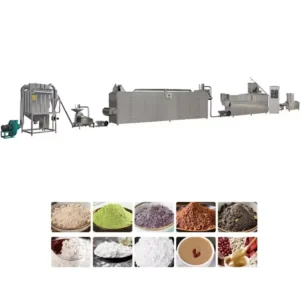
Healthy Baby Food Production Line Nutritional Powder Equipment for Baby Food Supplements for Flour Processing Machinery
¥8,500.00 Select options This product has multiple variants. The options may be chosen on the product page -
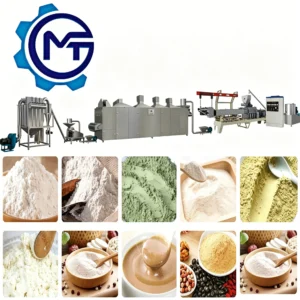
Organic Gluten Free Baby Rice Nutrition Powder Automatic 500kg/h Production Processing Line
¥8,238.27 Add to cart -
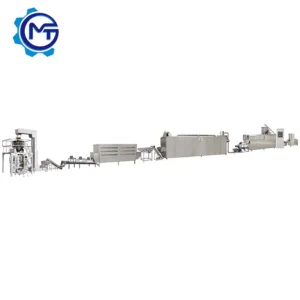
Automatic Nutritional Powder Making Machine Safe Rice Cereal for Babies
¥30.00 Select options This product has multiple variants. The options may be chosen on the product page