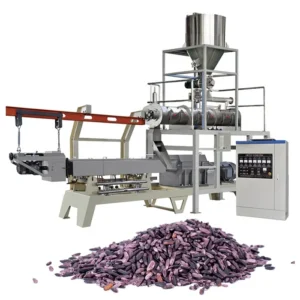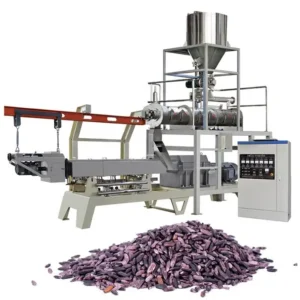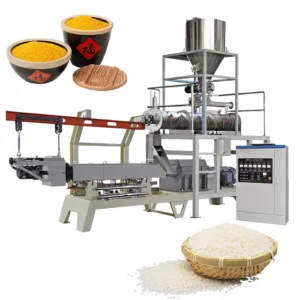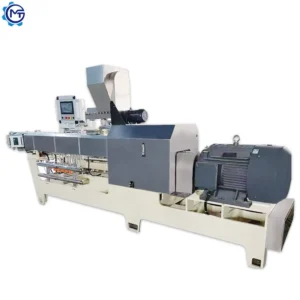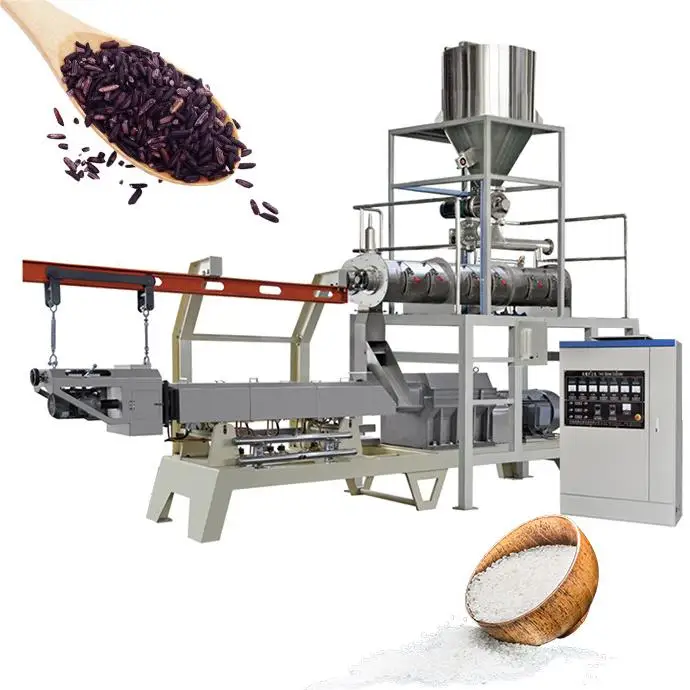


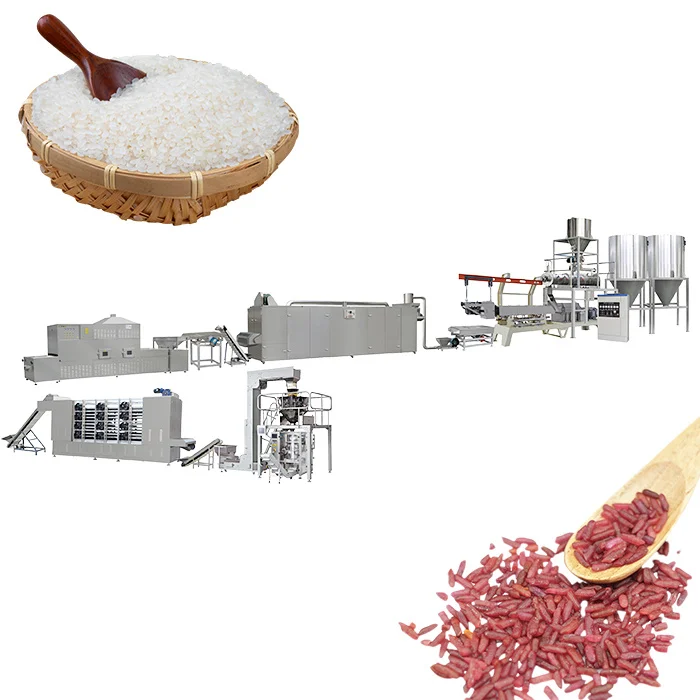
MT65, MT70, MT85, MT75, MT95 Fortified Rice Production Line, Twin-Screw Extruder, PLC/MCC Control — configured for artificial and vitamin-enriched rice kernel output from broken rice, corn, millet, and starch blends.
- Full turnkey layout from batching through extrusion, drying, and packing, with throughput balanced across every station to prevent bottlenecks
- Screw configuration and die design specified to the buyer’s raw material blend and target kernel density
Delivered with in-house trial run on customer raw material before shipment, complete line layout drawings, and on-site commissioning support.
Description
Turnkey integration under one roof — the Fortified Rice Production Line turnkey is engineered so extrusion, drying, and packing capacities align to the buyer’s actual grain blend rather than a generic template.
Technical Specifications
| Parameter | Value |
|---|---|
| Product Type | Fortified Rice Production Line |
| Extruder Type | Twin-screw |
| Available Models | MT65, MT70, MT85, MT75, MT95 |
| MT65 Installed Power | 85 kW |
| MT65 Power Consumption | 60 kW |
| MT65 Output Capacity | 80–100 kg/h (basis not stated in source) |
| MT65 Overall Dimensions | 28 × 1.2 × 2.2 m |
| MT70 Installed Power | 120 kW |
| MT70 Power Consumption | 85 kW |
| MT70 Output Capacity | 100–120 kg/h (basis not stated in source) |
| MT70 Overall Dimensions | 30 × 1.5 × 2.2 m |
| MT85 Installed Power | 235 kW |
| MT85 Power Consumption | 165 kW |
| MT85 Output Capacity | 200–300 kg/h (basis not stated in source) |
| MT85 Overall Dimensions | 34 × 3.5 × 4.3 m |
| MT75 Installed Power | 180 kW |
| MT75 Power Consumption | 135 kW |
| MT75 Output Capacity | 300–500 kg/h (basis not stated in source) |
| MT75 Overall Dimensions | 32 × 3.5 × 4.3 m |
| MT95 Installed Power | 260 kW |
| MT95 Power Consumption | 195 kW |
| MT95 Output Capacity | 800–1000 kg/h (basis not stated in source) |
| MT95 Overall Dimensions | 36 × 3.5 × 4.3 m |
| Speed Control | Frequency inverter |
| Lubrication & Cooling | Automatic |
| Feeding System | Single or double screw, selected by material characteristics |
| Screw Material | Wear-resistant alloy (special treatment) |
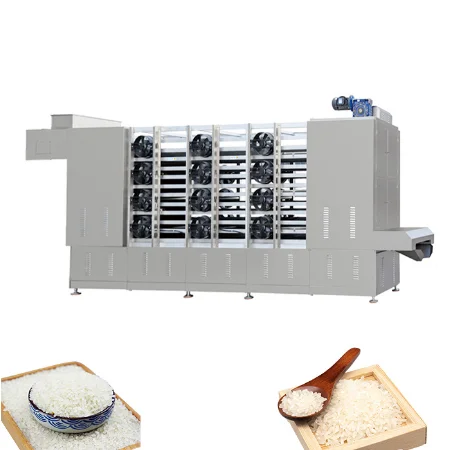
| Dryer Type | Mesh belt, circulation drying |
| Dryer Heating Source | Electric or gas |
| Dryer Speed Control | Frequency motor for mesh belt |
| Control System | Available with PLC or MCC control |
| Standards | CE, ISO |
Application Suitability
| Application | Material or Output |
|---|---|
| Nutritional programme rice fortification | Broken rice and corn blends enriched with vitamin and mineral premixes |
| Artificial rice kernel production | Millet, wheat, oats, buckwheat, bean, and starch formulations |
| Breakfast cereal grain processing | Rice and corn grits with added micronutrients for retail packaging |
| Turnkey food plant projects | Complete fortified rice processing from batching to packing |
Why "Rated Capacity" Means Nothing Without Your Raw Material
A Fortified Rice Production Line turnkey must be validated on the buyer’s exact grain and micronutrient blend, not a standard rice flour test.
I have stood in front of an extruder running a nutrition programme formulation where the standard test parameters produced perfect kernels, but the buyer’s actual broken rice and杂粮premix caused gelatinisation to collapse entirely. The extruded rice turned sticky and deformed. It took days of reconfiguring screw elements and temperature zones to stabilise the process. That is the gap between a catalogue number and a working line [NEED_CITE: twin-screw extrusion behaviour on variable starch blends].
When the Fortified Rice Production Line turnkey is quoted only on nominal throughput, the buyer discovers after installation that their vitamin-enriched formulation behaves differently from the factory test material. Moisture content, starch composition, and fibre ratio all shift expansion and density. Without a documented trial on the actual blend, commissioning becomes product development at the buyer’s expense.
Screw Configuration Dictates Kernel Integrity
The twin-screw extruder in this line allows screw element sequencing to match the gelatinisation window of the buyer’s specific grain blend. Broken rice behaves differently from corn or buckwheat under shear and heat. Wear-resistant alloy screws with special treatment maintain element geometry across production runs, preserving kernel shape consistency. Frequency inverter speed control lets the operator fine-tune residence time without stopping the line, adjusting for seasonal variation in raw material moisture.
Temperature Profiling Across the Barrel Zones
A Fortified Rice Production Line turnkey requires precise barrel temperature management because vitamin stability and starch gelatinisation compete for the same thermal budget. Too much heat destroys micronutrient potency; too little leaves the kernel fragile and prone to breakage during drying. The automatic lubrication and cooling system stabilises barrel conditions across long runs, preventing thermal drift that would otherwise force the operator to chase setpoints manually [NEED_CITE: vitamin degradation thresholds in extrusion processing].
Matching Dryer Capacity to Extruder Output
The mesh belt circulation dryer uses frequency motor control to adjust belt speed, keeping kernel residence time aligned with extruder throughput. Electric or gas heating sources are selected based on local utility costs and availability. If the dryer cannot remove moisture fast enough to match extruder output, kernels accumulate and degrade. If it runs too fast, surface hardening traps internal moisture, causing cracking during cooling.
How Core Parameters Shape the Final Kernel
The choice between single and double screw feeding systems depends on material flow characteristics. Fine vitamin-mineral premixes bridge easily in single-screw feeders; a double-screw configuration prevents rat-holing and ensures uniform dosing into the extruder barrel. The twin-screw extruder itself generates shear and pressure that determine starch gelatinisation degree, which directly controls kernel density and cooking behaviour when the end user prepares the rice. Screw material wear resistance matters because degraded elements change the compression ratio gradually, shifting kernel texture over weeks until the deviation is noticed only in customer complaints. The overall dimensions of the larger models — MT85, MT75, MT95 — reflect longer barrel sections and larger dryer footprints needed for higher throughput, affecting workshop layout and utility routing. PLC or MCC control selection determines whether recipe changes are stored digitally or managed through manual relay logic, influencing batch-to-batch repeatability across shift changes.
The Cost of Skipping Configuration Validation
When an extruder ships with a generic screw build copied from a different grain application, the buyer spends weeks after installation experimenting with element combinations to find a workable kernel texture. During that period, raw material is wasted, labour is consumed in repeated adjustments, and the production schedule slips. Dryer bottlenecks compound the problem — if the dryer was sized for a different moisture removal rate, kernels either exit too wet and spoil in storage, or the line must slow down to match dryer capacity, reducing actual throughput well below the quoted figure [NEED_CITE: consequences of mismatched extrusion and drying capacity].
Engineering Commitments Behind This Line
Throughput matching across every station means the extruder, dryer, and packing system are calculated together so no single unit constrains the others. Screw configuration and die design are specified to the buyer’s grain blend and target kernel dimensions before production begins. The in-house testing workshop runs the buyer’s actual fortified rice formulation before shipment, generating a trial report that documents stable parameters. Twin-screw expertise spans grain, starch, and protein applications, informing screw element choices that generic builders miss. Pre-sales consultation through installation and operator training ensures the line performs in the buyer’s facility as it did during the factory trial.
Documentation & Verification
- Line layout and capacity calculation matched to your grain blend and kernel specification
- Screw and die configuration record for your specific fortified rice formulation
- Trial run report on your actual raw material before shipment
- Electrical schematic with voltage and frequency confirmation for your facility
- CE declaration of conformity and ISO certificate included with shipment
- Operation and maintenance manual with wear parts list
Installation, Commissioning & Support
- Foundation and floor space planning based on overall dimensions of the selected model variant
- Dedicated power circuit sized to installed power requirements with voltage and frequency confirmation
- Extruder barrel and screw assembly verified on-site after transport
- First production run with parameter logging on the buyer’s grain blend
- Operator training covering PLC or MCC interface and recipe storage
- Wear parts list with lead times for screws, dies, and mesh belt sections
Preparing Your Inquiry
Share the specific grain types and vitamin-mineral premix ratios you intend to process, along with target kernel dimensions and daily production volume. Confirm your facility voltage, frequency, and available floor space so the layout can be drafted accurately. Indicate whether you require a trial run on your raw material before shipment, and specify the control system language preference for operator training.
Frequently Asked Questions
Q: How is throughput balanced between the extruder, dryer, and packing station?
A: Each station is calculated against the others based on the buyer’s raw material moisture content and target kernel density. The extruder output sets the baseline; dryer belt speed and heating capacity are matched to remove moisture at that rate, and the packing station is sized to handle the finished kernel flow without accumulation or starvation.
Q: Does the turnkey scope include utility planning and phased commissioning?
A: Yes. The layout includes electrical load distribution, water supply points, and ventilation requirements. Commissioning follows a phased schedule — mechanical assembly first, then electrical verification, dry runs, and finally production trials on the buyer’s material with parameter documentation at each stage.
Q: Can you run a trial on our actual fortified rice blend before delivery?
A: The testing workshop conducts trial runs on the buyer’s raw material formulation, documenting screw configuration, barrel temperatures, and moisture levels that produce stable kernels. The trial report ships with the line so commissioning begins from proven parameters rather than generic defaults.
Q: What documentation comes with the line?
A: Documentation includes line layout drawings, capacity calculation sheets, screw and die configuration records, electrical schematics, CE and ISO certificates, factory test records, operation manuals, and a wear parts list with reorder references.
Q: How is operator training and maintenance support handled after installation?
A: On-site training covers PLC or MCC operation, recipe management, screw and die changeover procedures, and daily maintenance checkpoints. Wear parts availability and maintenance schedules are documented so the buyer can plan replacements before failures interrupt production.
Related products
-
Small Scale MT Brand Automatic Baby Food Nutrition Powder Rice Flour Making Machine with 500kg/h Production Capacity PLC Control
¥9,500.00 Add to cart -

High Precision Automatic 500kg/h Baby Food Nutrition Powder Rice Extrusion Processing Line
¥8,238.27 Add to cart -
Hygienic Stainless Steel Infant Rice Powder Processing Line Automatic 500kg/h Capacity PLC Controlled
¥9,500.00 Add to cart -

Automatic Instant Powder Production Line Nutritional Powder Extruder Machine
¥10,000.00 Select options This product has multiple variants. The options may be chosen on the product page