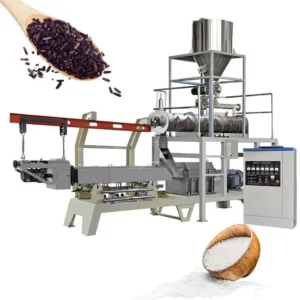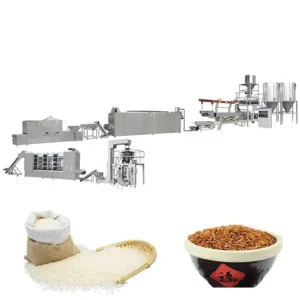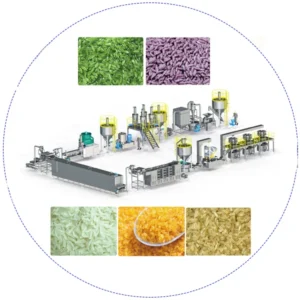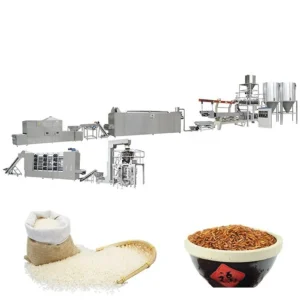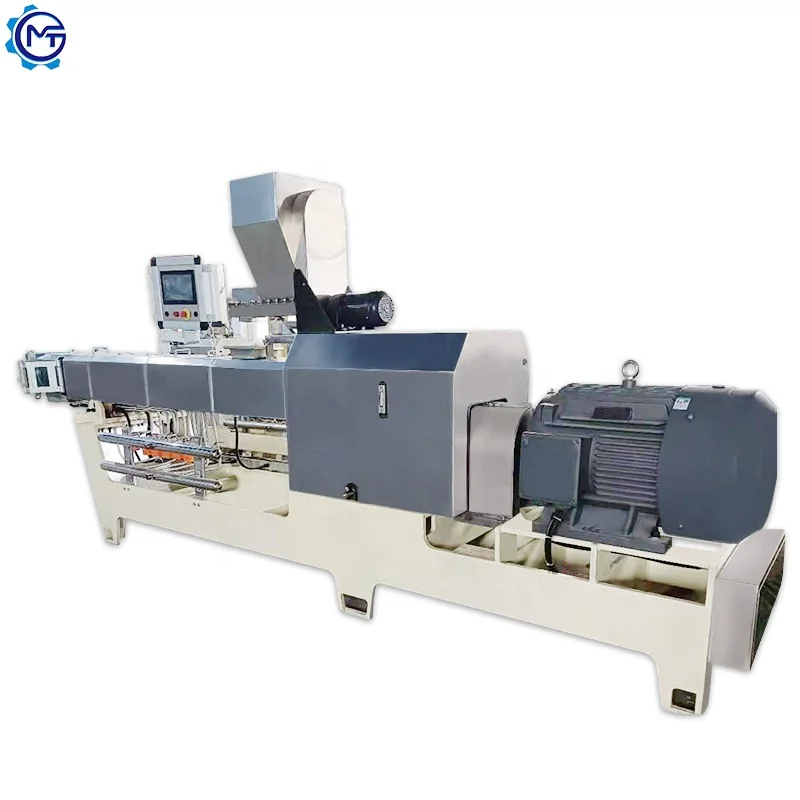


MT65, MT70, MT85, MT75, MT95 Fortified Rice Processing Line, Twin-Screw Extrusion, PLC Control — engineered as a complete turnkey project from batching to packing.
- Screw configuration and die design matched to your raw material blend for consistent kernel density and nutrient retention
- Every station — mixing, extrusion, drying, roasting, cooling — sized to extruder output so throughput is balanced across the line
- Circulation drying with frequency-controlled mesh belt speed ensures uniform moisture in the final product
Delivered with a trial run on your actual raw material before shipment, line layout with capacity calculation, and on-site commissioning support.
Description
Throughput-Matched Line Engineering — every station from mixing to packing is sized against your raw material formulation so no single node bottlenecks the output.
Technical Specifications
| Parameter | Value |
|---|---|
| Product Type | Fortified Rice Processing Line |
| Models Available | MT65, MT70, MT85, MT75, MT95 |
| Extruder Type | Twin-screw with single or double screw feeding |
| Control System | Frequency speed control, PLC and MCC, high automation |
| Lubrication | Automatic lubricating and cooling system |
| Dryer Heating Source | Electric or gas |
| Dryer Feature | Circulation drying, frequency motor controls mesh belt speed |
| MT65 Installed / Consumed Power | 85 kW / 60 kW |
| MT65 Capacity | 80–100 kg/h (basis to be confirmed — confirm raw material and moisture) |
| MT65 Dimensions | 28 × 1.2 × 2.2 m |
| MT70 Installed / Consumed Power | 120 kW / 85 kW |
| MT70 Capacity | 100–120 kg/h (basis to be confirmed — confirm raw material and moisture) |
| MT70 Dimensions | 30 × 1.5 × 2.2 m |
| MT85 Installed / Consumed Power | 235 kW / 165 kW |
| MT85 Capacity | 200–300 kg/h (basis to be confirmed — confirm raw material and moisture) |
| MT85 Dimensions | 34 × 3.5 × 4.3 m |
| MT75 Installed / Consumed Power | 180 kW / 135 kW |
| MT75 Capacity | 300–500 kg/h (basis to be confirmed — confirm raw material and moisture) |
| MT75 Dimensions | 32 × 3.5 × 4.3 m |
| MT95 Installed / Consumed Power | 260 kW / 195 kW |
| MT95 Capacity | 800–1000 kg/h (basis to be confirmed — confirm raw material and moisture) |
| MT95 Dimensions | 36 × 3.5 × 4.3 m |
| Standards | CE, ISO |
Application Suitability
| Application | Material or Output |
|---|---|
| Artificial rice kernel production | Broken rice, rice, rice bran blended with vitamins and minerals |
| Fortified rice for food aid programmes | Corn, millet, wheat, oats with micro-nutrient premix |
| High-nutrition grain reprocessing | Buckwheat, bean, starch with mineral and vitamin additives |
| Extruded nutritional kernels | Multi-grain blends targeting specific density and cooking behaviour |
Why "Rated Capacity" Means Nothing Without Your Recipe
A Fortified Rice Processing Line turnkey proposal that quotes throughput without specifying the raw material blend is a proposal that will disappoint at commissioning. Capacity must be proven on your exact formulation before the line ships.
I spent two weeks on a site in Colombia because the extruder was rated for a rice-heavy formula, but the buyer switched to a 40% buckwheat and bean blend after purchase. Gelatinisation dropped, the starch matrix would not hold the kernel shape, and fines built up across the dryer mesh until airflow choked. The extruder was never the problem — the screw configuration and temperature profile were wrong for that material. [NEED_CITE: starch gelatinisation behaviour across grain and legume blends]
Screw Configuration Dictates Kernel Integrity
Twin-screw extrusion allows the screw element sequence — conveying, kneading, reverse-pitch — to be rearranged for each raw material blend. A high-rice formula needs a moderate shear profile to preserve starch structure without over-gelatinising. A formula heavy in legumes and fibre demands more kneading blocks and a longer residence zone to achieve uniform hydration before the die. The Fortified Rice Processing Line turnkey layout specifies this configuration against your recipe, not a generic build.
Station Matching Prevents Downstream Choke Points
Extruder output means nothing if the dryer cannot remove moisture at the same rate. Low-temperature drying sets the kernel structure, while high-temperature roasting finishes the moisture profile. On one project in Peru, a contractor paired a large extruder with an undersized dryer and the line sat idle for hours each day while the drying belt caught up. Every station in this line — mixing, vibrating, cooling, roasting, packing — is sized to the extruder’s confirmed throughput so material flows continuously without queuing. [NEED_CITE: throughput balancing in multi-station food processing lines]
Reading the Power and Control Specs
Installed versus consumed power tells you the thermal and mechanical headroom available. The MT95 draws 195 kW under typical load against 260 kW installed, leaving margin for viscous formulations that demand higher torque. Frequency-controlled motors across the line allow speed adjustment at each station — the dryer mesh belt, the vibrating screen, the roaster conveyor — so you can fine-tune residence time without mechanical changeover. The automatic lubrication and cooling system on the twin-screw extruder reduces bearing wear during continuous shifts, which matters when running multi-day nutrition programme batches.
The Cost of Skipping the Trial Run
When a line arrives on site without a prior trial on your material, the first weeks become a costly experiment. Screw combinations are swapped, barrel temperatures are guessed, and off-spec product is either discarded or sold at a steep discount. I have watched operators pull apart a die plate three times in one shift trying to hit a target kernel density. [NEED_CITE: cost of unplanned commissioning delays in turnkey food plants] A factory test on your actual formulation — documented with screw configuration records and product samples — eliminates that front-end waste.
What This Project Structure Delivers
The line layout and capacity calculation is built around your specific grain blend and target kernel specification, not copied from a catalogue. Screw configuration and die design are recorded against your material trial, so replacement tooling matches the original build. Voltage, frequency, and control language are confirmed before production starts, preventing the commissioning delays that occur when a panel arrives wired for the wrong grid. The in-house testing workshop runs your raw material before the line ships, so product development is largely finished before installation begins. On-site commissioning, operator training, and ongoing maintenance support are included in the project scope.
Documentation & Verification
- Line layout drawing showing throughput match from mixing through packing
- Screw and die configuration record specific to your grain formulation
- Trial run report on your raw material conducted before shipment
- Electrical schematic with confirmed voltage and frequency for your site
- Factory test record with product samples from your material run
- CE declaration of conformity and ISO certificate
Installation, Commissioning & Support
- Floor space and utility connections planned around the selected model footprint from 28 m to 36 m line length
- Dedicated power circuits sized to installed power up to 260 kW with confirmed local voltage
- Modular station delivery allowing phased assembly where ceiling height or access is restricted
- First-run parameter setting on your grain blend during on-site commissioning
- Operator training covering screw changeover, dryer belt speed adjustment, and PLC navigation
- Wear parts list with screw elements, die plates, and dryer belt sections for first replacement cycle
- Maintenance schedule aligned with the automatic lubrication system intervals
What We Need from You to Scope the Line
Share the exact grain formulation — percentages of each cereal, legume, and starch base along with the micro-nutrient premix specification. Confirm the target kernel dimensions, density, and cooking behaviour expected in the destination market. Provide the available floor space with ceiling clearance and the local voltage, frequency, and control language requirements so the electrical design can be locked before production begins.
Frequently Asked Questions
Q: How is line capacity verified on my actual fortified rice raw material blend?
A: We run your exact formulation in the in-house testing workshop before the line ships. The trial uses the same screw configuration, die design, and barrel temperature profile planned for your installation. You receive a documented trial report with product samples and confirmed throughput figures based on your material, not nominal ratings.
Q: What is the phased installation and commissioning schedule?
A: Stations are delivered modularly and installed in sequence — extruder and mixer first, followed by dryer and roaster, then cooling and packing. Commissioning begins with individual station testing before the full line runs continuously. Operator training runs parallel so your team is familiar with controls before handover.
Q: How is throughput balanced between the extruder, dryer, and packing station?
A: Each station is sized during the line layout phase against the extruder output confirmed on your material. The dryer belt width and length, the roaster conveyor speed, and the packing station feed rate are all calculated so material flows without queuing or starvation at any point.
Q: What utility connections does the full line require?
A: Electrical supply must match the installed power of your selected model, with confirmed voltage and frequency for your region. Gas supply is needed if the dryer uses gas heating. Compressed air powers pneumatic valves, and water connections serve the automatic lubrication and cooling circuit on the extruder.
Related products
-
Healthy Baby Food Production Line Nutritional Powder Equipment for Baby Food Supplements for Flour Processing Machinery
¥8,500.00 Select options This product has multiple variants. The options may be chosen on the product page -

Automatic Instant Powder Production Line Nutritional Powder Extruder Machine
¥10,000.00 Select options This product has multiple variants. The options may be chosen on the product page -

Hygienic Stainless Steel Infant Rice Powder Processing Line Automatic 500kg/h Capacity PLC Controlled
¥9,500.00 Add to cart -
Industrial Instant Corn Paste Production Line Nutritional Powder Processing Equipment Meal Replacement Nutrition Powder Machine
¥65.00 Select options This product has multiple variants. The options may be chosen on the product page