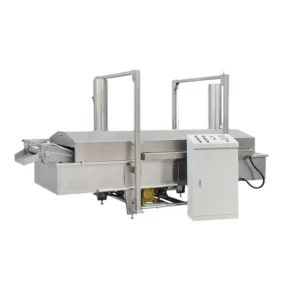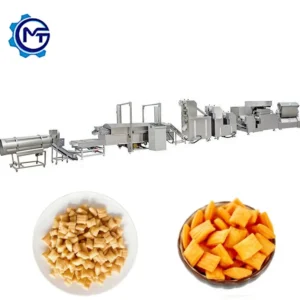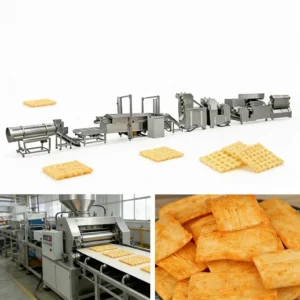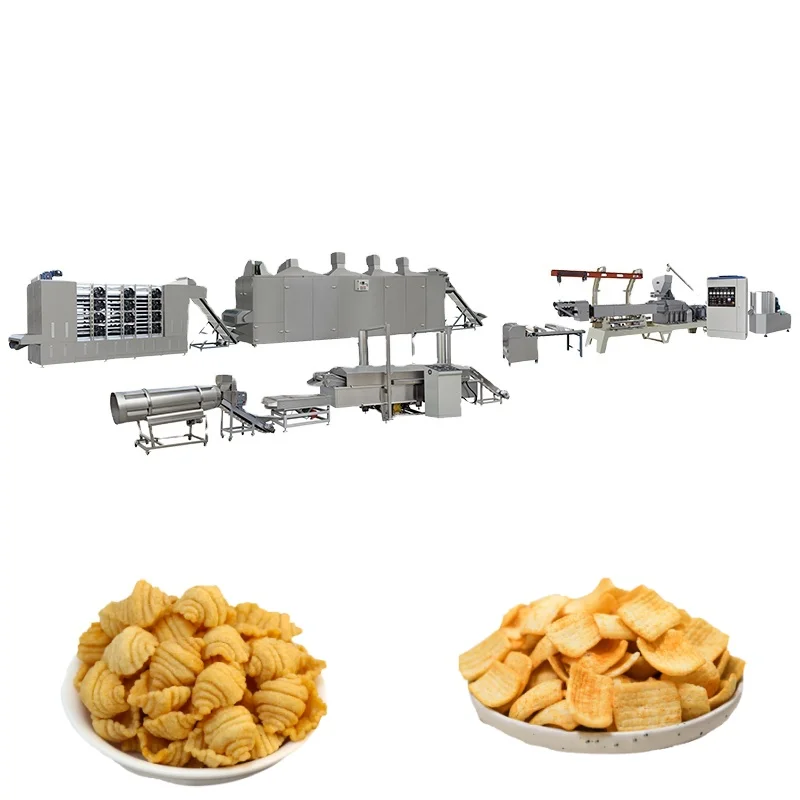


Fried Snack Food Production Line, Twin-Screw Extrusion, Gas/Electric/Diesel Heating — integrated from mixing through frying under a single supplier. Screw configuration and die design are specified to the buyer’s raw material blend and target product density, while the fryer belt speed and temperature profile are matched to extruder throughput. Every station is capacity-balanced to eliminate bottlenecks, with trial runs on customer formulations completed in the testing workshop before shipment.
- CE certified with voltage customization confirmed before production
- Interchangeable dies for bugles, sticks, chips, and pillow formats
- On-site installation, commissioning, and operator training included
Description
Throughput-Matched Stations — Every piece of equipment from the mixer through the fryer is sized to the same target output, preventing the bottlenecks that plague lines assembled from separate vendors.
Technical Specifications
| Parameter | Value |
|---|---|
| Product Type | Fried Snack Food Production Line |
| Extruder Models Available | MT-65 / MT-70 / MT-85 / MT-75 / MT-95 |
| Main Motor Power (MT-65) | 100 kW |
| Main Motor Power (MT-70) | 130 kW |
| Main Motor Power (MT-85) | 180 kW |
| Main Motor Power (MT-75) | 185 kW |
| Main Motor Power (MT-95) | 280 kW |
| Output Capacity (MT-65) | 120–150 kg/h (basis to be confirmed) |
| Output Capacity (MT-70) | 200–250 kg/h (basis to be confirmed) |
| Output Capacity (MT-85) | 300–500 kg/h (basis to be confirmed) |
| Output Capacity (MT-75) | 400–500 kg/h (basis to be confirmed) |
| Output Capacity (MT-95) | 800–1000 kg/h (basis to be confirmed) |
| Screw Type | Twin-screw, co-rotating sectional modules |
| Mixer Power Options | 4 kW / 7.5 kW / 15 kW |
| Cutting Machine Power | 1.47 kW |
| Fryer Belt Width | 600 mm stainless steel mesh |
| Fryer Energy Options | Electricity / Fuel / Gas |
| Drying Method Options | Gas / Electric / Diesel heating |
| Voltage Options | 3ph 380V 50Hz, 3ph 380V 60Hz, 3ph 415V 60Hz, 3ph 220V 60Hz |
| Die System | Interchangeable dies and rollers |
| Warranty | 1 year, lifetime maintenance service |
Application Suitability
| Application | Material or Output |
|---|---|
| Salad stick and corn chip production | Corn powder, wheat flour, corn starch blends |
| Bugles and shell-shaped fried snacks | Corn grits and potato starch formulations |
| Wavy and diamond chip formats | Wheat flour and potato powder mixtures |
| Pillow and tube-shaped extruded snacks | Multi-grain blends with corn and potato starch |
| Screw and round tube snack formats | Corn starch and wheat flour base materials |
Why "Nominal Capacity" Misses the Point on a Fried Snack Line
Actual throughput depends entirely on how your raw material behaves inside the barrel, not on the number printed in a brochure.
I have walked onto factory floors where a newly installed fried snack food production line turnkey setup was running well below its quoted capacity. The extruder motor was overloaded because the buyer’s corn blend had a higher fat content than the test material, and the screw configuration had not been adjusted for it. The fryer downstream was idling half-empty while the extruder struggled to keep up. These mismatches rarely show up until raw material hits the hopper [NEED_CITE: common causes of extrusion line underperformance after commissioning].
Matching Screw Geometry to Your Raw Material Blend
The co-rotating twin-screw extruder at the heart of this line uses sectional screw modules that can be rearranged to alter shear, residence time, and compression ratio. Corn powder behaves very differently from potato starch under heat and pressure — corn requires higher shear to gelatinise fully, while potato starch gelatinises earlier and needs gentler handling to avoid over-expansion. A fried snack food production line turnkey project succeeds when the screw profile is locked to the buyer’s exact formulation before metal is cut.
Die and Roller Changeover for Shape Flexibility
The interchangeable die and roller system allows a single extrusion station to produce bugles, salad sticks, shell shapes, square tubes, wavy chips, diamond chips, and pillow formats. Changeover involves swapping the die plate and, where required, the shaping roller — a process that takes minutes rather than hours. This flexibility matters when a snack manufacturer needs to test multiple formats with the same dough formulation before committing to a market launch [NEED_CITE: die configuration impact on extruded snack texture and density].
What the Motor Power and Fryer Belt Width Mean for Your Output
The available motor power range — from 100 kW on the MT-65 to 280 kW on the MT-95 — determines how much mechanical energy can be delivered into the barrel for shear and cooking. Higher motor power supports higher throughput on dense or high-moisture formulations that resist flow. The 600 mm stainless steel fryer belt width sets the maximum product bed depth; running product too thick on the belt results in uneven oil contact and inconsistent colour. Matching extruder output to fryer belt capacity is where lines either hold their rate or silently bottleneck.
The Hidden Cost of Unmatched Station Capacities
When an extruder is specified at a nominal rate but the fryer or dryer downstream is sized smaller, the line cannot run at its design speed without product backing up or quality degrading. I have seen operators forced to slow the extruder to match a smaller fryer, losing hours of saleable output per shift. The reverse is equally expensive — an oversized fryer burning energy on an empty belt while waiting for product [NEED_CITE: throughput mismatch consequences in multi-station food processing lines]. These problems are avoidable when every station is calculated against the same target rate from the start.
Why Source This Line From a Single Turnkey Supplier
Every station on this fried snack food production line turnkey project is throughput-matched under one supplier, which means the mixer capacity, extruder output, cutting speed, fryer belt area, and downstream cooling are all calculated together. Screw configuration and die design are specified to your raw material and target product shape rather than copied from a generic build. Before shipment, the line runs a trial on your actual formulation in the in-house testing workshop, so product development starts before installation rather than after. Voltage, frequency, and control language are confirmed in writing before production begins, eliminating the commissioning delays that happen when a 415V machine arrives at a 380V site. Pre-sales engineering, on-site installation, operator training, and ongoing wear parts supply all come from the same technical team.
Documentation & Verification
- Line layout showing throughput calculations for extruder, fryer, and all intermediate stations
- Trial run report on your raw material blend conducted before shipment
- Screw and die configuration record matched to your target product shape
- Electrical schematic with voltage and control language confirmed before production
- Factory test record documenting run parameters at verified output rate
- Wear parts list specifying screw elements, dies, and fryer belt components
Installation, Commissioning & Support
- Foundation plan based on the line’s overall dimensions and station weights provided before delivery
- Dedicated power circuit sized to the extruder’s main motor rating up to 280 kW
- Phased assembly sequence for the extruder, cutter, fryer, and downstream stations
- First-run parameter logging covering barrel temperatures, screw speed, and fryer belt rate
- Operator training on die changeover, screw cleaning, and fryer oil management
- Stocked wear parts including sectional screw modules and interchangeable die plates
What We Need to Build Your Line Proposal
To prepare a layout and capacity calculation that reflects your actual production conditions, we need your raw material formulation including moisture content, your target product shapes and dimensions, and your required hourly output rate. Please also confirm the voltage and frequency at your facility, the available floor space and ceiling height, and whether you need the control interface in a specific language. If you have existing upstream or downstream equipment that this line must integrate with, share those specifications so the throughput match accounts for the full process.
Frequently Asked Questions
Q: How is the output capacity verified on my specific raw material before shipment?
A: We run your actual formulation through the extruder and fryer in our in-house testing workshop. The trial records screw speed, barrel temperature profile, fryer temperature, and belt speed at a steady output rate. You receive a trial run report documenting these parameters, so you know the line’s verified capacity on your material before it leaves the factory.
Q: What does the installation and commissioning schedule look like?
A: Installation follows a phased sequence — foundation preparation, station positioning, utility connections, then individual station testing before full-line runs. Our engineers remain on site through the first production shifts to log parameters and train operators. The schedule is confirmed in the project documentation before shipment.
Q: How do you prevent one station from bottlenecking the rest of the line?
A: Every station is sized against the same target throughput during the layout phase. The mixer batch cycle, extruder output rate, cutting speed, fryer belt area, and downstream cooling capacity are all calculated together. The line layout document shows these matched values so you can verify the balance before production begins.
Q: What operator training is included with the line?
A: Training covers extruder screw configuration, die and roller changeover, fryer temperature and belt speed adjustment, and routine maintenance on all stations. It is conducted on your factory floor during commissioning. Control interface language is confirmed during the specification stage so operators work in a familiar language from day one.
Q: How are spare wear parts supplied after commissioning?
A: A wear parts list is included with your documentation, identifying screw elements, die plates, and fryer belt components. Free wearing parts ship with the line, and we recommend ordering two to three years of additional spares at the time of purchase. Replacement parts are manufactured to the same specifications as the originals.
Related products
-
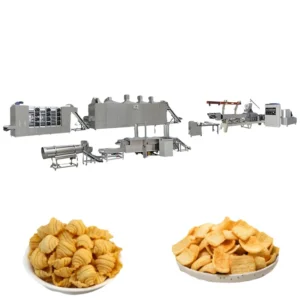
New Doritos Chips Frying Equipment Machine Automatic Tortilla Corn Chips Making Line Portable High Productivity
¥100.00 Select options This product has multiple variants. The options may be chosen on the product page -
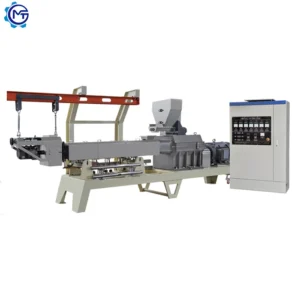
Industrial Wheat Flour Snacks Processing Equipment – Stainless Steel Fried Food Production Line
¥65.00 Select options This product has multiple variants. The options may be chosen on the product page -
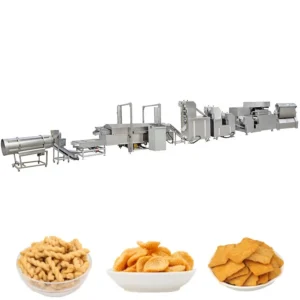
Frying Crispy 3D Corn Bugles Pellets Fried Chips Snacks Food Machine Production Line Bugles Making Extruder
¥100.00 Select options This product has multiple variants. The options may be chosen on the product page -
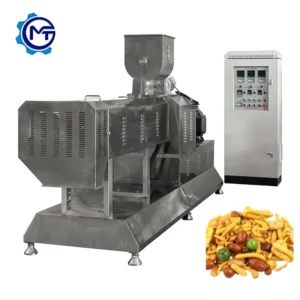
New Automatic Traditional Fried Nimko Making Machine High Productivity Large Capacity Stainless Steel Production Line
¥8,575.00 Select options This product has multiple variants. The options may be chosen on the product page