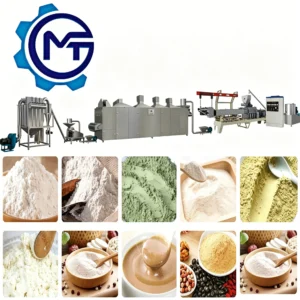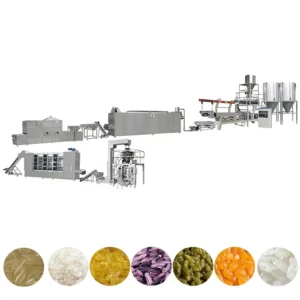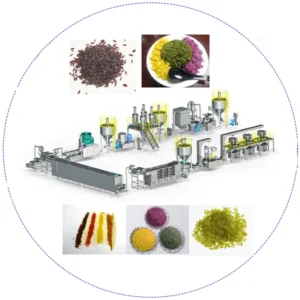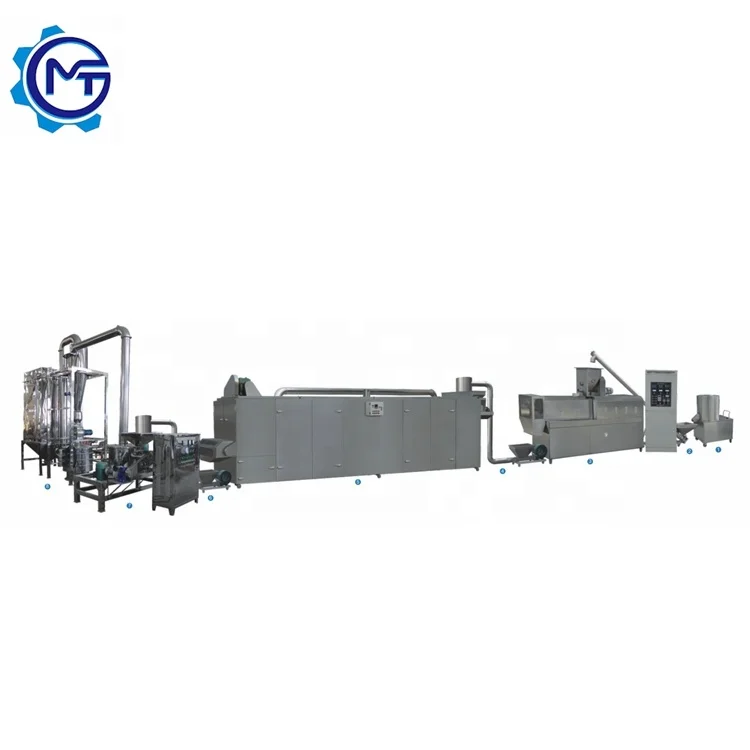


MT65 / MT70 / MT85 Twin-screw Nutritional Powder Processing Line — engineered for FBF, CSB and infant cereal production from cereal flour blends.
- Screw configuration and die design matched to raw material formulation and target powder density
- Throughput balanced across mixing, extrusion, drying, milling and packing stations as one integrated layout
- In-house trial runs on buyer’s actual raw material before shipment, with full documentation
11426
Description
Screw and die geometry — engineered to your cereal flour blend and target powder density before the extruder enters production.
Technical Specifications
| Parameter | Value |
|---|---|
| Model | MT65 / MT70 / MT85 |
| Product Type | Nutritional Powder Processing Line |
| Screw Type | Twin-screw extrusion |
| Installed Power | MT65 — 66 kW; MT70 — 100 kW; MT85 — 130 kW |
| Real Power | MT65 — 50 kW; MT70 — 67 kW; MT85 — 80 kW |
| Output Capacity | MT65 — 100–150 kg/h; MT70 — 200–240 kg/h; MT85 — 400–500 kg/h (basis not stated in source — confirm raw material formulation and moisture content) |
| Overall Dimensions (L×W×H) | MT65 — 19,000×1,200×2,200 mm; MT70 — 21,000×1,500×2,200 mm; MT85 — 30,000×3,500×4,300 mm |
| Voltage & Frequency | Three-phase 380 V / 50 Hz; Single-phase 220 V / 50 Hz (configurable to local supply) |
| Machine Material | Stainless steel on all contact and structural surfaces |
| Line Stations | Mixing → Extrusion → Drying → Milling → Packing |
| Control System | PLC and MCC |
| Standards | CE; ISO |
Application Suitability
| Application | Material or Output |
|---|---|
| Fortified Blended Food (FBF) programmes | Corn-soya blends, cereal-legume premixes for institutional and humanitarian procurement |
| Infant and baby food manufacturing | Rice, oat, wheat, and corn-based instant nutritional flour with vitamin and mineral premix |
| Corn Soya Blend (CSB) and Samaposha | Milled cereal and soy flours processed into instant drinkable powder |
| Contract nutritional powder production | Multi-ingredient cereal flour blends supplied to relief agencies and commercial brands |
What "Rated Capacity" Leaves Out on a Nutritional Powder Line
Throughput figures mean nothing unless they match your actual cereal flour formulation.
Most buyers receive a nutritional powder processing line turnkey proposal quoting a flat output number. That number was probably calculated on standard corn starch or white rice flour under controlled moisture. When a buyer’s real recipe introduces whey protein concentrate, dietary fibre, or a high-fat vitamin premix, the extruder barrel temperature profile and screw speed that worked on the test material no longer apply. I once spent four days in a Mexican plant recalibrating screw configuration and die clearance because a formula heavy in whey protein collapsed the expansion ratio entirely. The buyer’s launch date was nearly missed [NEED_CITE: common causes of extrusion line underperformance in high-protein formulations].
Throughput Matching from Mixing to Packing
Every station on a nutritional powder processing line turnkey must handle the same mass flow rate, otherwise the extruder runs starved or the dryer backs up. The MT65 / MT70 / MT85 series is specified end-to-end: the batching and mixing system is sized to feed the twin-screw extruder at its real throughput, the dryer length and airflow are calculated for the moisture drop the extrudate carries, and the milling station is selected to achieve the target particle size without becoming the bottleneck. This kind of station-by-station capacity calculation is rarely shown in standard quotations, yet it is the single factor that separates a line that runs at nameplate output from one that chronically underperforms.
Screw Geometry Matched to Your Flour Blend
Cereal flours behave differently under shear and heat. Corn gelatinises at a lower temperature range than oat, and soy flour introduces protein structures that resist expansion. The twin-screw configuration on this line allows the screw element arrangement — conveying, kneading, and reverse-flight sections — to be set specifically for the buyer’s blend before the machine ships. Die aperture and land length are then chosen to produce the extrudate density that the downstream mill can reduce into an instant powder within specification. Without this matching step, the powder can end up too coarse for rapid reconstitution or too fine to flow through the packing auger [NEED_CITE: twin-screw extrusion screw element configuration for cereal-based instant powders].
Reading the Spec Sheet Against Your Actual Recipe
Installed power and real power figures differ meaningfully on this line. The MT85 draws 130 kW at the motor nameplate but runs at roughly 80 kW under typical cereal flour load. That gap matters for utility planning: a facility designed around installed power will over-specify transformer capacity and switchgear, while one designed below real power risks tripping breakers during startup surges. The stainless steel construction across all food-contact surfaces also affects thermal mass during heat-up and cool-down cycles, which influences the time between recipe changeovers. Control through PLC and MCC means that barrel zone temperatures and screw RPM can be stored as recipe presets, reducing the variance between operators and shifts.
The Hidden Cost of Unmatched Station Capacity
When an extruder is sourced from one vendor and the dryer from another, the gap between quoted and actual output often traces back to an undersized drying section. Wet extrudate enters the dryer faster than it can lose moisture, so line speed must be throttled back. Downstream, a mill rated below the dryer output creates a second chokepoint. I have seen lines where the extruder was physically capable of its quoted throughput, but the packing station auger could not keep pace with the milled powder, forcing the entire line to idle in cycles. These mismatches surface only during commissioning, when the cost of modifying or replacing a station has already multiplied [NEED_CITE: throughput bottleneck analysis in integrated food processing lines].
Why This Line from Meiteng
Meiteng engineers the nutritional powder processing line turnkey as one project under one supplier, so every station from the batching hopper to the packing head is capacity-matched before the layout drawing is finalised. The in-house testing workshop runs your actual cereal flour blend — not a generic standard material — before shipment, producing a trial run report that documents the screw speed, barrel temperatures, and die configuration that achieved target expansion. Screw and die configuration records are included in the documentation package, so replacements can be ordered to the same geometry when wear parts are due. PLC programs and MCC schematics are confirmed for the buyer’s local voltage and control language before production begins, eliminating the commissioning delays that arise when a 380 V / 50 Hz control panel arrives in a 440 V / 60 Hz facility. Full stainless steel construction on every contact surface meets food-grade requirements without the buyer needing to specify it as an add-on.
Documentation & Verification
- Line layout and capacity calculation showing throughput at every station from mixer to packer
- Trial run report on your specific cereal flour formulation produced before dispatch
- Screw and die configuration record matched to your blend ratio and target powder density
- Electrical schematic with voltage, frequency, and PLC language confirmed for your facility
- CE declaration of conformity and ISO certificate covering the complete integrated line
- Wear parts list with screw element and die dimensions for reorder planning
Installation, Commissioning & Support
- Foundation and floor plan provided for the MT85’s 30-metre footprint, including dryer support points
- Three-phase 380 V / 50 Hz dedicated circuit specified with real-load draw figures for each station
- Line arrives in modular sections for assembly inside facilities with limited door clearance
- On-site commissioning covers barrel zone temperature calibration and PLC recipe storage for your flour blend
- Operator training includes screw configuration adjustment procedures for recipe changeovers
- Spare screw elements and die plates listed with part numbers and estimated replacement intervals
Before You Request a Quote
To scope a nutritional powder processing line turnkey accurately, share your cereal flour formulation including the ratio of corn, wheat, rice, oat, or soy and any protein or fibre additives. Specify your target daily output in kilograms and the moisture content you expect in the final packed powder. Confirm your facility’s voltage, frequency, and preferred PLC language. If you have existing upstream mixing or downstream packing equipment you intend to keep, provide those model details so the line can be engineered to integrate rather than replace.
Frequently Asked Questions
Q: How is output capacity verified against my raw material formulation?
A: The quoted throughput is based on a reference formulation. Before shipment, your actual cereal flour blend is run in the testing workshop, and the resulting trial report documents the screw speed, barrel temperatures, and expansion achieved. If the output on your recipe differs from the reference figure, the line is adjusted before it leaves the factory.
Q: How are voltage, frequency, and control language confirmed before production?
A: During the specification confirmation stage, the electrical schematic is reviewed with the buyer. Voltage and frequency are set to match the facility supply, and PLC interface language is selected. This confirmation is signed off before the MCC panel and extruder wiring enter assembly.
Q: What does the installation and commissioning schedule look like on site?
A: The line arrives in modular sections. Mechanical assembly, electrical connection, and station-by-station dry runs precede the first wet run with your raw material. Barrel temperatures and screw speeds are tuned to your formulation, and operators are trained on recipe recall and screw element replacement before the engineering team departs.
Q: How is screw and die configuration selected for different cereal flour blends?
A: Screw element arrangement and die geometry are chosen based on the starch-to-protein ratio and target powder density of your blend. The configuration record is included in the documentation package so that the same geometry can be reordered when wear parts reach their service interval.
Related products
-
Healthy Baby Food Production Line Nutritional Powder Equipment for Baby Food Supplements for Flour Processing Machinery
¥8,500.00 Select options This product has multiple variants. The options may be chosen on the product page -

High Precision Automatic 500kg/h Baby Food Nutrition Powder Rice Extrusion Processing Line
¥8,238.27 Add to cart -
Fully Automatic Fortified Nutrition Powder Baby Food Production Line
¥8,238.27 Select options This product has multiple variants. The options may be chosen on the product page -

High Quality Automatic PLC Controlled 500kg/h Twin Screw Extruder Machine for Baby Rice Nutrition Powder
¥8,238.27 Add to cart