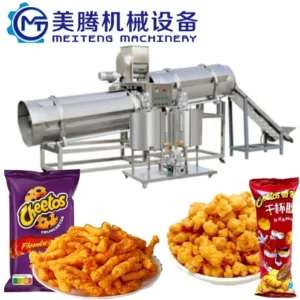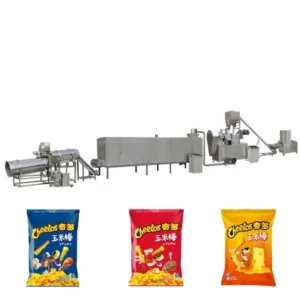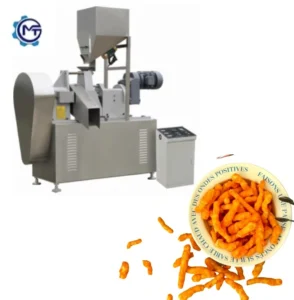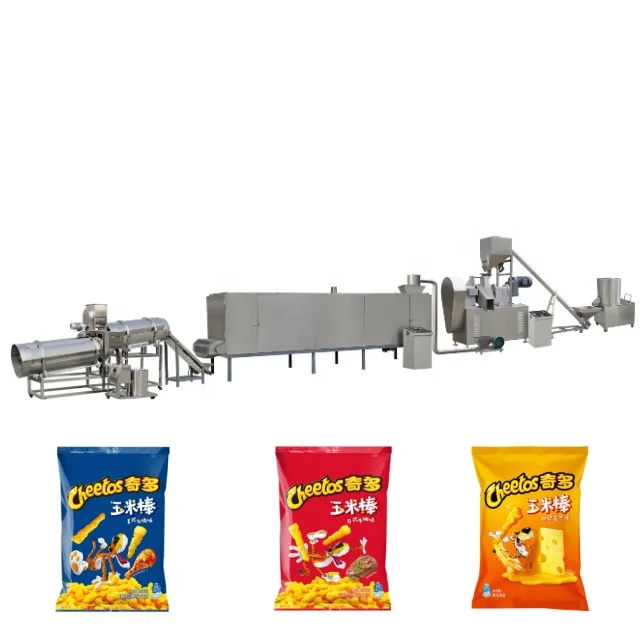
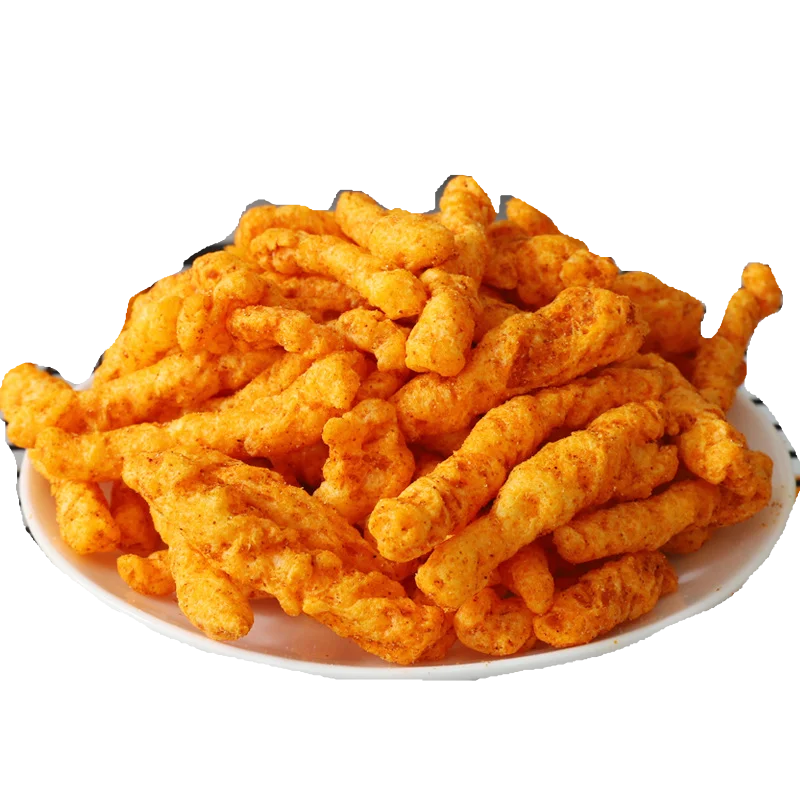

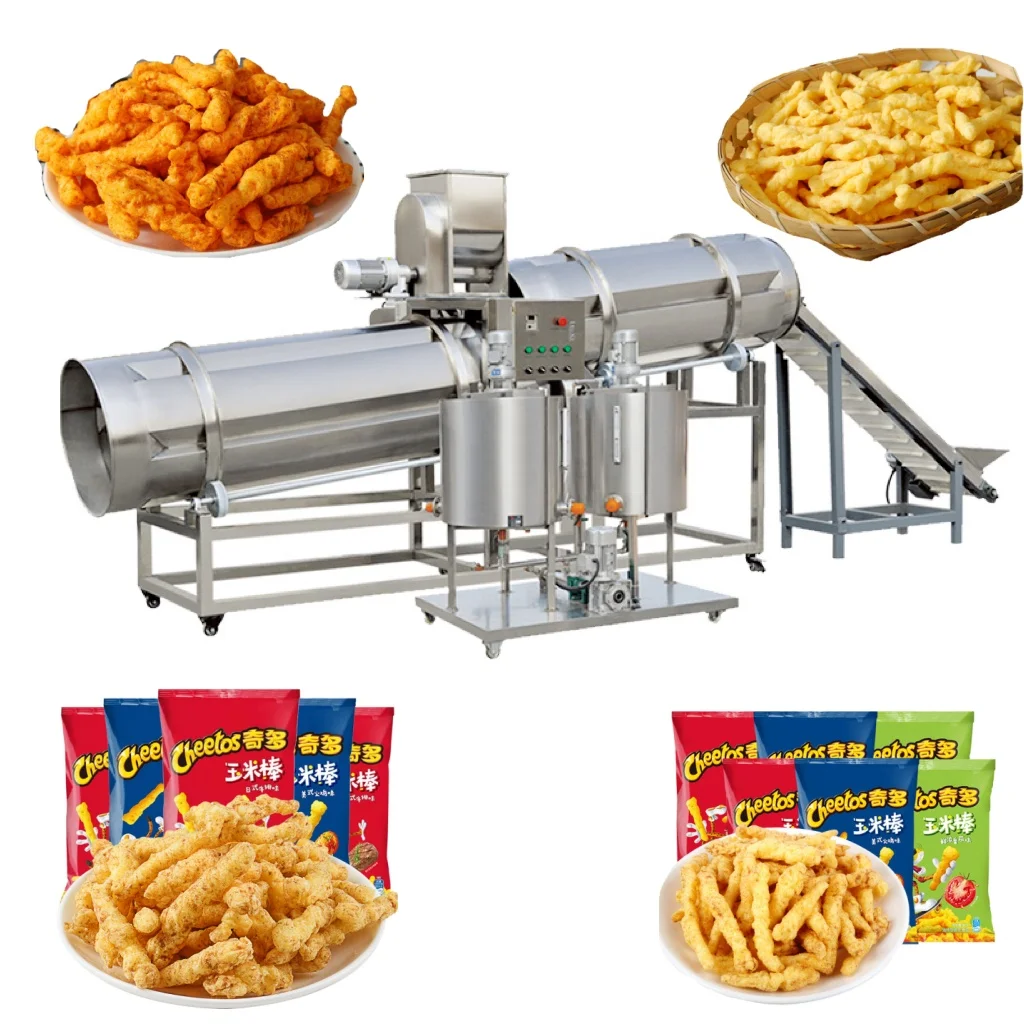


Kurkure Cheetos Snack Extrusion Production Line, 120–350 kg/h, Electric Heat, 304 Stainless Steel — engineered as a complete turnkey project where every station from batching through extrusion to flavouring and packing is throughput-matched under one layout. Screw configuration and die design are specified to your corn or grain formulation, controlling expansion, texture, and density to meet kurkure versus cheetos target profiles. Backed by in-house trial runs on your raw material before shipment, matched throughput across all stations, and pre-sales engineering through on-site commissioning support.
Description
Throughput-Matched Extrusion Lines — every station on this kurkure cheetos making machine turnkey production line is balanced from mixer to flavouring drum, preventing the mid-line bottlenecks that occur when extruders are quoted without downstream coordination.
Technical Specifications
| Parameter | Value |
|---|---|
| Product Type | Cheetos Kurkure Snack Extrusion Production Line |
| Output Capacity | 120–350 kg/h (basis not stated in source — confirm raw material / moisture / product format) |
| Heat Source | Electric |
| Construction Material | 304 Stainless Steel |
| Automation Level | Fully Automatic |
| Control System | Available with PLC or MCC control |
| Voltage & Frequency | Configurable to site requirements |
| Screw Configuration | Matched to raw material and target texture |
Application Suitability
| Application | Material or Output |
|---|---|
| Kurkure and Cheetos puffed snacks | Corn grits, corn meal, and grain-based formulations |
| Small-scale snack food manufacturing | Regional market entry with compact line footprint |
| Turnkey snack plant builds | Complete matched line for contractor-installed facilities |
| Extruded snack format diversification | Producers expanding from pellets or flakes into rotary-head formats |
What the Quoted Capacity Number Leaves Out on a Kurkure Cheetos Making Machine
A capacity figure is only meaningful when tied to your specific corn formulation and moisture level.
I once laid out a snack line for a Middle Eastern buyer where the extruder was rated to run comfortably at the top of its range, but the downstream fryer and flavouring drum could not keep pace with the actual output once the corn grits expanded beyond expected volume. The result was product stacking up between stations, operators constantly clearing jams, and an effective throughput well below what was promised. When sourcing a kurkure cheetos making machine turnkey production line, the capacity number on the spec sheet rarely accounts for the raw material behaviour you will actually run [NEED_CITE: extruder throughput variance across grain formulations].
Station-to-Station Balance Across the Extrusion Line
The defining challenge in a Cheetos or Kurkure line is that each station — mixing, extrusion, frying or baking, cooling, and flavouring — operates on a different physical principle and therefore responds differently to changes in upstream output. A rotary-head extruder pushing out expanded dough pieces must feed a fryer that has a fixed residence time, which in turn feeds a cooling conveyor and a seasoning drum that requires a consistent feed rate for even coating. This kurkure cheetos making machine turnkey production line is configured so that the throughput at each stage is calculated against the others, rather than each station being selected independently.
Thermal Profile and Expansion Control
Electric heating across the extrusion barrel provides zone-by-zone temperature management, which directly influences how the corn starch gelatinises and how much the product expands at the die face. Inconsistent barrel temperatures lead to pieces that vary in density — some too hard, some too hollow — and that variation carries through frying and into the finished bag. The thermal stability of a well-configured electric barrel profile is what keeps product texture consistent across a full production run [NEED_CITE: starch gelatinisation temperature windows in snack extrusion].
Reading the Specs That Actually Matter for Snack Extrusion
The 304 stainless steel construction across food-contact surfaces is not merely a hygiene checkbox; in a high-moisture, high-temperature extrusion environment, lower-grade steels corrode at the barrel liner and screw flight edges, introducing metal wear particles into the product stream and shortening the interval between screw replacements. The fully automatic control system governs feed rate, barrel temperature, and screw speed in relation to one another, which is essential because adjusting any one parameter in isolation changes the shear profile inside the barrel and alters expansion behaviour at the die. Output capacity of 120–350 kg/h spans a meaningful range for small to mid-scale snack producers, but the achievable rate on your line depends on the specific corn grit particle size and moisture content you feed into the mixer. Screw configuration is specified to the target product — Kurkure requires a different shear and compression profile than the smoother, more uniform Cheetos format — so the screw and die combination must be selected against your product sample, not pulled from a generic catalogue.
The Hidden Cost of a Mismatched Line Configuration
When the extruder screw and die are copied from a standard build rather than matched to your corn formulation, the product texture drifts outside what your market expects — too dense for a Kurkure that should have a distinctive crunch, or too fragile for a Cheetos that needs to hold its shape through frying and packaging. If the dryer or fryer is undersized relative to the extruder output, product accumulates on the transfer conveyor, cooling unevenly and absorbing oil inconsistently, which creates flavour hotspots and packaging weight variation [NEED_CITE: oil absorption variance in continuous frying systems].
Why This Line Configuration Works for Snack Producers
Every station from batching through to packing is sourced from a single supplier, which means throughput calculations are done across the entire line rather than leaving each vendor responsible only for their own machine. The screw configuration and die design are specified against your raw material sample and target product texture, not selected from a generic build library. An in-house testing workshop allows trial runs on your actual corn grits before the line ships, so product development begins at the factory rather than on your floor after installation. Electrical schematics and voltage are confirmed against your site supply before production starts, preventing the commissioning delays that happen when a machine arrives wired for a different frequency.
Documentation & Verification
- Line layout showing capacity calculation and throughput matching across all stations
- Screw and die configuration record matched to your raw material and target snack format
- Trial run report produced on your corn formulation before dispatch
- Electrical schematic with confirmed voltage, frequency, and control language
- Factory test record documenting run parameters and product sample output
- CE declaration of conformity and ISO certificate for the complete line
Installation, Commissioning & Support
- Foundation and floor space plan based on the full line footprint including fryer ventilation requirements
- Dedicated electrical circuit sizing for electric barrel heating zones and fryer elements
- Modular station delivery allowing phased installation in facilities with limited access
- First-run parameter setting and screw speed calibration against your corn formulation on site
- Operator training covering screw changeover, die cleaning, and flavouring drum adjustment
- Wear parts list with reorder schedule for screws, dies, and fryer mesh belts
What to Include in Your Enquiry
To configure a kurkure cheetos making machine turnkey production line that matches your actual production conditions, share your target product format along with a sample or specification of the corn or grain formulation you plan to run. Include your site voltage and frequency, available floor space, and the language preference for the control interface. If you have existing upstream mixing or downstream packing equipment, note the model and throughput so the new line can be integrated without bottlenecks.
Frequently Asked Questions
Q: How is the 120–350 kg/h capacity verified on this line?
A: The capacity range is confirmed through a trial run on your specific raw material in the in-house testing workshop before shipment. The trial report documents the actual throughput achieved at the target moisture content and product format, along with screw speed, barrel temperature, and die configuration used during the test.
Q: Which screw and die setup is used for Kurkure versus Cheetos?
A: Kurkure requires a screw profile that generates higher shear and a die that produces the characteristic irregular, twisted shape. Cheetos needs a smoother compression profile and a die that yields a uniform, elongated puff. Both configurations are selected based on your raw material test and product sample.
Q: How is throughput balanced between the extruder, fryer, and flavouring drum?
A: Each station is sized against the extruder output calculated on your formulation. The fryer belt speed and oil residence time are matched to the extruder feed rate, and the flavouring drum rotation and seasoning feed are calibrated so that coating coverage remains even without product accumulation between stages.
Q: Is a trial run on my raw material conducted before the line ships?
A: Yes. Your corn or grain formulation is run through the extruder in the factory testing workshop, and a trial report is generated covering output rate, product density, expansion ratio, and the specific screw and die configuration that achieved the target texture.
Related products
-
Twin Screw Extruder for Aquatic Fish Feed – Turnkey Solution
Read more -
Fried Snack Cheetos Kurkure Making Machine 200kg/H Capacity Production Line
¥8,238.27 Select options This product has multiple variants. The options may be chosen on the product page -
Modified Starch Processing Line for Industrial Drilling – Turnkey Solution
Read more -
Fried Snack Cheetos Kurkure Making Machine – Production Line
Read more