

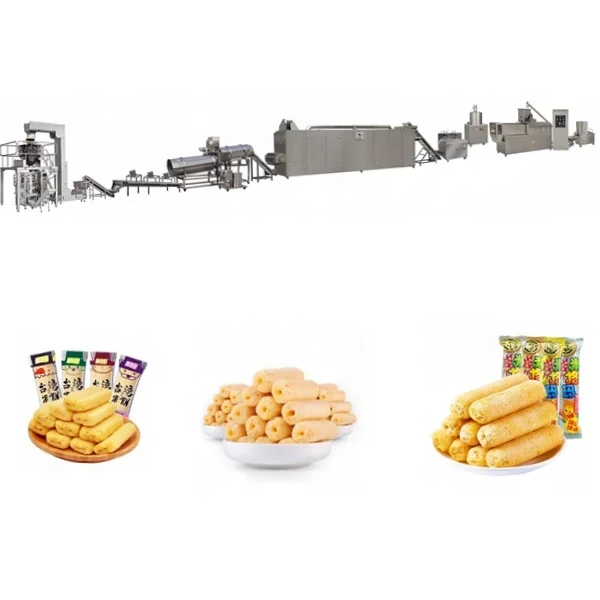
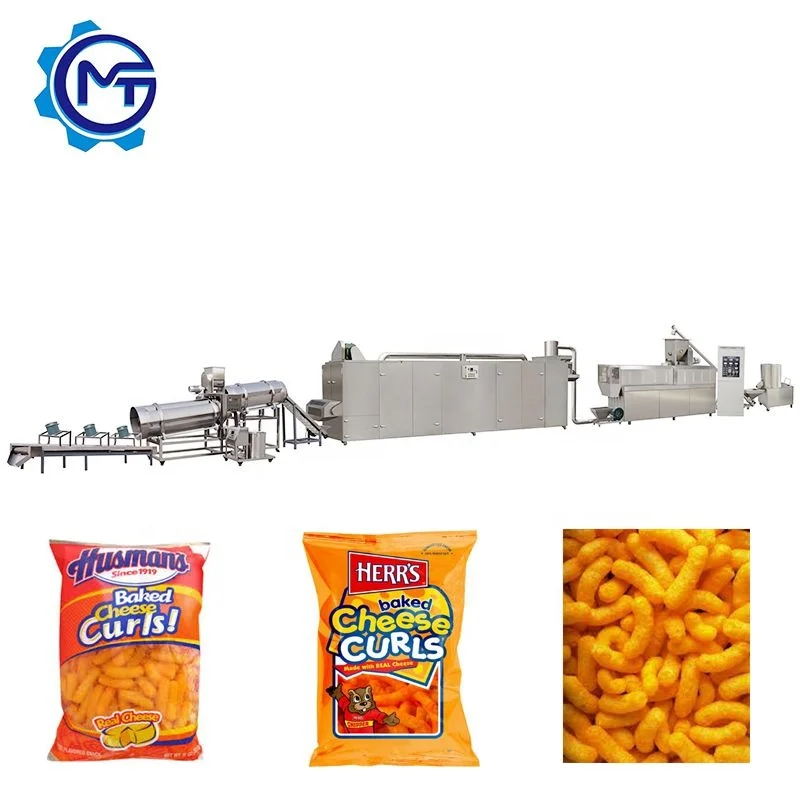
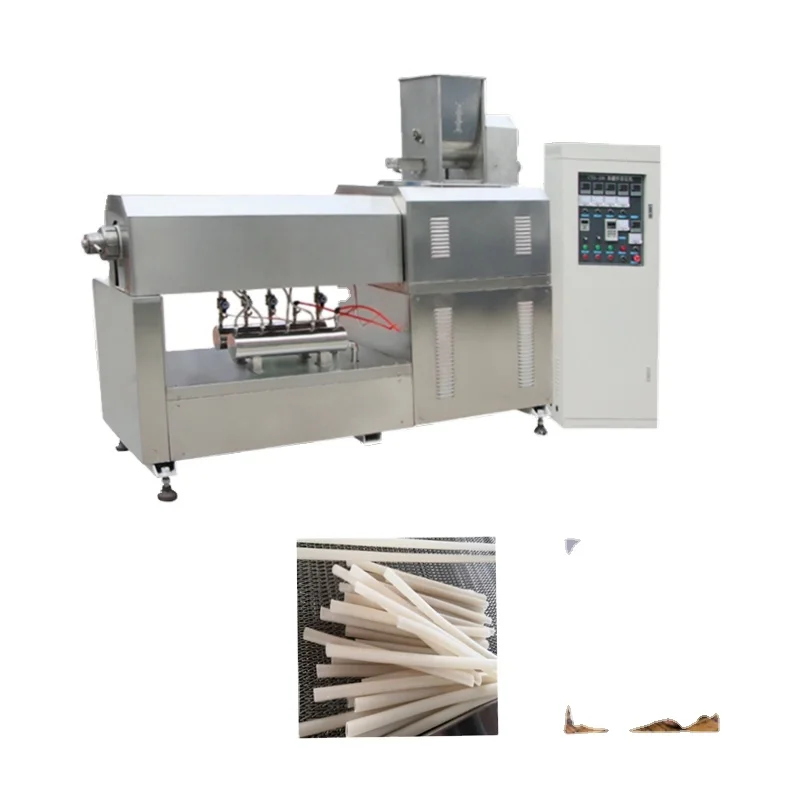
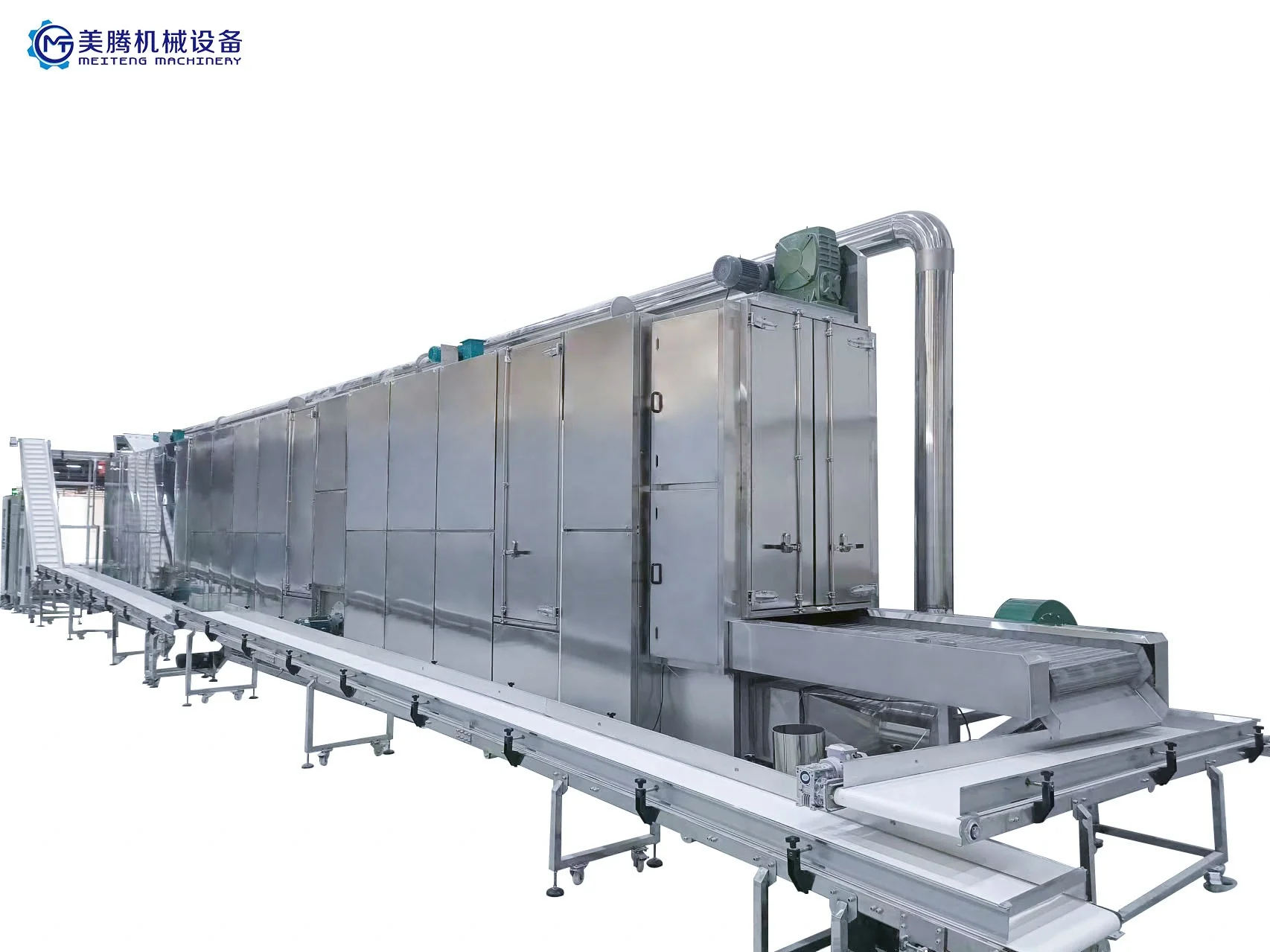
MT70 Twin Screw Corn Puff Snacks Extrusion Line, 130 kW Installed Power, PLC Control — configured as a complete turnkey project with throughput balanced across every station from batching through packing.
- Screw configuration and die design matched to your raw material and target snack geometry
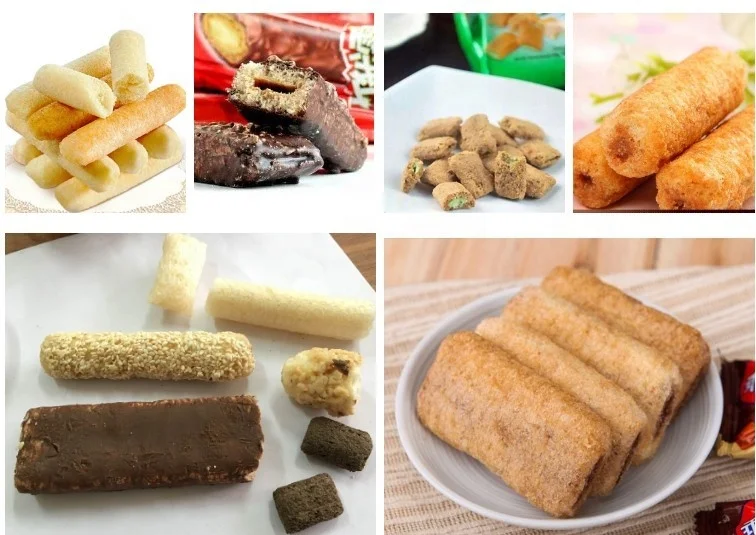
- Interchangeable dies support multiple shapes including ball, tube, ring, star, and fruit loop formats
- Integrated coating system with double tumble sugar melting sized to match extruder output
Line layout and capacity calculation provided showing throughput matching across every station, with trial runs on your actual raw material conducted before shipment.
Description
Throughput-balanced turnkey project — every station from batching to packing is engineered as one system, preventing the dryer or coating drum from bottlenecking your extruder output.
Technical Specifications
| Parameter | Value |
|---|---|
| Product Type | Twin Screw Corn Puff Snacks Extrusion Line |
| Extruder Model Options | MT70 / MT85 / MT75 |
| Screw Type | Twin Screw |
| Installed Power | 130 kW (MT70) / 180 kW (MT85) / 220 kW (MT75) |
| Power Consumption | 95 kW (MT70) / 120 kW (MT85) / 130 kW (MT75) |
| Output Capacity | 100–120 kg/h (MT70, basis to be confirmed) / 200–300 kg/h (MT85, basis to be confirmed) / 300–500 kg/h (MT75, basis to be confirmed) |
| Overall Dimensions (L×W×H) | 21 × 1.5 × 2.2 m (MT70) / 25 × 1.5 × 2.2 m (MT85) / 28 × 1.5 × 2.2 m (MT75) |
| Control System | PLC and MCC (model-specific confirmation required) |
| Line Stations | Mixing → Extruding → Drying → Coating/Flavoring → Cooling → Packing |
| Die Configuration | Interchangeable dies for ball, tube, stick, ring, fruit loop, star, wheel, flower, heart shapes |
| Dryer Heating Source | Gas / Electric (to be confirmed) |
| Coating System | Double tumble for sugar melting, elevator, coating drum, spraying nozzle |
| Raw Materials | Corn, rice, wheat, oat, barley flour |
| Assembly State | Complete turnkey line |
| Certification | CE (since 2014), ISO |
Application Suitability
| Application | Material or Output |
|---|---|
| Corn puff snack production | Corn flour and corn grits as primary cereal base |
| Cheese ball and ring snacks | Corn and rice flour blends with post-extrusion cheese powder coating |
| Fruit loop and star-shaped cereal snacks | Wheat, oat, and barley flour combinations |
| Extruded stick and tube snacks | Rice and corn blends for light, crispy texture |
| Sugar-coated puffed snacks | Any cereal-based extrudate processed through the double tumble sugar coating system |
Why Nominal Capacity Numbers Mislead Snack Line Buyers
A corn puff snacks production line turnkey project must verify throughput against your specific flour blend, moisture content, and target snack density before any equipment leaves the factory.
I have watched buyers sign off on an extruder rated at a certain hourly output, only to discover during commissioning that their corn flour formulation — slightly higher in fiber or slightly lower in starch than the seller tested with — cuts actual output and changes expansion behavior entirely. The dryer then runs below capacity while the extruder struggles to keep up, or the opposite: the extruder pushes product faster than the coating drum can tumble. These mismatches do not show up on a spec sheet. They surface on day one of production, when the line is already bolted to your floor [NEED_CITE: material-dependent throughput variation in twin-screw extrusion].
Matching Every Station to the Next
A turnkey corn puff snacks production line succeeds or fails on station-to station balance. The extruder does not operate in isolation — it feeds a dryer whose residence time depends on product moisture at the die face, and that dryer feeds a coating drum whose tumble speed and spray rate must match the incoming flow. When any one station is sized independently, the entire line settles to the pace of its slowest link. The layout engineering phase is where these calculations happen: belt width, conveyor speed, dryer length, and drum diameter all derive from the same target throughput rather than from catalog defaults.
Layout as a Turnkey Project Document
The factory floor is never a blank rectangle. Columns, overhead utilities, drainage slopes, and existing equipment all constrain where each station can sit. A proper turnkey project delivers a layout drawing that accounts for these constraints before metal is cut. This drawing includes utility drop points for water, compressed air, gas lines for the dryer, and electrical feed locations for the MCC panel. Without this document, installation crews improvise on site, and improvisation costs time [NEED_CITE: turnkey food processing line layout engineering standards].
Reading the Specs That Actually Matter
Twin screw extrusion for corn puff snacks relies on shear, heat, and pressure built up along the barrel. The installed power — ranging across the MT70, MT85, and MT75 options — determines how much mechanical energy the screws can deliver to the dough, which directly governs starch gelatinization and expansion at the die. A motor that is undersized for your formulation will produce dense, under-expanded snacks regardless of what the die geometry promises. The interchangeable die system supports multiple geometries — ball, tube, ring, fruit loop, star, wheel, flower, heart — but each shape demands a specific screw configuration and barrel temperature profile to expand correctly. The control system, available with PLC and MCC, manages these variables across production runs so that the first hour and the eighth hour yield the same snack density and texture.
The Hidden Cost of a Bottleneck You Did Not Plan For
Buyers who source an extruder from one supplier and a dryer from another frequently discover that the two machines disagree on what "full capacity" means. The extruder pushes product at a rate the dryer cannot handle, forcing operators to throttle the feed and run below the line’s paid-for potential. Alternatively, an undersized coating drum creates a backlog of unseasoned product on the cooling conveyor, where it absorbs ambient moisture and loses crispness. These integration failures compound: product waste rises, energy per kilogram of saleable output climbs, and the shift schedule stretches to meet daily targets [NEED_CITE: integration gap consequences in multi-vendor food processing lines].
Why This Turnkey Approach Works Differently
The corn puff snacks production line turnkey configuration is supplied as a complete system from a single source, meaning throughput calculations are performed across all stations simultaneously rather than per machine. The screw configuration and die design are specified to the buyer’s raw material and target snack geometry, not copied from a generic build. An in-house testing workshop runs trial production on the buyer’s actual flour blend before shipment, producing a trial run report that documents real output, expansion ratio, and texture. Electrical schematics confirm voltage, frequency, and control language for the destination market before the MCC panel is wired. Post-delivery, the scope covers on-site installation, commissioning, and operator training so that the line runs at validated capacity from day one.
Documentation & Verification
- Line layout and capacity calculation matched to your factory footprint and throughput target
- Screw and die configuration record specific to your snack shape and density requirement
- Trial run report on your actual corn or rice flour before dispatch
- Electrical schematic with voltage, frequency, and control language confirmed for your market
- Factory test record documenting station-by-station performance prior to crating
Installation, Commissioning & Support
- Floor plan marks utility drop points for the 21–28 m line footprint depending on model selection
- Dedicated electrical circuit sized for up to 220 kW installed power at confirmed voltage and frequency
- Line arrives in modular sections for staged assembly and alignment on your prepared foundation
- First-run commissioning includes screw speed, barrel temperature, and die pressure tuning on your raw material
- Operator training covers die changeover procedures across all supplied snack geometries
- Wear parts list identifies screws, dies, and dryer belts with replacement intervals for your production schedule
What to Prepare Before Requesting a Quote
To scope a turnkey corn puff snack project accurately, share your primary flour type and any secondary grains in the blend, along with the moisture content at which you typically store raw material. Specify your target daily output in finished kilograms and the snack shapes you intend to run. Provide your factory ceiling height, available floor length, and local voltage and frequency so the MCC panel and dryer heating source can be specified correctly. If you operate existing upstream or downstream equipment that the new line must connect to, include those machine dimensions and throughput rates.
Frequently Asked Questions
Q: How is line throughput balanced between the extruder, dryer, and coating station?
A: Each station is sized using the same target output calculation based on your specific raw material. The dryer length and belt speed are matched to the extruder’s validated output, and the coating drum diameter and tumble rate are set to handle the same flow without accumulation or starvation at transfer points.
Q: What does the turnkey project scope include beyond equipment supply?
A: The scope covers factory layout design matched to your floor plan, utility connection planning for water, gas, compressed air, and electricity, a phased installation schedule, full commissioning on your raw material, and operator training covering die changes, parameter adjustment, and daily maintenance routines.
Q: How is output capacity verified before the line ships?
A: The testing workshop runs your actual corn, rice, or blended flour through the configured extruder and records real throughput, expansion behavior, and snack density. A trial run report documents these results so you can review validated performance before the equipment is crated for shipment.
Q: What factory preparation is needed before installation begins?
A: You need a level floor area matching the line footprint — between 21 and 28 meters in length depending on model — with utility stubs positioned per the layout drawing. Electrical supply must match the confirmed voltage and frequency, and a dedicated circuit must be installed for the total connected load.
Q: How are snack shape changes handled within the line configuration?
A: The extruder uses interchangeable dies for each shape — ball, tube, ring, star, wheel, and others. Each die requires a corresponding screw configuration and barrel temperature profile, which are documented in your configuration record so operators can switch formats with repeatable results.
Related products
-

Automatic Corn Flake Processing Line Corn Coco Pops Breakfast Cereals Snacks Making Machinery
¥7,500.00 Select options This product has multiple variants. The options may be chosen on the product page -

Full Automatic Puffed Corn Snack Food Extruder Puffed Snack Corn bar Making Machine
¥8,500.00 Select options This product has multiple variants. The options may be chosen on the product page -

Automatic Puffed Food Snack Machine Electric Corn Puffs Snacks Making Machinery New Condition Flavorful Puff Snack Production
¥7,550.00 Select options This product has multiple variants. The options may be chosen on the product page -

New Stainless Steel Automatic Snack Food Machinery Extruder Puffed Corn Maize Puff Processing Line for Food Industry High
¥12,350.00 Select options This product has multiple variants. The options may be chosen on the product page


