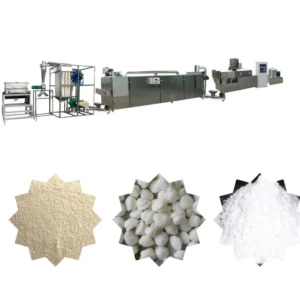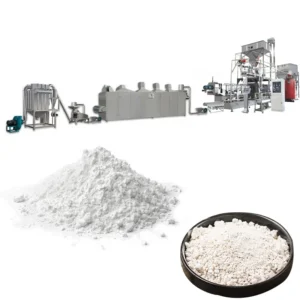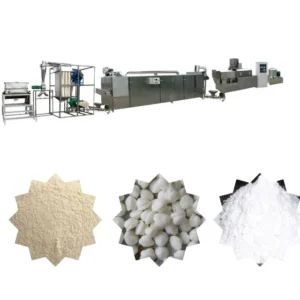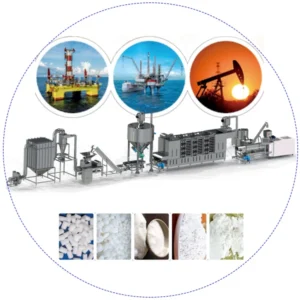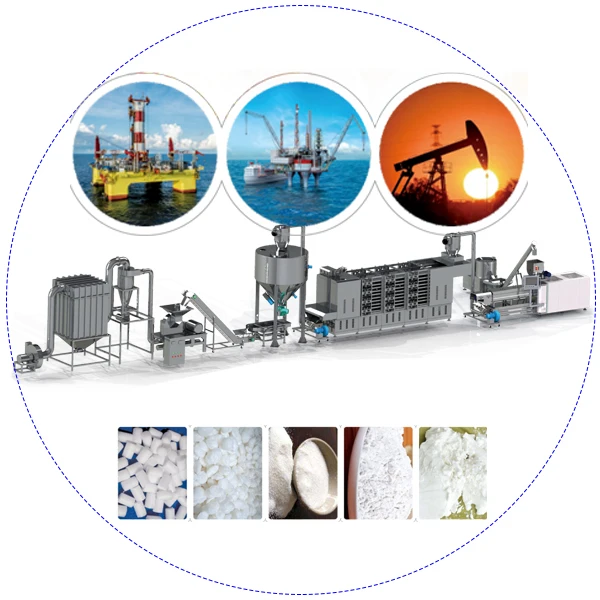


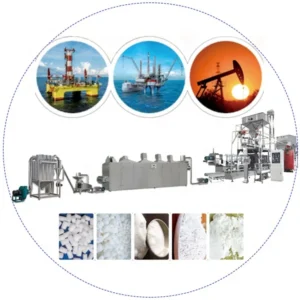
Twin Screw Modified Starch Processing Line, 45-200KW, PLC Control, Food Grade 304 Stainless Steel — engineered for complete production from raw material batching through extrusion to cooling and grinding. The line matches throughput across every station to prevent bottlenecks, with screw configuration and die design specified to your starch type and target modification degree. – Twin screw extrusion handles corn, wheat, potato and soybean starch with precise moisture and shear control – Pulse grinder with cyclone discharge and dust collector ensures consistent particle size – Cooling conveyor with wind knife drying preserves functional properties after modification Delivered as a turnkey project with in-house trial runs on your raw material, matched line throughput calculations, and on-site commissioning support.
Description
Matched throughput across every station — the modified starch processing line is configured from batching to packing so extruder output, cooling conveyor capacity, and pulse grinder feed rate stay synchronized under continuous operation.
Technical Specifications
| Parameter | Value |
|---|---|
| Product Type | Twin Screw Modified Starch Processing Line |
| Screw Type | Twin screw |
| Power | 45–200 kW |
| Capacity | 100–1500 kg/h (basis not stated in source — confirm raw material type, moisture content, modification degree) |
| Weight | 1000–5000 kg (varies by line configuration) |
| Voltage | 220–440 V, tri-phase |
| Frequency | 50 Hz / 60 Hz (configurable) |
| Control System | PLC (available with MCC control) |
| Contact Material | Food grade 304 stainless steel |
| Raw Materials | Corn starch, wheat flour, rice flour, soybean flour, potato starch, additive materials |
| Line Stations | Twin screw extruder, cooling conveyor, pulse grinder with cyclone discharge and dust collector |
| Fuel Options | Gas, diesel, electricity, steam (to be confirmed at quotation stage) |
| Standards | CE, ISO |
Application Suitability
| Application | Material or Output |
|---|---|
| Food-grade modified starch for thickeners and stabilizers | Corn starch, wheat flour, potato starch |
| Pregelatinised starch for instant food and nutrition products | Rice flour, corn starch with additive materials |
| Industrial modified starch for oil drilling fluids | Corn starch, soybean flour blends |
| Modified starch for papermaking surface sizing | Wheat flour, potato starch |
| Texturized and functional starch for meat analogues | Soybean flour, corn starch blends |
Why "500 kg/h" Means Nothing Without the Raw Material
A capacity figure only holds when tied to a specific starch type, moisture level, and target modification degree.
I learned this the hard way. A Southeast Asian customer ordered a line rated for corn starch, then showed up with cassava starch on the pallets. The gelatinisation temperature gap meant the screw speed and moisture profile we had dialed in were completely wrong. Two weeks of re-tuning followed before the line hit its nameplate numbers. The modified starch processing line turnkey proposal you evaluate should always specify the raw material basis for any throughput claim — otherwise you are buying a guess. [NEED_CITE: starch gelatinisation temperature differences across corn, cassava, wheat and potato sources]
How Screw Configuration Determines Your Starch Modification Window
The twin-screw extruder sits at the heart of this modified starch processing line turnkey project, and its screw profile dictates what the machine actually does to your material. Starch modification depends on shear, residence time, and thermal input — all controlled by the arrangement of conveying, kneading, and reverse elements inside the barrel. A screw set optimized for corn starch pregelatinisation will under-process wheat flour and over-shear potato starch. The configuration must match both the feedstock and the functional property you need in the final powder — viscosity, solubility, or film-forming ability.
Why the Grinder and Cooling Conveyor Cannot Be Afterthoughts
A common mistake is sizing the extruder correctly and then bolting on a generic grinder that chokes on the output rate. The pulse grinder on this line uses an auger feeder with variable speed, a rotor-and-stator cutting chamber, and a motor-driven classifier to control particle size distribution. Upstream, the cooling conveyor employs a low-power fan and wind-knife air blade to bring the extrudate to ambient temperature before it enters the mill. If the extruder pushes material faster than the conveyor can cool and the grinder can classify, you get heat buildup in the grinding chamber, which degrades the modification you just paid energy to create. [NEED_CITE: thermal degradation of pregelatinised starch during high-speed milling]
Reading the Specification Sheet Like a Process Engineer
The power range of 45–200 kW reflects the span from light pregelatinisation to deep chemical-thermal modification, where higher torque is needed to maintain screw fill under viscous conditions. Voltage configurability from 220 V to 440 V at 50 Hz or 60 Hz matters because a motor wound for the wrong frequency will run at the wrong speed, shifting your entire shear profile. Food-grade 304 stainless steel contact surfaces prevent iron-catalysed discoloration in starch products destined for food applications. The PLC control allows recipe storage — critical when a single line runs multiple starch types across shifts, because each recipe locks in screw speed, barrel temperature zones, and feed rate.
The Hidden Cost of Skipping the Trial Run
When a modified starch processing line turnkey project ships without a factory trial on the buyer’s actual raw material, commissioning becomes product development. The installer adjusts barrel temperatures, reorders screw elements, and experiments with moisture injection while the buyer’s production clock is already ticking. Each day spent tuning on-site is a day the downstream packing station sits idle. In one project I supported, a buyer who skipped the trial lost nearly three weeks before achieving the target viscosity specification — time that could have been compressed into a single pre-shipment run. [NEED_CITE: typical commissioning delays when extrusion trials are skipped before shipment]
What This Supplier Does Differently on Starch Lines
The line is engineered as one system rather than assembled from separate vendors, so throughput is matched across the extruder, cooling conveyor, and pulse grinder from the start. Screw configuration and die geometry are specified against your raw material and target modification, not copied from a generic build. An in-house testing workshop runs your actual starch before the line ships, producing a trial report you can audit. The electrical schematic and voltage confirmation are locked in before production begins, preventing the dead-on-arrival scenario where a motor will not start under local power. Documentation covers the full chain — from layout drawings to wear-parts lists — so your maintenance team is not guessing when the first screw element needs replacement.
Documentation & Verification
- Line layout and throughput calculation showing matched station capacity
- Screw and die configuration record tied to your starch type
- Trial run report on your raw material from the in-house testing workshop
- Electrical schematic with confirmed voltage and frequency
- CE declaration of conformity and ISO certificate copies
- Operation and maintenance manual with wear-parts catalogue
Installation, Commissioning & Support
- Foundation plan sized to the 1000–5000 kg line weight and extruder vibration load
- Dedicated tri-phase circuit matching the confirmed 220–440 V and 50/60 Hz supply
- Assembled line stations aligned and leveled by on-site technicians during commissioning
- Barrel temperature zones and screw speed profiles set against the trial run baseline
- Operator training covering PLC recipe changes across different starch feedstocks
- Wear-parts list for screws, dies, and grinder blades with recommended reorder intervals
Before You Request a Quote
Send the exact starch type or blend you will run, the functional property you need in the finished powder, and your target daily output. Include your workshop dimensions, ceiling height, and local voltage and frequency so the layout and electrical package are accurate from the first revision. If you have existing upstream mixing or downstream packing equipment, share the model and throughput so the line interfaces correctly.
Frequently Asked Questions
Q: How do you confirm the line capacity before shipment?
A: We run your actual raw material in our in-house testing workshop and document screw speed, barrel temperatures, moisture levels, and output rate in a trial report. This confirms the modified starch processing line turnkey project meets your throughput target on your specific starch before any equipment leaves the factory.
Q: What voltage and frequency options are available?
A: The line supports tri-phase supply from 220 V to 440 V at either 50 Hz or 60 Hz. We confirm the exact configuration during the quotation stage based on your local grid standard so motors, heaters, and PLC components match your site power.
Q: How do you match throughput between the extruder and downstream stations?
A: Each station — cooling conveyor, pulse grinder, cyclone separator — is sized against the extruder’s confirmed output rate on your material. The auger feeder speed on the grinder and the wind-knife airflow on the conveyor are calibrated during the factory trial to prevent bottlenecks.
Q: Can you run our proprietary starch formulation during the trial?
A: Yes. Send your raw material blend and target product specification, and we conduct the trial in our testing workshop. The resulting configuration record travels with your shipment so commissioning starts from a proven baseline rather than from scratch.
Q: What floor space does a complete line require?
A: We provide a scaled line layout drawing showing extruder, cooling conveyor, and grinder placement with utility connection points. Floor space depends on your selected capacity configuration, so share your workshop dimensions early and we will optimize the footprint accordingly.
Related products
-
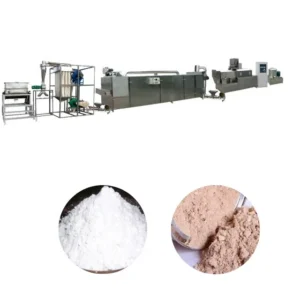
Modified Starch Production Line Industrial Drilling Twin Screw Extruder 304 Stainless Steel High Efficiency Flour Mill CE
¥50.00 Select options This product has multiple variants. The options may be chosen on the product page -
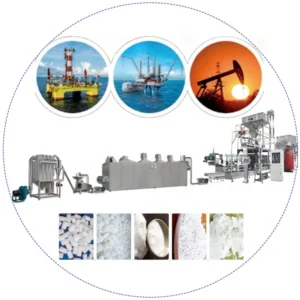
Automatic Modified Tapioca Starch Production Line 304 Stainless Steel Flour Mill and Bakery Machine
¥30.00 Select options This product has multiple variants. The options may be chosen on the product page -
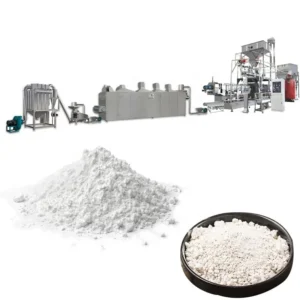
Corn Cassava Modified Starch Powder Production Line Electric-powered Motor Automatic 400kg/h Processing Equipment New Condition
¥65.00 Select options This product has multiple variants. The options may be chosen on the product page -
Automatic Industrial Adhesive Starch Modification Production Line – Pre-Gelatinization Extrusion Equipment
¥65.00 Select options This product has multiple variants. The options may be chosen on the product page