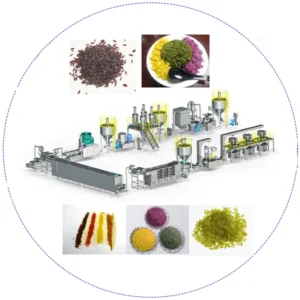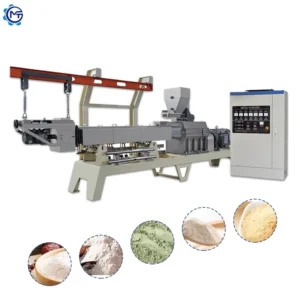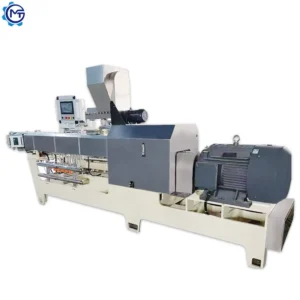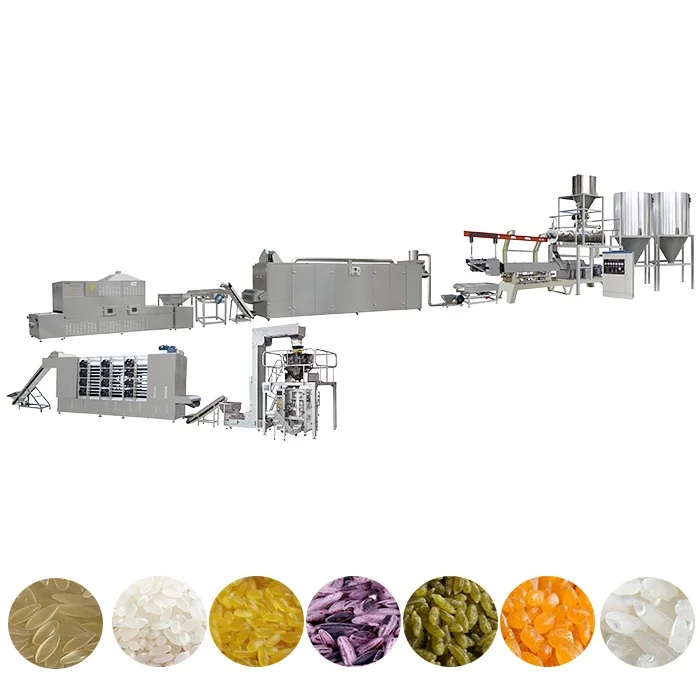


MT65 / MT70 / MT85 Nutritional Artificial Rice Production Line, Twin-Screw, PLC & MCC Control — configured as a complete turnkey system from mixing through extrusion, shaping, cooking and drying, with food-grade contact materials and CE certification.
Screw configuration and die design are matched to the buyer’s specific grain blend and fortification formulation, controlling starch gelatinisation, moisture and expansion for consistent rice grain density and shape across all three capacity tiers.
Every upstream and downstream station is throughput-matched under one supplier, backed by in-house trial runs on customer raw material before shipment.
Description
Screw Configuration Matched to Formula — we trial your exact grain blend and fortification recipe in our testing workshop, adjusting screw elements and die geometry before the line ships, so the nutritional artificial rice production line turnkey arrives calibrated to your real production conditions.
Technical Specifications
| Parameter | Value |
|---|---|
| Model | MT65 / MT70 / MT85 |
| Product Type | Nutritional Artificial Rice Production Line |
| Screw Type | Twin-screw |
| Output Capacity (MT65) | 70–100 kg/h (basis to be confirmed against raw material and moisture) |
| Output Capacity (MT70) | 100–120 kg/h (basis to be confirmed against raw material and moisture) |
| Output Capacity (MT85) | 200–300 kg/h (basis to be confirmed against raw material and moisture) |
| Power Consumption (MT65) | 60 kW |
| Power Consumption (MT70) | 85 kW |
| Power Consumption (MT85) | 165 kW |
| Control System | PLC and MCC |
| Assembly State | Complete turnkey line from mixing to packing |
| Line Stations | Mixing, screw conveying, extrusion, shaping, cooking, drying |
| Raw Material Compatibility | Rice, millet, black rice, buckwheat and other grains; fortified with vitamins, protein and mineral substances |
| Certification | CE |
| Delivery Time | 5–10 days if in stock; 15–20 days if not in stock (verify against current production schedule) |
| Payment Terms | ≤1000 USD 100% in advance; ≥1000 USD 30% T/T in advance, balance before shipment |
Application Suitability
| Application | Material or Output |
|---|---|
| Fortified rice for nutrition programmes | Rice flour blended with vitamin and mineral premix |
| Golden rice production | Beta-carotene enriched grain flour formulations |
| Buckwheat nutritional rice | Buckwheat flour with starch and protein additives |
| Purple potato rice analogues | Purple potato powder blended with cereal base |
| Artificial instant rice | Rice, millet or multi-grain flour with fortification agents |
| Institutional meal supply | High-volume fortified grain output for government feeding schemes |
What "Nominal Capacity" Leaves Out on a Fortified Rice Line
A capacity figure means nothing until it is proven on your actual grain blend and fortification premix.
I have watched buyers commit to a nutritional artificial rice production line turnkey based on a brochure number, only to discover during commissioning that their multigrain formulation — high in fiber, low in native starch — refuses to gelatinize at the temperatures the standard screw profile assumes. The extruder runs, but the rice kernels emerge under-expanded, brittle, or misshapen. The dryer then cannot keep pace because the product density is wrong, and the packing station sits idle half the shift. [NEED_CITE: starch gelatinization temperature variation across grain types]
How Screw Profile and Die Geometry Shape the Rice Kernel
The twin-screw extruder is the core of any nutritional artificial rice production line turnkey. Screw element sequencing — the ratio of conveying elements to kneading blocks — determines how much shear energy the grain flour receives inside the barrel. A formulation heavy in buckwheat or millet needs a different shear profile than pure rice flour because the starch granules rupture at different temperatures. Die aperture and land length then define the kernel cross-section and surface finish, directly influencing whether the dried product resembles natural rice or an obvious extrudate.
Barrel Temperature Zones and Fortification Sensitivity
Vitamins and certain protein isolates degrade under prolonged high heat. The extruder barrel is divided into independently controlled heating and cooling zones, and the temperature curve must be tuned so that starch gelatinization completes while heat-sensitive micronutrients survive the residence time. When we run a customer’s premix in our testing workshop, we log the temperature at each zone and adjust the profile until lab assays confirm nutrient retention is within the specification the buyer’s market requires. [NEED_CITE: thermal degradation thresholds for common vitamin fortificants]
Reading the Power and Capacity Figures Correctly
The MT65 draws 60 kW and is rated at 70–100 kg/h, but that capacity band shifts depending on the grain blend moisture content and the degree of expansion the target product demands. The MT70 at 85 kW and the MT85 at 165 kW follow the same logic — higher installed power provides the thermal and mechanical headroom for denser or more complex formulations. Buyers should treat the output figures as starting points for a conversation, not contractual guarantees, until a trial run on their actual raw material confirms the number. The PLC and MCC control system records every zone temperature and screw speed during the trial, giving both parties a repeatable baseline.
The Downstream Bottleneck That Invalidates the Extruder Rating
An extruder that produces 120 kg/h of shaped rice kernels is only as useful as the dryer that follows it. If the dryer cannot reduce moisture to the target shelf-stable level within the required dwell time, product accumulates on the cooling conveyors and the line stalls. Every station on this line — mixer, screw conveyor, shaping unit, cooker, dryer — is specified so that its throughput matches the extruder output for the buyer’s confirmed formulation, rather than being selected from a generic catalog.
Why Procurement Should Start With Your Raw Material, Not the Price
When a buyer skips the trial run and ships a line configured for generic rice flour, the on-site commissioning team then spends days swapping screw elements, re-cutting dies, and rewiring heater zones to accommodate the actual formulation. That delay burns installation labor, postpones first commercial shipment, and sometimes forces the buyer to air-freight replacement parts. A nutritional artificial rice production line turnkey is a capital project measured in weeks of commissioning time — the trial run compresses that schedule dramatically. [NEED_CITE: typical commissioning delay costs for food extrusion installations]
Why Source This Line From the Same Supplier That Builds the Extruder
The extruder, mixer, dryer and packing interface all come from one engineering team, so throughput calculations reference real machine curves rather than catalog estimates. Screw configuration and die design are documented against the buyer’s specific grain blend and fortification level. Every line undergoes a trial run with the customer’s raw material in our in-house testing workshop before crating. PLC and MCC panels are wired and labeled in the control language the buyer confirms during the specification phase. Food-grade contact materials are used throughout the product path, from the mixer bowl to the dryer belt.
Documentation & Verification
- Line layout showing throughput calculation at every station for your grain formulation
- Trial run report conducted on your supplied raw material before shipment
- Screw and die configuration record matched to your rice kernel shape and density target
- Electrical schematic with voltage, frequency and control language confirmed pre-production
- CE declaration of conformity for the complete processing line
- Wear parts list with reorder codes for screws, dies and seals
Installation, Commissioning & Support
- Foundation plan sized to the MT65/70/85 footprint and vibration load at each station
- Dedicated power circuit sized to the line’s total connected load, up to 165 kW for the MT85
- Modular station layout allowing phased installation within standard industrial ceiling heights
- Commissioning protocol covering PLC parameter upload, barrel zone calibration and dryer curve setting
- Operator training on screw element changes, die swaps and PLC fault diagnostics
- Spare screw elements and dies shipped with the initial order to cover the first replacement cycle
What We Need to Move Your Inquiry Forward
Send us your grain formulation — base flour types, fortification premix composition, target moisture after drying — along with the kernel shape and size you need for your market. Confirm your facility voltage and frequency, the control language your operators use, and the daily output volume you plan to run. If you can ship a sample batch of your raw material to our testing workshop, we will run it on a twin-screw extruder and return a trial report with the nutritional artificial rice production line turnkey proposal.
Frequently Asked Questions
Q: How do you verify the line can handle my specific grain blend and fortification recipe?
A: We ask you to supply a sample of your raw material — base flour, premix and any additives. Our testing workshop runs it on a twin-screw extruder, logging barrel temperatures, screw speed and moisture at each zone. The trial report includes the achieved output rate, kernel density and shape, forming the basis of the line configuration we quote.
Q: Is a trial run on my raw material possible before the line ships?
A: Yes. The trial run is a standard step in our sales process. We run your actual formulation in the testing workshop, adjust screw elements and die geometry as needed, and document the results. You receive the trial report before production of your line begins, so the configuration is locked to your material.
Q: How do you match upstream and downstream stations to the extruder output?
A: Each station — mixer capacity, screw conveyor rate, dryer belt length and dwell time — is calculated from the extruder output confirmed during the trial run. This prevents bottlenecks where the dryer cannot keep pace or the mixer runs idle between batches, ensuring the full line sustains its rated throughput.
Q: What voltage, frequency and control language options are available?
A: We confirm your site electrical supply during the specification phase. The PLC and MCC panels are then wired and programmed to match your voltage, frequency and preferred operator language. This confirmation happens before production starts, avoiding commissioning delays caused by mismatched electrical standards.
Q: What spare wear parts come with the line and how fast can I reorder?
A: The initial shipment includes spare screw elements, dies and seals sized to your configuration. The wear parts list in your documentation package contains reorder codes for each item. Reorder lead times depend on the specific screw and die profile; we confirm these at the time of your order so you can plan inventory accordingly.
Related products
-
New Automatic Nutritional Powder Making Machine for Baby Food Production Line
¥20.00 Select options This product has multiple variants. The options may be chosen on the product page -

Automatic Instant Powder Production Line Nutritional Powder Extruder Machine
¥10,000.00 Select options This product has multiple variants. The options may be chosen on the product page -

High Precision Automatic 500kg/h Baby Food Nutrition Powder Rice Extrusion Processing Line
¥9,500.00 Add to cart -

Hygienic Stainless Steel Infant Rice Powder Processing Line Automatic 500kg/h Capacity PLC Controlled
¥9,500.00 Add to cart