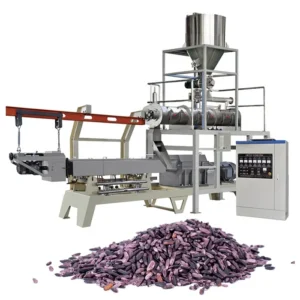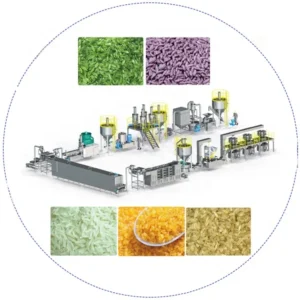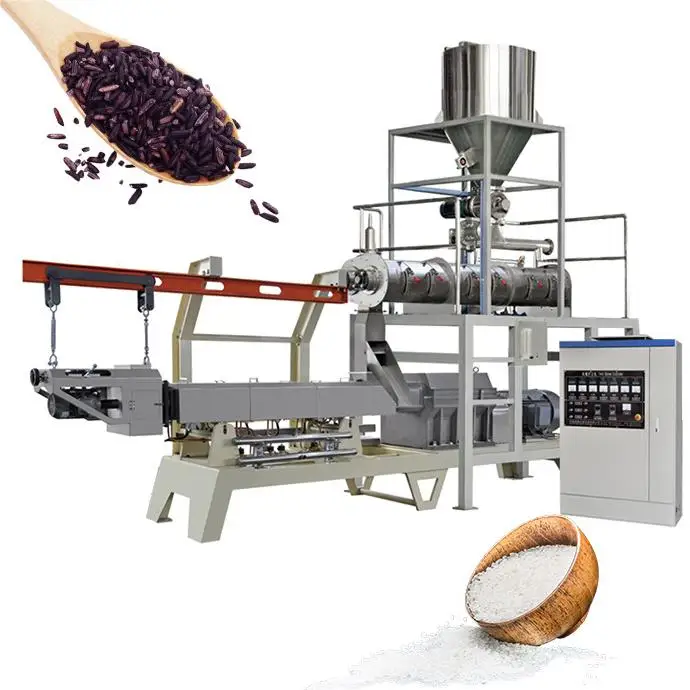
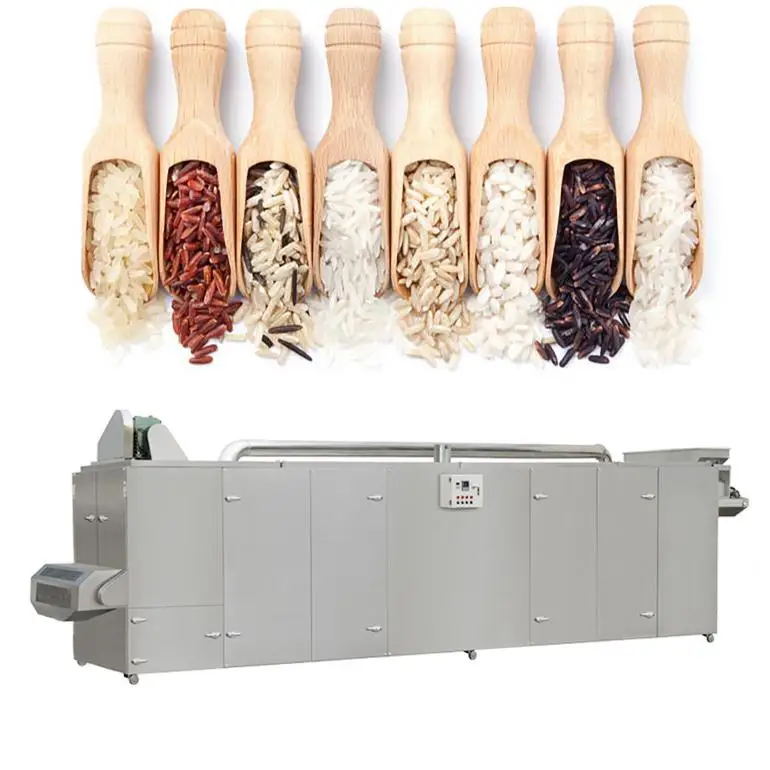
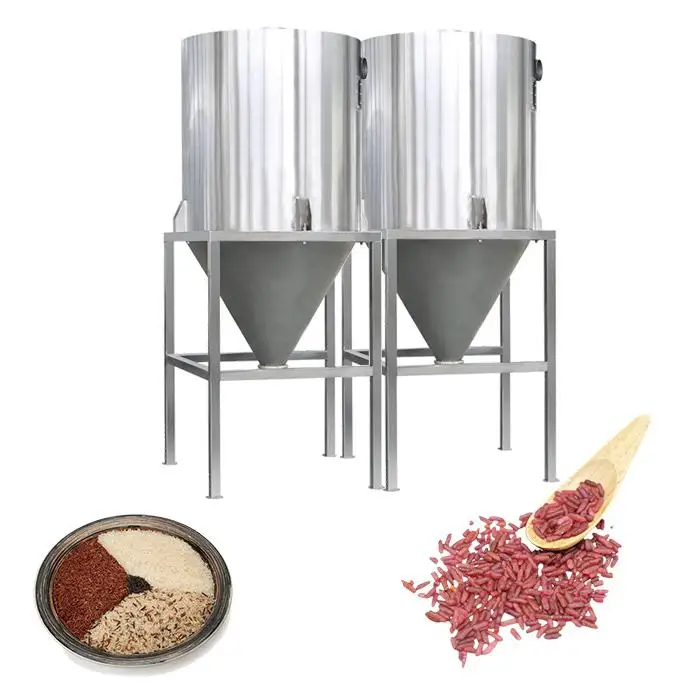
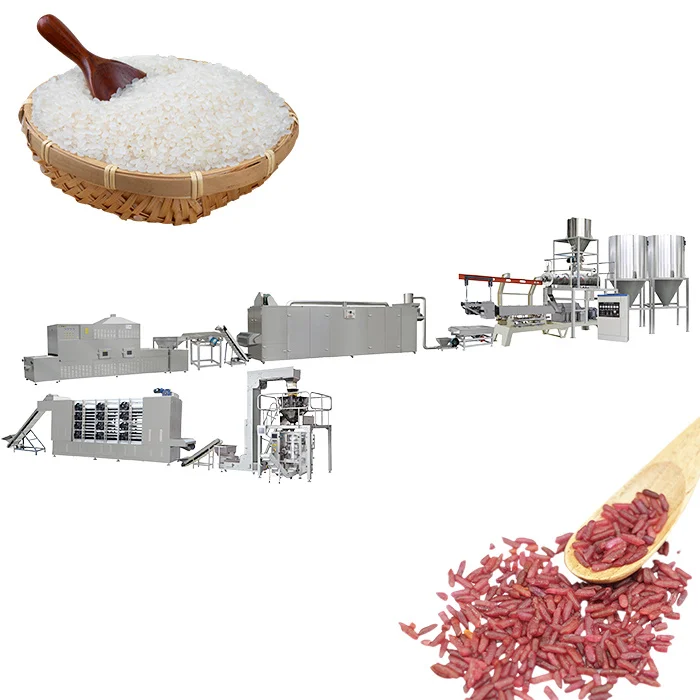


MT65 Nutritional Rice Production Line, Twin-Screw, PLC & MCC Control — complete turnkey system from mixing through extrusion, low-temperature drying, roasting, and packing.
Each station’s throughput is engineered to match across the full line, with screw configuration and die design specified to your raw material formulation and target kernel density. Multi-stage drying and roasting ensure precise moisture and texture control for fortified rice applications.
- Line layout and capacity calculation provided with every quotation
- Trial runs on customer raw material completed in-house before shipment
- On-site installation, commissioning, and operator training included
CE and ISO certified, serving producers in 60+ countries — backed by pre-sales engineering, factory testing, and ongoing maintenance support.
Description
Throughput Matched Across Every Station — every unit from mixer to packing station is engineered to the same output rate, so a bottleneck at the dryer never starves the roaster downstream.
Technical Specifications
| Parameter | Value |
|---|---|
| Product Type | Nutritional Rice Production Line |
| Extruder Models | MT65 / MT70 / MT85 / MT75 / MT95 |
| Screw Type | Twin Screw |
| Installed Power | 85 kW (MT65) / 120 kW (MT70) / 235 kW (MT85) / 180 kW (MT75) / 260 kW (MT95) |
| Power Consumption | 60 kW (MT65) / 85 kW (MT70) / 165 kW (MT85) / 135 kW (MT75) / 195 kW (MT95) |
| Capacity | 80–100 kg/h (MT65) / 100–120 kg/h (MT70) / 200–300 kg/h (MT85) / 300–500 kg/h (MT75) / 800–1000 kg/h (MT95) (basis not stated in source — confirm raw material formulation and moisture content) |
| Overall Dimensions (L×W×H) | 28×1.2×2.2 m (MT65) / 30×1.5×2.2 m (MT70) / 34×3.5×4.3 m (MT85) / 32×3.5×4.3 m (MT75) / 36×3.5×4.3 m (MT95) |
| Control System | PLC and MCC with frequency speed controlling |
| Heating Source (Dryer) | Electric or gas |
| Line Stations | Mixing, extruding, vibrating, low temperature drying, cooling, high temperature roasting, cooling, packing |
| Basic Materials | Broken rice, rice, corn, millet, wheat, oats, buckwheat, bean, starch with vitamin and mineral additions |
| Final Products | Artificial rice, fortified rice kernels |
| Assembly State | Complete turnkey production line |
| Standards | CE, ISO |
Application Suitability
| Application | Material or Output |
|---|---|
| Government and NGO rice fortification programmes | Broken rice and starch base blended with iron, folic acid, zinc, and vitamin A premix into fortified rice kernels |
| Rice milling by-product upcycling | Rice bran and broken rice fragments re-extruded into uniform nutritional rice matching milled grain dimensions |
| Instant and quick-cook rice production | Corn, wheat, or oat blends processed into artificial rice kernels with controlled gelatinisation for fast rehydration |
| Infant and weaning food ingredient supply | Millet and buckwheat formulations with added micronutrients extruded into small-dimension kernels for porridge blending |
| Emergency nutrition and ration contracts | Shelf-stable fortified kernels from locally available cereal and legume blends for long-term storage and distribution |
What Capacity Numbers Leave Out on a Nutritional Rice Production Line
A rated throughput is only valid when the raw material formulation, moisture content, and target kernel density are defined before the line is built.
On a recent project, a client ordered a line based on a published capacity figure. During the factory trial we ran standard rice flour and the output looked steady. When the client’s own formulation — heavier with bean flour and a different vitamin premix — arrived at their facility, the gelatinisation temperature shifted. Screw speed and feed ratio both needed adjustment, and commissioning stretched well past the original schedule. That delay would have been avoided entirely if the actual blend had been tested in our workshop before the machines shipped. On a nutritional rice production line turnkey project, the gap between a lab sample and a production blend is where most start-up problems hide [NEED_CITE: starch gelatinisation behaviour across different cereal and legume flour blends].
Screw Configuration and Die Geometry Dictate Kernel Integrity
The twin-screw extruder at the heart of this line is not fitted with a generic screw set. Each configuration is selected after reviewing the buyer’s specific cereal base, starch content, and micronutrient loading. Die aperture and land length determine the cross-section and cut length of the emerging kernel, which must visually match natural milled rice within tight tolerances. A die designed for pure rice flour will produce ragged edges when the formulation shifts to a high-fibre oat and buckwheat blend, so the tooling is specified to the actual recipe before the barrel is assembled.
Multi-Stage Thermal Processing Controls Moisture Migration
The drying and roasting sequence — low temperature drying, first cooling stage, high temperature roasting, second cooling — is designed to manage moisture migration within each kernel. Rapid single-pass drying traps internal moisture and causes surface cracking during storage. By stepping the thermal profile, the line allows the kernel core to equilibrate gradually, preserving the structural density that lets fortified rice survive bagging, transport, and cooking without disintegrating. Gas or electric heating options are selected based on the buyer’s facility utilities [NEED_CITE: moisture gradient effects on extruded kernel shelf stability].
Reading the Specification Sheet Against Your Actual Recipe
The MT65 through MT95 extruder range spans installed power from 85 kW to 260 kW, with corresponding power consumption between 60 kW and 195 kW. These figures define the thermal and mechanical energy available for starch gelatinisation within the barrel. A formulation high in resistant starch or legume protein demands more shear energy to achieve full gelatinisation, which pushes the selection toward the larger models. The overall line footprint stretches from 28 m to 36 m in length, so workshop planning must account for the full station sequence plus operator walkways and raw material staging. Frequency speed controlling on every drive allows fine adjustment of screw RPM and conveyor rates independently, which is essential when dialling in a new formulation during commissioning.
The Cost of Mismatched Station Throughput
When the extruder is selected in isolation and the dryer is sourced separately, the dryer’s belt width and residence time rarely match the extruder’s actual output. The result is either a bottleneck where kernels pile up waiting for drying capacity, or an oversized dryer running partially empty and wasting thermal energy. Either scenario erodes the effective capacity the buyer paid for. On a nutritional rice line, under-dried kernels entering the roaster develop case-hardened surfaces that crack during packing, while over-dried kernels fracture under their own weight in the cooling conveyor [NEED_CITE: throughput imbalance effects in multi-stage cereal processing lines].
Why Procure the Full Line From One Source
The line layout and capacity calculation is produced as a single document covering every station, so the mixer batch cycle, extruder throughput, dryer belt speed, and packing rate are all verified against one another before fabrication begins. Screw configuration and die design are recorded against your specific formulation, not copied from a reference build. An in-house testing workshop runs your actual raw material before shipment, generating a trial run report that documents the screw speed, barrel temperatures, and feed ratio that achieved the target kernel specification. Electrical schematics are confirmed against your facility voltage and frequency before the control panels are wired, eliminating on-site rewiring delays. The PLC and MCC control architecture is programmed with the operator language required at your facility, so the HMI is readable from day one.
Documentation & Verification
- Line layout drawing with throughput calculation across every station from batching to packing
- Screw and die configuration record matched to your cereal blend and kernel dimension target
- Trial run report on customer raw material documenting barrel temperature profile and screw speed
- Electrical schematic with voltage, frequency, and control language confirmed to destination facility
- CE declaration of conformity and ISO certificate for customs and regulatory submission
- Operation and maintenance manual with wear parts list and recommended replacement intervals
Installation, Commissioning & Support
- Foundation plan based on line dimensions up to 36 m length, accounting for extruder vibration isolation and dryer load distribution
- Dedicated power circuit sized to the selected model’s installed power, up to 260 kW, with voltage and frequency matched to local supply
- Station-by-station assembly sequence with mechanical and electrical connections verified against pre-confirmed schematics
- First-run parameter setting on the buyer’s actual formulation, adjusting screw speed and barrel zones to match trial run data
- Operator training covering PLC interface navigation, frequency drive adjustment, and emergency stop procedures across all stations
- Wear parts list identifying screw elements, dies, and dryer belt sections with reorder specifications
What We Need to Start Your Line Configuration
To prepare a layout and proposal for your nutritional rice production line turnkey project, send us your raw material formulation including the cereal base, starch ratio, and micronutrient premix composition. Specify the target kernel dimensions, daily output requirement, and the voltage and frequency at your facility. If you have existing upstream milling or downstream packing equipment, share the interface requirements so the line can be designed around them. We will also need a representative sample of your blend for the workshop trial run before any fabrication commitment.
Frequently Asked Questions
Q: How is throughput verified across every station before the line ships?
A: Each station — mixer, extruder, vibrating screen, dryer, roaster, cooler, and packing unit — is calculated against a single target output during the layout phase. The trial run in our testing workshop then confirms that the actual material flow matches the calculation. Any station that falls short is resized before the line leaves the factory, so you never discover a bottleneck during commissioning.
Q: What happens during the trial run on customer raw material?
A: Your formulation is processed through the extruder and downstream stations in our workshop. We record barrel temperatures, screw speed, feed rate, moisture content at each stage, and final kernel dimensions. The resulting trial run report becomes the baseline parameter set for on-site commissioning, reducing start-up time and eliminating guesswork with an unfamiliar blend.
Q: How are voltage and control language handled for international installations?
A: During the specification confirmation stage, your facility voltage, frequency, and preferred HMI language are documented on the electrical schematic. The PLC and MCC panels are wired and programmed accordingly before the factory test. This prevents the common delay of rewiring motors or reprogramming interfaces after the equipment arrives on site.
Q: What installation and training support is included?
A: Our engineers handle on-site installation, mechanical alignment, and electrical connection of every station. Commissioning includes running your production formulation and adjusting parameters to match the workshop trial. Operator training covers daily start-up, shut-down, cleaning procedures, screw and die changeover, and interpretation of PLC alarms across the full line.
Q: How is screw and die configuration chosen for different formulations?
A: The screw element sequence — conveying, kneading, and reverse-flight sections — is arranged based on the starch, protein, and fibre content of your blend. Die aperture and land length are selected to produce the target kernel cross-section and cut length. Both are recorded in the configuration document so replacement parts can be ordered with certainty when wear occurs.
Related products
-

Fully Automatic 500kg/h Baby Cereal Nutrition Powder Extrusion Drying Line with PLC Control
¥9,500.00 Add to cart -
High Productivity New Condition Nutritious Baby Food Meal Replacement Powder Production Line
¥30.00 Select options This product has multiple variants. The options may be chosen on the product page -
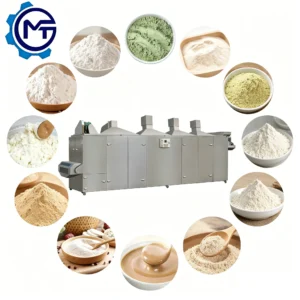
Small Scale MT Brand Automatic Baby Food Nutrition Powder Rice Flour Making Machine with 500kg/h Production Capacity PLC Control
¥9,500.00 Add to cart -
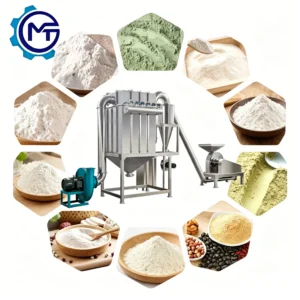
Compact Automatic Baby Cereal Nutrition Powder Production Line with 500kg/h Capacity and PLC Control
¥9,500.00 Add to cart