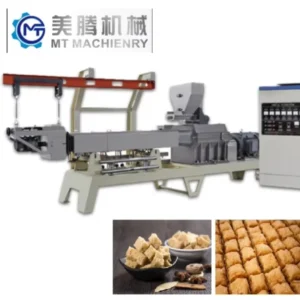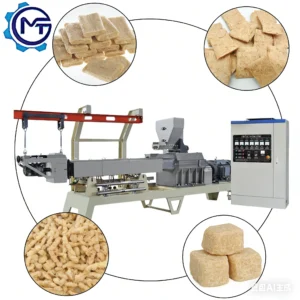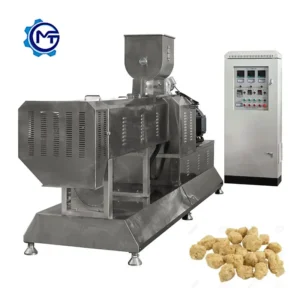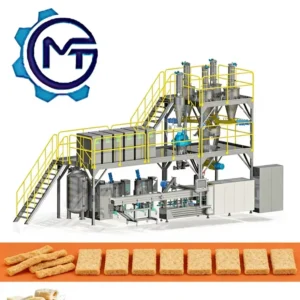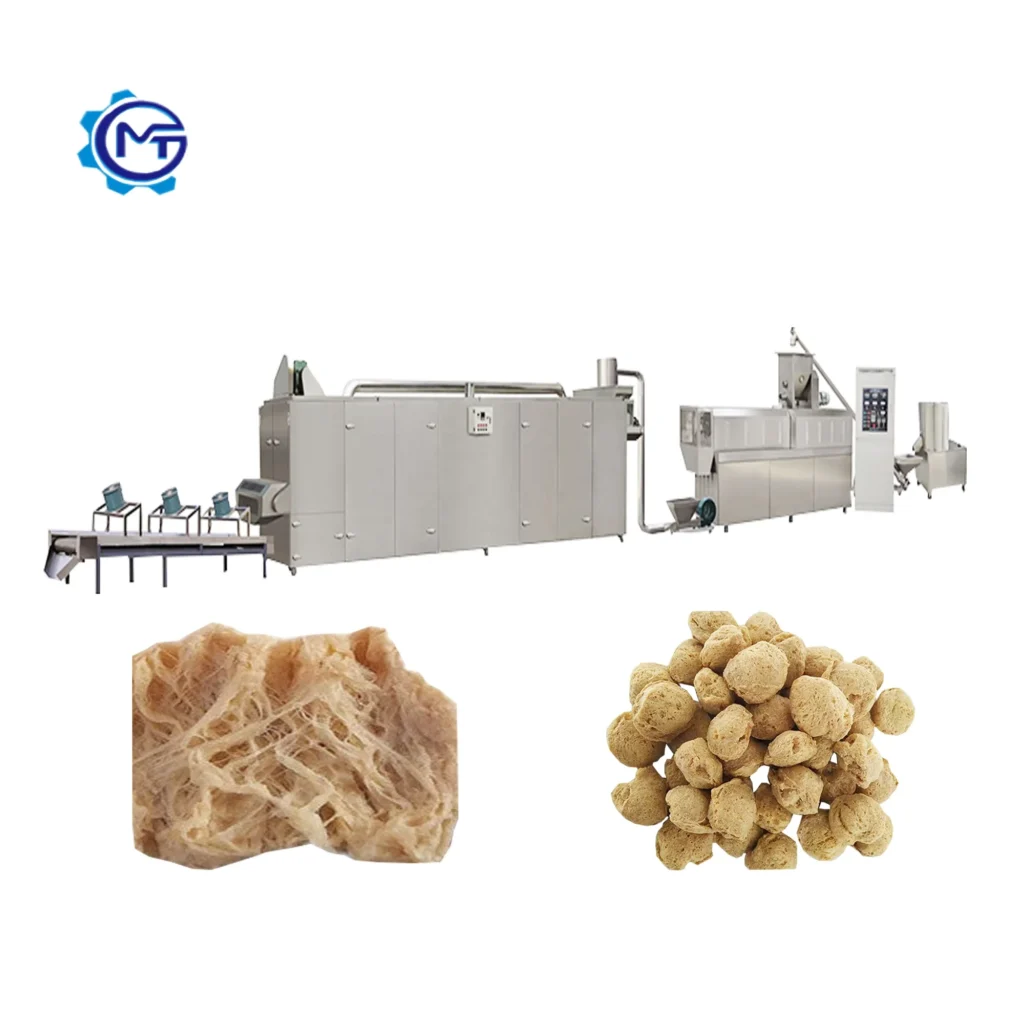


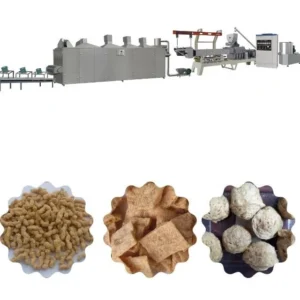
MT65, MT70, MT85 Twin-Screw Extrusion Line for Textured Vegetable Protein, stainless steel construction, CE certified — configured for soybean and peanut meal processing into plant-based meat alternatives.
Screw configuration and die design are matched to your raw material formulation and target fibre structure, with moisture, shear and barrel temperature profile controlled across the twin-screw extruder to achieve consistent protein texturization. Throughput is balanced across mixing, extrusion, drying and cooling stations to prevent bottlenecks at any single point.
Line layout, capacity calculation and trial run report on your actual raw material provided before shipment.
Description
Matched Throughput Across Stations — we configure every section from powder mixing through twin-screw extrusion to cooling and packing as one balanced line, so the dryer never bottlenecks the extruder and the cooling belt keeps pace with actual output.
Technical Specifications
| Parameter | Value |
|---|---|
| Product Type | Textured Vegetable Protein (TVP) / Plant-Based Meat Extrusion Production Line |
| Available Models | MT65, MT70, MT85 |
| Extruder Type | Double Screw Extruder (Twin-Screw) |
| MT65 Installed Power / Real Power | 85 kW / 65 kW |
| MT65 Output | 150–200 kg/h (basis not stated in source — confirm raw material formulation and moisture content) |
| MT65 Dimension | 18000 × 1300 × 2300 mm |
| MT70 Installed Power / Real Power | 120 kW / 90 kW |
| MT70 Output | 200–300 kg/h (basis not stated in source — confirm raw material formulation and moisture content) |
| MT70 Dimension | 20000 × 1500 × 2400 mm |
| MT85 Installed Power / Real Power | 195 kW / 165 kW |
| MT85 Output | 600–800 kg/h (basis not stated in source — confirm raw material formulation and moisture content) |
| MT85 Dimension | 24000 × 3500 × 4300 mm |
| Powder Mixer Tank Volume / Power | 150 kg / 4 kW |
| Powder Mixer Output / Rotary Speed | 300–600 kg/h / 385 rpm |
| High-Temperature Roaster Effective Belt Length | 3.5 m |
| Roaster Far Infrared Heater / Gas Consumption | 3.9 kW × 24 / 6.8 m³/h |
| Cooling Machine Capacity | 200–300 kg/h (basis to be confirmed) |
| Construction Material | Stainless Steel |
| Warranty | 1 year complete warranty |
| Assembly State | Complete production line |
Application Suitability
| Application | Material or Output |
|---|---|
| TVP production for meat alternatives | Low-temperature soybean meal, peanut meal |
| Plant-based protein ingredients | Defatted soy flour, pea protein blends |
| Protein additions for processed foods | TVP granules and chunks for ham, sausage, canned food |
| Quick-frozen food protein components | Textured vegetable protein pieces for frozen meals |
| Fast food ingredient supply | Rehydratable plant-based meat chunks and strips |
What "Nominal Capacity" Really Means for a Plant Based Meat Processing Line Turnkey
Your raw material defines the real output, not the nameplate.
I spent years on the exhibition circuit across Europe, learning line design from senior engineers who had seen every commissioning disaster firsthand. The most expensive mistake I witnessed was not a broken motor or a cracked barrel — it was a plant based meat processing line turnkey quoted at a certain hourly output, only to produce well below that once the buyer’s actual soybean meal formulation hit the screws. Different protein concentrations, fat residues, and moisture levels change how material flows through the barrel, and a screw configuration tuned for one recipe can fail completely on another [NEED_CITE: raw material variability effects on twin-screw extrusion throughput]. When we talk capacity, we start with your specific meal analysis, not a generic datasheet.
Phased Installation and Utility Planning for the Full Line
A turnkey plant based meat processing line involves more than placing machines in sequence. Each station — powder mixing, screw conveying, twin-screw extrusion, belt drying, cooling, and packing — demands its own utility feed, drainage path, and access corridor for maintenance. We map the electrical load per section so the main motor circuit, the far infrared heater banks on the roaster, and the cooling system each draw from properly rated supply points without cross-interference. Gas lines for the roaster, compressed air for pneumatic gates, and water inlets for barrel temperature control all appear on the layout drawing before a single foundation bolt is set.
Throughput Balancing Between Extrusion and Downstream Stations
The extruder may be the heart of the line, but an undersized dryer will force you to slow the screws. We calculate residence time in the roaster against the moisture reduction required for your target TVP texture, then size the belt length and heater zones accordingly. If the cooling machine cannot bring product temperature down within the required window before packing, condensation inside bags becomes a real problem. This station-by-station capacity matching is what separates a plant based meat processing line turnkey that runs at spec from one that constantly bottlenecks [NEED_CITE: throughput balancing methodology for continuous food extrusion lines].
Screw Geometry, Barrel Zones, and What They Mean for Fibre Structure
The twin-screw configuration matters because low-temperature soybean meal and peanut meal behave differently under shear and heat than simple starch-based feeds. The screw elements are arranged in zones — feed sections with deep flights to pull powder in, kneading blocks where protein alignment begins, and metering sections that push material through the die at controlled pressure. Barrel temperature zones work with the screw profile to manage protein denaturation; too much heat too early and the protein cross-links before it reaches the die, destroying the layered fibre structure that makes TVP convincing as a meat substitute. The MT65, MT70, and MT85 models differ in barrel diameter and motor power, which directly affects the shear rate available for your specific formulation. A higher installed power on the MT85 gives the main drive more headroom when processing high-protein meals that resist flow through the kneading zones, while the MT65 suits smaller batches where the protein content and moisture are easier to manage. Die aperture and land length then determine whether you get fine granules or larger chunks.
What Happens When You Skip the Trial Run
I once saw a project where the factory test used standard soybean meal and everything ran clean. The machine shipped to a buyer who switched to a pea protein blend with different hydration characteristics. Screw speed, barrel temperatures, and feed rate all needed complete recalibration — four full days of lost production while technicians worked through the parameter space from scratch. Every plant based meat processing line turnkey should run on the buyer’s actual material before crating. Without that step, you are essentially commissioning blind, and the cost of an engineer flying out to fix the problem on-site far exceeds the time spent in the testing workshop.
Why Source This Line Here
Complete line supply from one manufacturer means every station is designed to match — the powder mixer output aligns with extruder feed rate, and the roaster belt speed keeps pace with extrusion output. Screw configuration and die design are specified to your raw material analysis and target fibre structure, not copied from a generic build. Our in-house testing workshop runs your actual soybean meal or peanut meal before shipment, producing a trial report that confirms output and texture [NEED_CITE: importance of pre-shipment material trials for extrusion equipment]. Stainless steel construction across all machinery contact surfaces meets food-grade requirements. Pre-sales layout engineering, on-site installation, commissioning, and operator training are handled under one project scope rather than split across multiple vendors.
Documentation & Verification
- Line layout with throughput calculation for each station against your raw material
- Screw and die configuration record matched to your protein meal formulation
- Trial run report from in-house testing workshop on your actual material
- Electrical schematic with confirmed voltage and frequency for your market
- CE declaration of conformity and ISO certificate for the complete line
- Operation manual with wear parts list and replacement intervals
Installation, Commissioning & Support
- Foundation plan accounts for the MT85 line footprint of up to 24000 × 3500 × 4300 mm with access clearances
- Electrical supply sized for up to 195 kW installed load with dedicated circuits for the main extruder motor and roaster heaters
- Line arrives in modular sections for sequential assembly and belt alignment on-site
- First-run parameter setting covers screw speed, barrel zone temperatures, and die pressure for your formulation
- Operator training addresses screw element inspection and die cleaning procedures
- Wear parts list identifies screws, dies, and mixer blades with stocking recommendations
What We Need to Scope Your Line
Share your raw material specification — protein percentage, moisture content, particle size — along with your target TVP format, whether granules, chunks, or strips. Tell us your daily production target, workshop dimensions, and ceiling height so the layout team can map station placement. Confirm your local voltage and frequency, preferred control language, and whether you want to send a batch of your actual meal for a pre-shipment trial run in our testing workshop.
Frequently Asked Questions
Q: How is line output verified against my specific soybean or peanut meal formulation?
A: We run your actual raw material through the twin-screw extruder in our testing workshop before shipment. The trial records screw speed, barrel temperatures, feed rate, and resulting fibre structure. You receive a trial run report confirming what the plant based meat processing line turnkey produces on your specific formulation, not on a generic reference meal.
Q: What screw and die configuration is recommended for my target fibre structure and density?
A: Screw element arrangement and die geometry are selected after reviewing your protein content, moisture level, and target product shape. Kneading block placement controls protein alignment, while die aperture and land length determine chunk or granule size. The configuration record is documented and shipped with your line for future reference and replication.
Q: Are voltage, frequency, and control language confirmed before shipment?
A: Yes. The electrical schematic is prepared with your local supply specifications and the control interface language confirmed during the order stage. This prevents commissioning delays caused by incompatible motor ratings or unreadable HMI screens when the plant based meat processing line turnkey arrives at your facility.
Q: How is throughput balanced between the extruder, dryer, and cooling stations?
A: Each station is sized based on the extruder output on your material. The roaster belt length and heater zones are calculated for the moisture reduction your TVP requires, and the cooling machine capacity is matched to bring product to packing temperature. No station is allowed to become a bottleneck under normal running conditions.
Q: What spare wear parts are included and what is the replacement schedule?
A: The wear parts list identifies screws, dies, and mixer blades with expected service intervals based on your material abrasiveness. Initial spare sets ship with the line. We provide replacement specifications so you can reorder before the first change-out is due, avoiding unplanned downtime on your plant based meat processing line turnkey.
Related products
-
New Condition Soybean Protein Machine for Soy Chunks Production Textured Vegetable Protein Production Line
¥30.00 Select options This product has multiple variants. The options may be chosen on the product page -
Textured Soy Protein Production Line for Vegetarian Meat Nugget Manufacturing
¥8,238.27 Select options This product has multiple variants. The options may be chosen on the product page -
High Productivity Single Screw Extruder Machine New Condition Textured Soya Meat & Soy Protein Like Meat Making Machine
Price range: ¥20.00 through ¥30.00 Select options This product has multiple variants. The options may be chosen on the product page -
Dry Protein Drawing Equipment – Intelligent Puffing Machine for Cake Protein & Vegetarian Meat
¥65.00 Select options This product has multiple variants. The options may be chosen on the product page