6144
Description
Matched Throughput Across Every Station — We calculate extruder, dryer and cooler output on your specific soy formulation before drawing the layout, so no single machine holds back the rest of the plant based meat processing line.
Technical Specifications
| Parameter | Value |
|---|---|
| Product Type | Twin Screw Extruder Production Line for Textured Vegetable Protein (Plant Based Meat) |
| Model Options | MT65 / MT70 / MT75 / MT85 |
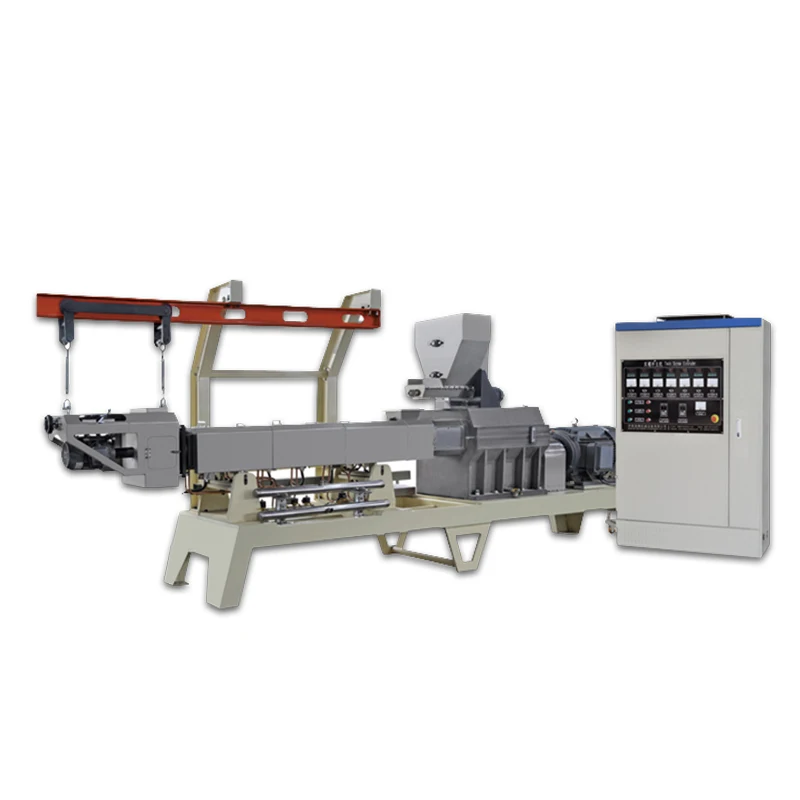
| Screw Type | Twin Screw |
| Screw Diameter | 65 mm / 70 mm / 75 mm / 85 mm |
| Installed Power | MT65: 84 kW | MT70: 160 kW | MT75: 190 kW | MT85: 210 kW |
| Power Consumption | MT65: 59 kW | MT70: 120 kW | MT75: 140 kW | MT85: 140 kW |
| Output Capacity | MT65: 100–150 kg/h (basis not stated in source); MT70: 150–200 kg/h (basis not stated in source); MT75: 150–200 kg/h (basis not stated in source); MT85: 250–300 kg/h (basis not stated in source) |
| Overall Dimensions (L×W×H) | MT65: 40 000×1 200×2 200 mm | MT70: 41 000×1 500×2 200 mm | MT75: 43 000×1 500×3 200 mm | MT85: 45 000×1 500×3 500 mm |
| Main Motor Power | 22 kW / 30 kW / 45 kW (mapping to model to be confirmed) |
| Heating Power | 10 kW / 14 kW (mapping to model to be confirmed) |
| Screw Length | 1 050 mm / 1 520 mm (mapping to model to be confirmed) |
| Feeding Motor | 0.75 kW |
| Rotary Cutting Motor | 0.75 kW |
| Pump Motor | 0.37 kW |
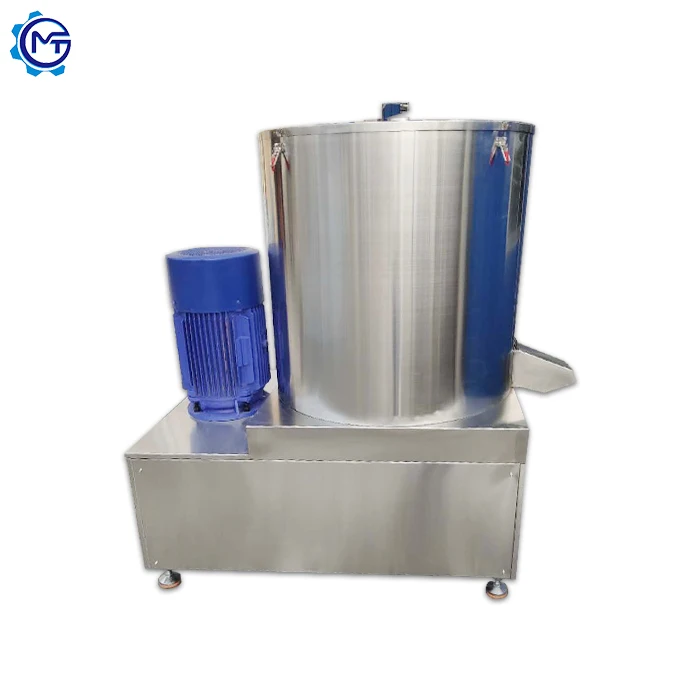
| Mixer Capacity | 20–30 kg / 70–80 kg / 170–180 kg |
| Mixer Power | 4 kW / 7.5 kW / 15 kW |
| Mixer Construction | Vertical type, stainless steel 304 mixing ruler |
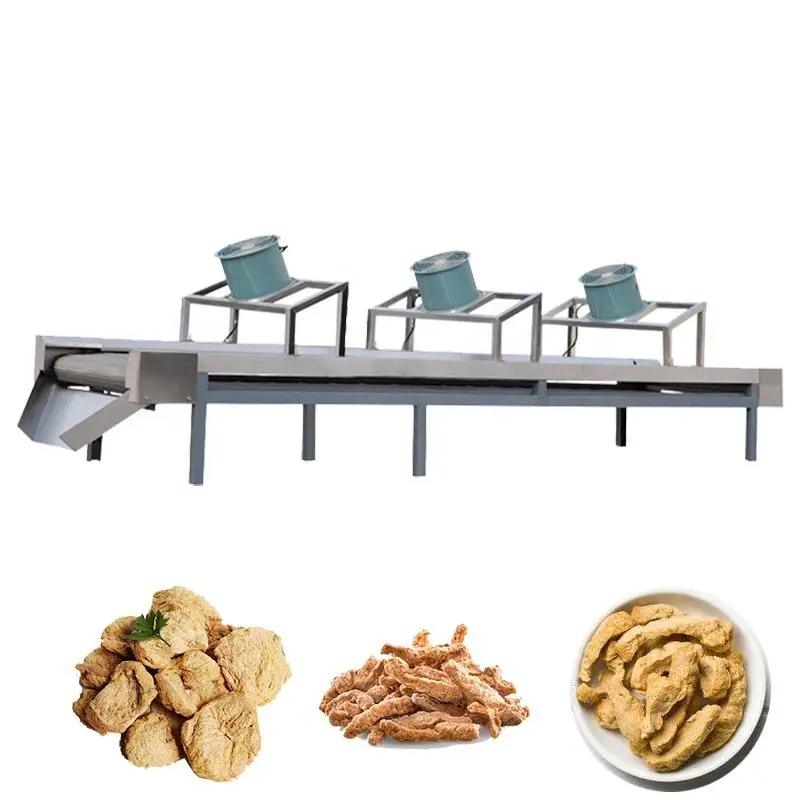
| Dryer Drive | Double pitch roller chain, round-trip drying |
| Dryer Energy Options | Fuel / Gas / Electricity |
| Control System | PLC and MCC |
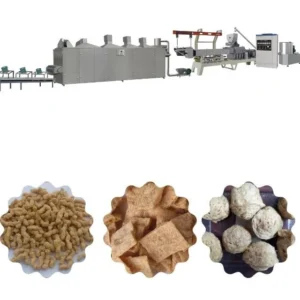
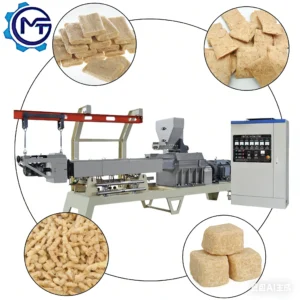
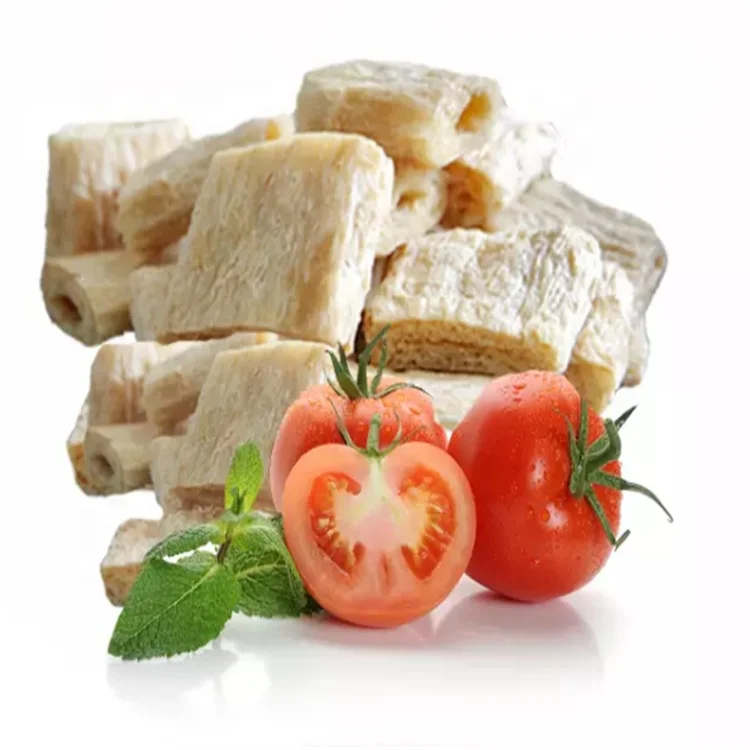
| Die Configuration | Interchangeable moulds for soya nuggets, TVP/TSP, soya chunks |
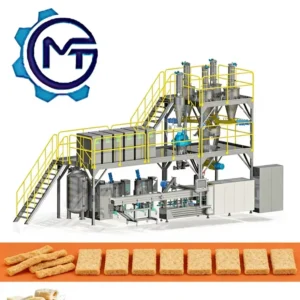
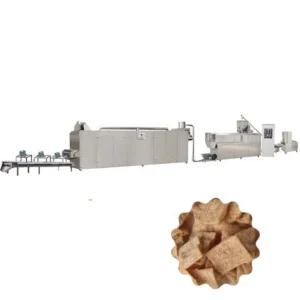
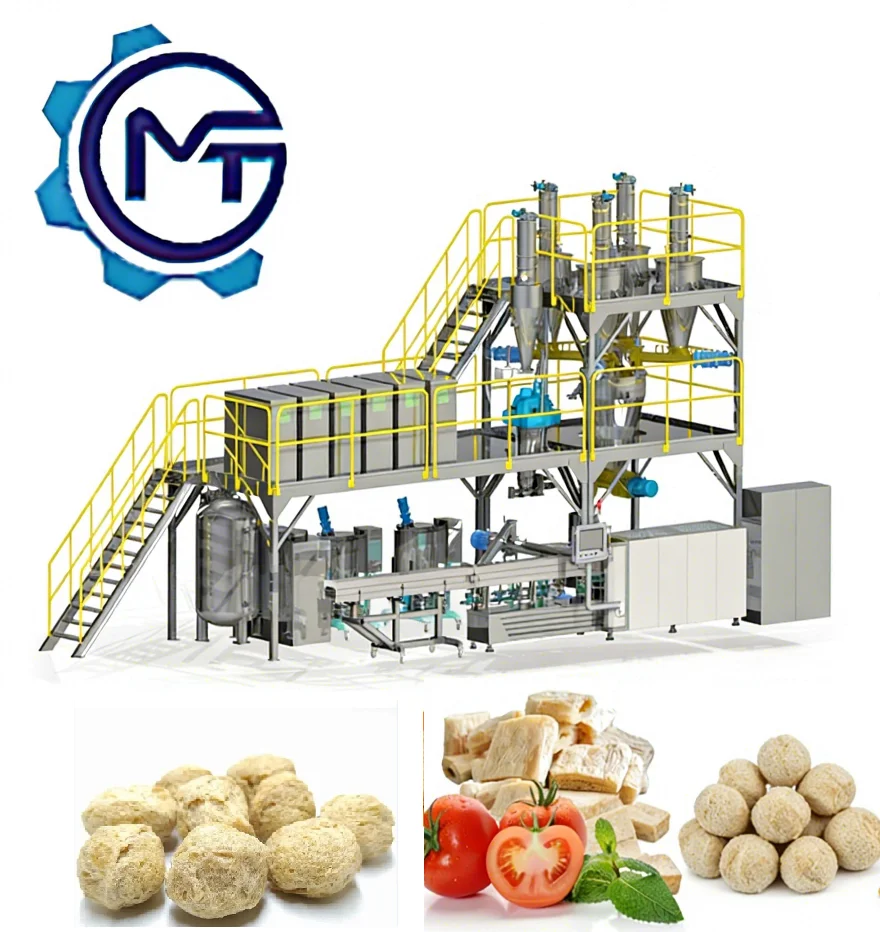
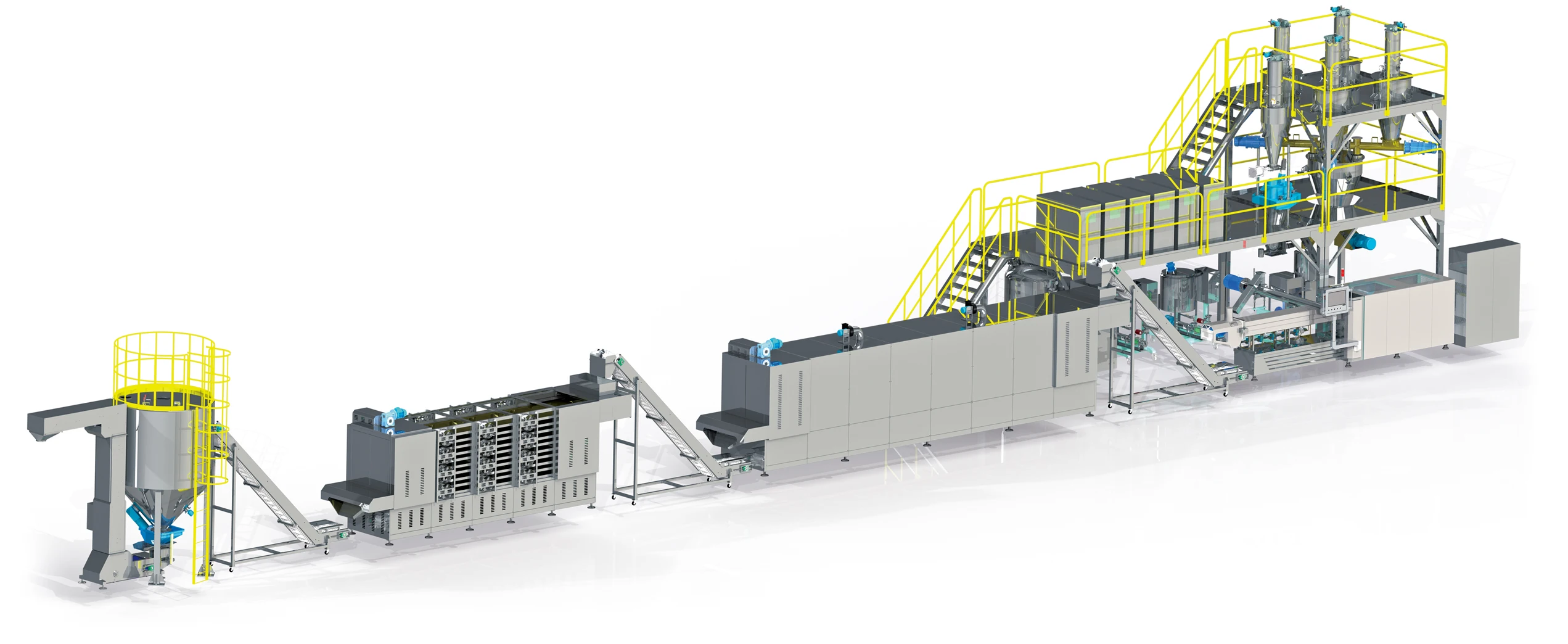
| Line Stations | Mixer → Screw Conveyor → Twin Screw Extruder → Air Conveyor → Multi-layer Dryer → Cooling Machine |
| Assembly State | Complete line, pre-assembled stations |
| Certifications | CE (since 2014), ISO |
Application Suitability
| Application | Material or Output |
|---|---|
| Soya nuggets and chunks for meat analogue production | Defatted soya flour, low-temperature soya flakes |
| Textured vegetable protein (TVP/TSP) ingredient supply | Soybean dregs, peanut dregs |
| Plant-based meat floss and fiber-structured protein blocks | Defatted soya flour with layer fiber target |
| Vegetarian snack and fast food ingredient preparation | Low-temperature soya flakes at controlled moisture |
| Deep-freeze food and meat product industry supply | TVP/TSP formulated for rehydration stability |
Why "Nominal Capacity" Is the Wrong Starting Point for a Plant Based Meat Processing Line
Real throughput is verified on your defatted soy flour, not copied from a generic spec sheet.
A plant based meat processing line turnkey quote often lists a round number for hourly output, but that figure is typically derived from a standard test material at a fixed moisture level. Defatted soya flour behaves differently from low-temperature soya flakes, and peanut dregs introduce yet another variable in starch gelatinisation and expansion. When the extruder is tuned for one formulation and the buyer runs another, density drifts, fiber structure weakens, and downstream drying times no longer match [NEED_CITE: extrusion behaviour of varying soy protein formulations]. I once watched a Middle Eastern commissioning stall because the front-end extruder outpaced the dryer on a high-moisture dreg blend; material piled up on the floor while we re-matched station speeds. That is why every capacity figure above carries a note that the basis must be confirmed on the buyer’s actual raw material before the layout is signed off.
Station-by-Station Throughput Matching
A twin screw extruder TVP production line only performs as well as its slowest station. The mixer must batch at a rhythm that feeds the extruder without gaps or surges, the dryer must remove moisture at a rate that keeps pace with extruder output, and the cooling machine must stabilise product temperature before packing. On the MT65 through MT85 range, we calculate each station’s effective throughput against the buyer’s target moisture reduction and residence time, then adjust belt width, layer count and chain speed so the whole line moves as one unit.
Screw Configuration and Die Design for Fiber Structure
The twin screw extruder TVP production line relies on screw element arrangement and die geometry to create the layered fiber structure that distinguishes convincing plant-based meat from ordinary puffed snacks. A longer screw barrel increases residence time for protein alignment, while die aperture shape controls expansion direction. We document the screw configuration record and die selection for your target product — whether that is dense soya chunks for stew applications or light, open-structure TVP for fast food filling — so the build is traceable and repeatable across future orders.
Reading the Power and Dimension Table
Installed power ranges from 84 kW on the MT65 to 210 kW on the MT85, but actual consumption sits lower because heating and main motor loads fluctuate with barrel temperature profile and raw material viscosity. The overall length of 40 m to 45 m reflects the full station sequence from mixer to cooler; buyers should verify workshop length and ceiling height against the 2.2 m to 3.5 m maximum station height. Main motor options of 22 kW, 30 kW and 45 kW map to different throughput tiers, and the correct pairing depends on the soy protein concentration and desired shear intensity inside the barrel [NEED_CITE: twin screw motor sizing for high-protein extrusion].
The Hidden Cost of Skipping Pre-Shipment Trials
When a plant based meat processing line turnkey project ships without an in-house trial run on the buyer’s defatted soya flour, all product development shifts to the buyer’s factory floor. Commissioning stretches from days into weeks, raw material batches are consumed in test runs, and the dryer may need re-tuning that delays the entire ramp-up. We saw this firsthand when a client’s local soy dreg blend produced higher moisture than the standard test flour; without a prior trial, the dryer needed two extra weeks of on-site adjustment. Running your material in our testing workshop before dispatch compresses that learning curve into a documented trial run report instead of a costly on-site experiment.
Why Source the Full Line from One Supplier
Sourcing each station from separate vendors leaves throughput matching to the buyer, and responsibility gaps appear when the extruder output exceeds the dryer’s removal rate. Our line keeps batching, extrusion, drying and cooling under one engineering team, so the plant based meat processing line turnkey layout is calculated as a single system. Screw and die configurations are specified to your soy formulation, not copied from a generic build. The in-house testing workshop lets us validate your raw material before the machines leave the factory. PLC and MCC control panels are wired and labelled in-house, meaning voltage, frequency and operator language are confirmed before production starts. CE and ISO documentation is issued for the complete line, not pieced together from separate certificates [NEED_CITE: CE machinery directive requirements for complete processing lines].
Documentation & Verification
- Line layout drawing with station-by-station throughput calculation for your soy protein formulation
- Screw and die configuration record matched to your target TVP fiber structure and density
- Trial run report on your defatted soya flour or dreg blend conducted in our testing workshop
- Electrical schematic with voltage, frequency and control language confirmed to your market
- CE declaration of conformity and ISO certificate covering the full line assembly
- Wear parts list specifying screw elements, die plates and mixer components with replacement intervals
Installation, Commissioning & Support
- Workshop length of 40–45 m and ceiling clearance of up to 3.5 m must be verified before foundation work
- Dedicated power circuit sized for MT85 peak consumption of 210 kW with voltage confirmed on schematic
- Pre-assembled stations reduce on-site mechanical work to conveyor linking and utility connection
- First-run parameter setting covers barrel temperature zones, screw speed and dryer chain timing
- Operator training addresses die changeover, screw element inspection and mixer batching rhythm
- Spare screw elements and die plates shipped with initial order to cover first replacement cycle
What We Need to Quote Your Line Accurately
To size the extruder, dryer and cooler correctly, share your raw material type — defatted soya flour, low-temperature flakes or dregs — along with the moisture content you plan to feed. Tell us the target product format (soya nuggets, TVP granules or fiber-structured chunks) and the daily output you need to hit. Confirm your workshop dimensions, local voltage and frequency, and the control language your operators will use. If you have upstream milling or downstream packing equipment already in place, list those so we can match the line’s entry and exit points.
Frequently Asked Questions
Q: How is output capacity verified on my actual soy protein formulation?
A: We run your defatted soya flour, flakes or dregs through the extruder in our in-house testing workshop before shipment. The trial records throughput, moisture reduction and product density, and those figures — not generic catalogue numbers — form the basis of the line layout and dryer sizing.
Q: What screw and die setup is chosen for my target fiber structure?
A: Screw element sequence and die aperture are specified to your product format. Dense soya chunks need a different compression profile than open-structure TVP. We document the configuration in a record sheet so future reorders or product changes reference a known baseline.
Q: How do you match the dryer to the extruder’s throughput?
A: Dryer layer count, belt speed and energy source are calculated from the extruder’s measured output and the moisture your formulation releases. This prevents material backlog between stations and keeps the full plant based meat processing line running without bottlenecks.
Q: What electrical and control details are confirmed before production starts?
A: Voltage, frequency, plug type and PLC language are written into the electrical schematic before any panel is wired. This avoids on-site rewiring delays and ensures operators can read alarms and set-points in their own language from day one.
Q: Which spare wear parts ship with the line?
A: The initial package includes screw elements, die plates and mixer contact parts sized to cover the first replacement cycle. A wear parts list with part numbers and expected change intervals is included in the documentation set so you can reorder before production is interrupted.
Related products
-
Vegetarian Beef Substitute Making Machine with Twin Screw Extruder
¥9,500.00 Select options This product has multiple variants. The options may be chosen on the product page -
Textured Soy Protein Production Line for Vegetarian Meat Nugget Manufacturing
¥8,238.27 Select options This product has multiple variants. The options may be chosen on the product page -
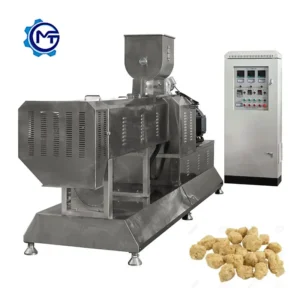
Soy Bean Meat Protein Production Line Machine Multi-functional Extruder for Soy Protein Food
¥8,650.00 Select options This product has multiple variants. The options may be chosen on the product page -
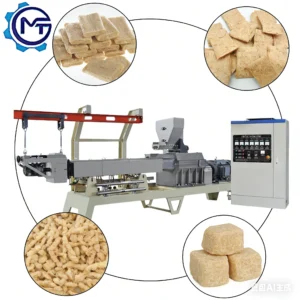
Twin Screw Extruder for Textured Vegetable Protein (TVP)
¥9,500.00 Select options This product has multiple variants. The options may be chosen on the product page