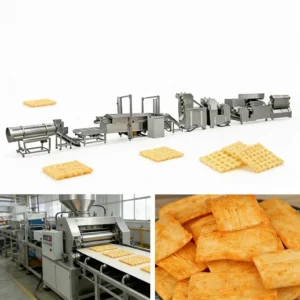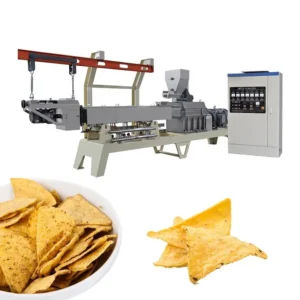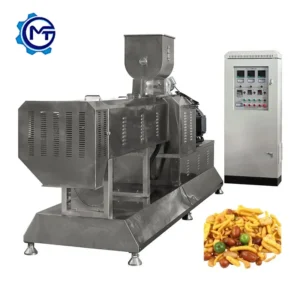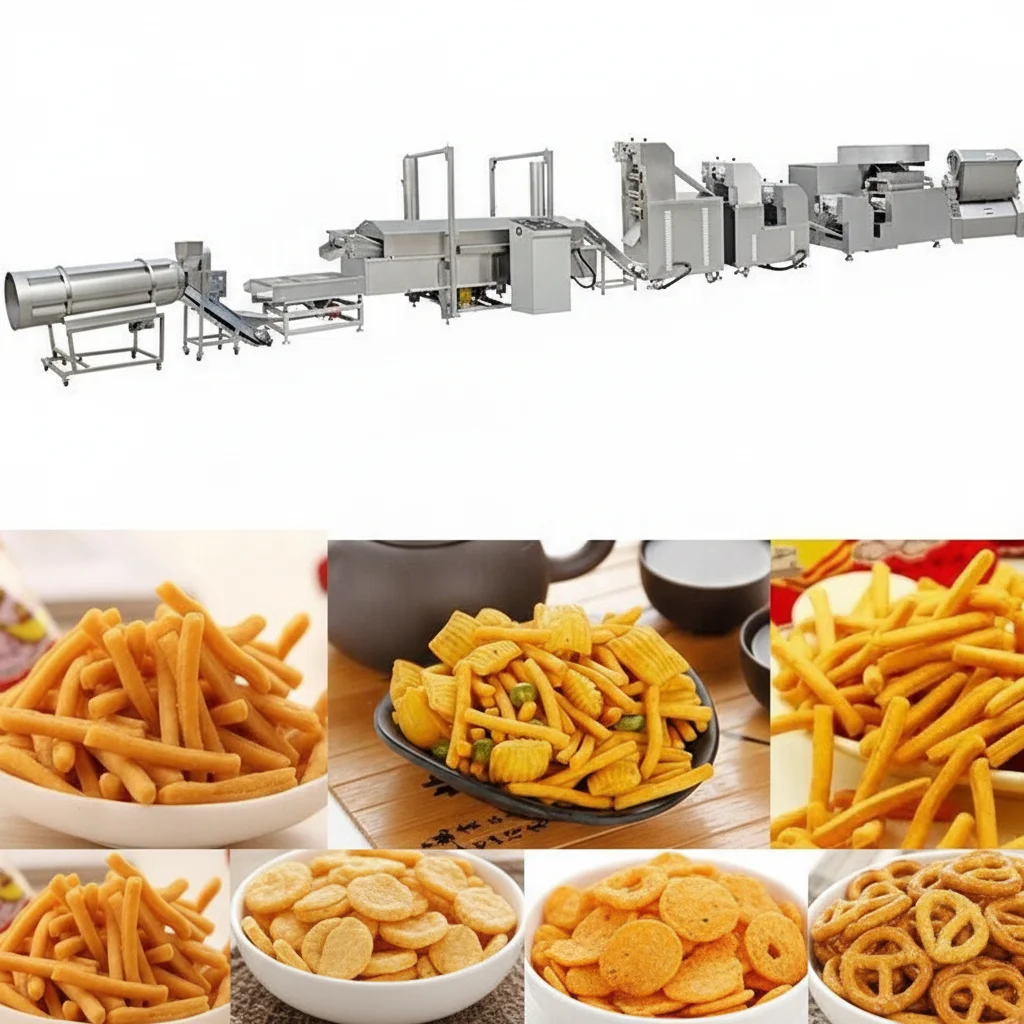

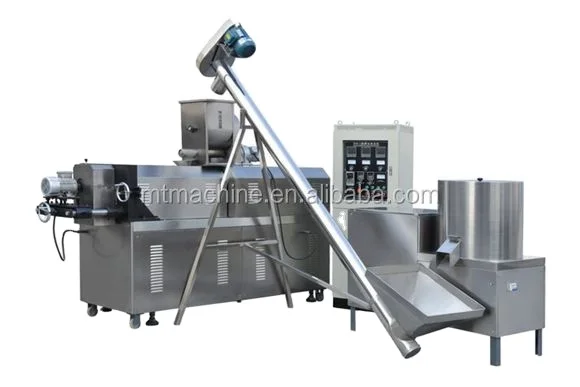


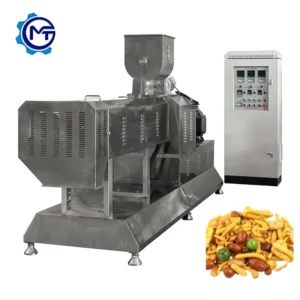
MT100/MT120 Puffed Snack & Fried Chip Production Line, PLC Controlled, Three-phase 380V/50Hz — configured for continuous output of bugles, rice crust, and golgappa across multiple die shapes including screw shell, round tube, ring, and cartoon formats.
- Throughput-matched from mixing through extrusion, frying, flavoring and cooling, with screw and die geometry specified to your raw material’s gelatinisation and expansion behaviour.
- Energy-flexible across electricity, gas, diesel or steam heating; food-grade stainless steel contact surfaces at every station.
Every station sized to your target output before build, with trial runs on your actual flour or starch confirming texture, density and shape before the line ships.
Description
Integrated Line Throughput Matching — every station from mixer to flavoring drum is sized against the extruder’s actual output so your snack line never stalls at a bottleneck.
Technical Specifications
| Parameter | Value |
|---|---|
| Product Type | Puffed Snack & Fried Chip Production Line (Bugles / Rice Crust / Golgappa) |
| Extruder Type | Single-screw extruder |
| Output Capacity | 120 kg/h (basis not stated in source) |
| Rated Power | 50–70 kW (electric heating); 50–60 kW (gas/diesel heating) |
| Voltage & Frequency | Three-phase 380V/50Hz; Single-phase 220V/50Hz (customizable) |
| Control System | PLC controlled |
| Overall Dimensions (L×W×H) | 12,000–26,000 × 1,200 × 2,200 mm |
| Material | Food-grade stainless steel 201 (304 available) |
| Energy Options | Electricity / Gas / Diesel / Steam |
| Electrical Components | Siemens (China-made) or top Chinese brand motors; Delixi or Delta inverters |
| Die Configuration | Adjustable dies for screw shell, round tube, square tube, ring, cartoon shapes |
| Raw Materials | Wheat flour, corn starch, potato starch |
| Line Stations | Mixer → Screw Conveyor → Extruder → Pulling & Cutting Machine → Automatic Fryer → Automatic Flavoring Line → Cooling |
| Standards | CE, ISO 9001 |
Application Suitability
| Application | Material or Output |
|---|---|
| Bugles and horn-shaped fried chips | Wheat flour and corn starch blends |
| Rice crust and secondary-puffing snacks | Rice flour, potato starch mixes |
| Golgappa / Pani Puri shells | Wheat flour, semolina-based dough |
| Tube and ring-shaped pellet snacks | Potato starch and corn starch formulations |
| Cartoon-shaped fried snack pieces | Multi-grain flour blends with adjustable moisture |
Why the Fryer Capacity Question Must Precede the Line Order
An extruder running at full output means nothing when the downstream fryer cannot keep pace.
I have watched snack producers invest in a high-output extrusion station only to discover the fryer was specified for a different throughput class entirely. The extruder piles up cut pieces faster than the fryer can process them, moisture climbs in the holding zone, and the product texture collapses before it ever hits the oil. This mismatch is the single most common reason a puffed snack frying production line turnkey project underperforms against its nameplate promise [NEED_CITE: common causes of throughput loss in multi-vendor snack lines]. When the whole line comes from one supplier who calculates station-to-station balance during the layout phase, that failure mode disappears before metal is cut.
Station Balance Across the Complete Frying Line
A puffed snack frying production line turnkey installation lives or dies on whether each station can absorb the output of the one before it. The MT100/MT120 line starts with a mixer sized to feed the screw conveyor at a rate the single-screw extruder can accept without surge loading. Downstream, the pulling and cutting machine is set to match extruder discharge speed, and the automatic fryer is specified with a belt length and oil volume that handle the cut-piece flow without queuing. Flavoring drum residence time is then matched to fryer output so seasoning coverage stays consistent.
Raw Material Behavior and Line Configuration
The way wheat flour, corn starch, or potato starch gelatinizes inside the barrel determines the expansion ratio at the die face, which in turn governs how the product behaves once it enters the hot oil. Different starch ratios shift the moisture window and alter the fry time needed to reach the target crunch. Our in-house testing workshop runs your actual flour blend through the extruder and fryer before the line ships, locking die selection, barrel temperature profile, and cutter speed to your specific formulation rather than to a generic recipe [NEED_CITE: starch gelatinisation behaviour in single-screw snack extrusion].
Reading the Spec Sheet Against Your Production Reality
The rated power band of 50–70 kW for electric heating and 50–60 kW for gas or diesel heating tells you the thermal headroom available at the extruder barrel and the fryer. Selecting gas or diesel heating shifts the electrical load downward, which matters when your facility has a contracted power ceiling. The PLC control system stores separate recipes for each die shape — screw shell, ring, tube — so operators switch formats by loading a saved profile rather than recalibrating from memory. Stainless steel 201 contact surfaces are standard, with 304 available for buyers whose food safety protocol mandates it. The dimensional range of 12,000–26,000 mm in line length reflects the different dryer and fryer configurations that sit between extruder and flavoring station depending on product format.
The Hidden Cost of Skipping the Trial Run
When a line ships without a documented test on your actual raw material, the first week of production becomes the trial run — on your floor, with your downtime, and your wasted ingredients. I have seen producers discover only at commissioning that their local wheat flour has a different protein and moisture profile than the standard test flour, causing expansion to drop and fry oil absorption to spike. Reconfiguring screw elements and die geometry after installation costs weeks of lost production [NEED_CITE: post-installation line reconfiguration costs in snack extrusion]. A factory trial run before dispatch eliminates that exposure.
Why Procurement Through This Channel Works
Every station on this line — mixer, conveyor, extruder, cutter, fryer, flavoring drum, cooler — is specified under one engineering responsibility, so throughput numbers are cross-checked rather than assumed. Screw and die configurations are recorded against your target product shape and raw material blend before manufacturing begins. The in-house testing workshop runs your flour or starch formulation through both extrusion and frying stages, generating a documented report before the line is crated. Electrical schematics are drawn with your facility voltage and frequency confirmed in writing, preventing the commissioning delays that happen when a 380V machine arrives at a 440V site. Wear parts lists covering screws, dies, and cutter blades ship with the line so your first replacement cycle does not become an emergency sourcing exercise.
Documentation & Verification
- Line layout drawing showing throughput calculation at every station from mixer to cooler
- Screw and die configuration record matched to your target snack shape and formulation
- Factory trial run report on your actual wheat flour or starch blend before dispatch
- Electrical schematic with voltage, frequency, and PLC language confirmed for your facility
- CE declaration of conformity and ISO 9001 certificate included in shipping documents
- Operation and maintenance manual with wear parts list and replacement intervals
Installation, Commissioning & Support
- Foundation and floor space planning based on the 12,000–26,000 mm line length range
- Dedicated electrical circuit sizing for the 50–70 kW extruder and fryer heating load
- Modular station delivery with on-site assembly sequence and utility hookup schedule
- First-run parameter setting covering barrel zones, die gap, cutter speed, and fryer temperature
- Operator training on PLC recipe loading for each die shape from screw shell to ring format
- Wear parts supply covering extruder screws, die plates, and cutter blades for ongoing production
What to Include With Your Inquiry
To move from inquiry to line proposal, share your target product format and the primary flour or starch blend you intend to run. Confirm your facility voltage, frequency, and preferred heating energy source so the electrical and thermal design aligns with your site utilities from the start. If you have existing upstream mixing or downstream packing equipment, note the interface dimensions so the line layout accounts for those connections.
Frequently Asked Questions
Q: How is line capacity verified against my specific raw material and moisture content?
A: Your actual flour or starch blend is run through the extruder and fryer in our testing workshop before shipment. The trial records expansion ratio, fry oil absorption, and final texture against your target specification. Screw configuration and barrel temperature profile are adjusted during this run, and the locked parameters ship with the line documentation.
Q: What voltage, frequency and control language options are confirmed before shipment?
A: Your facility’s electrical supply specifications are confirmed during the proposal stage and written into the electrical schematic. The PLC interface language is set to match your operator team’s requirement. This prevents the commissioning delays that occur when control systems arrive configured for a different market standard [NEED_CITE: voltage and frequency standards by export market].
Q: How are extruder output and fryer capacity matched to prevent bottlenecks?
A: Each station is calculated against the extruder’s discharge rate during the layout phase. The fryer belt length, oil volume, and residence time are sized to absorb peak cutter output. The flavoring drum speed is then set to match fryer throughput, ensuring no station queues product and causes moisture-related texture loss.
Q: Can a trial run on my raw material be conducted before shipment, and what does the report cover?
A: Yes. The trial run uses your supplied raw material and records die selection, barrel temperature settings, cutter timing, fry temperature, and final product density. The report documents all locked parameters so your production team can replicate the result from day one of installation.
Q: What is the phased installation and commissioning schedule for a complete turnkey snack line?
A: Stations arrive in modular sections sized to your facility access. Mechanical assembly and utility connections are completed first, followed by dry runs without product. Wet commissioning then begins with your raw material, and PLC recipes are saved for each die shape. Operator training runs parallel to the first production batches.
Related products
-
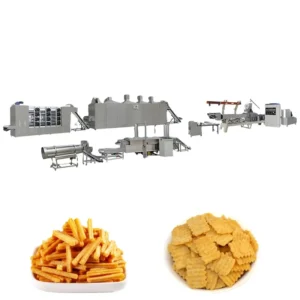
Fried Bugles Chips Production Line Fried Doritos Tortilla Snack Food Extruder
¥100.00 Select options This product has multiple variants. The options may be chosen on the product page -
Fried Puffs Snack Food Making Machine Whole Line Solution Design by Factory Price Crispy Snack Machine
¥20.00 Select options This product has multiple variants. The options may be chosen on the product page -
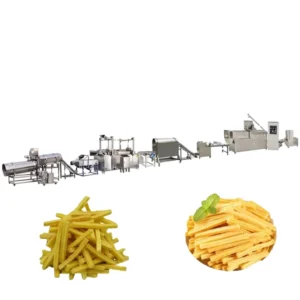
High-Yield Automated Fried Snack Production Line – Double Screw Salad Strips & Millet Crust Making Equipment
¥65.00 Select options This product has multiple variants. The options may be chosen on the product page -
New Automatic Traditional Fried Nimko Making Machine High Productivity Large Capacity Stainless Steel Production Line
¥8,575.00 Select options This product has multiple variants. The options may be chosen on the product page