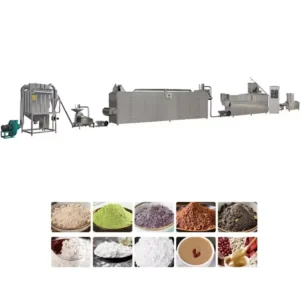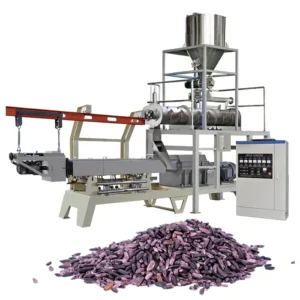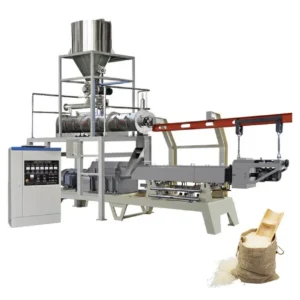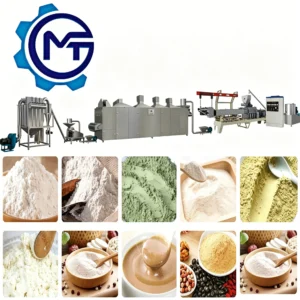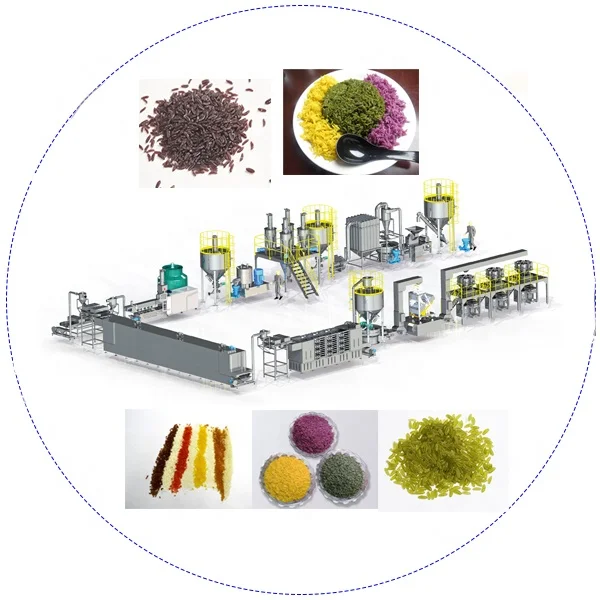
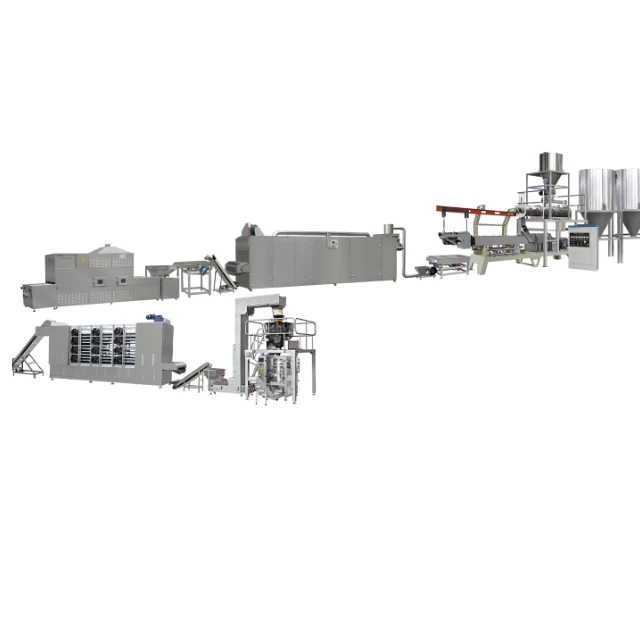

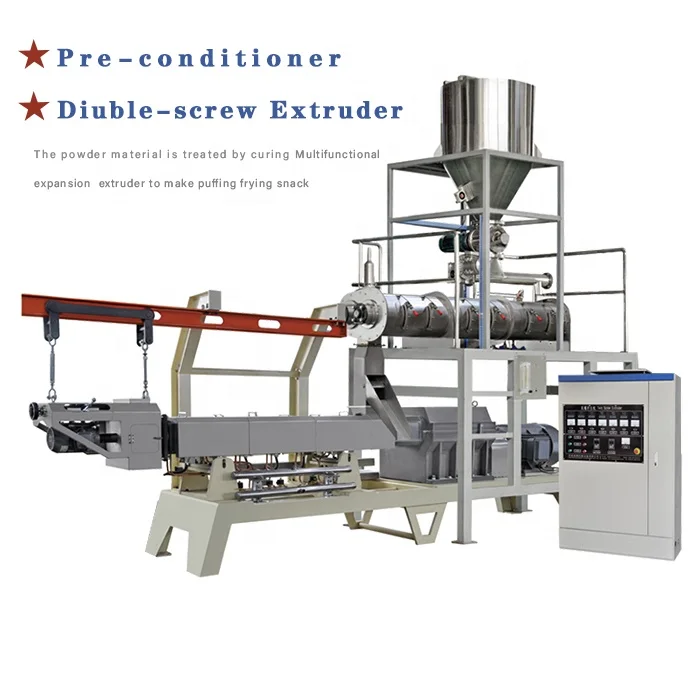

MT65 / MT70 / MT85 / MT75 / MT95 Fortified Rice Kernel Extrusion Production Line, Twin-Screw, CE Certified — engineered as a complete turnkey system from batching through packing with throughput matched across every station.
- Screw configuration and die design specified to your raw material blend and target kernel density, ensuring consistent shape and cooking behaviour
- Circulation drying oven with frequency motor-controlled belt speed for precise moisture control
- Line capacity matched between extruder, dryer, and packing to eliminate bottlenecks
In-house trial runs on your raw material before shipment, with a full trial report covering output, texture, and density verification against your formulation.
Description
Integrated Turnkey Layout — From raw material batching to final packing, every station on this Fortified Rice Kernel Extrusion Production Line is throughput-matched under a single responsibility, eliminating the bottleneck gaps that typically emerge when lines are assembled from separate vendors.
Technical Specifications
| Parameter | Value |
|---|---|
| Model | MT65 / MT70 / MT85 / MT75 / MT95 |
| Product Type | Fortified Rice Kernel Extrusion Production Line |
| Screw Type | Twin-screw |
| Installed Power | 85 kW (MT65) / 120 kW (MT70) / 235 kW (MT85) / 180 kW (MT75) / 260 kW (MT95) |
| Power Consumption | 60 kW (MT65) / 85 kW (MT70) / 165 kW (MT85) / 135 kW (MT75) / 195 kW (MT95) |
| Output Capacity | 80–100 kg/h (MT65) / 100–120 kg/h (MT70) / 200–300 kg/h (MT85) / 300–500 kg/h (MT75) / 800–1000 kg/h (MT95) (basis not stated in source — confirm raw material formulation and moisture content) |
| Overall Dimensions (L×W×H) | 28×1.2×2.2 m (MT65) / 30×1.5×2.2 m (MT70) / 34×3.5×4.3 m (MT85) / 32×3.5×4.3 m (MT75) / 36×3.5×4.3 m (MT95) |
| Feeding System | Single or double screw feeding, selected according to material characteristics |
| Screw Material | Special alloy, wear-resistant |
| Lubrication | Automatic lubricating and cooling system |
| Control System | Frequency speed controlling with high automation (PLC / MCC details to be confirmed) |
| Drying Oven Heating Source | Electric or gas |
| Line Stations | Mixing → Extruding → Vibrating → Low-temperature drying → Cooling → High-temperature roasting → Cooling → Packing |
| Assembly State | Complete turnkey line from batching to packing |
| Standards | CE (since 2014); ISO certified |
Application Suitability
| Application | Material or Output |
|---|---|
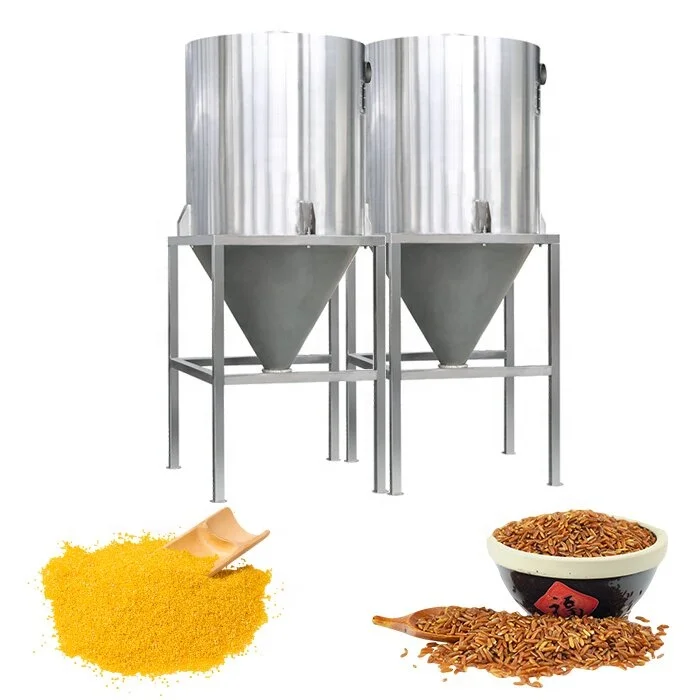
| Artificial and fortified rice kernel production | Broken rice, corn, millet, wheat, oats, buckwheat, bean, starch as main ingredients |
| Micro-nutrient fortified rice for public health programmes | Vitamin and mineral premix blended before extrusion into rice-shaped kernels |
| Commercial fortified rice for retail markets | Nutritional rice kernels matching the size, colour, and cooking behaviour of natural milled rice |
| Grain by-product valorisation | Rice bran and broken rice fractions converted into high-nutritional-value reconstituted kernels |
| Food aid and nutrition programme supply | Shelf-stable fortified kernels blended with natural rice at specified ratios for distribution |
What "Nominal Capacity" Leaves Out About Fortified Rice Output
Your raw material formulation determines the real throughput, not the brochure number.
I spent years assembling extruders on the shop floor before moving into turnkey project planning, and the single most recurring complaint I hear from buyers is that a Fortified Rice Kernel Extrusion Production Line quoted at a certain capacity cannot sustain that output once their specific grain blend enters the barrel. Broken rice from one region absorbs moisture differently than corn grits from another. A starch-heavy formulation may gelatinise earlier in the screw channel, creating back-pressure that the motor was never sized to handle. The result is a line that runs at a fraction of its promised rate while operators scramble to adjust barrel temperatures on the fly. [NEED_CITE: starch gelatinisation behaviour across different grain formulations in twin-screw extrusion]
Screw Configuration Dictates Kernel Density and Shape
The twin-screw design in this line allows operators to rearrange screw elements and swap die plates to match the exact kernel profile required by the destination market. A long-grain rice market demands a different die orifice and compression ratio than a short-grain or medium-grain specification. The screw configuration directly controls residence time and shear intensity inside the barrel, which in turn determines how thoroughly the starch matrix is gelatinised before the material exits the die. This is not a setting you adjust on a touchscreen after installation — it must be engineered before the line ships, based on trial runs with the buyer’s actual raw material blend.
Throughput Matching Across Every Station Prevents Hidden Losses
A Fortified Rice Kernel Extrusion Production Line is only as productive as its weakest station. If the drying oven cannot remove moisture fast enough to keep pace with the extruder, kernels accumulate on the mesh belt, sticking together and deforming under their own weight. The circulation drying oven on this line uses a frequency motor-controlled belt speed so that drying time can be adjusted independently of extruder output. The low-temperature drying stage removes surface moisture without case-hardening the kernel, while the subsequent high-temperature roasting stage develops the colour and aroma that buyers expect in a finished fortified rice product. [NEED_CITE: moisture removal rate matching in multi-stage cereal drying systems]
Reading the Specs: What the Numbers Actually Mean for Your Facility
The installed power ratings across the five models — ranging from 85 kW on the MT65 to 260 kW on the MT95 — reflect the mechanical energy required to drive the twin-screw assembly through dense grain formulations. Power consumption figures are lower than installed ratings because the drive motors rarely operate at peak load during steady-state production. The overall dimensions tell you how much floor space the complete line occupies, including the drying oven and cooling conveyors, which is essential when planning utility routing and structural load distribution. The automatic lubricating and cooling system for the screw shafts reduces unplanned downtime by maintaining bearing temperatures within safe limits during continuous shifts. The single or double screw feeding option at the inlet end is chosen based on whether your premix includes fine mineral powders that tend to bridge in a single-screw hopper.
The Cost of Skipping Pre-Shipment Validation
Buyers who accept a line without a trial run on their own raw material often discover during commissioning that the screw configuration produces kernels with the wrong density — either too porous, causing them to float during cooking, or too compact, resulting in a hard texture that consumers reject. By the time replacement screws and dies are ordered and shipped, weeks of production capacity have already been lost. [NEED_CITE: common commissioning delays caused by untested raw material formulations in extrusion lines]
Why Procure This Line From a Single Turnkey Supplier
Every station from the batching mixer through the packing head is designed and supplied under one responsibility, meaning throughput calculations are performed across the entire chain rather than at individual machine boundaries. The screw and die configuration is specified against the buyer’s raw material and target kernel density before fabrication begins. An in-house machine testing workshop conducts trial runs on the buyer’s actual grain blend before shipment, generating a trial run report that documents moisture levels, throughput rates, and kernel quality metrics. Electrical schematics include voltage and frequency confirmation for the destination market, preventing the commissioning delays that arise when a control cabinet arrives wired for the wrong power supply. The line carries CE certification and ISO compliance, providing the documentation package required by public health procurement programmes and international food aid distributors.
Documentation & Verification
- Line layout and capacity calculation specifying throughput at each station against your grain formulation
- Trial run report on your raw material conducted in the testing workshop before dispatch
- Screw and die configuration record matched to your target kernel shape and density
- Electrical schematic with voltage and frequency confirmation for your destination market
- Factory test record documenting assembly verification before packing
- Operation and maintenance manual with wear parts list and replacement intervals
Installation, Commissioning & Support
- Floor space planning based on the overall dimensions of the selected model, up to 36×3.5×4.3 m for the MT95
- Dedicated power circuit sized to the installed power rating of the chosen model, up to 260 kW
- Phased assembly sequence from extruder positioning through drying oven and cooling conveyor alignment
- First-run parameter setting for barrel temperature profile, screw speed, and die pressure based on trial run data
- Operator training covering feeding system changeover between single and double screw configurations
- Wear parts inventory planning for screws and dies with recommended replacement intervals
What to Include in Your Enquiry
To move from an initial conversation to a firm line configuration, share your primary grain ingredients and any micro-nutrient premix composition, your target daily output and shift pattern, and the voltage and frequency standard at your facility. If you have existing upstream milling or downstream packing equipment, provide the interface specifications so the line layout can integrate cleanly. Let us know whether you want to send a sample of your raw material for a pre-shipment trial run.
Frequently Asked Questions
Q: How is output capacity verified against my specific raw material blend?
A: Before the line ships, your raw material — including the exact grain ratios and micro-nutrient premix — is run through the extruder in the testing workshop. The trial run report documents actual throughput, moisture content at the die exit, and kernel density measurements, so the capacity figure you receive is tied to your formulation, not a generic benchmark.
Q: How are screw and die configurations selected for my target kernel?
A: The screw element arrangement and die plate orifice are chosen based on the starch composition of your grain blend and the kernel shape, size, and cooking behaviour required by your market. Trial runs validate these selections before the line leaves the factory.
Q: What does the installation and commissioning schedule look like?
A: The turnkey line arrives in modular sections. Assembly proceeds from the extruder and feeding system through the vibrating conveyor, drying oven, cooling stages, and packing station. Commissioning includes parameter tuning based on the trial run report and operator training on your specific formulation.
Q: How is throughput balanced between the extruder, dryer, and packing station?
A: Each station is sized during the line layout phase so that no single stage creates a bottleneck. The drying oven belt speed is adjustable via frequency motor control, allowing drying time to be matched to the extruder output rate and the moisture profile of your specific kernel formulation.
Q: Can a trial run be performed before shipment, and what does it cover?
A: Yes. The trial run uses your raw material in the testing workshop and covers throughput rate, kernel shape and density, moisture levels at each drying stage, and screw and die configuration validation. A written report accompanies the shipment.
Related products
-
Fully Automatic Fortified Nutrition Powder Baby Food Production Line
¥8,238.27 Select options This product has multiple variants. The options may be chosen on the product page -

Full Automatic Complete Baby Food Nutrition Powder Porridge Processing Production Line for Infant Nutrition Factory
¥9,500.00 Add to cart -

Industrial Automatic 500kg/h Baby Cereal Nutrition Powder Extruder Manufacturing Process Line
¥8,238.27 Add to cart -

High Precision Automatic 500kg/h Baby Food Nutrition Powder Rice Extrusion Processing Line
¥8,238.27 Add to cart