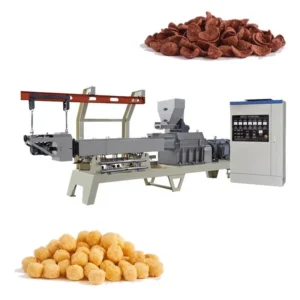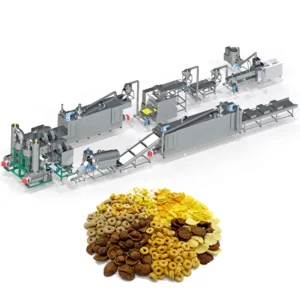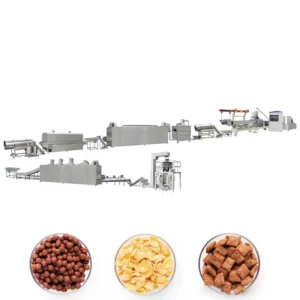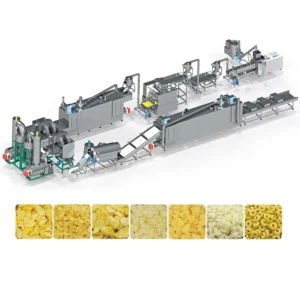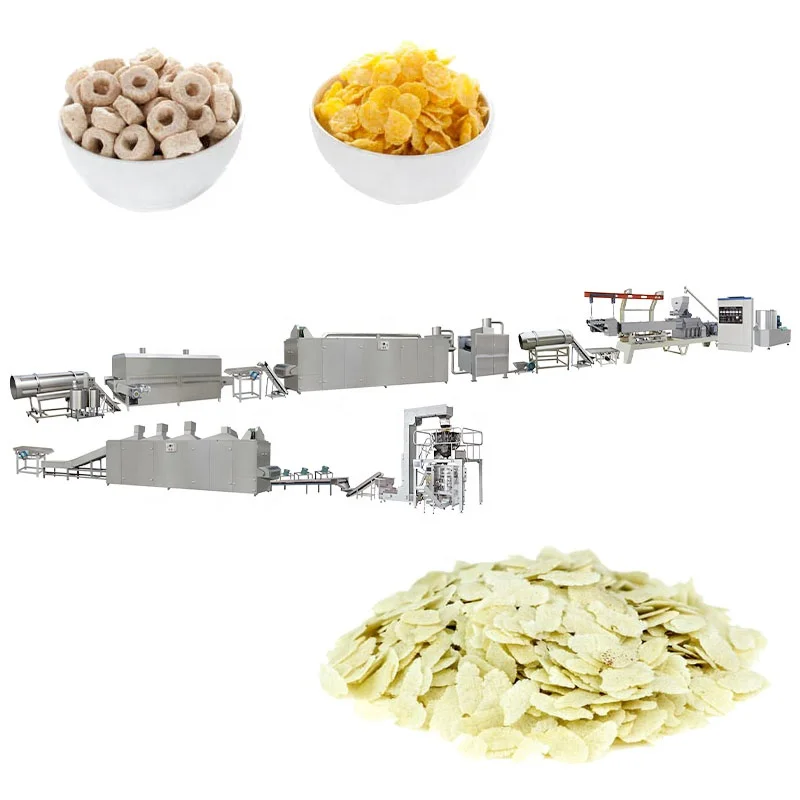
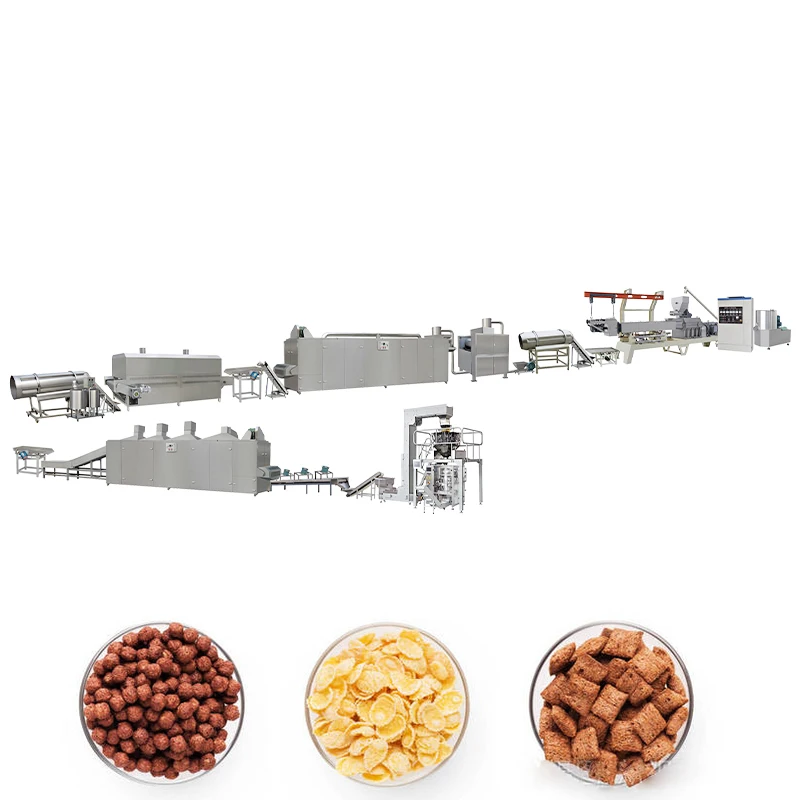

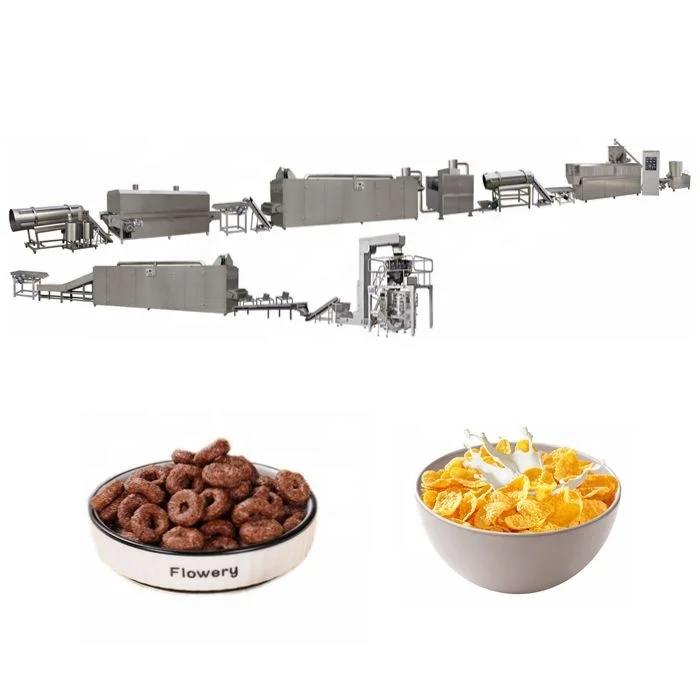

MT70 / MT85 / MT75 Corn Flakes Production Line, Twin-Screw Extruder, PLC Control — engineered as a complete turnkey system from batching through packing.
- Throughput balanced across mixing, extruding, flaking, drying, roasting, coating and cooling stations to eliminate bottlenecks
- Flaking unit features hydraulic double-roller drive with infrared temperature control for consistent flake thickness
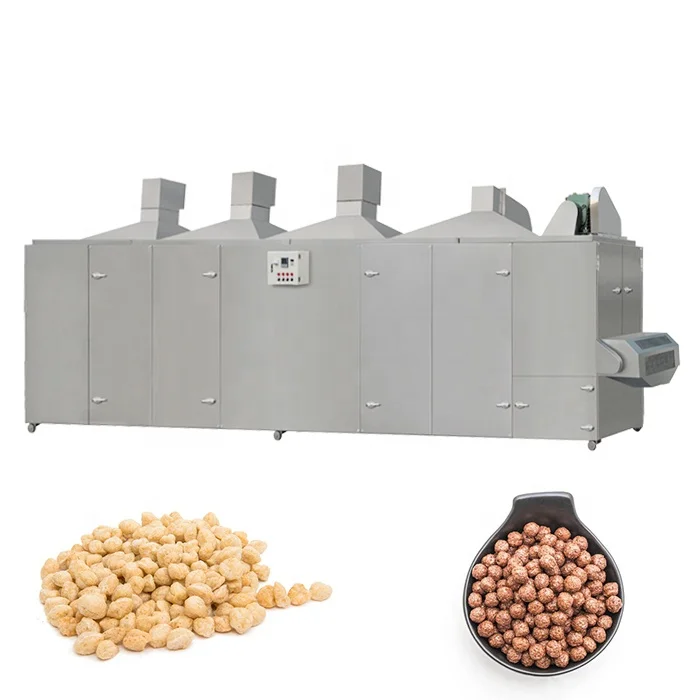
- Hot air roasting oven with dual circulating fans and cyclone dust removal for sanitary crisping
Layout, capacity calculation, and trial run report on your raw material provided before shipment.
Description
Precision Throughput Balancing — Every station from mixer to packer is calculated against the extruder’s real output on your grain formulation, preventing the dryer or flaking mill from becoming a hidden bottleneck.
Technical Specifications
| Parameter | Value |
|---|---|
| Product Type | Corn Flake Production Line / Breakfast Cereal Extruder |
| Available Models | MT70, MT85, MT75 |
| Installed Power | 160 kW (MT70) / 190 kW (MT85) / 210 kW (MT75) |
| Power Consumption | 120 kW (MT70) / 140 kW (MT85) / 150 kW (MT75) |
| Output Capacity | 150–200 kg/h (MT70) / 300–400 kg/h (MT85) / 300–500 kg/h (MT75) (basis to be confirmed) |
| Overall Dimensions | 41 × 1.5 × 2.2 m (MT70) / 43 × 1.5 × 3.2 m (MT85) / 45 × 1.5 × 3.5 m (MT75) |
| Extruder Type | Twin Screw |
| Screw Material | Special wear-resistant alloy |
| Control System | PLC control with MCC integration |
| Flaking Drive | Dual-motor independent roller drive with hydraulic gap adjustment |
| Flaking Temperature Control | Infrared sensor-regulated temperature pipe |
| Dryer Heating Source | Gas or electric (selectable) |
| Roasting Oven | Hot air with conciliation burner, dual circulating fans, cyclone dust removal |
| Coating System | Double tumble sugar melting, elevator, coating drum, spray nozzle array |
| Lubrication | Automatic lubricating and cooling on extruder barrel |
| Raw Materials | Corn, rice, wheat, oat, barley powder |
| Final Shapes | Flakes; optional die shapes — ball, tube, stick, ring, fruit loop, star, wheel, flower, heart |
| Assembly State | Complete line from batching to packing |
| Standards | CE, ISO certified |
Application Suitability
| Application | Material or Output |
|---|---|
| Natural corn flake manufacturing | Corn grits or corn flour, toasted and packaged without sugar coating |
| Sugar-coated breakfast cereal line | Corn, rice, or multigrain base with sugar or honey glaze application |
| Shaped cereal snack production | Wheat, oat, or barley blends formed into rings, balls, or stars via interchangeable dies |
| Fortified breakfast cereal processing | Grain blends with added vitamin and mineral premix requiring controlled gelatinisation |
Why "Rated Capacity" Means Nothing Without a Line Balance Audit
A corn flakes production line turnkey project fails the moment one station cannot swallow the output of the one before it.
I once watched a cereal startup lose entire shifts because the flaking mill could not keep pace with an extruder running a high-fat oat blend. The extruder pushed material faster than the rollers could sheet it, creating a backlog of warm, sticky grits that hardened into unusable lumps [NEED_CITE: throughput mismatch losses in breakfast cereal plants]. The line was rated for a certain hourly output on paper. On the buyer’s actual formulation, the bottleneck appeared within the first hour of commissioning.
When stations are sourced from separate vendors, no single supplier owns the throughput calculation. The extruder builder blames the dryer, the dryer builder blames the flaking gap, and the plant operator absorbs the downtime.
Throughput Engineering Across Every Station
This corn flakes production line turnkey configuration starts with a capacity calculation that runs backward from the packing station. The packing speed sets the target, and every upstream unit — extruder, flaking mill, dryer, roasting oven, coating drum — is sized to deliver slightly above that target so no single machine starves the next. The MT70 suits pilot and small-batch runs where floor space is limited, while the MT85 and MT75 serve full-scale breakfast cereal plants that need continuous multi-shift operation.
Layout Design Against Your Actual Floor Plan
A breakfast cereal line stretches over 40 metres in its standard arrangement, and the floor plan rarely matches a catalogue diagram. Utility drops for gas, compressed air, and three-phase power must align with each station before concrete pads are poured. We map the line to your building dimensions, column spacing, and existing ventilation ducts so that installation follows a planned sequence rather than improvised repositioning [NEED_CITE: industrial plant layout constraints for food extrusion lines].
Reading the Specs That Actually Matter
The twin-screw extruder carries an automatic lubricating and cooling circuit that maintains barrel temperature within a narrow band during long runs. In corn flake extrusion, starch gelatinisation requires precise moisture and shear control; if the barrel overheats in one zone, the dough exits the die with inconsistent expansion, producing flakes that shatter during roasting rather than crisp evenly.
The flaking station uses a hydraulic system to set roller gap pressure, and dual independent motors prevent the sheeted dough from tearing when formulation viscosity changes between corn and multigrain batches. Infrared sensors monitor the temperature pipe feeding into the nip, keeping the material pliable enough to flatten without sticking to the roller surface.
The hot air roasting oven pairs a conciliation burner with two separate circulating fans and a cyclone dust removal unit. The dual-fan arrangement creates an even air curtain across the belt, while the cyclone captures fine particulate before it can settle back onto the flakes — a requirement for food-grade hygiene audits.
The Hidden Cost of Skipping the Trial Run
I learned this the hard way on a 200 kg/h corn flake project. Our testing workshop ran the line flawlessly on standard corn grits. When the customer’s raw material arrived at their plant — higher fat content, different particle size — the extrudate would not expand properly. The flakes came out dense and brittle. Two days of reconfiguring screw elements, adjusting feed moisture, and resetting the die gap followed before the density fell back within market specification [NEED_CITE: raw material variability effects on twin-screw extrusion output].
Since then, every breakfast cereal line we ship goes through a trial run using the buyer’s own grain supply. The trial report documents screw configuration, barrel temperature profile, moisture percentage at the die, and flake density measurements — the exact parameters the commissioning engineer needs on day one.
Why Procurement Starts Here
Line throughput is calculated as a single system, not assembled from independent machine quotes, so extruder output and downstream capacity stay aligned from the first hour of production.
Screw configuration and die geometry are specified against your grain type and target flake thickness, not copied from a generic build sheet.
An in-house testing workshop runs your actual raw material before the line is crated, producing a documented trial report that travels with the shipment.
CE and ISO documentation is prepared in-house, matching the exact machine configuration that ships — not a generic certificate covering a product family.
Electrical schematics confirm voltage, frequency, and control panel language for your market before production begins, eliminating on-site rewiring during commissioning.
Documentation & Verification
- Line layout drawing with throughput calculation for every station matched to extruder model
- Screw and die configuration record specific to your grain formulation and target flake density
- Trial run report from our testing workshop using your raw material with density and moisture data
- Electrical schematic confirming voltage, frequency, and PLC language for your facility
- CE declaration of conformity matched to the shipped machine serial numbers
- Wear parts list with part numbers for screws, dies, flaking roller sleeves, and spray nozzles
Installation, Commissioning & Support
- Foundation load plan based on the 41–45 m line footprint and individual station weights for your floor slab
- Three-phase power distribution schedule matching 120–150 kW running load with dedicated breaker circuits per station
- Modular shipping configuration allowing extruder, flaking mill, and dryer to be rigged through standard factory doors
- Commissioning protocol covering screw speed ramp-up, flaking gap calibration, and roasting oven temperature profiling
- Operator training on PLC screen navigation, automatic lubrication intervals, and hydraulic roller pressure adjustment
- Spare wear parts package including replacement screw sections, die inserts, and flaking roller sleeves for the first maintenance cycle
What We Need to Configure Your Line
To size the extruder, dryer, and flaking stations correctly, share your primary grain material, any sugar or coating requirements, and your target hourly output based on your specific formulation. Floor plan dimensions with column positions help us draft a layout that fits your building before the quotation stage. Confirm your local voltage and frequency so the MCC and control panels are wired for your grid on arrival.
Frequently Asked Questions
Q: How do you match throughput across the extruder, dryer, flaking mill, and coating drum?
A: We calculate each station’s capacity against the extruder’s real output on your grain formulation, not a generic catalogue figure. The dryer belt speed, flaking roller feed rate, and coating drum volume are all set to handle the extruder output plus a margin, so no station starves or accumulates backlog during continuous production.
Q: What voltage, frequency, and control language options are confirmed before the line ships?
A: Before production begins, we document your site voltage and frequency and configure the MCC and PLC accordingly. The control panel language is set to your operator preference. This confirmation is part of the specification package, so there is no on-site rewiring or software reloading during commissioning.
Q: Can the line layout be adapted to our factory floor plan and phased installation schedule?
A: Yes. We draft the layout against your building drawing, accounting for column spacing, door clearances, and utility drop points. If your project is phased — extruder and dryer first, coating line later — we design the mechanical and electrical interfaces so future stations connect without modifying the installed equipment.
Q: Do you perform a trial run on our actual raw material before shipment?
A: Every line undergoes a trial in our testing workshop using the grain formulation you supply. The trial report records screw configuration, barrel temperatures, moisture content at the die, and flake density. This report ships with the machine so your commissioning engineer can reproduce the same parameters on day one at your plant.
Q: What spare wear parts come with the line, and what is the replacement schedule?
A: The initial package includes replacement screw elements, die inserts, and flaking roller sleeves. Replacement timing depends on your grain abrasiveness and daily run hours, and the wear parts list in your documentation specifies part numbers and recommended inspection intervals for each component.
Related products
-
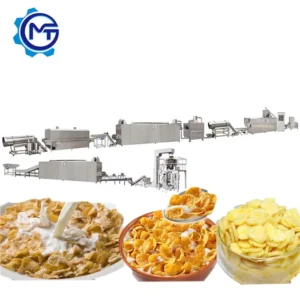
Sweet Corn Flakes Maize Breakfast Cereal Full-automatic Food Grade Stainless Steel Heat Exchanger Mixer Fryer Processing Line
¥8,000.00 Add to cart -
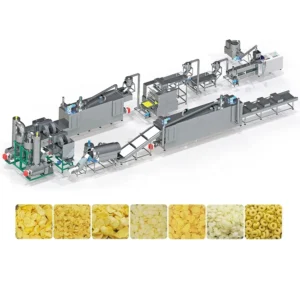
Hot Selling Automatic Corn Flakes Breakfast Cereal Production Line Making Machine
¥20,000.00 Select options This product has multiple variants. The options may be chosen on the product page -
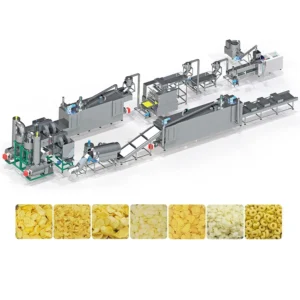
Automatic Cornflakes Making Machine Corn Flakes Breakfast Cereals Processing Production Line
¥500.00 Select options This product has multiple variants. The options may be chosen on the product page -
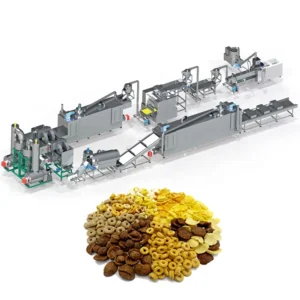
Corn Flakes Production Line Breakfast Cereal Production Machine Line Corn Flake Making Machinery
¥59,800.00 Select options This product has multiple variants. The options may be chosen on the product page