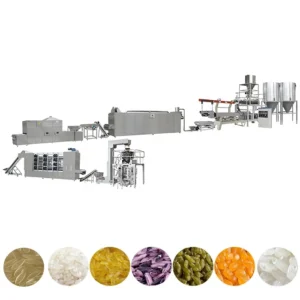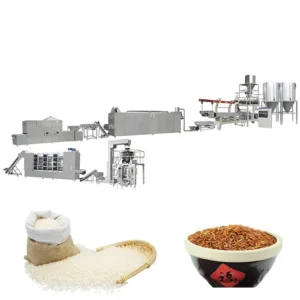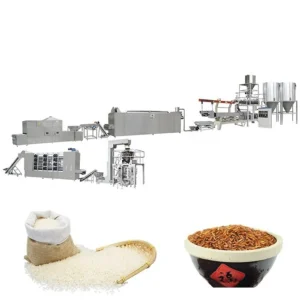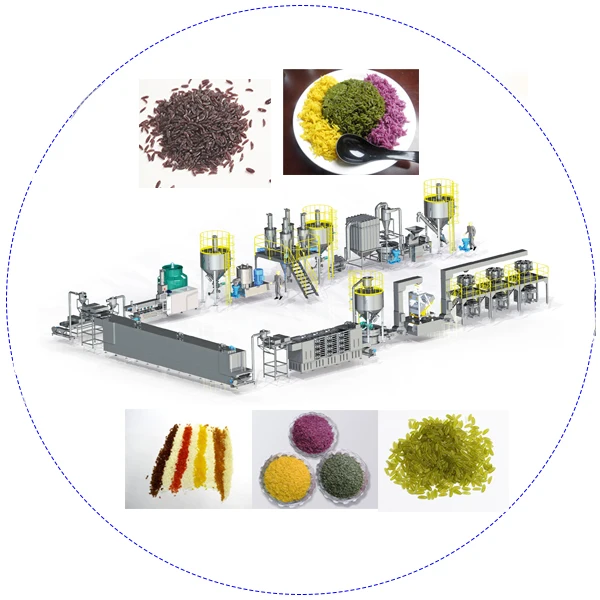


MT65/MT70/MT75/MT85/MT95 Artificial Fortified Rice Processing Line, Twin-Screw, CE Certified — configured for broken rice, corn, millet, wheat and starch blends with vitamin and mineral enrichment.
- Screw configuration and die design specified to your raw material formulation and target kernel density
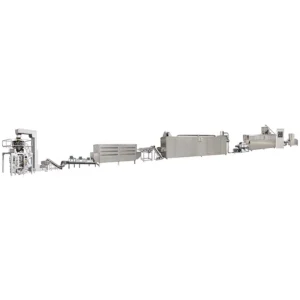
- Complete line stations from mixing through low-temperature drying, roasting, cooling and packing, throughput-matched across every stage
Trial runs on your actual raw material in our testing workshop confirm real-world output before shipment.
Description
Capacity-Matched Line Engineering — Every station from batching through packing is sized to your raw material blend and target kernel density, eliminating bottlenecks that plague assembled-from-separate-vendors builds.
Technical Specifications
| Parameter | Value |
|---|---|
| Model | MT65, MT70, MT75, MT85, MT95 |
| Product Type | Artificial Fortified Rice Processing Line |
| Screw Type | Twin-screw |
| Line Stations | Mixing, Extruding, Vibrating, Low temperature drying, Cooling, High temperature roasting, Cooling, Packing |
| Material Compatibility | Broken rice, rice, corn, millet, wheat, oats, buckwheat, bean, starch with vitamin and mineral additions |
| Final Products | Artificial rice, fortified rice kernels |
| MT65 Installed Power | 85 kW |
| MT65 Power Consumption | 60 kW |
| MT65 Capacity | 80–100 kg/h (basis not stated in source — confirm raw material and moisture content) |
| MT65 Dimensions | 28 × 1.2 × 2.2 m |
| MT70 Installed Power | 120 kW |
| MT70 Power Consumption | 85 kW |
| MT70 Capacity | 100–120 kg/h (basis not stated in source — confirm raw material and moisture content) |
| MT70 Dimensions | 30 × 1.5 × 2.2 m |
| MT75 Installed Power | 180 kW |
| MT75 Power Consumption | 135 kW |
| MT75 Capacity | 300–500 kg/h (basis not stated in source — confirm raw material and moisture content) |
| MT75 Dimensions | 32 × 3.5 × 4.3 m |
| MT85 Installed Power | 235 kW |
| MT85 Power Consumption | 165 kW |
| MT85 Capacity | 200–300 kg/h (basis not stated in source — confirm raw material and moisture content) |
| MT85 Dimensions | 34 × 3.5 × 4.3 m |
| MT95 Installed Power | 260 kW |
| MT95 Power Consumption | 195 kW |
| MT95 Capacity | 800–1000 kg/h (basis not stated in source — confirm raw material and moisture content) |
| MT95 Dimensions | 36 × 3.5 × 4.3 m |
| Control System | Frequency speed controlling, high automation |
| Feeding System | Single or double screw feeding system selected according to material |
| Drying Oven Heating Source | Electric or gas |
| Drying Oven Feature | Circulation drying process, frequency motor controls mesh belt speed |
| Lubrication | Automatic lubricating and cooling system |
| Certification | CE, ISO |
Application Suitability
| Application | Material or Output |
|---|---|
| Fortified food and nutrition programme supply | Vitamin- and mineral-enriched rice kernels from broken rice and starch blends |
| Broken rice value recovery | Artificial rice kernels from broken rice, rice bran and millet with retained cooking texture |
| Multi-grain rice analogue production | Extruded kernels from corn, oats, buckwheat and bean starch with micro-nutrient inclusion |
| Institutional feeding programme output | Uniform fortified rice kernels meeting government nutritional specifications |
| Breakfast cereal and grain processor expansion | High-value artificial rice from low-cost grain fractions and starch |
What "Nominal Capacity" Means When Your Raw Material Changes the Rules
An artificial fortified rice production line turnkey is only as fast as its slowest station on your actual formulation.
I watched a client in Southeast Asia receive a line quoted at a rated throughput based on standard white rice flour. When they switched to a brown rice and quinoa blend on day one, the gelatinisation temperature shifted, the extrudate turned gummy, and the dryer belt jammed within hours. The commissioning team spent over a week re-tuning barrel zones and die geometry on-site — work that should have been done before the crates left the factory [NEED_CITE: raw material variability in extrusion processing]. Every MT line is trialled on your specific broken rice, starch or multi-grain blend in the testing workshop before shipment, so the artificial fortified rice production line turnkey you receive has already proven its throughput on your material.
How Screw Configuration Shapes Kernel Density and Cooking Behaviour
Twin-screw extrusion gives operators independent control over shear, residence time and barrel temperature across multiple zones. For artificial rice kernels, the screw profile determines how completely starch gelatinises before the material reaches the die. A configuration that works for pure rice flour may leave buckwheat or bean starch under-processed, resulting in kernels that fracture during drying or turn mushy when cooked. Each build is specified with a screw arrangement and die geometry matched to the buyer’s formulation and target kernel density, which is the core engineering discipline behind a reliable artificial fortified rice production line turnkey.
Drying and Roasting Stages That Hold Kernel Integrity
Low-temperature drying followed by cooling and high-temperature roasting is not a generic sequence — the transition points between stages determine whether fortified rice kernels retain their shape or develop stress cracks. The circulation drying oven uses frequency-controlled mesh belt speed, allowing operators to adjust residence time as moisture content shifts between batches. Gas or electric heating sources are available depending on local utility costs. When drying is too aggressive, vitamin and mineral inclusions degrade; when it is too slow, downstream packing backs up and the entire line stalls [NEED_CITE: thermal degradation thresholds for micro-nutrient retention in extruded grain products]. Matching dryer throughput to extruder output is where most assembled lines fail.
Reading the Specification Sheet Against Your Production Reality
The installed power figures across the MT65 through MT95 models reflect the motor and heater load required to maintain barrel temperature and screw torque at different throughputs. Power consumption values sit below installed power because heaters cycle and motors rarely run at full rated load continuously. The feeding system choice — single or double screw — depends on whether your formulation includes fibrous materials like rice bran or free-flowing starches. Automatic lubricating and cooling on the extruder barrel reduces unplanned stops during long production runs, which matters when a nutrition programme contract demands uninterrupted output.
The Hidden Cost of Mismatched Station Throughput
A line assembled from separate vendors often has an extruder that outruns its dryer or a cooling conveyor that bottlenecks the packing station. The result is not just lower output — it is inconsistent kernel moisture, uneven roasting colour and vitamin degradation from kernels sitting too long in holding bins between stages. Buyers who skip the layout and capacity calculation phase end up paying for a second dryer or wider belt conveyor months after installation, plus the downtime of re-routing utilities [NEED_CITE: throughput mismatch consequences in multi-station food processing lines]. This is the most common failure mode in turnkey projects where no single supplier owns the full line responsibility.
Why Source the Complete Line From One Engineering Team
The artificial fortified rice production line turnkey is designed as a single integrated system rather than a collection of standalone machines. Screw configuration and die design are specified to the buyer’s raw material and target kernel specification before production begins. The in-house testing workshop runs trial batches on the customer’s actual formulation, generating a documented trial run report before shipment. Electrical schematics confirm voltage, frequency and control language for the destination market. Pre-sales consultation covers line layout, utility planning and phased installation scheduling, with on-site commissioning and operator training included in the project scope.
Documentation & Verification
- Line layout and capacity calculation showing matched throughput from mixing through packing
- Trial run report on your specific broken rice or starch blend before dispatch
- Screw and die configuration record specifying the exact build for your formulation
- Electrical schematic with voltage and frequency confirmation for your facility
- CE declaration of conformity and ISO certificate
- Operation and maintenance manual with wear parts list
Installation, Commissioning & Support
- Foundation and utility planning matched to the selected model’s footprint and power draw, up to 36 m line length for the MT95
- Dedicated electrical circuits sized to the installed power rating with confirmed voltage and frequency for local grid standards
- Extruder, dryer and roasting stations shipped in modular sections for sequential on-site assembly
- First-run parameter setting including barrel temperature profile, screw speed and mesh belt frequency tuning on your material
- Operator training covering feeding system selection, die changeover and automatic lubrication system maintenance
- Wear parts inventory including spare screws, dies and mesh belts supplied with initial shipment
What to Include in Your Initial Inquiry
Share your primary grain or starch material, the specific vitamin and mineral premix you intend to add, and your target daily output in kilograms. Confirm your facility voltage, frequency and preferred control language, along with available floor space and ceiling height for the drying and roasting sections. If you have existing upstream mixing or downstream packing equipment, provide model details so the line can be configured to integrate rather than duplicate.
Frequently Asked Questions
Q: How is line capacity verified on my specific raw material before shipment?
A: Your formulation — including grain type, starch ratio and micro-nutrient premix — is run through the extruder and dryer in the testing workshop. The trial run report documents actual throughput, kernel density and moisture content at the packing station. Capacity figures are confirmed on your material, not on a generic reference flour.
Q: How do you match screw and die configuration to my broken rice or starch formulation?
A: The screw profile and die geometry are selected based on your material’s gelatinisation temperature, amylose content and target kernel shape. A configuration record is generated before production and included in your documentation package. Adjustments are validated during the in-house trial run before the extruder ships.
Q: What is the phased installation and commissioning schedule for a complete line?
A: Installation follows a station-by-station sequence — extruder first, then dryer and roasting ovens, then cooling conveyors and packing integration. Commissioning begins with individual station checks, progresses to wet runs with water, and concludes with production runs on your material. The full schedule is provided in the project layout document.
Q: How do you confirm voltage, frequency and control language for my target market?
A: The electrical schematic is prepared after you confirm local supply specifications. Motor ratings, heater elements and control panel components are sourced to match. Control interface language is set before the panel is wired, so operators see familiar terminology from day one of commissioning.
Q: What spare wear parts are included and how are replacements supplied?
A: The initial shipment includes spare screw elements, die plates and dryer mesh belt sections sized to your line model. A wear parts list with part numbers is included in the documentation package. Replacement orders are fulfilled from factory stock, and urgent shipments can be arranged for critical production schedules.
Related products
-

High Quality Automatic PLC Controlled 500kg/h Twin Screw Extruder Machine for Baby Rice Nutrition Powder
¥8,238.27 Add to cart -
High Productivity New Condition Nutritious Baby Food Meal Replacement Powder Production Line
¥30.00 Select options This product has multiple variants. The options may be chosen on the product page -

Hygienic Stainless Steel Infant Rice Powder Processing Line Automatic 500kg/h Capacity PLC Controlled
¥9,500.00 Add to cart -
High Productivity New Condition Safe Healthy and Nutritious Baby Food Meal Replacement Powder Production Line
¥30.00 Select options This product has multiple variants. The options may be chosen on the product page