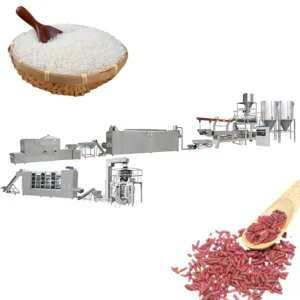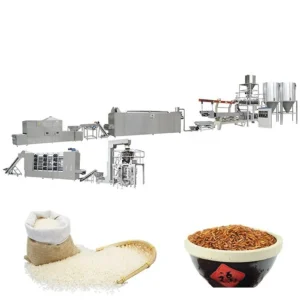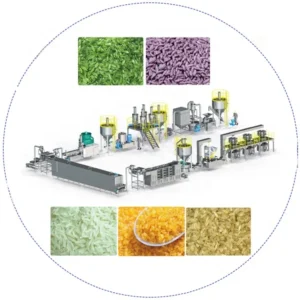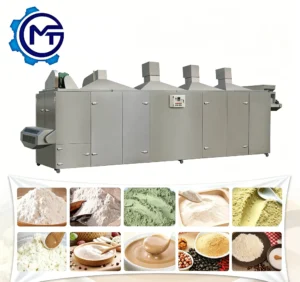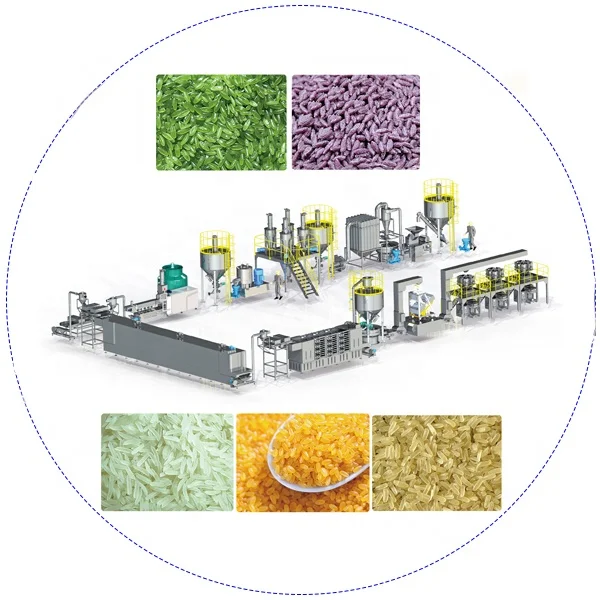


MT65 / MT70 / MT85 / MT75 / MT95 Artificial Rice and Fortified Rice Kernel Extrusion Line, Twin-Screw, Frequency Speed Control — throughput-matched from batching through extrusion, low-temperature drying, high-temperature roasting, and packing. Screw configuration and die design are specified to the buyer’s grain formulation, controlling viscosity, elasticity, and kernel density to match natural rice characteristics.
- Multi-stage drying with circulation mesh belt ensures uniform moisture
- Automatic lubricating and cooling system for continuous operation
- Trial runs on customer raw material performed in-house before shipment, with full configuration records and capacity verification documentation provided
Description
Turnkey Engineering — Every station from batching through packing is throughput-matched to your grain formulation and target kernel density, eliminating the bottlenecks that plague multi-vendor lines.
Technical Specifications
| Parameter | Value |
|---|---|
| Product Type | Artificial Rice and Fortified Rice Kernel Extrusion Line |
| Available Models | MT65, MT70, MT85, MT75, MT95 |
| Extruder Type | Twin-screw |
| Installed Power | MT65: 85 kW / MT70: 120 kW / MT85: 235 kW / MT75: 180 kW / MT95: 260 kW |
| Power Consumption | MT65: 60 kW / MT70: 85 kW / MT85: 165 kW / MT75: 135 kW / MT95: 195 kW |
| Output Capacity | MT65: 80–100 kg/h; MT70: 100–120 kg/h; MT85: 200–300 kg/h; MT75: 300–500 kg/h; MT95: 800–1000 kg/h (basis not stated in source) |
| Overall Dimensions (L×W×H) | MT65: 28 × 1.2 × 2.2 m; MT70: 30 × 1.5 × 2.2 m; MT85: 34 × 3.5 × 4.3 m; MT75: 32 × 3.5 × 4.3 m; MT95: 36 × 3.5 × 4.3 m |
| Control System | Frequency speed control with automated operation (PLC/MCC to be verified) |
| Feeding System | Single or double screw feeding based on material characteristics |
| Screw Material | Wear-resistant alloy engineered for grinding resistance |
| Drying Oven Heating | Electric or gas options |
| Drying Method | Circulation drying, mesh belt speed controlled by frequency motor |
| Line Stations | Mixing → Extruding → Vibrating → Low Temperature Drying → Cooling → High Temperature Roasting → Cooling → Packing |
| Lubrication | Automatic lubricating and cooling system |
| Certification | CE (verify per shipment) |
Application Suitability
| Application | Material or Output |
|---|---|
| Fortified rice for nutrition programs | Broken rice and rice bran blended with vitamins and minerals |
| Grain-based staple food fortification | Corn, millet, wheat, oats, buckwheat, and beans blended with micronutrients |
| Value-added processing of rice byproducts | Broken rice converted into premium artificial kernels with minimal nutrition loss |
| Commercial fortified rice production | Micronutrient-enriched kernels for institutional and retail markets |
What a Nominal Capacity Figure Hides About Your artificial rice production line turnkey
Capacity is only meaningful when verified on your exact grain blend, moisture content, and target kernel size.
I have stood in processing halls where a newly commissioned line ran at barely half its nameplate output. The cause was almost always the same: the extruder had been configured for a standard rice flour recipe, while the buyer was running a high-fiber multigrain blend with different gelatinisation behaviour. The screw profile did not match the material, expansion was inconsistent, and kernels fractured during drying. [NEED_CITE: grain formulation variability and extruder screw matching] An artificial rice production line turnkey project must account for this from the outset, or the throughput number on the quotation becomes irrelevant once real production begins.
Screw Configuration and Die Design Matched to Your Grain Recipe
The twin-screw extruder is the core of any artificial rice production line turnkey installation. Screw element sequencing and die aperture are selected based on the starch-to-protein ratio of the buyer’s grain blend. A recipe heavy in broken rice behaves differently under shear and heat than one incorporating buckwheat or bean flour, and the screw configuration must reflect this to achieve the correct kernel density and cooking parity with natural rice.
Multi-Stage Drying to Control Kernel Integrity
After extrusion, kernels pass through a vibrating station before entering low-temperature circulation drying. This initial phase reduces surface moisture gradually, preventing case hardening that would trap steam inside the kernel. The subsequent high-temperature roasting stage then develops the final texture and colour. Frequency-controlled mesh belt speed allows operators to adjust residence time, which is essential when switching between formulations with different moisture release profiles. [NEED_CITE: multi-stage drying principles for extruded grain products]
Reading the Specification Sheet Against Your Production Target
Installed power and power consumption figures vary significantly across the MT65 through MT95 range. The gap between installed and consumed power reflects the motor headroom available for denser formulations that demand higher torque during extrusion. When evaluating an artificial rice production line turnkey proposal, buyers should cross-reference the power consumption figure with their specific recipe viscosity, since a high-fiber blend will draw more continuous current than a pure starch mix. The overall line dimensions also scale with capacity, so workshop layout planning must account for the full station sequence from mixer to packer, including clearance for maintenance access around the extruder barrel and dryer sections.
The Hidden Cost of Mismatched Line Stations
An extruder that outpaces its downstream dryer creates a backlog of wet kernels that clump and degrade before they can be stabilized. Conversely, an oversized dryer running below capacity wastes thermal energy and extends cycle times unnecessarily. [NEED_CITE: throughput balancing across extrusion line stations] These mismatches are common when line components are sourced from separate vendors without a unified capacity calculation, and the result is a production floor that never reaches the output the buyer paid for.
Why Procurement Through One Supplier Changes the Outcome
The complete artificial rice production line turnkey sequence — from batching through mixing, extrusion, drying, roasting, cooling, and packing — is engineered under a single supplier, meaning throughput is calculated across every station rather than assembled from independent quotations. Screw configuration and die design are specified to the buyer’s raw material before production begins, not copied from a generic template. An in-house testing workshop allows trial runs on the buyer’s actual grain blend before the line ships, catching formulation issues while adjustments still cost days rather than months. Electrical schematics are confirmed against the destination market’s voltage and frequency standards, reducing commissioning delays. The automatic lubricating and cooling system on the extruder supports continuous operation without manual intervention during extended production runs.
Documentation & Verification
- Line layout and capacity calculation showing throughput match across all stations
- Screw and die configuration record specific to your grain formulation
- Trial run report on your raw material conducted before dispatch
- Electrical schematic with voltage, frequency, and control language confirmed
- CE declaration of conformity and ISO certificate per shipment
- Operation and maintenance manual with wear parts list included
Installation, Commissioning & Support
- Foundation and floor space planned against the full line dimensions (up to 36 × 3.5 × 4.3 m for MT95)
- Power supply routed to match installed power requirements (up to 260 kW) with dedicated circuit breakers
- Extruder barrel and screw elements assembled on-site with alignment verification before first run
- Frequency-controlled feeding and dryer belt speed calibrated to your recipe during commissioning
- Operator training covers screw configuration changes for different grain blends
- Wear parts list provided with recommended replacement intervals for screws and dies
Preparing Your Inquiry
To receive a line configuration that reflects your actual production conditions, provide the grain formulation you intend to run — including the ratio of broken rice, alternative grains, and micronutrient premix — along with your target daily output and the moisture content of your incoming material. Specify the voltage, frequency, and control language required at your facility, and note whether you can ship a sample of your raw material for a pre-shipment trial run.
Frequently Asked Questions
Q: How is line capacity verified on my specific grain formulation?
A: Before shipment, your raw material is run through the extruder in the testing workshop. The trial confirms achievable throughput, kernel density, and surface quality on your exact blend of broken rice, alternative grains, and micronutrients. A trial run report documenting these results is included with the shipment, so capacity expectations are grounded in your actual material behaviour rather than a generic benchmark.
Q: How is screw configuration matched to my raw material blend?
A: Screw element sequencing and die aperture are selected based on the starch content, fiber level, and moisture profile of your formulation. A high-fiber multigrain blend requires a different compression ratio and shear profile than a pure broken rice recipe. The chosen configuration is recorded in your documentation package, and adjustments are made during the pre-shipment trial if kernel quality does not meet specification.
Q: What voltage and frequency options are confirmed before commissioning?
A: Electrical schematics are prepared to match the voltage, frequency, and plug standard of the destination market. Control panel language is confirmed during the specification phase. This prevents the situation where a line arrives on-site and cannot be powered or operated due to an electrical mismatch, which is a common cause of commissioning delays in cross-border equipment purchases.
Q: How is throughput balanced between the extruder, dryer, and roasting stations?
A: Each station is sized so that its processing rate matches the extruder output for your specific formulation. The dryer belt speed and roasting residence time are calculated against the moisture removal curve of your kernels. This prevents wet-kernel backlog after extrusion and avoids oversized downstream equipment that wastes energy without contributing to output.
Related products
-

Hygienic Stainless Steel Infant Rice Powder Processing Line Automatic 500kg/h Capacity PLC Controlled
¥9,500.00 Add to cart -
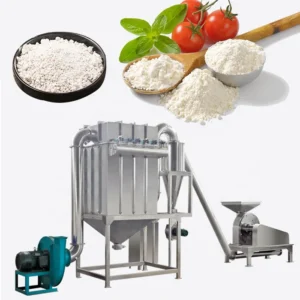
New Automatic Nutritional Powder Making Machine for Baby Food Production Line
¥20.00 Select options This product has multiple variants. The options may be chosen on the product page -

Automatic Instant Powder Production Line Nutritional Powder Extruder Machine
¥10,000.00 Select options This product has multiple variants. The options may be chosen on the product page -
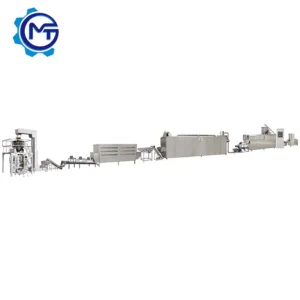
Automatic Nutritional Powder Making Machine Safe Rice Cereal for Babies
¥30.00 Select options This product has multiple variants. The options may be chosen on the product page