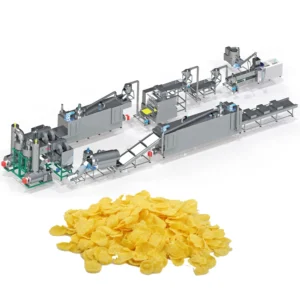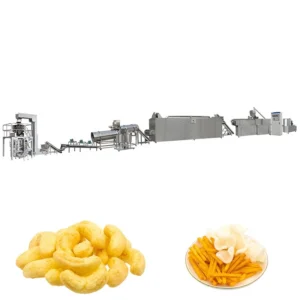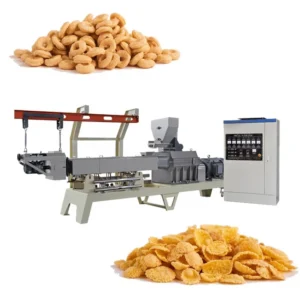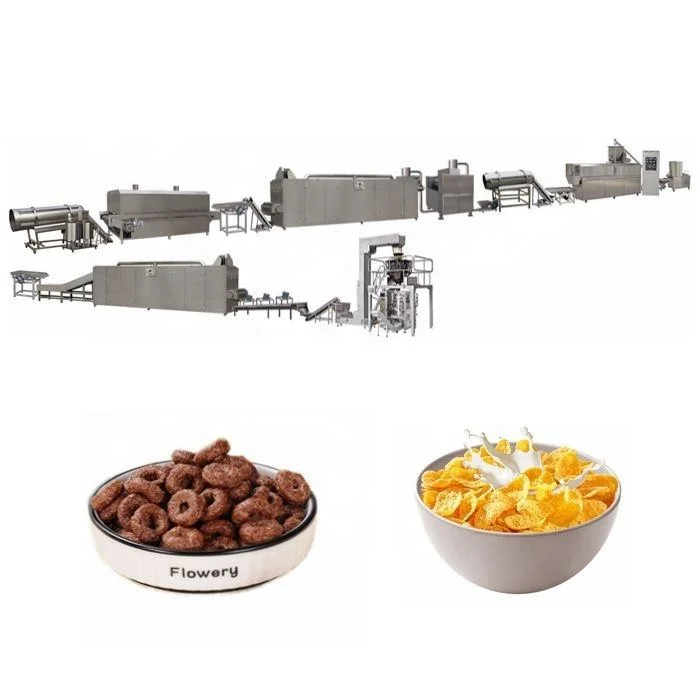


MT70 / MT85 / MT75 Corn Flakes Production Line, Twin-Screw Extruder, PLC & MCC Control, 100–500 kg/hr Capacity Range — engineered as a complete turnkey project from batching through packing, with throughput matched across extruder, flaker, dryer, roaster, and coating stations to eliminate bottlenecks common in multi-vendor assemblies. Screw configuration and die design are specified to your raw material and target flake density, validated by trial runs in our in-house testing workshop before shipment.
- Line stations: Mixing → Extruding → Flaking → Drying → Hot Air Roasting → Cooling → Packing (sugar coating optional)
- Raw materials: corn, rice, wheat, oat, barley powder
- Final products: natural corn flakes, sugar-coated flakes, shaped cereals (ball, tube, ring, star, heart)
- Flaking machinery: hydraulic double-roller system, infrared temperature control, PLC operation
- Hot air roasting oven: cyclone dust removal, dual circulating fans, precise crispiness control
- Layout customizable to factory footprint; voltage and frequency confirmed per local requirement
- CE and ISO certified; full documentation including line layout, capacity calculation, and electrical schematic provided
Single-source responsibility from line design through on-site commissioning and operator training, with screw and die configuration records and wear parts lists delivered at shipment.
Description
Throughput-matched engineering — Every station from batching to packing is calculated against the same output target so the extruder, flaker, dryer and roaster run without bottlenecks on your actual raw material.
Technical Specifications
| Parameter | Value |
|---|---|
| Product Type | Corn Flakes Breakfast Cereal Production Line |
| Line Models Available | MT70 / MT85 / MT75 |
| Extruder Type | Twin Screw |
| Raw Materials | Corn, rice, wheat, oat, barley powder |
| Control System | PLC (flaking machinery); MCC and PLC (line-level) |
| Flaking System | Hydraulic double rollers, PLC-controlled, infrared temperature sensing |
| Hot Air Roasting Oven | Conciliation burner, dual circulating fans, cyclone dust removal |
| Coating System | Double tumble sugar melter, elevator, coating drum, spraying nozzle |
| Final Products | Natural corn flakes, sugar-coated flakes, shaped cereals |
| CE / ISO Status | CE certified since 2014; ISO certified |
Application Suitability
| Application | Material or Output |
|---|---|
| Natural corn flakes production | Corn grits or corn flour via extrusion, flaking and roasting |
| Sugar-coated corn flakes | Natural flakes with sugar syrup spraying and tumble coating |
| Shaped breakfast cereals | Rice, wheat or oat blends formed into balls, tubes, rings, stars, fruit loops, wheels, flowers and hearts |
| Multi-grain cereal lines | Blends of barley, wheat and oat powders processed through the same twin-screw platform |
Why "Rated Capacity" Means Nothing Without the Raw Material Context
A corn flakes production line turnkey is only as reliable as the throughput calculation behind each station.
I once watched a breakfast cereal project in Iraq grind to a halt because the flaker was sized to the extruder’s nominal output, not the actual corn grits the buyer was sourcing locally. The particle size was coarser than the line was configured for, and the resulting flakes shattered before they ever reached the roaster. The whole line rhythm collapsed [NEED_CITE: raw material variability in grain processing across Middle East markets]. That experience changed how I look at every specification sheet: the number on the extruder nameplate is not the line capacity. The real capacity is what comes out of the packing station after every dryer, flaker and coater has done its job.
Layout and Station Matching Across the Full Line
A corn flakes production line turnkey requires the extruder, flaking machinery, dryer, hot air roasting oven and coating drum to share a common throughput target. When stations are sourced from separate vendors, each supplier sizes their equipment to their own nameplate, and the mismatches only surface during commissioning. The flaker might handle the extruder output, but the dryer falls behind, forcing the operator to slow the entire line. Designing the complete layout from one engineering source means every conveyor speed, dryer residence time and roaster pass is calculated against the same hourly target.
Phased Installation and Utility Planning
A new breakfast cereal factory involves steam, compressed air, gas supply for the roaster, electrical panels for the MCC and PLC cabinets, and drainage for the coating area. Coordinating these utilities across multiple equipment vendors leads to missed connections and rework on site [NEED_CITE: industrial utility coordination challenges in food plant construction]. A single-source turnkey approach sequences the installation: foundations first, then the extruder and dryer, followed by the flaking and roasting stations, and finally the coating and packing end. Each phase is verified before the next begins, reducing the commissioning window.
How Screw Configuration and Die Design Shape the Flake
The twin-screw extruder is where starch gelatinisation and dough conditioning happen. Screw element arrangement — kneading blocks, reverse elements, conveying sections — controls residence time and shear, which directly influence how the dough behaves when it hits the flaking rollers. A die designed for the buyer’s specific corn variety and moisture content produces a consistent pellet that flattens evenly under the hydraulic double rollers. The infrared sensor on the flaking machinery monitors roller temperature to keep thickness uniform across the full roller width. The hot air roasting oven then develops the surface blistering that defines a quality corn flake, with its two separate circulating fans and cyclone dust removal ensuring even heat distribution and a clean production environment.
The Hidden Cost of Undersized Downstream Equipment
When a buyer focuses on extruder power and ignores the dryer or roaster capacity, the result is a line that can never reach its nameplate output. Wet flakes pile up before the dryer, sticking together and creating waste. An undersized roaster forces longer residence times, slowing the entire line to match its pace. The sugar coating drum, if too small, cannot tumble the flakes evenly, leaving inconsistent coverage that the market rejects [NEED_CITE: downstream bottleneck effects in cereal processing lines]. These problems are expensive to fix after installation because they require replacing entire stations, not adjusting a parameter.
Why Source the Complete Line Here
The MT70, MT85 and MT75 models share a common engineering platform, so a buyer starting at lower output can plan a future upgrade without redesigning the factory layout. Every line includes a trial run on the buyer’s actual raw material in the in-house testing workshop before shipment, so screw configuration and die design are validated early. The flaking machinery uses a hydraulic system with separate double motors for each roller, giving independent speed control. The hot air roasting oven features a vibrating pan with high-temperature spraying tubes and precise temperature control, ensuring consistent crispiness batch after batch. Line-level MCC and PLC control provides centralized monitoring from mixing through packing.
Documentation & Verification
- Line layout and capacity calculation showing throughput at every station from mixing to packing
- Trial run report on your specific corn, rice or oat raw material before shipment
- Screw and die configuration record matched to your target flake density and shape
- Electrical schematic with voltage and frequency confirmed for your local grid standard
- Operation and maintenance manual covering extruder, flaker, dryer, roaster and coater
- Wear parts list identifying screws, dies and flaking rollers with replacement intervals
Installation, Commissioning & Support
- Foundation plan accounts for the overall line dimensions up to 45 × 1.5 × 3.5 m depending on model
- Electrical load balanced across MCC and PLC cabinets, with installed power up to 210 kW
- Equipment ships in modular sections for phased assembly inside the factory building
- First-run commissioning includes screw configuration fine-tuning on your local raw material
- Operator training covers PLC interface navigation, flaker hydraulic pressure adjustment and roaster temperature profiling
- Spare wear parts including screws, dies and flaking roller surfaces stocked at delivery
What to Include in Your Inquiry
To size a complete line, share your target raw material type and its typical moisture content, the daily or hourly output you need at the packing station, and your factory floor dimensions including ceiling height. Specify the local voltage and frequency, the control language your operators require, and whether the line should produce natural flakes, sugar-coated flakes or shaped cereals — or all three across different production runs.
Frequently Asked Questions
Q: How is line capacity verified against my specific raw material?
A: Before shipment, your raw material is run through the extruder and downstream stations in the in-house testing workshop. The trial run report documents the actual throughput, flake quality and any screw or die adjustments made. This means the capacity figure you receive reflects your material, not a generic benchmark.
Q: How do you prevent throughput mismatches between stations?
A: Every station — extruder, flaker, dryer, roaster and coater — is specified to the same throughput target during the layout design phase. The capacity calculation document shows the rated value at each station, so no single machine becomes a bottleneck when the line runs continuously.
Q: What does commissioning and operator training cover on site?
A: Commissioning includes mechanical alignment, electrical verification against the confirmed voltage and frequency, and test runs with your raw material. Operators are trained on the PLC interface, hydraulic flaker adjustment, roaster temperature control and daily maintenance routines for screws, dies and roller surfaces.
Q: Can the line layout be adapted to my existing factory building?
A: The layout is designed around your floor dimensions, ceiling height and utility connection points. Conveyor lengths, dryer orientation and packing station position are adjusted during the engineering phase so the line fits your building rather than requiring structural modifications.
Related products
-
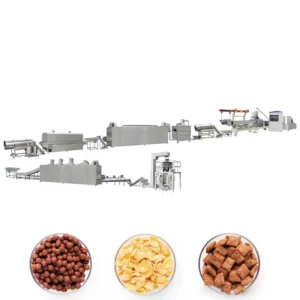
1000 Lbs Automatic Corn Flakes Production Line Mixer Breakfast Cereal Corn Flakes Production Line
¥45,000.00 Select options This product has multiple variants. The options may be chosen on the product page -

200kg/h Breakfast Cereal Extruder Making Machine Hot Sale Corn Flake Production Line
¥30,000.00 Select options This product has multiple variants. The options may be chosen on the product page -
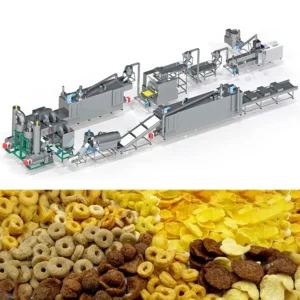
Corn Flakes Breakfast Cereal Production Line Making Machine Automatic
¥8,000.00 Select options This product has multiple variants. The options may be chosen on the product page -
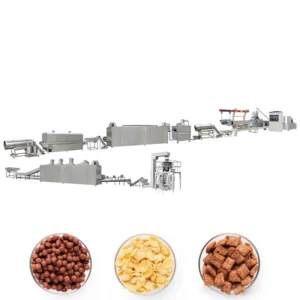
Kelloggs Corn Flakes Breakfast Cereal Normal Making Machine Breakfast Cereal Extruder Production Line
¥30,000.00 Select options This product has multiple variants. The options may be chosen on the product page