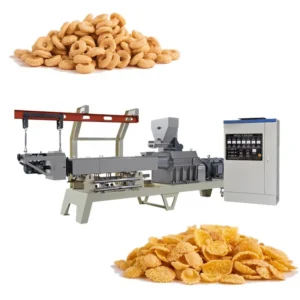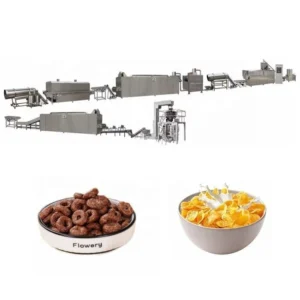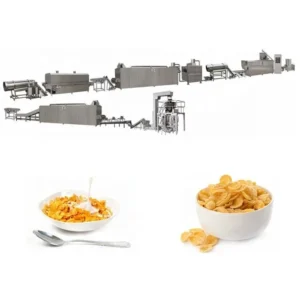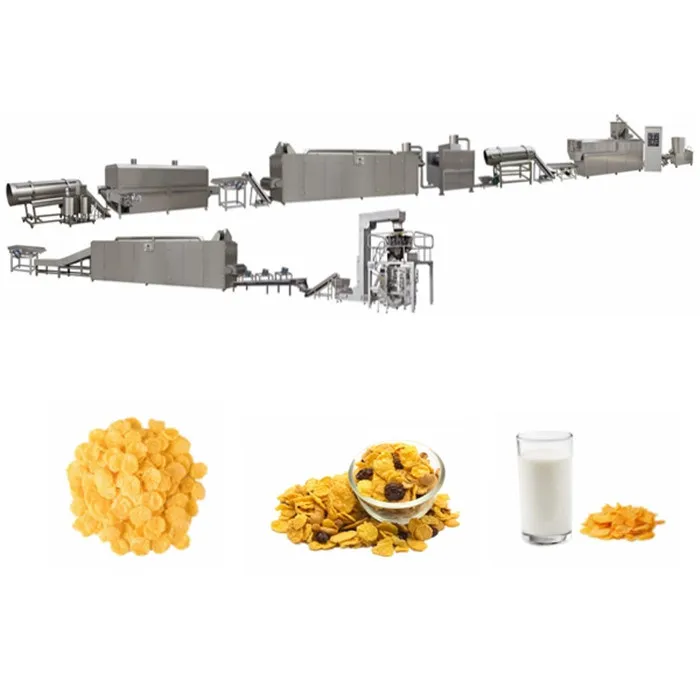

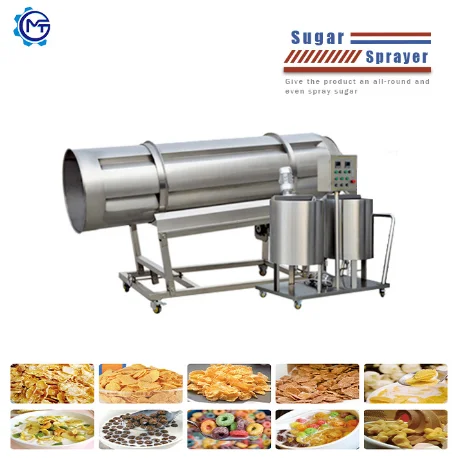
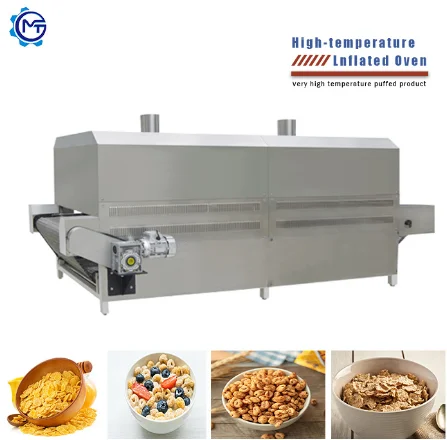


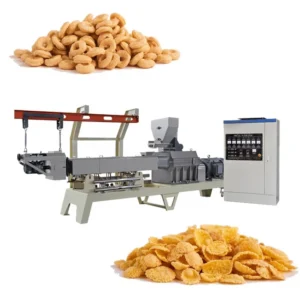
MT70 / MT85 / MT75 Corn Flakes Extrusion Production Line, Twin-Screw, PLC Control — engineered as a complete turnkey project from batching through extrusion, flaking, roasting and packing. Screw configuration and die design are matched to your raw material and target flake density, with hydraulic double-roller flaking and infrared temperature sensing for consistent thickness. Every station is throughput-matched under a single supplier to eliminate integration bottlenecks. Trial runs on your actual raw material are completed in our testing workshop before shipment, with full line layout and capacity documentation provided.
- CE and ISO certified
- Customized voltage and frequency
- Natural and sugar-coated process paths available
Description
Throughput-Matched Engineering — Every station from batching to packing is sized to your raw material behaviour, eliminating the flaking bottleneck that plagues cereal lines assembled from separate vendors.
Technical Specifications
| Parameter | Value |
|---|---|
| Product Type | Corn Flakes Extrusion Production Line |
| Model | MT70 / MT85 / MT75 |
| Screw Type | Twin Screw |
| Installed Power | 160 kW (MT70) / 190 kW (MT85) / 210 kW (MT75) |
| Power Consumption | 120 kW (MT70) / 140 kW (MT85) / 150 kW (MT75) |
| Output Capacity | 150–200 kg/hr (MT70, basis to be confirmed) / 300–400 kg/hr (MT85, basis to be confirmed) / 300–500 kg/hr (MT75, basis to be confirmed) |
| Overall Dimensions (L×W×H) | 41 × 1.5 × 2.2 m (MT70) / 43 × 1.5 × 3.2 m (MT85) / 45 × 1.5 × 3.5 m (MT75) |
| Control System | PLC and MCC line-wide control |
| Flaking Machinery Drive | Double motors for separate roller driving; hydraulic system for double rollers |
| Flaking Temperature Control | Infrared sensor for even temperature pipe control |
| Dryer Heating Source | Gas / Electric (selectable) |
| Roasting Oven | Hot air roasting with vibrating pan, high-temperature spraying tubes, conciliation burner, dual circulating fans, cyclone dust removal |
| Coating System | Double tumble for sugar melting, elevator, coating drum, spraying nozzle |
| Basic Raw Materials | Powder of corn, rice, wheat, oat, barley |
| Production Procedure (Natural) | Mixing → Extruding → Flaking → Drying → Hot Air Roasting → Cooling → Packing |
| Production Procedure (Sugar-Coated) | Mixing → Extruding → Flaking → Drying → Hot Air Roasting → Sugar Spraying → Sugar Coating → Drying → Cooling → Packing |
| Final Product Shapes | Natural corn flakes, coated corn flakes, ball, tube, stick, ring, fruit loop, star, wheel, flower, heart |
| Voltage & Frequency | Customized to customer’s local voltage and frequency |
| Certification | CE, ISO |
| Lubrication | Automatic lubricating and cooling function |
Application Suitability
| Application | Material or Output |
|---|---|
| Natural corn flakes for retail breakfast cereal | Corn powder and corn grits at controlled moisture |
| Sugar-coated corn flakes for children’s cereal market | Corn and rice blends with sugar syrup coating |
| Multi-grain flaked cereals | Wheat, oat, and barley powder blends |
| Multi-shape puffed cereal formats | Corn and rice powder formed into rings, balls, stars, and fruit loops via interchangeable die plates |
| Fortified breakfast cereals for institutional nutrition programmes | Cereal powder blends with added vitamin and mineral premix |
Why "Rated Capacity" Misleads Breakfast Cereal Buyers
A corn flakes production line turnkey rated at a headline number will not hold that output if the screw configuration was never tested on your actual grain blend.
I once watched a Southeast Asian cereal producer struggle for two days because their local corn flour carried higher fibre than the standard recipe the extruder was built around. The expansion ratio never reached the target, and the flakes came out dense and brittle after roasting. The problem was not the machine; it was the assumption that one screw configuration fits every flour profile. [NEED_CITE: raw material variability in extrusion processing and its effect on expansion]
When stations are sourced from separate vendors, the flaking rollers often cannot keep pace with the extruder output at higher moisture contents. The result is a pile-up between drying and flaking, and operators end up running the line well below its nameplate capacity just to avoid jamming the conveyor transfer points.
Screw Configuration Dictated by Your Grain, Not a Catalogue
The twin-screw extruder in this corn flakes production line turnkey is configured after we receive your raw material sample. Screw element sequencing — the ratio of conveying elements to kneading blocks, the pitch of the final metering section — is adjusted to the starch gelatinisation behaviour of your specific corn, wheat, or oat blend. A high-fibre oat flour demands a different shear profile than degerminated corn grits, and the die plate aperture is matched to the target flake thickness before the material ever reaches the roller station.
Flaking and Roasting Sized to Extruder Output, Not Quoted Separately
The hydraulic double-roller flaking unit uses infrared temperature sensing across the roller face so that sheet thickness stays consistent even as throughput varies during start-up and shutdown transitions. Downstream, the hot air roasting oven uses a conciliation burner with two independent circulating fans and a cyclone dust removal device. [NEED_CITE: hot air distribution uniformity in cereal roasting ovens and blister consistency] Both stations are capacity-matched to the extruder so that no single section forces the entire line to run below its intended rate.
Reading the Specification Sheet Beyond the Headline Numbers
The installed power figures across the three models — ranging from 160 kW to 210 kW — reflect the total connected load of the full line, not just the extruder motor. Actual power consumption sits lower because the drying and roasting stages cycle through heating and holding phases. The PLC and MCC control architecture means the operator sets the recipe once at the main panel, and each station — extruder screw speed, flaking roller pressure, roasting oven temperature zones — follows the same programme without manual adjustment at individual machines. The automatic lubricating and cooling function on the extruder gearbox reduces the chance of bearing failure during continuous shifts, which matters when a breakfast cereal plant runs back-to-back production days to meet packing schedules.
The Cost of Skipping a Trial Run Before Shipment
When a cereal line ships without a documented trial on the buyer’s actual flour, the first weeks on site become a costly experiment. Screw elements are swapped, die plates are re-machined, and the roasting oven temperature profile is adjusted through guesswork. [NEED_CITE: commissioning delays in food processing lines caused by untested raw material compatibility] Operators blame the machine, maintenance crews blame the process, and the packing line sits idle waiting for product that meets specification. Every day of trial-and-error on a live production floor costs more than a pre-shipment test run ever would.
What Sets This Project Apart from Assembled Lines
Every station in this corn flakes production line turnkey is engineered under one supplier, which means throughput calculations are cross-checked between the extruder, flaking unit, dryer, and roasting oven before metal is cut. The screw and die configuration is recorded against your specific raw material, not pulled from a generic build sheet. An in-house testing workshop runs your flour blend before the line ships, so you receive a trial run report — not a promise. The natural and sugar-coated process paths share the same extrusion platform, giving producers the flexibility to add coated variants or multi-shape puffed formats without investing in a second line. Pre-sales engineering covers layout, utility planning, and phased installation scheduling, and on-site commissioning includes operator training tied to the actual PLC interface your crew will use daily.
Documentation & Verification
- Line layout drawing with station-by-station capacity calculation for your target cereal output
- Screw and die configuration record tied to your raw material sample
- Trial run report produced in our testing workshop on your corn, wheat, or oat blend
- Electrical schematic with confirmed voltage, frequency, and control language for your facility
- Factory test record covering full line run-up before crating
- Operation and maintenance manual with wear parts list specific to your model
Installation, Commissioning & Support
- Foundation plan provided for the full 41–45 m line length, accounting for dryer and roasting oven dead loads
- Dedicated power circuit specified for the 160–210 kW installed load with voltage and frequency confirmed pre-production
- Line ships in modular sections for containerised transport; reassembly supervised on site by our engineers
- First production run supervised with PLC recipe programming and flaking roller pressure calibration
- Operator training covers twin-screw extruder parameters, sugar coating drum operation, and roasting oven temperature zones
- Wear parts list including screw elements, die plates, and flaking roller surfaces stocked for rapid dispatch
What We Need to Scope Your Line
To move from an initial inquiry to a layout proposal, we need your target cereal format — natural flakes, sugar-coated, or multi-shape puffed — along with the grain blend you plan to run. Share your local voltage and frequency so that the motor specifications and control panel labelling are correct before production starts. If you have an existing packing line or upstream milling system, tell us the interface points so that conveyor heights and transfer chutes are matched in the layout.
Frequently Asked Questions
Q: How is line throughput verified against my specific grain blend before shipment?
A: We run your raw material sample — corn, wheat, oat, or a blend — through the twin-screw extruder in our in-house testing workshop. The trial produces actual flakes that are measured for thickness, expansion ratio, and roasting colour. You receive a written trial run report showing the screw configuration, moisture levels, and temperature profile used, so you know what to expect at your own facility before the equipment leaves our factory.
Q: How do you ensure no single station bottlenecks the rest of the line?
A: Each station is sized using a shared throughput calculation. The extruder output, flaking roller feed rate, dryer residence time, and roasting oven belt speed are all cross-referenced so that no section forces the upstream or downstream equipment to idle. This matching is documented in the line layout drawing you receive before production begins.
Q: What does the installation and commissioning schedule look like?
A: The line arrives in modular sections that are reassembled on your factory floor under our engineer’s supervision. Commissioning covers extruder screw speed calibration, flaking roller pressure setting, roasting oven temperature profiling, and PLC recipe programming. Operator training runs alongside the first production batches so your crew gains hands-on experience with the actual control interface.
Q: How are voltage, frequency, and control language confirmed for my market?
A: We collect your site electrical specification during the inquiry stage and confirm motor ratings, heater element ratings, and control panel labelling before the order enters production. The PLC interface language and electrical schematic are prepared for your destination market so that your electricians can commission the line without translation delays.
Q: What spare parts and maintenance support is available after commissioning?
A: You receive a wear parts list specific to your model, covering screw elements, die plates, flaking roller surfaces, and roasting oven burner components. Our service team supports troubleshooting remotely through the PLC connection, and replacement parts are dispatched from our workshop stock to minimise unplanned downtime.
Related products
-
Corn Flakes Breakfast Cereal Production Line Making Machine Automatic
¥8,000.00 Select options This product has multiple variants. The options may be chosen on the product page -
Automatic Commercial Breakfast Wheat Circle Corn Flake Production Line
¥65,000.00 Add to cart -

Small Scale Breakfast Cereal Manufacturing Machine for Corn Flakes Process Line
¥45,000.00 Select options This product has multiple variants. The options may be chosen on the product page -
Corn Flakes Machine Breakfast Cereal Corn Flakes Production Line Cornflakes Making Machine
¥85,800.00 Select options This product has multiple variants. The options may be chosen on the product page