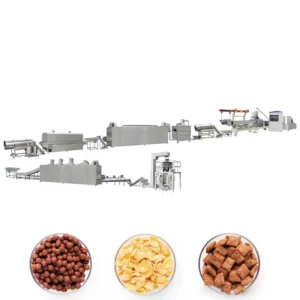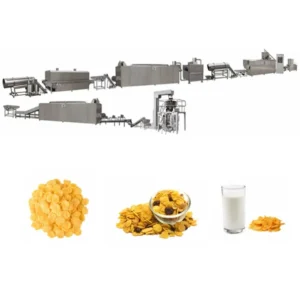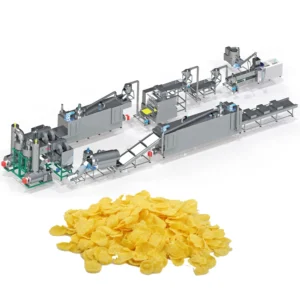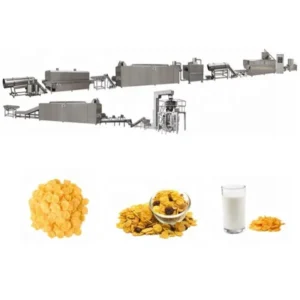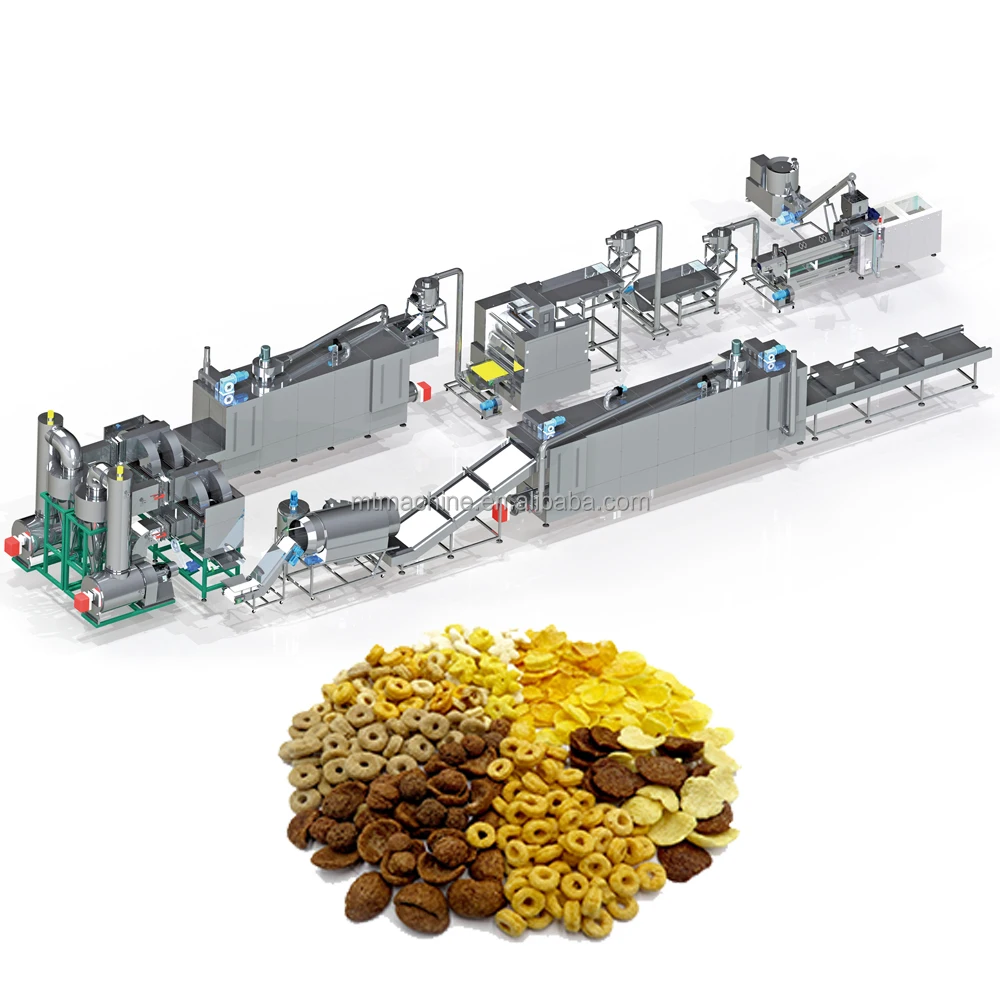


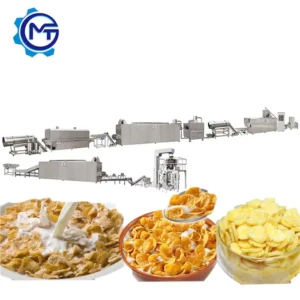
MT70 / MT85 / MT75 Corn Flakes Production Line, Twin-Screw Extrusion, PLC & MCC Control — complete turnkey layout from mixing through extruding, flaking, drying, roasting and coating, with throughput matched across every station to your target output.
- Screw configuration and die design specified to your grain blend and target flake density
- Hydraulic double-roller flaking with infrared temperature sensing for uniform thickness
- Hot air roasting oven with dual circulating fans and cyclone dust removal
Trial runs on your actual raw material are completed in our testing workshop before shipment, with full line layout and capacity calculation provided.
Description
Turnkey Line Integrity — Every station from mixing to packing is throughput-matched so the extruder output, dryer capacity, roaster residence time, and coating drum volume align with your specific grain blend and target flake density.
Technical Specifications
| Parameter | Value |
|---|---|
| Product Type | Corn Flakes Production Line |
| Models Available | MT70, MT85, MT75 |
| Extruder Type | Twin Screw |
| MT70 Installed Power | 160 kW |
| MT70 Power Consumption | 120 kW |
| MT70 Capacity | 150–200 kg/h (basis to be confirmed) |
| MT70 Overall Dimensions | 41 × 1.5 × 2.2 m |
| MT85 Installed Power | 190 kW |
| MT85 Power Consumption | 140 kW |
| MT85 Capacity | 300–400 kg/h (basis to be confirmed) |
| MT85 Overall Dimensions | 43 × 1.5 × 3.2 m |
| MT75 Installed Power | 210 kW |
| MT75 Power Consumption | 150 kW |
| MT75 Capacity | 300–500 kg/h (basis to be confirmed) |
| MT75 Overall Dimensions | 45 × 1.5 × 3.5 m |
| Control System | PLC with MCC available |
| Flaking Drive | Double motors with hydraulic roller system |
| Flaking Temperature Sensing | Infrared sensor |
| Dryer Heating Source | Gas or Electric (selectable) |
| Roasting Oven | Hot air with dual circulating fans and cyclone dust removal |
| Coating System | Double tumble sugar melter, elevator, coating drum with spraying nozzle |
| Raw Materials | Corn, rice, wheat, oat, barley powder |
| Production Procedure | Mixing → Extruding → Flaking → Drying → Hot Air Roasting → Sugar Spraying & Coating → Drying → Cooling → Packing |
| Final Product Shapes | Natural corn flakes, sugar-coated flakes, ball, tube, stick, ring, fruit loop, star, wheel, flower, heart |
| Certifications | CE (since 2014), ISO |
Application Suitability
| Application | Material or Output |
|---|---|
| Natural corn flakes for breakfast cereal retail | Corn grits or corn flour |
| Sugar-coated and honey-glazed corn flakes | Corn base with sugar or honey spray coating |
| Multi-grain breakfast flakes | Rice, wheat, oat, barley powder blends |
| Puffed cereal snacks in shaped formats | Corn or mixed grain flour with die changes |
| Institutional breakfast cereal supply | Corn or blended grain at commercial scale |
Why "Nominal Capacity" Can Mislead Your Commissioning Schedule
A corn flakes production line turnkey quoted on paper capacity often fails to hold that output once the buyer’s actual grain blend enters the hopper.
Capacity is only real when measured against your specific raw material moisture, starch content, and target flake thickness.
I remember a 2019 project in the Middle East where a client received a line rated for a certain hourly output, but their local corn flour ran higher in moisture than the supplier had assumed. The extruder could not achieve proper expansion, and the flaking rollers produced uneven sheets. The line ran at roughly sixty percent of the quoted figure for weeks while the supplier scrambled to reconfigure the screw profile remotely. That kind of delay costs more than the machine itself in lost market window and idle labor [NEED_CITE: common causes of extrusion line commissioning delays].
Screw Configuration and Die Design for Your Grain Profile
The twin-screw extruder at the heart of this line is not a generic build. The screw element arrangement — conveying, kneading, and reverse-flight sections — is specified after reviewing your grain type, protein level, and moisture content. Die geometry determines the pellet shape and size before flaking, which directly influences how evenly the rollers compress the material. A corn flakes production line turnkey that skips this step forces operators to chase thickness variation with manual roller gap adjustments all shift long.
Throughput Matching Across Every Station
An extruder running at full output means nothing if the dryer cannot remove enough moisture in the available residence time, or if the roasting oven lacks the air volume to blister the flake surface evenly. On this line, each station is calculated against the others. The dryer length, roaster pan speed, and coating drum volume are all derived from the extruder’s confirmed output on your material. This prevents the bottleneck pattern where one station sits idle while another chokes [NEED_CITE: throughput balancing in continuous food processing lines].
Reading the Power and Footprint Numbers
The MT70 draws 120 kW in operation across a 41-meter line footprint, while the MT75 pulls 150 kW over 45 meters. These figures reflect the cumulative load of the extruder main motor, flaking hydraulic system, dryer heating elements, roasting oven burners, and coating drum drives. The installed power is higher than consumption because start-up current and heater ramp-up create brief peaks. For your facility planning, the consumption figure matters for transformer sizing and running cost, while the installed figure determines cable cross-section and breaker rating. The infrared sensor on the flaking unit maintains even roller temperature so that flake thickness stays consistent from the first minute of a run to the last — without it, thermal drift across a long shift produces a mix of thin, brittle flakes and thick, doughy ones. The hot air roasting oven uses two separate circulating fans and a cyclone dust removal device to manage both heat distribution and the fine particulate that naturally sheds from toasted grain surfaces.
The Cost of Skipping Pre-Shipment Verification
When a line ships without a trial run on your actual raw material, every process variable becomes a question mark. The screw profile may be wrong for your starch gelatinisation temperature. The die opening may produce pellets too large for your target flake diameter. The dryer belt speed may need to be slower or faster than the factory default. Each of these discoveries on-site adds days to commissioning, and each day of delayed production is revenue lost in a market where breakfast cereal shelf space waits for no one [NEED_CITE: risk mitigation through factory acceptance testing in food machinery].
What Sets This Turnkey Approach Apart
Throughput is matched across every station — mixing, extruding, flaking, drying, roasting, coating, and packing — so no single vendor’s equipment becomes a bottleneck. The screw configuration and die design are specified to your raw material, not copied from a generic template. Every line goes through a trial run in the in-house testing workshop using your actual grain blend before it ships. The PLC and MCC control architecture is confirmed to your facility’s voltage, frequency, and operator language before the electrical cabinets are wired. Documentation covers the full engineering record, from line layout and capacity calculation through to wear parts lists, so your maintenance team is never guessing which screw element or die plate to reorder.
Documentation & Verification
- Line layout and capacity calculation matched to your target hourly output
- Trial run report on your specific grain blend conducted before shipment
- Screw and die configuration record written for your product, not a generic copy
- Electrical schematic with voltage, frequency, and PLC language confirmed
- CE declaration of conformity and ISO certificate included in the shipping package
- Wear parts list with reorder codes for screws, dies, and roller sleeves
Installation, Commissioning & Support
- Foundation plan provided based on the 41–45 m line length and station weights
- Power supply requirements confirmed for 120–150 kW consumption at your local voltage and frequency
- Equipment arrives in modular sections for staged assembly inside your facility
- First-run parameter setting includes extruder barrel temperature profile and roller gap calibration
- Operator training covers PLC interface navigation, screw element changes, and hydraulic roller adjustment
- Spare screw elements, die plates, and flaking roller sleeves supplied with initial shipment
What We Need to Move Your Project Forward
To prepare an accurate line configuration, share your target grain type and moisture range, the flake dimensions you need, and your daily production target in kilograms. Let us know your facility’s available floor length and ceiling height, plus the local voltage and frequency standard. If you have existing upstream mixers or downstream packing machines, tell us their throughput so we can match the new line to them. We can arrange a trial run on your raw material before you commit to the full order.
Frequently Asked Questions
Q: How is the line capacity verified on my specific raw material before shipment?
A: We run your actual grain blend through the extruder and flaking unit in our in-house testing workshop. The trial confirms expansion ratio, flake thickness, and achievable throughput under your material conditions. You receive a written trial run report with the results before the line ships.
Q: How do you ensure throughput is matched between the extruder, dryer, roaster, and coating stations?
A: Each station’s capacity is calculated from the extruder’s confirmed output on your material. Dryer belt length, roaster pan speed, and coating drum volume are all derived from that figure, so no single station creates a bottleneck during continuous production.
Q: What does the phased installation and commissioning schedule look like?
A: The line arrives in modular sections. Foundation work and utility connections are completed first, followed by mechanical assembly station by station. Electrical commissioning and PLC calibration come next, then wet runs with your raw material until the target flake specification is met consistently.
Q: How are voltage, frequency, and PLC language confirmed for my facility?
A: We request your site electrical specifications during the proposal stage. The electrical schematic is drawn to your voltage and frequency standard, and the PLC interface is loaded with your preferred operator language before the control cabinets leave the factory.
Q: What operator training and maintenance support is included?
A: On-site training covers PLC operation, screw element and die changes, hydraulic roller gap adjustment, and daily cleaning procedures. A wear parts list with reorder codes is provided, and ongoing technical support is available for process questions after commissioning.
Related products
-
Stainless Steel Honey Small Corn Flake Breakfast Cereal Flakes Maker Making Machine Production Plant
¥30,000.00 Add to cart -
Automatic Cornflakes Making Machine Corn Flakes Breakfast Cereals Processing Production Line
¥500.00 Select options This product has multiple variants. The options may be chosen on the product page -
Corn Flake Making Machine Corn Puffs Making Machine Snack Food Production Line
Price range: ¥500.00 through ¥1,200.00 Select options This product has multiple variants. The options may be chosen on the product page -
Automatic 500kg/h Corn Flakes Making Machine New Condition High Productivity Sweet Breakfast Cereal Processing Line From Factory
¥8,500.00 Select options This product has multiple variants. The options may be chosen on the product page