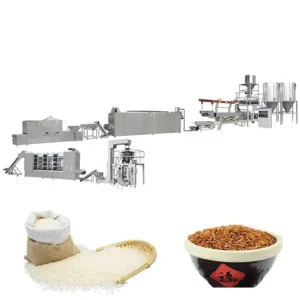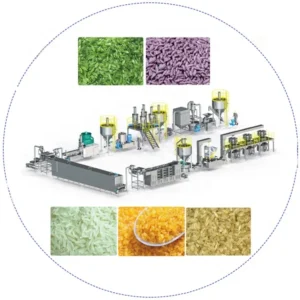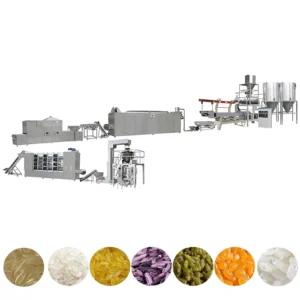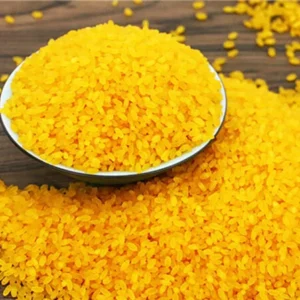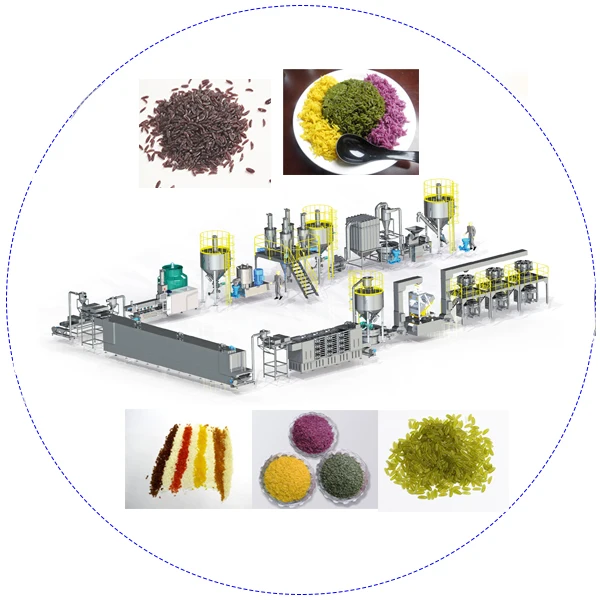
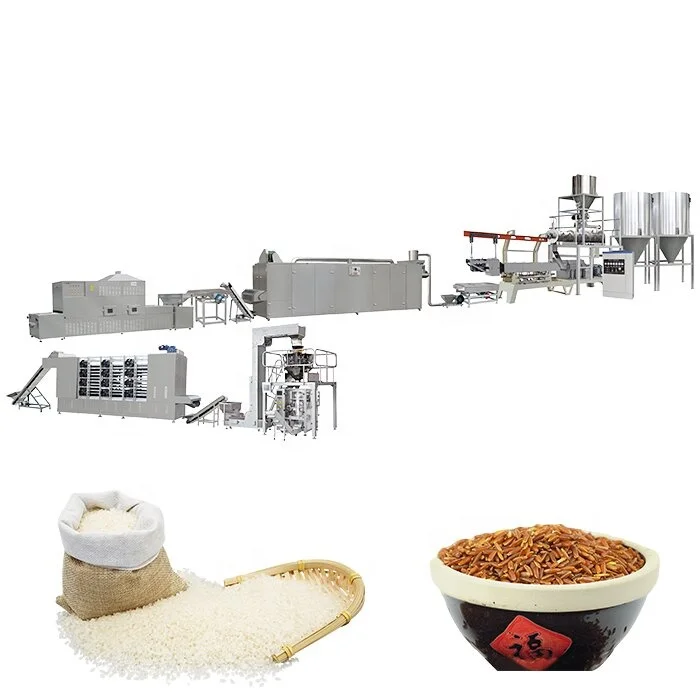
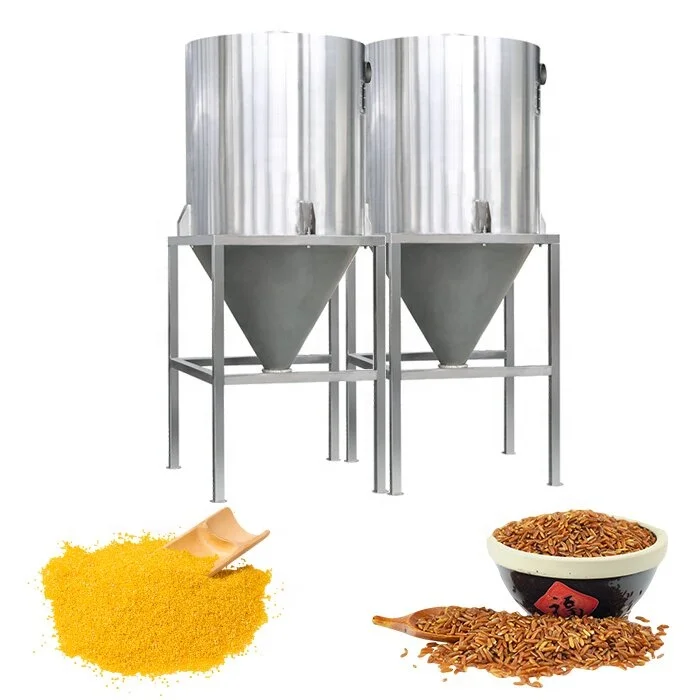
Fortified Artificial Rice Production Line, Twin-Screw Extrusion, 100–1000 kg/hr Capacity Range — designed for complete turnkey projects from batching to packing.
- Screw configuration and die design matched to your raw material blend and target kernel density
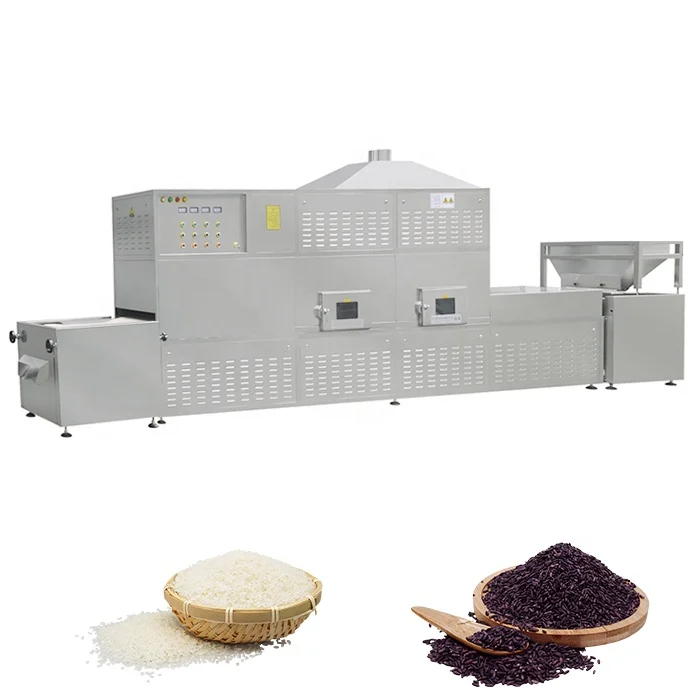
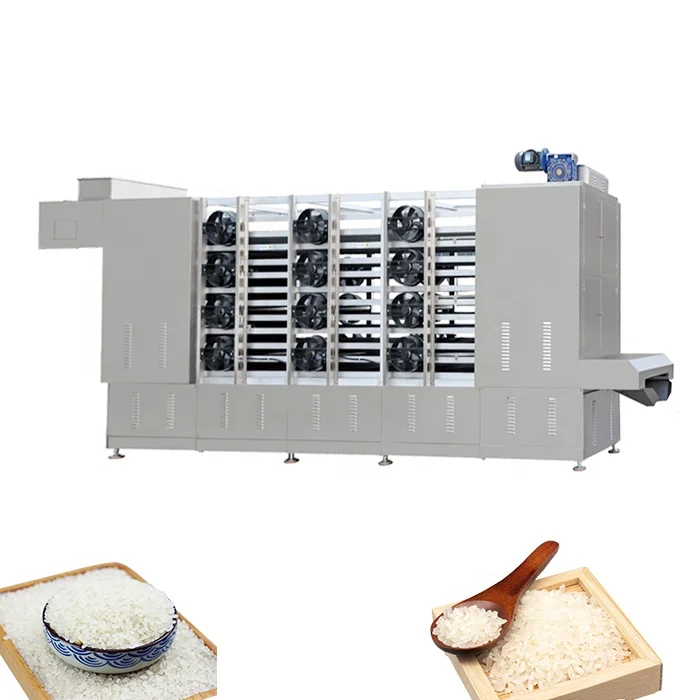
- Circulation drying oven with frequency-controlled mesh belt for consistent moisture reduction
- Five-model extruder range supports phased scale-up from pilot to full production
Backed by in-house trial runs on your formulation before shipment, throughput matching across every station, and full documentation from layout drawings to operator training manuals.
Description
Integrated line engineering — every station from batching to packing is specified against the buyer’s actual raw material formulation, preventing the throughput mismatches that stall commissioning on fortified artificial rice projects.
Technical Specifications
| Parameter | Value |
|---|---|
| Product Type | Fortified Artificial Rice Production Line |
| Extruder Screw Type | Twin-screw (single or double screw feeding options based on material) |
| Control System | Frequency speed control, automated |
| Extruder Models Available | MT65, MT70, MT75, MT85, MT95 |
| MT65 Installed Power | 85 kW |
| MT65 Power Consumption | 60 kW |
| MT65 Capacity | 80–100 kg/hr (basis not stated in source — confirm raw material formulation) |
| MT65 Overall Dimensions | 28 × 1.2 × 2.2 m |
| MT70 Installed Power | 120 kW |
| MT70 Power Consumption | 85 kW |
| MT70 Capacity | 100–120 kg/hr (basis not stated in source — confirm raw material formulation) |
| MT70 Overall Dimensions | 30 × 1.5 × 2.2 m |
| MT75 Installed Power | 180 kW |
| MT75 Power Consumption | 135 kW |
| MT75 Capacity | 300–500 kg/hr (basis not stated in source — confirm raw material formulation) |
| MT75 Overall Dimensions | 32 × 3.5 × 4.3 m |
| MT85 Installed Power | 235 kW |
| MT85 Power Consumption | 165 kW |
| MT85 Capacity | 200–300 kg/hr (basis not stated in source — confirm raw material formulation) |
| MT85 Overall Dimensions | 34 × 3.5 × 4.3 m |
| MT95 Installed Power | 260 kW |
| MT95 Power Consumption | 195 kW |
| MT95 Capacity | 800–1000 kg/hr (basis not stated in source — confirm raw material formulation) |
| MT95 Overall Dimensions | 36 × 3.5 × 4.3 m |
| Drying System | Circulation drying oven with mesh belt, electric or gas heating, frequency motor controlled belt speed |
| Screw Material | Wear-resistant alloy with special processing technology |
| Lubrication & Cooling | Automatic lubricating and cooling system |
| Voltage & Frequency | Customizable to local standard |
| Certification | CE |
Application Suitability
| Application | Material or Output |
|---|---|
| Fortified and artificial rice production | Broken rice, rice bran, corn, millet, wheat, oats, buckwheat, beans, starch base ingredients |
| Micronutrient-fortified rice kernels | Premix blends targeting nutritional supplementation programmes for government or NGO procurement |
| Instant rice and reconstituted rice products | Partially gelatinised starch matrices designed for rapid hot-water rehydration |
| Value-added utilisation of milling by-products | Broken rice and rice bran converted into shaped, fortified kernel products |
What a Nominal Capacity Figure Leaves Out on a Fortified Artificial Rice Line
A rated output is only meaningful when tied to the exact raw material blend, moisture content, and target kernel density you will actually run.
I have walked into facilities where the extruder nameplate promised a certain throughput, yet the line stalled because the buyer’s broken rice carried higher protein than the generic test formulation the seller used. Screw wear accelerated, density drifted outside the buyer’s specification, and downstream drying could not keep pace. On a fortified artificial rice production line turnkey project, the gap between brochure capacity and real throughput is where most budgets bleed [NEED_CITE: typical extruder capacity deviations when raw material formulation diverges from test benchmark]. That is why running the buyer’s own formulation through the testing workshop before the line ships is not a luxury — it is the only way to set screw configuration, die geometry, and dryer belt speed with any confidence.
Screw Configuration Matched to Starch and Protein Behaviour
A fortified artificial rice production line turnkey project succeeds or fails on how well the twin-screw profile handles the specific starch-to-protein ratio in the blend. Broken rice from different milling sources carries varying amylose content, which shifts gelatinisation temperature and expansion behaviour inside the barrel. The screw configuration and die design are therefore specified after the trial run, not copied from a generic build, so that kernel density and cooking behaviour match the market expectation the buyer must meet.
Throughput Balancing Across Every Station
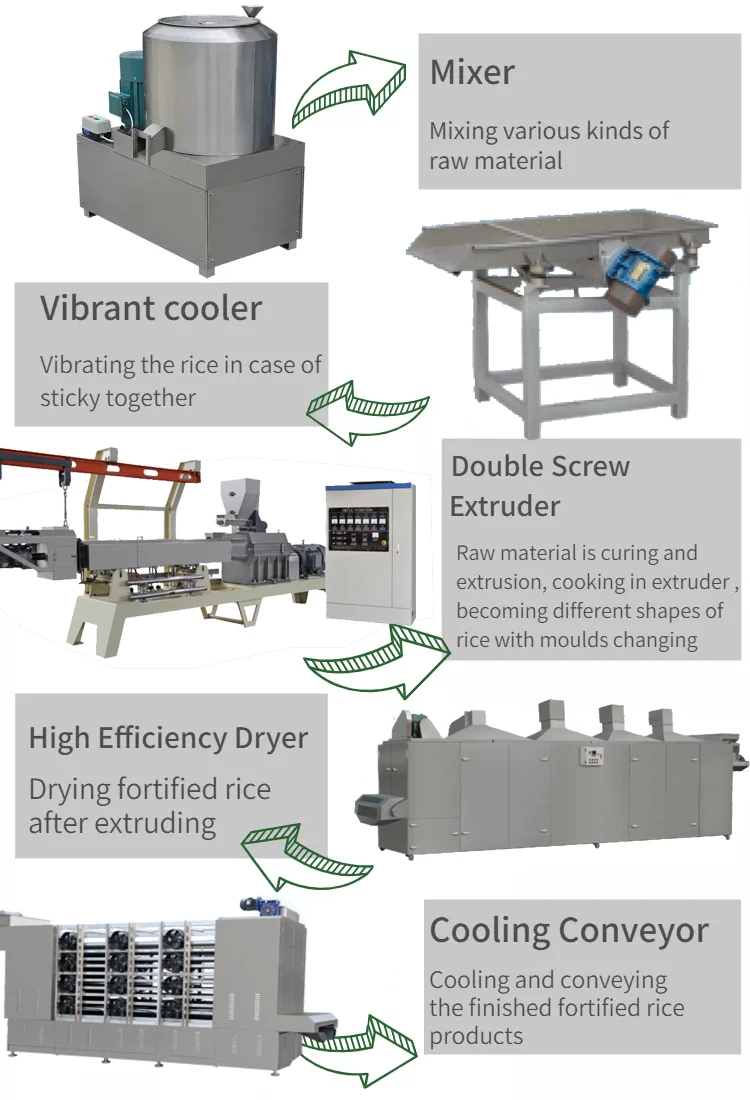
The extruder may hold a steady feed rate, but if the circulation drying oven cannot remove moisture fast enough, kernels crack or remain too soft for packing. Each station — mixing, extruding, vibrating, low-temperature drying, cooling, high-temperature roasting, final cooling, and packing — is calculated so that its maximum throughput aligns with the extruder output confirmed during the trial run. This prevents the bottleneck effect that forces operators to throttle the extruder and run below the line’s real capacity [NEED_CITE: throughput mismatch consequences in multi-station food extrusion lines].
Reading the Power and Dimension Data
Installed power on models from MT65 through MT95 spans a wide range, reflecting barrel length, screw diameter, and motor sizing. Power consumption figures sit noticeably lower than installed capacity because the extruder rarely draws peak load once the barrel reaches thermal equilibrium. Overall dimensions grow from a relatively compact footprint on the MT65 to a significantly larger envelope on the MT95, which affects workshop layout and utility routing. The circulation drying oven adds further length; buyers must confirm floor space and ceiling height before the layout drawing is finalised. Frequency-controlled motors on the dryer belt allow operators to fine-tune residence time without mechanical gear changes, keeping moisture reduction consistent across the kernel cross-section.
The Cost of Skipping the Trial Run
When a line ships without a prior trial on the buyer’s actual formulation, commissioning turns into product development. Screw elements that looked adequate on paper wear prematurely against abrasive bran fractions, forcing unplanned shutdowns while replacement parts are sourced. Die orifices sized for a generic blend produce kernels that either float when they should sink or shatter during drying. The buyer absorbs the cost of idle labour, wasted raw material, and delayed market entry — expenses that far outweigh the time spent running samples in the testing workshop beforehand [NEED_CITE: hidden commissioning costs in food extrusion turnkey projects].
Why Source the Entire Line From One Supplier
Every station on a fortified artificial rice production line turnkey project is engineered under a single scope, so throughput calculations, utility loads, and control logic are coordinated before fabrication begins. The in-house testing workshop validates screw configuration and die geometry on the buyer’s raw material, generating a trial run report that travels with the shipment. Wear parts lists are compiled from the exact screw and barrel assembly that ships, ensuring first replacements match. Voltage, frequency, and control language are confirmed against the buyer’s facility standard during the specification stage, not discovered as a mismatch during installation. Pre-sales consultation through on-site commissioning and operator training keeps one engineering team accountable from layout drawing to steady-state production.
Documentation & Verification
- Line layout and capacity calculation showing throughput matching between extruder, dryer, and packing stations
- Trial run report generated on the buyer’s raw material formulation in the testing workshop before shipment
- Screw and die configuration record specific to target kernel shape, density, and cooking behaviour
- Electrical schematic with voltage and frequency confirmed against facility standard, including control language
- CE declaration of conformity and ISO certificate covering the complete line scope
- Operation and maintenance manual with wear parts list and recommended replacement intervals
Installation, Commissioning & Support
- Foundation and floor space planning based on the selected extruder model dimensions and drying oven length
- Dedicated power circuit sized to the installed power of the chosen extruder and heating source for the dryer
- Phased mechanical assembly starting with the extruder, then drying and cooling stations, ending with packing integration
- First-run parameter setting using the trial run report as the baseline for screw speed, barrel temperature, and belt speed
- Operator training covering formulation adjustments, screw wear inspection, and automatic lubrication system checks
- Spare wear parts package including screw elements and die plates matched to the shipped configuration
What to Include With Your Inquiry
To move from a general concept to a workable line proposal, we need the raw material formulation you intend to run, including the proportion of broken rice, bran, starch, and any micronutrient premix. Share your target daily output and the kernel shape and density your market expects. Let us know the voltage, frequency, and control language at your facility, along with available workshop dimensions and ceiling height, so the layout drawing reflects real constraints.
Frequently Asked Questions
Q: How is line capacity verified on my specific raw material formulation rather than a generic benchmark?
A: We run your actual blend in the in-house testing workshop before the line ships. Screw speed, barrel temperature profile, and die geometry are adjusted until kernel density and expansion match your specification. The trial run report documents the achieved throughput under those conditions, forming the baseline for commissioning.
Q: What documentation accompanies the turnkey project from layout drawings through to operator training?
A: You receive a line layout with capacity calculations, machine specification sheets, screw and die configuration records, electrical schematics with confirmed voltage and frequency, a trial run report on your raw material, CE and ISO documentation, and operation manuals with wear parts lists and maintenance schedules.
Q: How is throughput matched between the extruder, drying oven, and downstream packing to prevent bottlenecks?
A: Each station is sized so its maximum throughput aligns with the extruder output confirmed during the trial run. The circulation drying oven belt speed is frequency-controlled to match residence time requirements, and packing speed is set to absorb the cooled output without accumulation or starvation.
Q: What is the phased installation and commissioning schedule for a complete fortified rice line?
A: Mechanical assembly proceeds from the extruder through drying and cooling stations to packing. Utility connections follow, then dry runs without material, then wet runs using the trial run parameters. Operator training runs in parallel, and steady-state production is verified before the engineering team leaves site.
Q: Can the screw configuration and die design be adjusted if I later add new formulations or change kernel specifications?
A: Yes. The screw elements are modular and the die plates are replaceable. We keep the configuration record on file, so when you introduce a new blend or kernel shape, we can recommend element changes and, if needed, run the new formulation in the testing workshop to validate the adjustment before you commit to production.
Related products
-

High Precision Automatic 500kg/h Baby Food Nutrition Powder Rice Extrusion Processing Line
¥8,238.27 Add to cart -
Industrial Instant Corn Paste Production Line Nutritional Powder Processing Equipment Meal Replacement Nutrition Powder Machine
¥65.00 Select options This product has multiple variants. The options may be chosen on the product page -
High Precision Automatic 500kg/h Baby Food Nutrition Powder Rice Extrusion Processing Line
¥9,500.00 Add to cart -

Automatic Instant Powder Production Line Nutritional Powder Extruder Machine
¥10,000.00 Select options This product has multiple variants. The options may be chosen on the product page