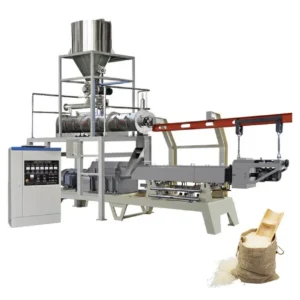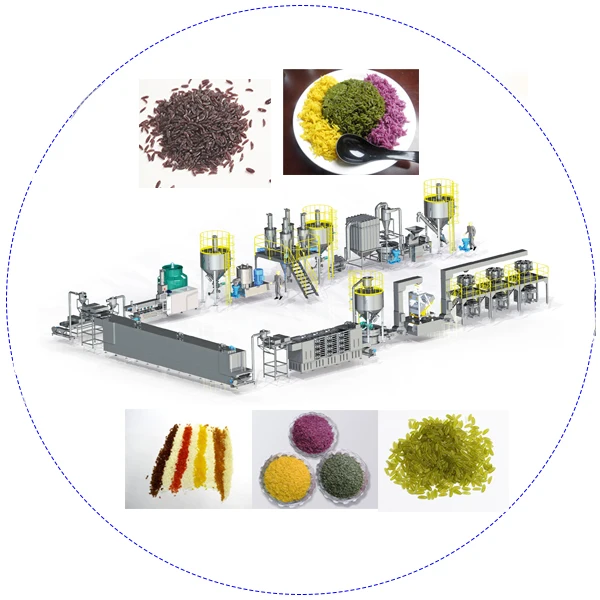


MT65, MT70, MT85, MT75, MT95 Twin Screw Extrusion Fortified Rice Processing Line — complete turnkey system from mixing to packing with PLC control and frequency speed regulation. Designed for artificial and fortified rice production, screw configuration and die geometry are specified to your grain blend and target kernel density, ensuring consistent expansion and moisture control through low-temperature drying and high-temperature roasting stages. Every station is throughput-matched under a single supplier to prevent bottlenecks, with electrical specifications and control language confirmed before production begins.
- CE certified turnkey line with trial runs conducted on your raw material before shipment
Description
Turnkey Line Engineering — Every station from batching through packing is throughput-matched under one supplier, eliminating the bottleneck gaps that form when extruders, dryers, and roasters are sourced separately.
Technical Specifications
| Parameter | Value |
|---|---|
| Product Type | Twin Screw Extrusion Fortified Rice Processing Line |
| Model Options | MT65, MT70, MT75, MT85, MT95 |
| Installed Power | MT65: 85 kW; MT70: 120 kW; MT75: 180 kW; MT85: 235 kW; MT95: 260 kW |
| Power Consumption | MT65: 60 kW; MT70: 85 kW; MT75: 135 kW; MT85: 165 kW; MT95: 195 kW |
| Output Capacity | MT65: 80–100 kg/h; MT70: 100–120 kg/h; MT75: 300–500 kg/h; MT85: 200–300 kg/h; MT95: 800–1000 kg/h (basis to be confirmed on actual raw material formulation and moisture) |
| Overall Dimensions (L×W×H) | MT65: 28×1.2×2.2 m; MT70: 30×1.5×2.2 m; MT75: 32×3.5×4.3 m; MT85: 34×3.5×4.3 m; MT95: 36×3.5×4.3 m |
| Screw Type | Twin-screw |
| Extruder System Components | Feeding system, extruding system, cutting system, heating system, gearing system, controlling system |
| Speed Control | Frequency speed controlling (inverter) |
| Lubrication | Automatic lubricating and cooling system |
| Feeding System | Single or double screw feeding, selectable by material |
| Barrel and Screw Material | Wear-resistant construction |
| Line Stations | Mixing → Extruding → Vibrating → Low temperature drying → Cooling → High temperature roasting → Cooling → Packing |
| Drying Oven Heating Source | Electric or gas |
| Drying Oven Feature | Circulation drying process, frequency motor controlled mesh belt speed |
| Control System | PLC and MCC |
| Assembly State | Complete turnkey line |
| Standards | CE, ISO |
Application Suitability
| Application | Material or Output |
|---|---|
| Nutritional food programmes | Vitamin and mineral-enriched rice kernels from broken rice or rice flour blends |
| Fortified rice manufacturing | Artificial rice kernels from corn, millet, wheat, oats, and buckwheat with added micronutrients |
| Rice processor value addition | Nutritional rice products converted from broken rice and rice bran streams |
| Grain and starch processing | Custom-formulation artificial rice using bean, starch, and multi-grain blends |
Why the Quoted Capacity May Not Match Your Workshop Floor
A rated kg/h figure means nothing until it is validated on your actual grain blend at your target moisture level.
I spent two weeks in an Iraqi plant reconfiguring a screw set because the trial had been done on standard rice flour, but the customer was running 30% chickpea flour in the mix. Viscosity climbed, the extrusion chamber choked, and the whole line rhythm collapsed. The machine was fine — the configuration was wrong for that recipe. [NEED_CITE: effect of legume flour ratio on extrusion viscosity and die pressure] When buyers evaluate a fortified rice processing line turnkey, the first question should not be the headline output number but the exact formulation and moisture content behind it. A line that runs smoothly on pure rice flour can behave entirely differently when bean starch or oat bran enters the barrel.
Screw Configuration Dictates Kernel Density and Shape
A fortified rice processing line turnkey succeeds or fails inside the extrusion barrel. The twin-screw arrangement allows operators to rearrange screw elements and adjust the die profile so that the shear, residence time, and pressure match the specific grain formulation. A rice-and-corn blend demands a different screw pitch and compression ratio than a blend heavy in buckwheat or oat flour. Getting this right before the line ships means the kernels exit the die with the correct expansion, surface texture, and cooking behaviour the market expects.
Drying and Roasting Determine Final Moisture Uniformity
After extrusion and cutting, the kernels pass through a low-temperature drying stage, then cooling, and finally a high-temperature roasting stage with a second cooling pass. The circulation drying oven uses a frequency-controlled mesh belt so that exposure time can be adjusted to the kernel size and initial moisture leaving the extruder. This two-stage thermal sequence prevents case-hardening — where the outer shell dries too fast and traps moisture inside — which would cause cracking during storage or uneven cooking at the consumer level. [NEED_CITE: two-stage drying protocol for extruded grain kernels]
Reading the Specs: What Power, Dimensions, and Control Mean in Practice
Installed power ranges from 85 kW on the MT65 to 260 kW on the MT95, with actual consumption lower across all models. That gap between installed and consumed power reflects the thermal load profile: the extruder barrel heaters, dryer, and roasting oven cycle on and off depending on set-point temperatures and ambient conditions, so a facility’s electrical supply must handle peak draw without voltage sag. Overall line length extends from 28 m to 36 m depending on the model, with the larger models requiring 3.5 m width and over 4 m ceiling clearance to accommodate the roasting oven and cooling conveyors. Frequency-controlled inverters on both the extruder screw and the dryer belt motor allow operators to fine-tune throughput without mechanical gear changes, keeping kernel geometry consistent across shifts. The automatic lubrication and cooling system reduces the risk of bearing overheating during continuous production runs, which matters when the line is scheduled for back-to-back batches.
What Happens When Stations Are Sourced Separately
Piecing together an extruder from one vendor, a dryer from another, and a roasting oven from a third often leads to throughput mismatches. The extruder may push kernels faster than the dryer can reduce their moisture, creating a backlog that forces the cutting system to slow down. [NEED_CITE: throughput bottleneck between extrusion and drying stages in grain processing] Kernel density drifts upward when residence time in the dryer is too short, and the final product fails the cooking test. A single-supplier fortified rice processing line turnkey eliminates this by calculating belt speed, oven length, and thermal capacity against the extruder’s actual output on the buyer’s formulation.
Why Procurement Here Differs from Assembling Vendors
Every station — mixing, extruding, vibrating, drying, roasting, cooling, and packing — is specified under one engineering team, so throughput calculations start from the extruder output and propagate downstream. Screw configuration and die design are matched to the buyer’s raw material and target kernel specification rather than copied from a generic build. An in-house testing workshop runs the buyer’s actual grain formulation before the line ships, generating a trial run report that confirms kernel shape, density, and moisture behaviour. Electrical schematics, voltage and frequency settings, and control language are confirmed before production begins, preventing commissioning delays at the installation site. On-site installation includes operator training and a documented wear parts list so that the first screw and die replacement can be planned before it becomes urgent.
Documentation & Verification
- Line layout and capacity calculation showing throughput matching across all stations
- Trial run report generated on your specific grain formulation before shipment
- Screw and die configuration record detailing the exact element arrangement for your blend
- Electrical schematic with confirmed voltage, frequency, and control language
- CE declaration of conformity and ISO certificate for import clearance
- Operation and maintenance manual with wear parts list and replacement intervals
Installation, Commissioning & Support
- Foundation must support the full line length up to 36 m with level tolerance for the drying oven mesh belt
- Dedicated power circuit sized for the model’s installed power, up to 260 kW peak on the MT95
- Line arrives in sectioned modules; extruder barrel and screw assemblies require on-site alignment
- First-run commissioning includes screw speed, barrel temperature profile, and belt frequency calibration
- Operator training covers PLC interface navigation, frequency inverter adjustment, and automatic lubrication monitoring
- Wear parts list specifies screw elements, die plates, and cutting blades with lead times for re-order
What to Include in Your Inquiry
Share the exact grain formulation — broken rice percentage, supplementary flours, vitamin and mineral premix ratios — along with the target kernel dimensions and cooking characteristics your market requires. Specify your facility’s available floor length and ceiling height, the local voltage and frequency standard, and the preferred control language for the PLC interface. If you already operate upstream milling or downstream packing equipment, provide their throughput rates so the line can be matched end to end. Indicate whether you want a trial run on your raw material at our testing workshop before the line ships.
Frequently Asked Questions
Q: How is line capacity verified against our actual raw material formulation?
A: The quoted output is based on a reference formulation. We request your exact grain blend, moisture level, and premix ratios, then calculate throughput station by station. The capacity calculation document we provide shows the basis — formulation, moisture, and kernel size — behind every kg/h figure.
Q: Can a trial run be conducted on our specific fortified rice formulation before shipment?
A: Yes. Our in-house testing workshop runs your actual raw material through the extruder and dryer configuration specified for your line. The trial run report documents kernel shape, density, moisture content, and any screw or die adjustments made, so you see production results before the equipment leaves the factory.
Q: How is throughput matched between the extruder, dryer, and roasting oven?
A: We start from the extruder’s verified output on your formulation, then size the drying oven belt length, roasting oven residence time, and cooling conveyor speed to handle that volume. Each station’s capacity is documented in the line layout so no section becomes a bottleneck.
Q: What voltage, frequency, and control language options are confirmed before production?
A: We confirm your facility’s voltage and frequency standard, the preferred PLC interface language, and the electrical schematic before production begins. This prevents rewiring and reprogramming delays during on-site commissioning.
Q: How is the screw and die configuration tailored to our grain blend and target kernel density?
A: Screw elements are selected and arranged based on the starch, protein, and fibre content of your blend, which determines the required shear and compression. The die profile is designed to produce the kernel cross-section and expansion ratio your market expects. The exact configuration is recorded and supplied with the line.
Related products
-
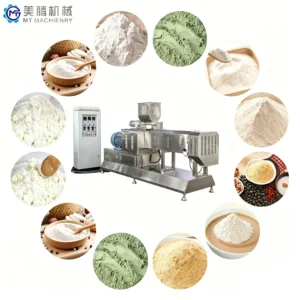
150-500kg/h Twin Screw Extruder Baby Rice Flour Making Machine
¥9,500.00 Select options This product has multiple variants. The options may be chosen on the product page -
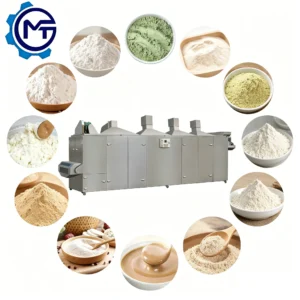
Small Scale MT Brand Automatic Baby Food Nutrition Powder Rice Flour Making Machine with 500kg/h Production Capacity PLC Control
¥9,500.00 Add to cart -
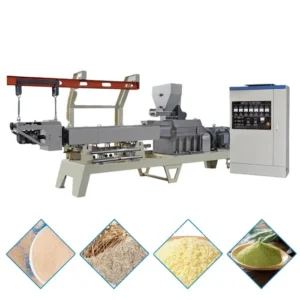
Industrial Instant Corn Paste Production Line Nutritional Powder Processing Equipment Meal Replacement Nutrition Powder Machine
¥65.00 Select options This product has multiple variants. The options may be chosen on the product page -

Full Automatic Complete Baby Food Nutrition Powder Porridge Processing Production Line for Infant Nutrition Factory
¥9,500.00 Add to cart