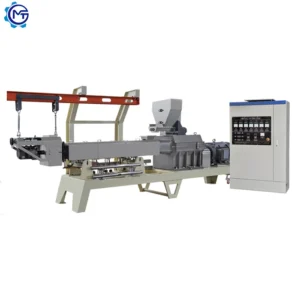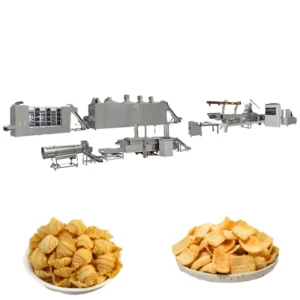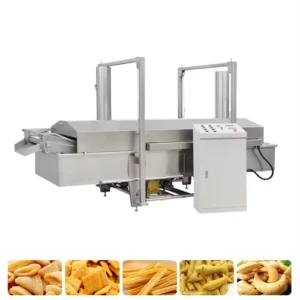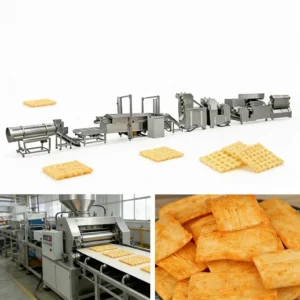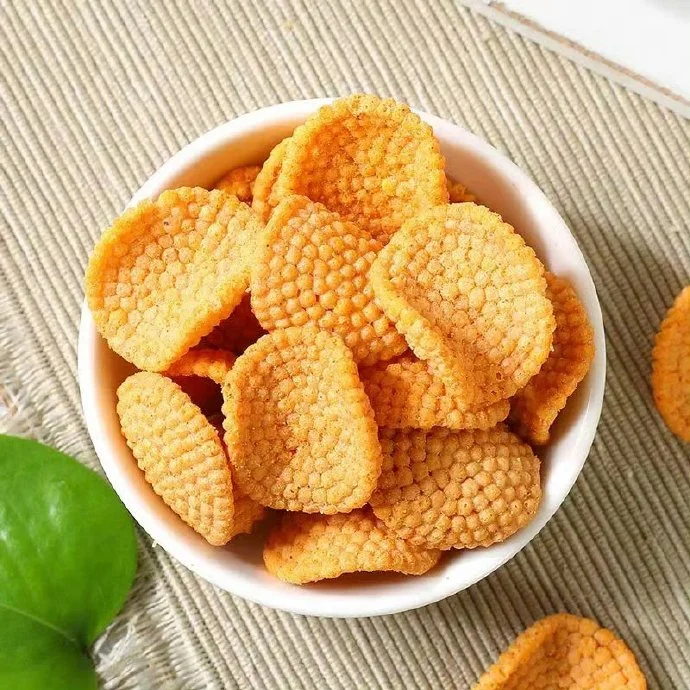


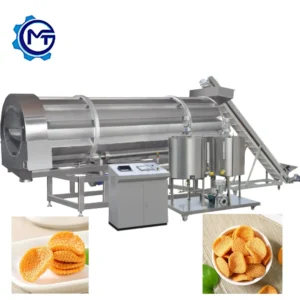
Fried Puffed Snack Production Line, 380V/50Hz, PLC Touch Screen Control — engineered as a complete turnkey project from extrusion through frying, de-oiling, flavouring and packing.
- Double-layer mesh belt fryer with stepless speed regulation and 60 kW heating capacity ensures precise frying control
- Continuous oil filtration system with 320 L reservoir maintains oil quality throughout production runs
- Food-grade 304 stainless steel construction with automatic lifting hood for rapid cleaning access
Every station is throughput-matched during layout design, with screw and die configuration specified to your raw material before trial runs in our testing workshop.
Description
Throughput-Matched Line Design — Every station from extrusion through frying to packing is calculated against the buyer’s actual raw material and target output format, not quoted on a generic nameplate figure.
Technical Specifications
| Parameter | Value |
|---|---|
| Product Type | Fried Puffed Snack Production Line |
| Rated Power (Main Drive / Conveyor) | 2.6 kW |
| Frying Unit Heating Tube Power | 60 kW |
| Voltage & Frequency | 380V / 50Hz (configurable for target market) |
| Control System | PLC with touch screen panel |
| Overall Dimensions — Fryer Section (L×W×H) | 6700 × 2200 × 1200 mm (full line layout provided after project confirmation) |
| Net Weight — Fryer Section | 2000 kg (full line weight depends on station configuration) |
| Output Capacity | 100–1000 kg/h (basis not stated in source — confirm raw material, moisture, product format) |
| Frying Oil Capacity | 320 L |
| Heating Method | Electric heating or gas heating (dual option) |
| Frying Belt Type | Upper and lower double-layer mesh belt, frequency conversion stepless speed regulation |
| Oil Filtration | Continuous oil circulation filtration system |
| Lifting System | Automatic lifting for upper hood and mesh belt |
| Slag Discharge | Bottom slag discharge system |
| Material | Food-grade 304 stainless steel |
| Warranty | 1 year (core components: 1 year) |
Application Suitability
| Application | Material or Output |
|---|---|
| Fried corn chip production | Corn grits, maize flour, and corn-based dough formulations |
| Bugles-type puff snack processing | Corn meal and starch blends formed into conical shapes before frying |
| Fried maize snack formats | Pellet or extruded半成品 in various geometries requiring continuous frying |
| Commercial snack food factory lines | Multi-format fried puffed snacks for packaged retail distribution |
| Small-batch specialty snack shops | Shorter runs of fried extruded products with recipe flexibility |
Why the Line Stops When One Station Runs Faster Than the Rest
A fryer rated at higher capacity than the extruder upstream will sit idle for minutes every cycle; a fryer rated lower will force the entire extrusion section to throttle down.
In my years laying out fried snack lines, I watched a Middle East client commission a corn chip line where the extruder ran well on its own, but the fryer belt speed and the downstream de-oiling conveyor were never reconciled. Semi-fried product piled up on the transfer section, absorbed ambient moisture, and lost the texture the market expected. Two days of on-site re-tuning followed before the line held steady [NEED_CITE: throughput synchronization across sequential food processing stations]. The fried puff snack production line turnkey approach avoids this by calculating every station’s real throughput against your specific dough formulation and target product geometry — not against a catalog figure that assumes ideal conditions.
Throughput Matching Across the Full Fried Snack Line
When a buyer requests a fried puff snack production line turnkey, the question is never just "how fast can the fryer run." The extruder’s output in kg/h at a given moisture content sets the ceiling. The forming station must shape that output without creating a queue. The fryer belt, with its stepless frequency-controlled speed, must hold each piece in oil long enough to reach the target moisture reduction without scorching the outer layer. Then the de-oiling section, the flavouring drum, and the packing weigh-scale each need their own cycle time verified against the station before it.
What Happens When Oil Temperature and Belt Speed Drift Apart
A continuous fryer with 60 kW of heating capacity and a 320 L oil reservoir can maintain temperature only if the product load entering per minute stays within the design envelope. Push more mass in than the thermal recovery rate allows, and oil temperature drops — pieces emerge under-fried, oil-soaked, and shelf life shortens. Run the belt too slow and throughput collapses. The PLC touch screen panel lets the operator log the belt speed and oil temperature together, so the relationship is repeatable across shifts and product changeovers [NEED_CITE: continuous frying thermal recovery rate versus product mass flow].
Reading the Fryer Specs Against Your Actual Product
The double-layer mesh belt with frequency conversion stepless speed regulation means frying time is adjustable without mechanical gear changes — important when the same line may run thin corn chips one shift and thicker Bugles-type cones the next. The 320 L oil volume provides thermal mass to buffer short load variations, but sustained output depends on the heating method selected: electric heating recovers differently than gas heating under continuous load. The automatic lifting system for the upper hood and mesh belt matters during cleaning cycles — residue buildup on the belt changes oil flow patterns and creates uneven colour on the product. The continuous oil circulation filtration system removes fines before they carbonize and darken the oil, extending usable oil life and keeping product appearance consistent through a full production run.
The Cost of Ignoring Station-to-Station Handoff
I have seen snack lines where the extruder and fryer were sourced from different suppliers, each quoting their own capacity independently. The result was a transfer section that acted as a bottleneck — product cooled, surface moisture condensed, and the fryer had to run hotter to compensate, burning more energy and degrading oil quality faster. On another project, the downstream flavouring drum was sized for a throughput the fryer could never sustain, so seasoning tumbled with insufficient product and coating uniformity suffered [NEED_CITE: consequences of mismatched station capacity in food processing lines]. These are not visible on a spec sheet until the line is running your actual raw material.
Why Source the Full Line From One Engineering Point
A fried puff snack production line turnkey project under one supplier means the extruder screw configuration is specified to your corn or maize formulation before the fryer belt speed is set. The line layout document shows throughput at each station, calculated rather than assumed. The in-house testing workshop runs your actual raw material before shipment, so the trial run report captures real behaviour — not theoretical output. Electrical schematics confirm voltage, frequency, and PLC language for the destination market before the panel is built. On-site installation follows a phased schedule so that utility connections, belt tensioning, and oil filling happen in sequence rather than overlapping and delaying commissioning. Operator training covers the relationship between extruder feed rate and fryer oil recovery, not just button sequences.
Documentation & Verification
- Line layout with throughput calculated at each station for your raw material and target product
- Trial run report recorded on your actual corn or maize formulation before dispatch
- Screw and die configuration record matched to target puff geometry and post-fry texture
- Electrical schematic with voltage, frequency, and PLC screen language confirmed to destination market
- Factory test record documenting fryer oil temperature recovery and belt speed under load
- CE declaration of conformity covering machinery directive requirements for the complete line
Installation, Commissioning & Support
- Floor plan showing fryer section footprint of 6700 × 2200 mm plus upstream and downstream station spacing
- Dedicated electrical circuit sized for 60 kW fryer heating load plus 2.6 kW drive and conveyor motors
- Fryer arrives with hood lowered; lifting system used on-site to install mesh belt and fill 320 L oil reservoir
- PLC touch screen commissioning includes setting belt speed profiles for each product format in your range
- Operator training covers oil filtration system maintenance intervals and bottom slag discharge procedures
- Wear parts list for mesh belt sections, heating elements, and extruder screw segments provided at handover
What We Need to Scope Your Line Correctly
To configure a fried puff snack production line turnkey for your facility, share your raw material type and formulation — corn grits, maize flour, or a blend — along with the target product geometry and post-fry moisture specification. We also need your local voltage and frequency, preferred PLC language, workshop length and ceiling height, and whether you have existing upstream mixing or downstream packing equipment that the new line must integrate with.
Frequently Asked Questions
Q: How is real line capacity verified against my raw material and target product format?
A: Before shipment, your raw material runs through the extruder and fryer in our testing workshop. The trial run report records actual throughput, oil temperature behaviour, and product texture at different belt speeds. Capacity is confirmed on your formulation, not on a generic catalog figure.
Q: What is the full station list from batching through packing, and how is throughput matched?
A: The line typically includes batching, mixing, extrusion, forming, frying, de-oiling, flavouring, cooling, and packing. Each station’s cycle time is calculated against the station before it, and the line layout document shows matched throughput at every point.
Q: Can voltage, frequency, and PLC language be configured for my target market?
A: Yes. Electrical schematics are confirmed to your destination voltage and frequency before the control panel is built. PLC touch screen language is set to your operator’s preference, and the documentation package reflects these settings at delivery.
Q: What is the phased installation and commissioning schedule for a complete line?
A: Installation follows a sequence: utility connections first, then mechanical assembly of each station, oil filling and belt tensioning, PLC parameter loading, and finally a full-line production run. Commissioning is scheduled in phases so each station is validated before the next is brought online.
Q: What operator training and ongoing maintenance support is included after commissioning?
A: Training covers the relationship between extruder feed rate and fryer oil temperature recovery, belt speed adjustment for different products, oil filtration maintenance, and slag discharge routines. A wear parts list with recommended replacement intervals for mesh belts, heating elements, and screw segments is provided at handover.
Related products
-
Fried Bugles Chips Production Line Fried Doritos Tortilla Snack Food Extruder
¥100.00 Select options This product has multiple variants. The options may be chosen on the product page -
Doritos Chips Making Extruder Fried Corn Bugles Crispy Chips Process Machine Frying Salad Sticks Pellet Snacks Production Line
¥100.00 Select options This product has multiple variants. The options may be chosen on the product page -
Fried Puffs Snack Food Making Machine Whole Line Solution Design by Factory Price Crispy Snack Machine
¥20.00 Select options This product has multiple variants. The options may be chosen on the product page -
Automatic Rice Crust Chips Making Machine Bugles Pizza Rolls Fried Snack Food Processing Line Machine
¥8,570.00 Select options This product has multiple variants. The options may be chosen on the product page