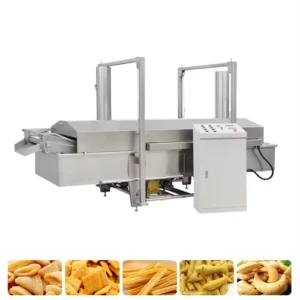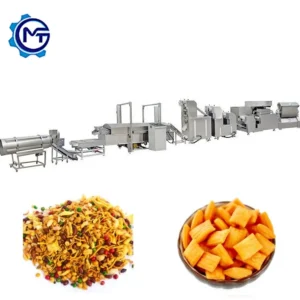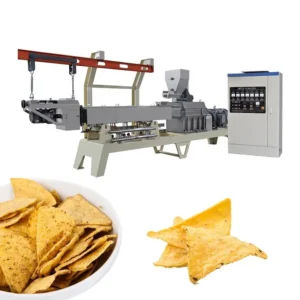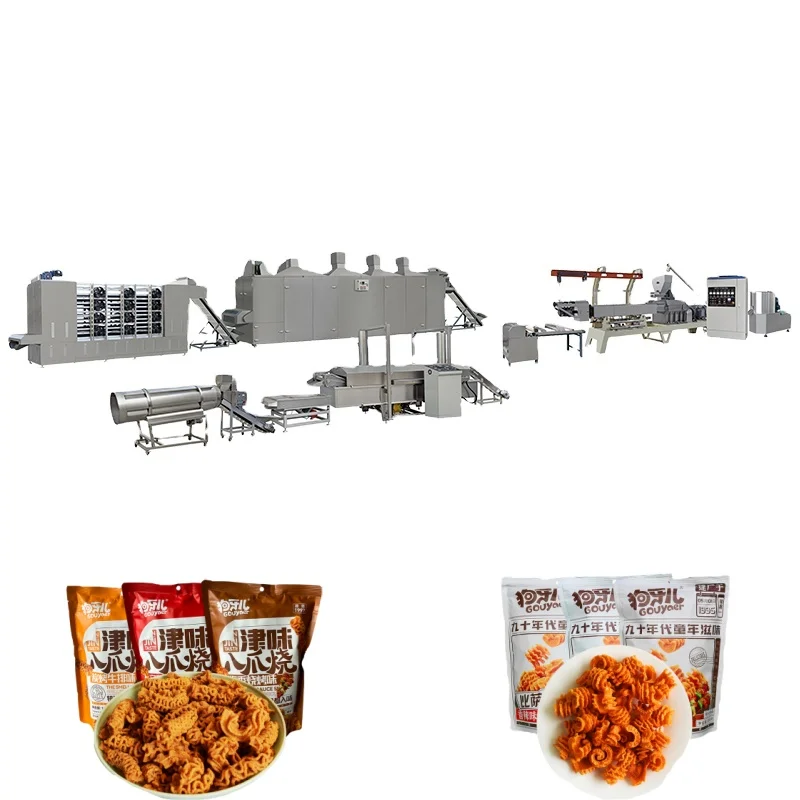


Twin Screw Extruded Fried Snack Production Line, 100–280kW, CE — engineered as a complete turnkey project with throughput balanced across every station from mixing through extrusion, cutting, frying, de-oiling, and flavouring to packing. Screw configuration and die design specified to buyer’s raw material formulation and target pellet density, with in-house trial runs on customer material before shipment to validate product texture.
- Interchangeable die system supports bugles, corn chips, tubes, and pillow formats on one line
- Voltage and frequency confirmed pre-production to match site supply and avoid commissioning delays
- Single-supplier delivery with line layout documentation, electrical schematics, and on-site installation support
Description
Integrated throughput engineering — Every station from mixer to fryer is calculated against the extruder output so no single machine bottlenecks the fried extruded chips production line turnkey project.
Technical Specifications
| Parameter | Value |
|---|---|
| Product Type | Twin Screw Extruded Fried Snack Production Line |
| Extruder Models Available | MT-65 / MT-70 / MT-85 / MT-75 / MT-95 |
| Main Motor (MT-65) | 100 kW |
| Main Motor (MT-70) | 130 kW |
| Main Motor (MT-85) | 180 kW |
| Main Motor (MT-75) | 185 kW |
| Main Motor (MT-95) | 280 kW |
| Output Capacity (MT-65) | 120–150 kg/h (basis to be confirmed) |
| Output Capacity (MT-70) | 200–250 kg/h (basis to be confirmed) |
| Output Capacity (MT-85) | 300–500 kg/h (basis to be confirmed) |
| Output Capacity (MT-75) | 400–500 kg/h (basis to be confirmed) |
| Output Capacity (MT-95) | 800–1000 kg/h (basis to be confirmed) |
| Screw Type | Co-rotating twin screw with sectional modules |
| Drying Method | Gas / Electric / Diesel heating options |
| Mixer Power Options | 4 kW / 7.5 kW / 15 kW (matched to line model) |
| Cutting Machine Power | 1.47 kW |
| Fryer Belt Width | 600 mm stainless steel belt |
| Fryer Energy Options | Electricity / Fuel gas |
| Voltage & Frequency | Customizable per site supply (3ph 380V 50Hz, 3ph 415V 60Hz, 3ph 220V 60Hz) |
| Die Configuration | Interchangeable dies for bugles, sticks, square sheet, rib chips, diamond chips, wavy chips, pillow, shell, screw, round tube, wave shapes |
| Key Features | Complete line from mixing to packing; PLC and MCC control available; CE certified; ISO certified |
Application Suitability
| Application | Material or Output |
|---|---|
| Corn chip and Doritos-style chip production | Corn flour and corn starch blends |
| Bugles and hollow tube snacks | Wheat flour and corn flour mixtures |
| Pellet-based fried snacks | Potato starch and potato powder formulations |
| Pillow and shell-shaped fried snacks | Rice flour and wheat flour combinations |
| Wavy and diamond chip formats | Multi-grain flour blends for savory snack lines |
What Nominal Capacity Numbers Never Tell You About Your Snack Line
Real output depends on your raw material formulation, not the brochure figure.
When I first started laying out snack extrusion projects in Shandong, I watched a client commission a line rated for a certain hourly tonnage — only to discover their corn flour particle size was coarser than the trial material. The extruder ran fine mechanically, but the product came out under-expanded and the actual throughput dropped significantly. Two weeks of screw reconfiguration in our testing workshop later, the line finally matched the intended pace. That fried extruded chips production line turnkey taught us that every capacity number carries an invisible footnote about moisture content, starch ratio, and grind size. Without confirming those variables on your actual material, you are essentially purchasing a promise. [NEED_CITE: typical moisture content ranges for extruded corn snack formulations]
Screw Modules That Respond to Your Flour Blend
Twin-screw extrusion gives you sectional screw elements that can be rearranged along the barrel. For a fried extruded chips production line turnkey, this matters because corn flour behaves differently from wheat flour under shear — corn starch gelatinises at a different temperature and moisture threshold. We reconfigure the conveying, kneading, and reverse-screw elements based on trial runs with your specific blend, rather than shipping a generic screw profile that assumes a one-size-fits-all recipe.
Die Geometry and the Expansion You Actually Need
The die opening shape and length-to-diameter ratio determine how the dough expands the instant it exits the barrel. Bugles require a thin-wall annular die that allows rapid steam release, while a pillow chip needs a wider slit that holds moisture longer for a controlled puff. On a fried extruded chips production line turnkey, swapping dies is a routine changeover — but only if the upstream extrusion pressure and barrel temperature profile have been set with that specific die in mind. [NEED_CITE: relationship between die land length and extrudate expansion in twin-screw processing]
Reading Between the Spec Sheet Lines
The main motor ratings across the model range span from 100 kW on the MT-65 to 280 kW on the MT-95, but motor power alone does not predict your finished snack output. What matters is how that power translates into specific mechanical energy — the actual work done per kilogram of dough passing through the barrel. A higher motor rating on the MT-85 or MT-75 supports greater throughput only when the screw speed, feed rate, and barrel temperature zones are calibrated together. The mixer power options of 4 kW, 7.5 kW, and 15 kW exist because different line scales require matched blending capacity — an undersized mixer forces the extruder to run on inconsistent feed, which introduces density variation in the final fried chip. The fryer belt width of 600 mm in stainless steel must carry the full extruder output at a speed that achieves the target oil residence time; if the belt runs too fast, chips pass through under-cooked, and if it runs too slow, the extruder backs up.
When Stations Are Sized in Isolation
A common failure mode we see is a buyer specifying the extruder capacity first, then sourcing a fryer and dryer separately. The fryer might handle the stated kilogram-per-hour figure on paper, but if it cannot maintain oil temperature recovery when cold product enters continuously, the chips absorb excess oil and exit the line inconsistent in colour and texture. The de-oiling station then cannot compensate, and the flavouring drum receives product that is already outside specification. On a turnkey project, this kind of mismatch surfaces only during commissioning — the most expensive moment to discover it. [NEED_CITE: thermal load calculations for continuous industrial fryers in snack food plants]
Why a Turnkey Snack Line Project Succeeds Here
Throughput matching across every station means the mixer, extruder, cutter, fryer, de-oiling unit, and flavouring drum are all calculated against one shared output target before fabrication starts, not assembled from independent vendors who each quote their own maximum. Screw configuration and die design are documented against your raw material sample — you receive the configuration record, not a generic screw set. Our in-house testing workshop runs your actual corn flour, wheat flour, or potato starch blend before the line ships, so product development happens in Shandong instead of on your factory floor. Voltage and frequency are confirmed against your site supply before production begins, eliminating the commissioning delays we have seen when a 50 Hz machine arrives at a 60 Hz facility. The complete line carries CE and ISO certification, with full electrical schematics and customs documentation prepared as part of the project package.
Documentation & Verification
- Line layout drawing with throughput calculation for every station on your fried snack line
- Screw and die configuration record matched to your flour blend trial results
- Factory test report on your raw material before dispatch from Jinan
- Electrical schematic and voltage confirmation sheet issued before production begins
- CE declaration of conformity and ISO certificate included in shipment documentation
Installation, Commissioning & Support
- Foundation plan referencing overall line dimensions and floor loading for your extruder model selection
- Power distribution diagram specifying dedicated circuits for main motors up to 280 kW
- Assembly sequence from sectional delivery through station alignment and belt tensioning
- First-run parameter log capturing barrel temperatures, screw speed, and fryer oil settings
- Operator training on die changeover and screw module replacement procedures
- Wear parts list with reorder intervals for screw elements, dies, and fryer belt sections
What We Need to Scope Your Line
Send us your target product samples or reference images, the raw material formulation you plan to run, and your intended daily output in kilograms. We also need your workshop floor plan with ceiling height and your local voltage and frequency specification so the fried extruded chips production line turnkey layout fits your site from day one.
Frequently Asked Questions
Q: How is line throughput verified and what raw material formulation is the capacity based on?
A: Every capacity figure we quote is tied to a specific raw material blend, moisture content, and target product density. Before shipment, we run your actual flour formulation in our testing workshop and document the real output achieved. The trial run report accompanies the line so you know the capacity basis before installation starts.
Q: How do you match fryer and dryer capacity to the extruder output to avoid bottlenecks?
A: We calculate the thermal load the fryer must absorb based on the extruder output rate, product moisture entering the oil, and target oil temperature recovery. The dryer and de-oiling station are then sized to handle that same throughput. This matching is documented in the line layout and capacity calculation provided with every project.
Q: What is the phased installation and commissioning schedule for a complete turnkey line?
A: Stations arrive pre-assembled where possible and are positioned according to the approved layout drawing. Mechanical alignment, electrical connection, and utility hookup are followed by dry runs and then production trials with your raw material. The full schedule depends on line scale and site readiness, typically spanning several weeks from container arrival to stable output.
Q: Can the line layout be adapted to my existing workshop footprint?
A: Yes. We work from your floor plan and ceiling height to arrange stations in the sequence that fits your building. Conveyor lengths, dryer orientation, and fryer position are adjusted while keeping throughput balanced. We flag any station where a layout compromise would affect product quality before fabrication begins.
Q: What operator training is included and how are wear parts supplied post-installation?
A: On-site training covers screw module replacement, die changeover, fryer belt tension adjustment, and daily maintenance routines. You receive a wear parts list with recommended reorder intervals for screw elements, dies, and cutting blades. Spares are shipped directly from our Jinan facility, and ongoing technical support continues after the commissioning period ends.
Related products
-
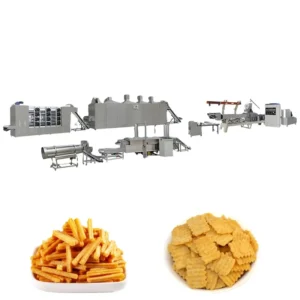
Fried Bugles Chips Production Line Fried Doritos Tortilla Snack Food Extruder
¥100.00 Select options This product has multiple variants. The options may be chosen on the product page -
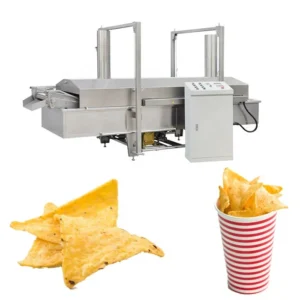
New Fully Automatic Large Capacity 304 Stainless Steel Savory Frying Snack Production Line Crisp Bugles Chips Processing Machine
¥30.00 Select options This product has multiple variants. The options may be chosen on the product page -
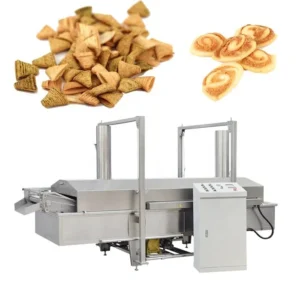
Double Screw Extruder Corn Flour Puffs Snack Nacho Chips Tortilla Doritos Making Machine Savory Snack Production Line
¥50.00 Select options This product has multiple variants. The options may be chosen on the product page -
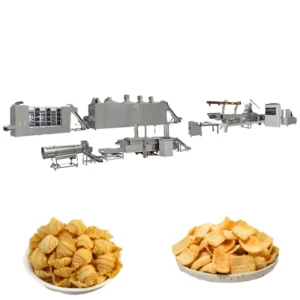
Hot Selling Puffed Ball Snacks Food Processing Line Fried Snacks Processing Line Corn Puff Snacks Machine
¥100.00 Select options This product has multiple variants. The options may be chosen on the product page