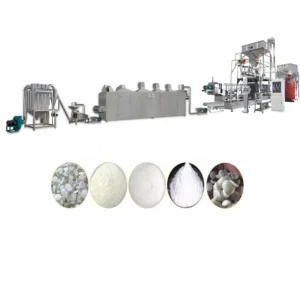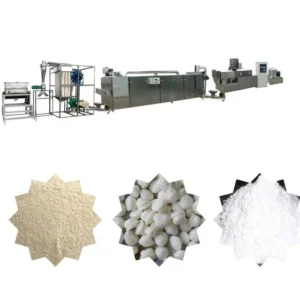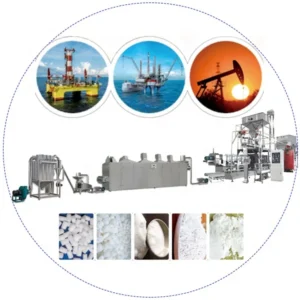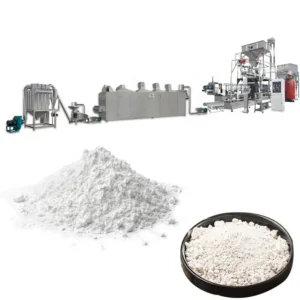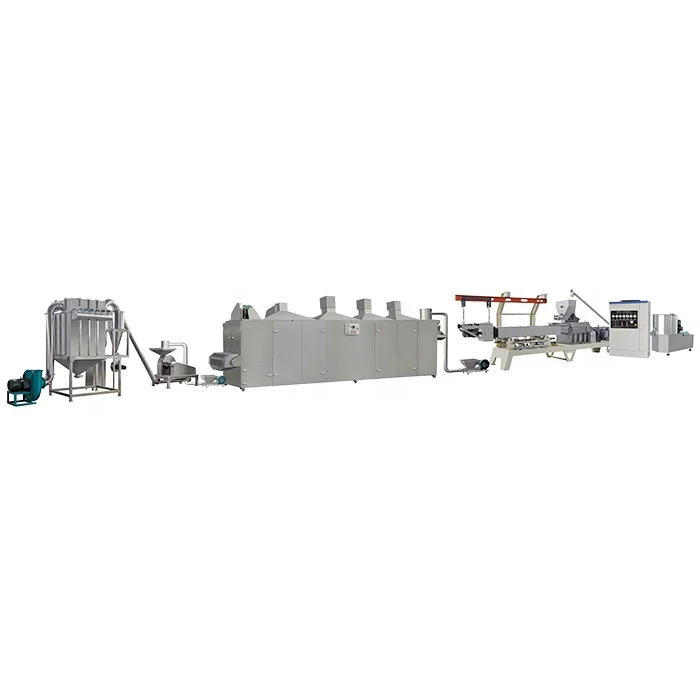



MT70 / MT85 / MT75 Modified Starch Production Line, Twin-Screw Extruder, 38CrMoAl Screws — designed for corn and wheat starch gelatinization with screw configuration and die geometry matched to your target E-number grade.
- Barrel cooling system and temperature profiling ensure controlled starch denaturation across varying moisture inputs
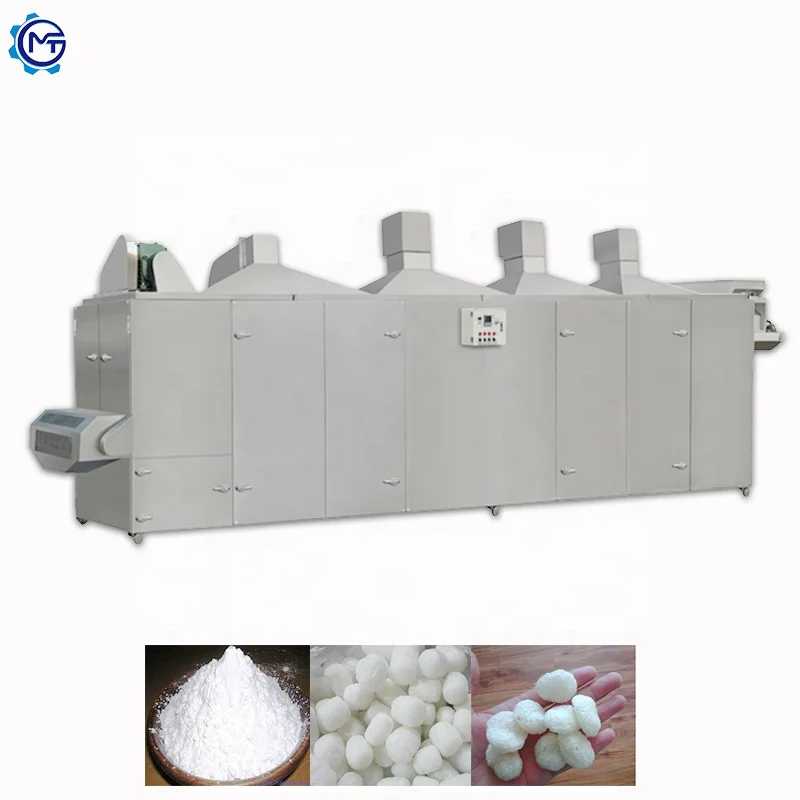
- 5-layer dryer with inverter speed control prevents line bottleneck, throughput matched from batching through pulse grinding
In-house trial runs on your raw material verify capacity and product quality before shipment, supported by complete electrical schematics and layout documentation.
Description
Screw Configuration Matched to Raw Material — we specify screw elements and die geometry based on your starch type and target E-number grade, then validate on your actual sample in our testing workshop before the line ships.
Technical Specifications
| Parameter | Value |
|---|---|
| Product Type | Modified Starch Twin-Screw Extrusion Production Line |
| Model | MT70 / MT85 / MT75 |
| Installed Power | MT70: 160 kW; MT85: 190 kW; MT75: 210 kW |
| Power Consumption | MT70: 120 kW; MT85: 140 kW; MT75: 150 kW |
| Output Capacity | MT70: 150–200 kg/h; MT85: 300–400 kg/h; MT75: 300–500 kg/h (basis to be confirmed with buyer’s raw material, moisture and modification degree) |
| Overall Dimensions (L×W×H) | MT70: 41000×1500×2200 mm; MT85: 43000×1500×3200 mm; MT75: 45000×1500×3500 mm |
| Screw Type | Twin-screw |
| Screw Diameter | 70 mm (MT70) |
| Screw Length | 1520 mm (MT70) |
| Screw Material | 38CrMoAl alloy steel |
| Main Motor Power | 30 kW (MT70) |
| Voltage & Frequency | 380V 50Hz three-phase (configurable to 380V/415V 60Hz, 220V 60Hz) |
| Control System | PLC and MCC |
| Barrel Cooling | Integrated barrel cooling circuit |
| Mixer Capacity | 20–30 / 70–80 / 170–180 kg per batch (model-dependent) |
| Mixer Construction | 201SS or 304SS stainless steel |
| Dryer Type | 5-layer baking oven, 5.0×1.2×2.3 m |
| Dryer Speed Control | Inverter-driven belt |
| Dryer Fuel Options | Gas or diesel |
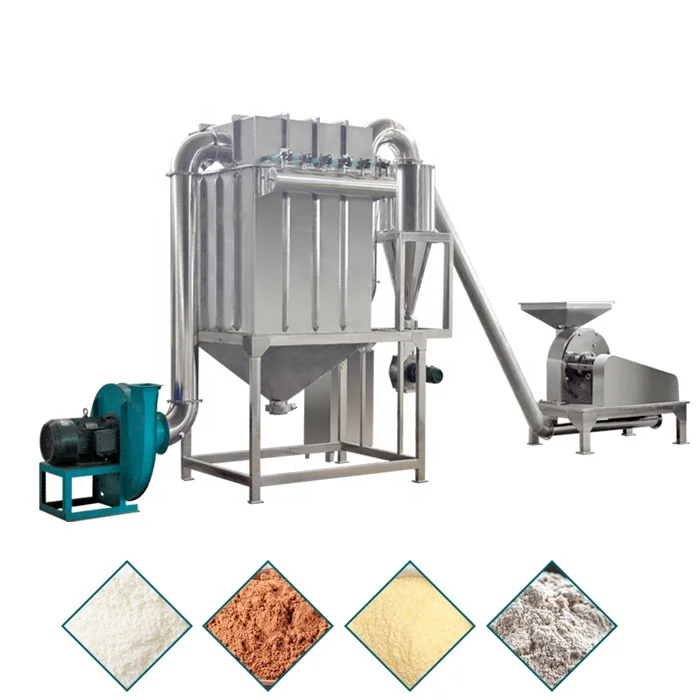
| Grinder Type | Pulse grinder with cyclone discharge and dust collector |
| Key Features | Food-grade stainless steel contact parts, modular station layout, CE certified |
Application Suitability
| Application | Material or Output |
|---|---|
| E1422 (acetylated distarch adipate) production | Corn starch or wheat flour base for food thickener and stabilizer markets |
| Pregelatinized starch for instant foods | Corn or tapioca starch with controlled gelatinization in extruder barrel |
| Industrial modified starch for textile sizing | Corn starch with modified viscosity profile for warp yarn coating |
| Papermaking binder and surface sizing starch | Wheat or corn starch modified for adhesion and film-forming properties |
| Building material additive starch | Corn starch processed for use in gypsum board and mortar formulations |
Why Nominal Capacity Means Nothing Without Your Raw Material
A modified starch production line turnkey quoted at 400 kg/h on one feedstock may deliver far less when your actual starch goes in the hopper.
I saw this firsthand when a starch processor in Southeast Asia asked us to match a competitor’s throughput figure. They quoted us based on cassava starch parameters, but their actual daily production used corn starch with a completely different gelatinization temperature and shear requirement. When we first ran their material, expansion was weak and the line only held roughly six-tenths of the nominal rate [NEED_CITE: raw material variability in starch extrusion output].
We recalculated the screw element sequence and die aperture, then spent days on-site adjusting moisture feed and barrel temperature zones until the line stabilized. That experience shaped how we now approach every modified starch production line turnkey project — your raw material goes into our testing workshop before any machine is finalized.
Barrel Temperature Profiling for Starch Gelatinization
Starch modification through twin-screw extrusion depends on precise thermal control across the barrel zones. Each section of the barrel — feed, compression, gelatinization, and metering — must hold a distinct temperature window to achieve the target degree of substitution without degrading the polymer chain. The integrated barrel cooling circuit on the MT70, MT85, and MT75 allows operators to pull heat from specific zones when exothermic reactions push temperatures above the setpoint. This level of control is what separates a line that produces consistent E-number grade starch from one that generates off-spec material requiring rework.
Screw Element Sequencing for Different Modification Targets
The screw assembly in a modified starch production line turnkey project is not a fixed configuration — it is a stack of kneading blocks, conveying elements, and reverse-flight sections arranged to produce a specific shear and residence time profile. Producing E1422 acetylated distarch adipate demands a different element sequence than pregelatinized starch for instant food applications. We document the screw configuration against your raw material certificate of analysis and target modification degree, so the assembly is purpose-built rather than copied from a generic build sheet [NEED_CITE: screw configuration impact on starch modification degree].
Reading the Specs That Actually Matter for Starch Lines
The 38CrMoAl alloy steel used in the screw and barrel provides wear resistance against the mildly abrasive nature of starch slurries running at elevated temperatures over long production cycles. The 1520 mm screw length on the MT70 gives a length-to-diameter ratio that provides sufficient residence time for complete gelatinization without excessive shear degradation. Mixer capacity must be matched to extruder throughput — a 70–80 kg batch mixer feeding a 300–400 kg/h extruder creates a rhythm mismatch that forces the extruder into intermittent starvation. The 5-layer dryer with inverter speed control allows belt dwell time adjustment so that moisture exits at the exact percentage required before the pulse grinder stage.
The Hidden Cost of Mismatched Station Throughput
When a starch line is assembled from separate vendors, the extruder may be rated for one throughput while the dryer handles a different volume entirely. The result is product piling up before the oven or the grinder choking on material that arrives faster than it can process. This kind of bottleneck is rarely visible in the quotation stage — it only appears during commissioning, when you are already committed to the equipment on your factory floor [NEED_CITE: throughput mismatch consequences in multi-vendor processing lines]. We have seen operators resort to reducing extruder speed to match a slower downstream station, effectively paying for capacity they cannot use.
Why Buyers Choose This Line for Starch Projects
Every station — mixer, twin-screw extruder, dryer, pulse grinder — is specified as one integrated system, so throughput is calculated and matched across the entire chain before fabrication. The screw and die configuration is engineered around the buyer’s submitted raw material sample, not pulled from a catalog default. We run your actual starch in our testing workshop and provide a trial report documenting expansion ratio, moisture curve, and throughput before the line is crated. Electrical schematics and voltage confirmation are finalized against your facility’s power supply, preventing commissioning delays tied to frequency or phase mismatch. The 38CrMoAl screw elements and stainless steel contact surfaces meet food-grade requirements for E-number starch destined for food ingredient markets.
Documentation & Verification
- Line layout drawing showing station-to-station throughput calculation for your starch grade
- Screw and die configuration record tied to your raw material certificate of analysis
- Trial run report on your submitted starch sample with moisture and expansion data
- Electrical schematic with voltage, frequency, and control language confirmed for your market
- CE declaration of conformity and factory test record before dispatch
- Wear parts list with part numbers for screw elements, dies, and grinder blades
Installation, Commissioning & Support
- Foundation plan based on the MT70/MT85/MT75 overall length of up to 45 m, including dryer and grinder placement
- Dedicated circuit specification for the 160–210 kW installed power range with proper phase balancing
- Modular station delivery with on-site assembly sequence and utility connection schedule
- First-run commissioning with barrel temperature and screw speed profiling on your production starch
- Operator training on PLC interface, inverter dryer control, and pulse grinder classifier adjustment
- Recommended spare stock of 38CrMoAl screw elements and die plates for first replacement cycle
What We Need to Build Your Line Accurately
Send us your starch type, supplier specification sheet, and the target E-number or modification grade you intend to produce. We also need your facility voltage, frequency, and available floor length to determine which model fits and how stations will be arranged. If you have existing upstream batching or downstream packaging equipment, share the interface details so we match the line boundaries correctly.
Frequently Asked Questions
Q: How is line capacity verified against my specific starch raw material and moisture content?
A: We request a representative sample of your raw starch and run it through our testing workshop extruder. The trial documents actual throughput, expansion behavior, and moisture profile at the dryer exit. Those results become the basis for the final capacity figure in your quotation, replacing generic nominal values.
Q: How are screw configuration and die design matched to different modification targets?
A: Each E-number grade requires a different combination of shear intensity, residence time, and barrel temperature profile. We select kneading block angles, conveying element pitch, and die aperture based on your target degree of substitution, then document the full assembly for your records.
Q: How do you ensure throughput matching between the extruder, dryer, and grinder?
A: Every station is specified as part of one line from the start. The mixer batch size, extruder output, dryer belt speed, and grinder capacity are calculated together so no single station forces the others to run below their design rate.
Q: What voltage, frequency, and control language options are available?
A: The line is configurable for 380V, 415V, or 220V at 50Hz or 60Hz. The PLC and MCC control system can be programmed with operator interface language matching your production team, and the electrical schematic is reviewed with your facility engineer before production begins.
Q: What does the pre-shipment trial run include?
A: We process your submitted starch sample through the extruder at production-scale screw and barrel settings. You receive a report covering throughput, gelatinization degree, moisture at each stage, and product appearance — all data points your quality team needs to confirm the line will meet specification on your factory floor.
Related products
-
Modified Starch Production Line Modified Starch Processing Line Modified Starch Extruder
¥8,580.00 Select options This product has multiple variants. The options may be chosen on the product page -
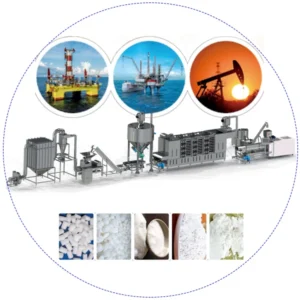
Modified Starch Production Line for Industrial Drilling Twin Screw Extruder Large Output Modified Starch Manufacturing Machine
¥50.00 Select options This product has multiple variants. The options may be chosen on the product page -
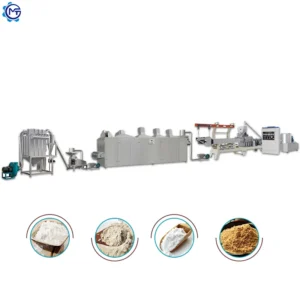
Automatic Deep Processing Machine – Food Grade Modified & Pregelatinized Starch Manufacturing Line
¥65.00 Select options This product has multiple variants. The options may be chosen on the product page -
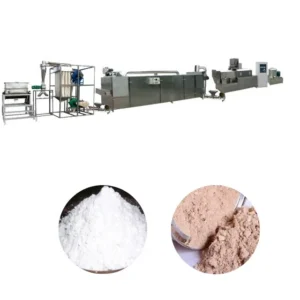
Big Capacity Modified Starch Industrial Use and Food Additives
¥50.00 Select options This product has multiple variants. The options may be chosen on the product page