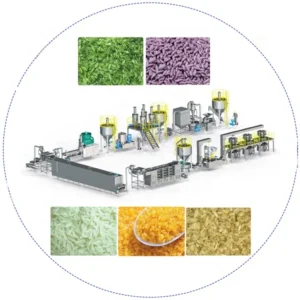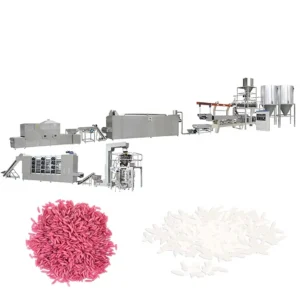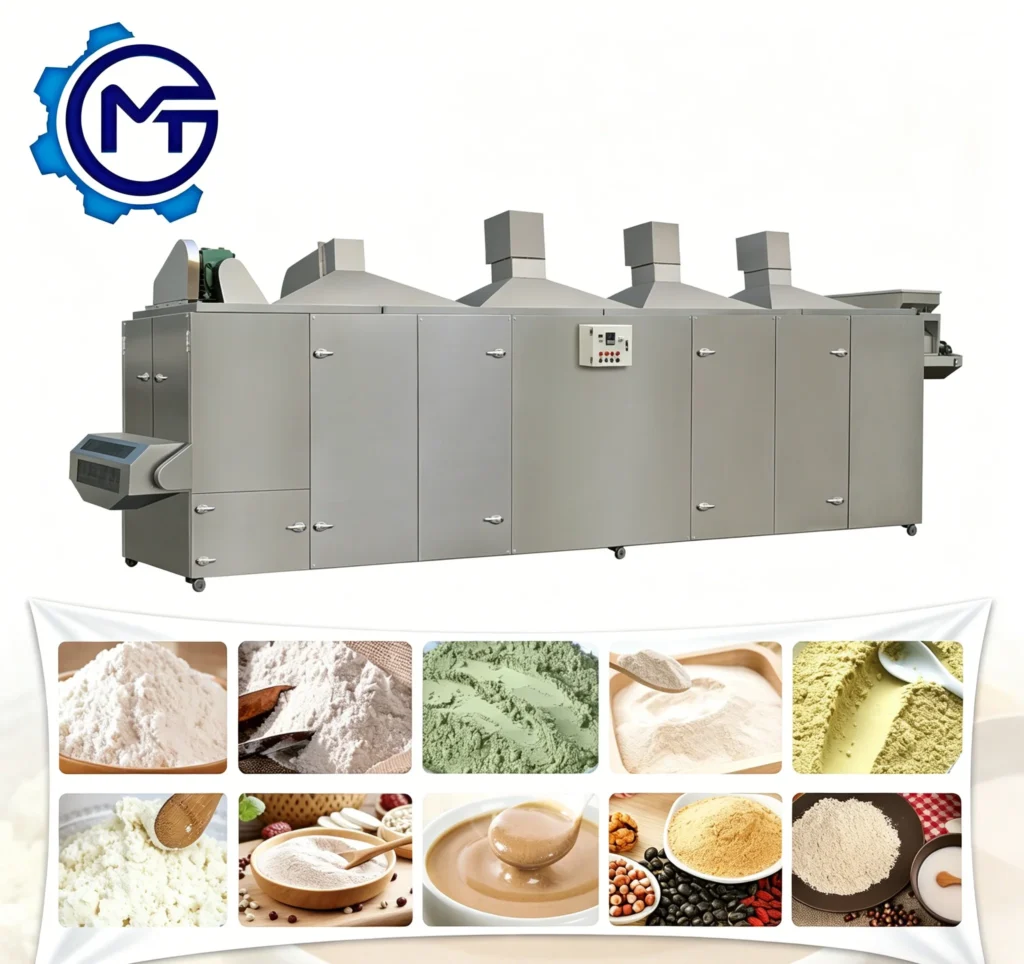


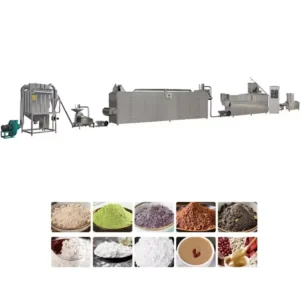
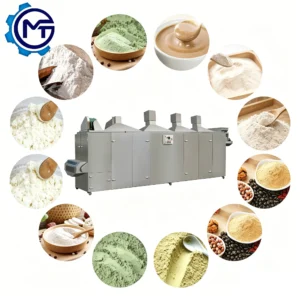
Nutrition Powder Processing Line, Food-Grade 304 SS, Touch Control Panel, Full Automatic — engineered for baby food and infant formula production, converting rice, corn, beans and multi-grain formulations into nutritional powders and instant porridge. Flexible heat source options across electric, gas and steam adapt to your factory’s energy infrastructure, with throughput matched across every station from mixing through drying to packing under one supplier. Trial runs on your specific raw material are conducted in our testing workshop before shipment, so real output is confirmed before the line leaves the factory.
Description
Throughput-Matched Engineering — every station from batching to packing is sized to the same real-world output, eliminating the bottleneck risk that comes from assembling a nutrition powder line from separate vendors.
Technical Specifications
| Parameter | Value |
|---|---|
| Product Type | Nutrition Powder Processing Line |
| Output Capacity | 200–500 kg/h (basis not stated in source — confirm raw material formulation, moisture content and product density) |
| Construction Material | Food-Grade 304 Stainless Steel |
| Heat Source Options | Electric / Gas / Steam |
| Control System | Touch Control Panel with Digital System |
| Automation Level | Full Automatic |
| Line Stations (listed) | Baking Oven, Mixer (full configuration to be confirmed) |
| Warranty | 1 Year |
Application Suitability
| Application | Material or Output |
|---|---|
| Infant nutrition and baby food powder | Rice, corn, and multi-grain blends formulated for infant consumption |
| Fortified nutritional porridge | Beans, millet, sorghum, and cereal mixes with added micronutrients |
| Instant breakfast and weaning food | Pre-cooked grain flours requiring consistent gelatinisation |
| Programme-supplied fortified blends | Diverse grain and legume formulations targeting specific nutritional profiles |
Why Nominal Capacity Figures Mislead on a Nutrition Powder Line
The only capacity number that matters is the one proven on your exact formulation.
A nutrition powder processing line turnkey package quoted at a headline throughput often cannot sustain that output once your specific grain blend, moisture level, and target particle size enter the extruder. The gap between brochure capacity and actual sustained output is where most commissioning delays begin. I have watched lines sit idle for days while engineers adjusted screw speeds and barrel temperatures just to reach a fraction of the promised rate [NEED_CITE: factors affecting extrusion throughput on grain-based formulations]. When the nutrition powder processing line turnkey scope is evaluated, the trial run on your raw material is the only honest way to set expectations before the equipment leaves the factory.
Matching Every Station to Your Actual Output
A complete nutrition powder processing line turnkey project involves mixing, extrusion, drying, milling, and packing. If the dryer is sized for a nominal figure while the extruder runs at a different real-world rate, moisture removal becomes the constraint and product quality drifts. Each station on this line is calculated against the same verified throughput so that material flow remains continuous without intermediate buffering or starvation.
Thermal Profile Control Across Grain Formulations
Different grains gelatinise at different temperatures and moisture thresholds. Rice starch behaves differently from sorghum or millet under shear and heat. The barrel temperature profile and screw configuration are specified to your formulation, ensuring the degree of cook is consistent batch after batch. This is where a generic screw build copied from a standard catalogue fails — the product either under-cooks, leaving raw starch, or over-shears, destroying the nutritional profile [NEED_CITE: starch gelatinisation temperatures across common cereal grains].
Reading the Specifications That Actually Matter
The food-grade 304 stainless steel contact surfaces are non-negotiable for infant and baby food production, where hygiene audits trace every material certificate. The touch control panel with digital system reduces operator error during recipe changeovers — a critical factor when switching between a rice-only formula and a multi-grain blend with beans. Heat source flexibility (electric, gas, or steam) means the line adapts to your factory’s existing boiler or electrical infrastructure rather than forcing a costly utility upgrade. The full automatic control sequence covers start-up, steady-state running, and shutdown, keeping batch-to-batch variation within specification without relying on operator judgment alone.
The Cost of Skipping a Pre-Shipment Trial
When a line ships without a trial run on the buyer’s actual raw material, the first weeks of production become an expensive experiment. Screw and die configurations that work on one grain blend may produce the wrong density or particle size on another. I have seen installations in West Africa where the nutrition powder came out with inconsistent gelatinisation because the extruder settings were never validated against the local maize variety before dispatch [NEED_CITE: impact of raw material variability on extrusion output quality]. The result is product rejection, rework, and a commissioning period that stretches far beyond the planned schedule.
Why Buyers Source This Line Here
Every station — mixer, extruder, dryer, milling, packing — is engineered under one supplier, so throughput calculations are internally consistent rather than negotiated between unrelated vendors. Screw configuration and die design are specified to your raw material and target product density, not copied from a generic build. The in-house testing workshop runs your exact formulation before shipment, producing a trial report that becomes the baseline for commissioning. CE and ISO certification frameworks are maintained across the production process. On-site installation, operator training, and ongoing wear parts supply are handled by the same team that built and tested the line.
Documentation & Verification
- Line layout and capacity calculation based on your grain formulation and target density
- Trial run report on your raw material from the in-house testing workshop
- Electrical schematic and voltage confirmation matched to your local power supply
- Screw and die configuration record specifying barrel zones and die geometry
- Operation and maintenance manual covering recipe changeover procedures
- Wear parts list with part numbers for screws, dies, and seals
Installation, Commissioning & Support
- Foundation and utility planning based on the full automatic line footprint and heat source selection
- Electrical connection verified against your factory voltage, frequency, and dedicated circuit requirements
- Barrel temperature zones and screw speed parameters set during first-run commissioning on your material
- Operator training on the touch control panel covering start-up, recipe changes, and shutdown sequences
- Wear parts inventory reviewed before dispatch to prevent unplanned downtime during early production
- Maintenance schedule aligned with the baking oven thermal cycle and mixer bearing service intervals
Preparing Your Inquiry
To configure a line that matches your actual production conditions, share your grain formulation (including ratios and moisture content), target output per shift, available floor space and ceiling height, local voltage and frequency, and preferred control language. If you have an existing upstream milling system or downstream packing format, include those details so the throughput match is calculated across your entire process.
Frequently Asked Questions
Q: How is the 200–500 kg/h capacity verified against my specific raw material and formulation?
A: Before shipment, your exact grain blend is processed in the in-house testing workshop. The trial run records actual throughput, product density, and gelatinisation degree. The resulting report becomes the reference document for commissioning, replacing nominal figures with proven data tied to your formulation.
Q: Which line stations are included, and how is throughput matched between them?
A: The line covers mixing, extrusion, drying, milling, and packing. Each station is sized to the same verified throughput rather than selected independently. This prevents bottlenecks where one station — typically the dryer — cannot keep pace with the extruder’s real-world output.
Q: What voltage, frequency, and control language options are confirmed before commissioning?
A: The electrical schematic and control panel language are confirmed during the specification stage to match your factory’s power supply and operator preference. This avoids delays on site where rewiring or reprogramming would otherwise push back the first production run.
Q: Can a trial run be performed on my raw material before shipment, and what does the test report cover?
A: Yes. Your raw material is processed in the testing workshop, and the report documents throughput, moisture content at each stage, product density, particle size distribution, and the screw and die configuration used. This report ships with the line.
Q: What is the scope of on-site installation, operator training, and ongoing spare parts supply?
A: Engineers handle mechanical assembly, electrical connection, and first-run parameter tuning. Operators are trained on the touch control panel for normal production and recipe changes. A wear parts list with part numbers is supplied at delivery, and replacement screws, dies, and seals remain available for ongoing orders.
Related products
-
High Productivity New Condition Nutritious Baby Food Meal Replacement Powder Production Line
¥30.00 Select options This product has multiple variants. The options may be chosen on the product page -
Healthy Baby Food Production Line Nutritional Powder Equipment for Baby Food Supplements for Flour Processing Machinery
¥8,500.00 Select options This product has multiple variants. The options may be chosen on the product page -
500kg/h Automatic PLC Controlled Nutrition Baby Food Extruder Machine for Rice Cereal Processing
¥9,500.00 Add to cart -

High Quality Automatic PLC Controlled 500kg/h Twin Screw Extruder Machine for Baby Rice Nutrition Powder
¥8,238.27 Add to cart